
APPrOVE: Approximate Personalized Propagation Over Varied Edges





😎 Summary
A PyTorch Geometric implementation of APPrOVE: Approximate Personalized Propagation Over Varied Edges. APPrOVE extends the well-known personalized PageRank algorithm to heterogeneous graphs (graphs with varied edges) and furnishes a message-passing layer that generalises the propagation scheme of "Predict then Propagate: Graph Neural Networks meet Personalized PageRank".
🚀 Installation
The most recent release can be installed from PyPI with:
$ pip install approve
The most recent code can be installed directly from GitHub with:
$ pip install git+https://github.com/mrmrob003/approve.git
🏃 Getting Started
To demonstrate our heterogeneous personalized PageRank algorithm, consider the following toy-model of a citation network consisting of three papers and two venues.
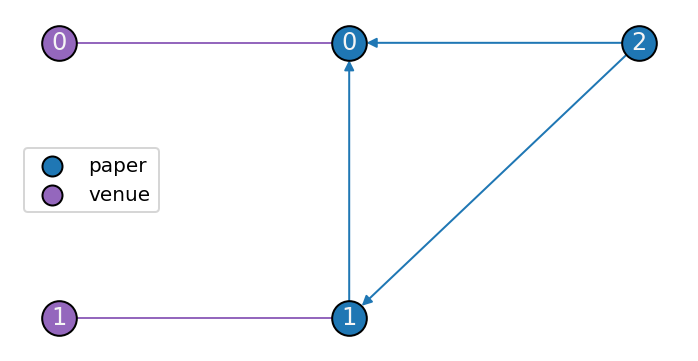
Paper 0 is cited by the other two papers and published by venue 0, while paper 1 is cited by paper 2 and published by venue 1.
We can represent this citation network as a torch.data.HeteroData object as follows:
hetero_data = HeteroData()
hetero_data['paper', 'cites', 'paper'].edge_index = torch.tensor(
    [[1, 2, 2],
     [0, 0, 1]]
)
hetero_data['venue', 'publishes', 'paper'].edge_index = torch.tensor(
    [[0, 1],
     [0, 1]]
)
hetero_data['paper', 'rev_publishes', 'venue'].edge_index = \
    hetero_data['venue', 'publishes', 'paper'].edge_index[[1, 0]]
hetero_data['paper'].num_nodes = 3
hetero_data['venue'].num_nodes = 2
To compute the type-sensitive PageRank score of each node, we uniformly assign an initial fraction (of the total score for a given node type) to all nodes of a given type. For example, since there are three papers and two venues, we assign each paper a third of the total 'paper' score and each venue half of the total 'venue' score.
We can store these initial scores as follows:
hetero_data['paper'].x = torch.full((3, 1), 1 / 3)
hetero_data['venue'].x = torch.full((2, 1), 1 / 2)
In addition, we need to add self-loops to 'paper' nodes, and a special edge from paper 2 (which is as-yet-unpublished) to a special 'venue' node, as depicted below.
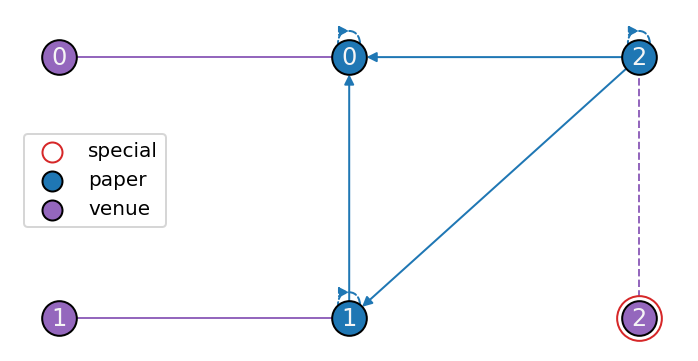
The addition of the self-loops, the special edge and the special node prevents the total score for each node type from leaking. The approve.models.HeteroAPPr model takes care of all these considerations. The model can be easily used to compute the type-sensitive PageRank score of each node as follows:
model = HeteroAPPr(K=30)
output = model(
    hetero_data.x_dict,
    edge_index_dict=hetero_data.edge_index_dict,
)
output
{'paper': tensor([[0.4605],
         [0.3289],
         [0.2105]]),
 'venue': tensor([[0.4803],
         [0.4145],
         [0.1053]])}
Unsurprisingly, paper 0 is the most important paper, since it is cited by the other two papers. Venues 0 and 1 have comparable scores; venue 0's score is slighlty larger than venue 1's score, because venue 0 publishes a higher-ranked paper than the paper published by venue 1. Venue 2, the special 'venue' node, has a comparably low score because it relates to the lowest ranked paper.
👋 Attribution
⚖️ License
The code in this package is licensed under the MIT License.
📖 Citation
If you use this software in your work, please cite it using the "Cite this repository" widget located on the sidebar.
1 maintainer

Release files for approve 0.1.1
For a detailed explanation of source distributions (sdists) and built distributions (wheels), please see the package formats documentation.
Source distribution (sdist)
| File | Size | Uploaded | |
|---|---|---|---|
| approve-0.1.1.tar.gz | 15.1 kB | Details |
Built distribution (wheel)
| File | Interpreter | ABI | Platform | Reset |
|---|---|---|---|---|
| approve-0.1.1-py3-none-any.whl | Python 3 | none | any | Details |
Total release size:27.3 kB
Release files / approve-0.1.1.tar.gz
| Download URL | approve-0.1.1.tar.gz |
|---|---|
| Size | 15.1 kB |
| Tags | Source |
|
SHA-256 checksum How to use checksums |
2730e23de2e2c8fe7198496ad31618dbb3bc76c229e79f4e1bbcdcc143ae7bac
|
|
BLAKE2b-256 checksum How to use checksums |
3a8aa7a53938802fa1f5431418dfdee3605563a6a5d5996baee2fae91f6afb79
|
| Upload date | |
|
Uploaded using Trusted Publishing? What is trusted publishing? |
No |
| Uploaded via |
twine/4.0.2 CPython/3.9.18
|
Release files / approve-0.1.1-py3-none-any.whl
| Download URL | approve-0.1.1-py3-none-any.whl |
|---|---|
| Size | 12.2 kB |
| Tags | Python 3 |
|
SHA-256 checksum How to use checksums |
4022d198d30ca92c7db74e5e311de5b3f27f6ee347c307c210745076f4eb7d57
|
|
BLAKE2b-256 checksum How to use checksums |
6d1d7cf3983009296a68521a78fd743864e63ed123905d06c9fa04b047f32ad1
|
| Upload date | |
|
Uploaded using Trusted Publishing? What is trusted publishing? |
No |
| Uploaded via |
twine/4.0.2 CPython/3.9.18
|













