
ArchytasZX
Develop quantum algorithms without fixing the size or dimensionality of the machine. Write a circuit once,
for n qudits of dimension d, and get its states, measurement statistics and proofs of its
identities as closed forms that hold for every n and every d at once.


ArchytasZX is a symbolic engine built on the qufinite ZX-calculus, with integration into Dirac notation. Qudit count and dimension are symbols, so nothing is ever enumerated, sampled or simulated: every result comes from exact rewriting and has the same shape for every size.
Example: Deutsch–Jozsa for every n
examples/deutsch_jozsa.azx, a balanced oracle on an n-qubit register,
with n never given a value:
var n
gate U_f = |x>|y> -> |x>|y xor bit(x, 0)>
|psi> = |0>^@n @ |1>
(H^@n @ H)|psi>
U_f|psi>
(H^@n @ I)|psi>
var z = floor(measure|psi>/2)
$ archytaszx --unicode examples/deutsch_jozsa.azx
|ψ⟩ = |0⟩^⊗n ⊗ |1⟩
|ψ⟩ = 2^(-n/2 - 1/2) Σ_{y=0}^{1} Σ_{x=0}^{2^n - 1} (-1)^y |x⟩ ⊗ |y⟩
|ψ⟩ = 2^(-n/2 - 1/2) Σ_{y=0}^{1} Σ_{x=0}^{2^n - 1} (-1)^y |x⟩ ⊗ |(y ⊕ bit(x, 0))⟩
|ψ⟩ = 2^(-n - 1/2) Σ_{y=0}^{1} Σ_{x=0}^{2^n - 1} Σ_{x'=0}^{2^n - 1} (-1)^(y + x·x') |x'⟩ ⊗ |(y ⊕ bit(x, 0))⟩
z = [(1, 1)]
|ψ⟩⟨ψ| = 1/2 Σ_{k1=0}^{1} |1⟩⟨1| ⊗ |k1⟩⟨k1|
The measurement is a Born distribution derived symbolically: outcome 1 with probability 1,
so the oracle is balanced, for every register size. The post-measurement state is the mixed
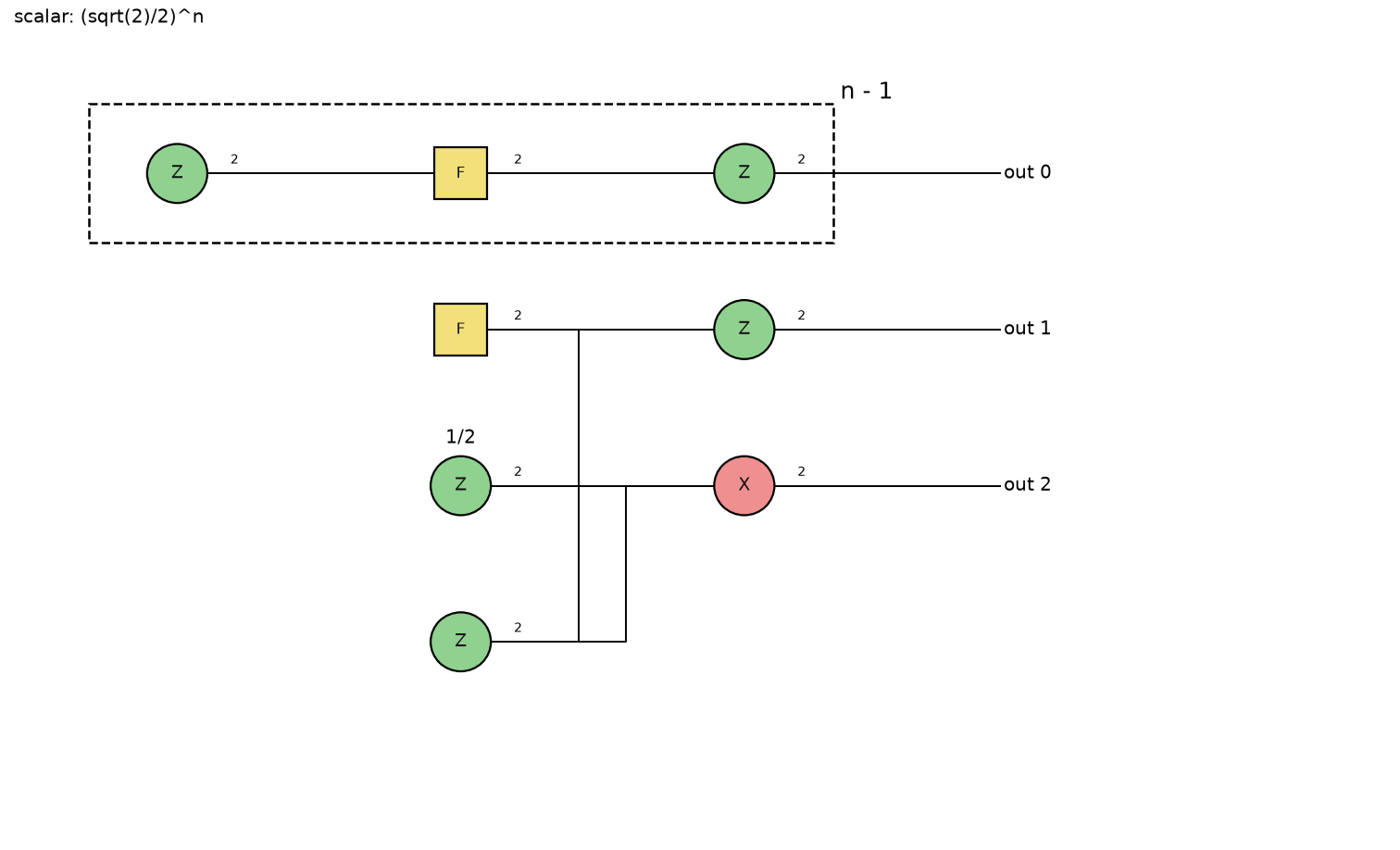
state on the last line. The same states can be drawn as ZX diagrams (--zx), where the
register is a bang box of multiplicity n - 1 rather than n copies:
The qudit version,
examples/deutsch_jozsa_proof.azx,
proves that the whole circuit of examples/deutsch_jozsa_qudits.azx returns
e^{2πi c/d} |0⟩^⊗n ⊗ F†|1⟩ for the constant oracle and |0⟩^⊗(n-1) ⊗ |1⟩ ⊗ F†|1⟩ for the
balanced one, for every n and every d. Both proofs are written out as Lean 4 files.
What it does
- Symbolic size. Qudit count, dimension and multiplicities stay symbols.
|0>^@30is one leg under a bang box, not thirty, and a concrete value is substituted into the closed form at the end at no cost in its size. - Exact arithmetic. Scalars are tracked exactly (roots of unity, character sums, Gauss sums); no global factor is ever dropped, so results are equalities, not proportionalities.
- Proofs for all
n. Diagram rewriting, a normal-form procedure, equality saturation and proof search decide equalities; induction over bang-box multiplicities proves whole families. - Independent checking. Every proof emits a replayable certificate, is re-checked by a small proof kernel, and can be exported to Lean 4 and Mathlib, where it is checked again from scratch.
- A language for algorithms. Dirac notation with gates, sums, measurement, control flow and f-strings, run as scripts or interactively, and embeddable in Python and Jupyter.
Install
Python ≥ 3.12. numpy and sympy are the only runtime dependencies. With matplotlib
installed, output is typeset and ZX diagrams are drawn as images in terminals that show them;
without it, both fall back to Unicode text.
pip install archytaszx           # or 'archytaszx[viz]' to add matplotlib
archytaszx                       # interactive shell
archytaszx script.azx            # run a script
Quickstart
The .azx language
var n
gate F = |x>_d -> 1/sqrt(d) sum(y in 0..d){ e^(2*pi*i*x*y/d) |y>_d }
|psi> = H^@n |0>^@n
var z = measure|psi>
show(z, |psi>)
print(f"z = {z}")
Output styles are --render (default, typeset images), --unicode, --ascii and --latex;
several style flags print every output in each style, and --order groups the output by style
at the end. --zx, --both and --raw switch between Dirac notation and ZX diagrams, and
--images DIR saves every rendered image as a PNG. In the shell, commands starting with :
drive the engine directly (:help lists them).
examples/learn_azx.azx
is a guided tour of the whole language, ending in Deutsch–Jozsa for every n; the complete
reference is docs/LANGUAGE.txt.
From Python
from archytaszx import azx               # a shared Program; archytaszx.Program() for a fresh one

azx("var n")
azx.psi = azx.H ** azx.n | azx.ket(0) ** azx.n      # |psi> = H^@n |0>^@n
azx["|phi>"] = azx["|psi> - 2 |0><0|psi>"]
azx.phi       # |φ⟩ = 2^(-n/2) Σ_{x=0}^{2^n - 1} |x⟩ - 2^(1 - n/2) |0⟩^⊗n
azx.phi.latex()                          # also rendered by Jupyter

y = azx.measure | azx.psi
y             # [(k, 2^(-n)) : k ∈ {0,…,2^n - 1}]
examples/learn_azx.py
is the same tour from Python.
The diagram engine
Build two Z spiders over a symbolic dimension d, fuse them, check the rewrite, and prove it for
every count at once.
from archytaszx.algebra.dimension import Dim
from archytaszx.diagram.generators import Z_SPIDER
from archytaszx.diagram.graph import Diagram, Direction, PortRef
from archytaszx.rewrite.match import find_matches
from archytaszx.rewrite.engine import apply
from archytaszx.rewrite.rules_library import SPIDER_FUSION

d = Dim.symbol("d")

g = Diagram()
a = g.add_node(Z_SPIDER, input_dims=[], output_dims=[d, d])
b = g.add_node(Z_SPIDER, input_dims=[d], output_dims=[d, d])
g.add_wire(PortRef(a, Direction.OUTPUT, 0), PortRef(b, Direction.INPUT, 0))
g.set_boundary_outputs([
    PortRef(a, Direction.OUTPUT, 1),
    PortRef(b, Direction.OUTPUT, 0),
    PortRef(b, Direction.OUTPUT, 1),
])

result = apply(g, SPIDER_FUSION, find_matches(g)[0])

len(result.diagram.nodes)             # 1         -- two spiders became one
len(result.diagram.boundary_outputs)  # 3         -- the boundary is unchanged
result.diagram.scalar                 # Scalar(1) -- exact, never discarded
A certificate records the derivation; verify replays it step by step, and tampering with any
recorded field (scalar, rule, consumed wire, side condition, multiplicity) fails the replay.
from archytaszx.semantics.check import compare
from archytaszx.semantics.certificate import certify, verify

compare(g, result.diagram, {"d": 5}).matched   # True -- numeric oracle at d = 5

certificate = certify(g, [result], label="fuse A into B")
verify(certificate, {"d": 3}).verified         # True
Wrap the graph in a bang box of multiplicity m and prove the fusion for every m, with d
still symbolic:
from archytaszx.diagram.bangbox import abstract_subgraph_count
from archytaszx.semantics.induction import prove_by_induction

boxed, box_id, mult = abstract_subgraph_count(g, frozenset({a, b}), 1, stem="m")
fused = apply(boxed, SPIDER_FUSION, find_matches(boxed)[0]).diagram

proof = prove_by_induction(boxed, fused, witness={"d": 2})

proof.proved          # True
proof.verdict         # Verdict.PROVED_UNIFORM -- for all m, not a finite schema check
proof.index           # 'm'
proof.discharge       # StepDischarge.UNIFORM_REWRITE -- the tier that settled the step
proof.held_symbolic   # frozenset({'d'}) -- what stayed universally quantified
Concrete numbers typed by the user are abstracted back into symbols, with the values kept for
output; prefix a numeral with literal to keep it concrete:
from archytaszx.repl.parser import parse_dirac_source

p = parse_dirac_source("sum_{k=0}^{3-1} |k>^{30}; copy")
dict(p.parameters)   # {'d': 3, 'n': 29}
Documentation
The full reference documentation is in docs/:
| Document | Contents |
|---|---|
INDEX.txt |
Index of the documentation, conventions and reading order |
OVERVIEW.txt |
What the engine is, its guarantees and its limits |
INSTALL.txt |
Installation, the Lean library, configuration and environment variables |
LANGUAGE.txt |
The .azx language reference |
SHELL.txt |
The archytaszx command: flags, views, styles, meta-commands, exit codes |
ENGINE_COMMANDS.txt |
The : engine commands and the diagram input forms |
PYTHON_API.txt |
The Python embedding and the engine import map |
ALGEBRA.txt |
Layer A: dimensions, phases, exact scalars |
DIAGRAM.txt |
Layer B: generators, diagrams, bang boxes, scalable notation, validation |
REWRITE.txt |
Layer C: rules, matching, strategies, normal form, e-graph, tactics |
RULES.txt |
Every rewrite rule with its scalar and side conditions |
SEMANTICS.txt |
Layer D: denotation, contraction, the oracle, path sums, measurement |
PROOFS.txt |
Deciding equality, proof search, induction, certificates, the kernel |
LEAN.txt |
The Lean 4 library and the export of proofs and refutations |
ZX_VIEW.txt |
How language states become ZX diagrams and how they are drawn |
ERRORS.txt |
The exception hierarchy of every module |
GLOSSARY.txt |
Definitions of the terms used throughout |
Formal proofs in Lean
Proofs found by the engine are exported to Lean 4 (:certificate lean proof.lean) against a
Mathlib library bundled in archytaszx/lean, in which a diagram is a tensor network over ℂ and
every rewrite rule is a lemma proved once. Families over multiplicities become Lean
inductions, equalities the rewriter cannot reach are closed by a verified normaliser of
symbolic sums, and verdicts that two diagrams differ export a Lean refutation. #print axioms
lists only Lean's standard axioms; any step without a lemma is a named unproved_* axiom, and
the REPL reports how many there are.
cd archytaszx/lean && lake exe cache get && lake build      # once
lake env lean /path/to/proof.lean
docs/LEAN.txt has the
semantics, the trust boundary, the normaliser and the refutation method.
Architecture
Four engine layers, depending strictly downward, with the language on top:
| Layer | Package | Contents |
|---|---|---|
| A | algebra |
Dimension expressions with one canonical form and a unifier; phase vectors tied to d; exact scalars over roots of unity with a character-sum simplifier |
| B | diagram |
Qufinite ZXW generators (Z, X, Fourier box, triangle, W, dimension binder/splitter) with per-port dimensions; bang boxes and scalable sheet wires; validation |
| C | rewrite |
Rule library, matcher and engine with provenance; normal form; diagram-level e-graph; tactics and bidirectional proof search |
| D | semantics |
Symbolic and numeric contraction; path sums and Born distributions; the decide_equal ladder; induction; certificates, proof kernel and Lean export |
| — | repl |
The .azx language, parser and printer, ZX view and drawing, shell |
Sub-package __init__.py files are empty; archytaszx itself exports only Program, Value
and azx, so engine objects are imported by full module path. Each module raises only its own
<Area>Error hierarchy: <Area>GrammarError for a wrong call and <Area>DomainError for a case
not implemented yet.
Status
In beta and under active development: the API is unstable and changes between
releases. Equality checking is sound but not complete, so decide and prove can answer
"unknown". Known limits:
- Symbolic contraction slows sharply as the number of phased spiders grows.
- Symbolic contraction refuses a bang box wired to a node outside it, and a port box over two W nodes.
- The dimension unifier reports
DEFERREDwhere an equation has several solution branches (d1*d2 == 6,d**n == d**m); deferred dimensions are recorded as assumptions and appear in certificates and Lean theorems as hypotheses. - A rule restricted to prime
drefuses to fire at a symbolicd. compare_symbolichas three outcomes (equal, unequal, indeterminate); read.reasonwhen it does not match.- Steps the Lean export cannot prove yet are listed in
LEAN_GAPS.txt.
Development
git clone https://github.com/Arhip-Dmitriev/ArchytasZX.git
cd ArchytasZX
python -m venv .venv && source .venv/bin/activate
pip install -e '.[dev]'

python -m pytest -n 8     # default tier
python -m pytest -m slow  # fuzz sweeps and oracle differentials
ruff format . && ruff check . && mypy archytaszx
The default tier is 10,072 tests and the slow tier 3,898 (counted 2026-10-22). ruff format is
authoritative for layout; mypy runs in strict mode.
Citation
If you use ArchytasZX in academic work, please cite it via
CITATION.cff, or:
@software{dmitriev_archytaszx,
  author  = {Dmitriev, Arkhip Alekseyevich},
  title   = {ArchytasZX: Size- and Dimension-Agnostic Engine for Quantum Algorithm Development Based on {ZX}-Calculus},
  year    = {2026},
  url     = {https://github.com/Arhip-Dmitriev/ArchytasZX},
  license = {Apache-2.0}
}
Contributing
Bug reports, counterexamples and questions about the mathematics are the most useful
contributions; a soundness bug (a rewrite that changes the denoted map, scalar included) is the
most valuable report of all. See
CONTRIBUTING.md.
References
ArchytasZX builds chiefly on the qufinite ZX-calculus of Wang
(arXiv:2104.06429), the ZXW completeness results of Poór,
Wang et al. (arXiv:2302.12135,
arXiv:2309.13014), and bang boxes and scalable notation
(arXiv:2204.11702). Full BibTeX is in
REFERENCES.bib.
Full reference list
Dirac notation and quantum foundations
- Dirac, A new notation for quantum mechanics, Math. Proc. Camb. Phil. Soc. 35 (1939) — doi:10.1017/S0305004100021162
- Born, Zur Quantenmechanik der Stoßvorgänge, Z. Phys. 37 (1926), the Born rule — doi:10.1007/BF01397477
- Nielsen & Chuang, Quantum Computation and Quantum Information (2010), density matrices, measurement, the quantum Fourier transform — doi:10.1017/CBO9780511976667
- Gottesman, Fault-tolerant quantum computation with higher-dimensional systems (1999), qudits — arXiv:quant-ph/9802007
ZX-calculus, qudit and qufinite ZX/ZXW
- Penrose, Applications of negative dimensional tensors (1971), tensor-network diagrams
- Coecke & Duncan, Interacting quantum observables, ICALP 2008 / NJP 13 (2011) — arXiv:0906.4725
- Coecke & Kissinger, Picturing Quantum Processes (2017) — doi:10.1017/9781316219317
- van de Wetering, ZX-calculus for the working quantum computer scientist — arXiv:2012.13966
- Ranchin, Depicting qudit quantum mechanics and mutually unbiased qudit theories, EPTCS 172 (2014) — arXiv:1404.1288
- Hadzihasanovic, A diagrammatic axiomatisation for qubit entanglement, LICS 2015, the W node — arXiv:1501.07082
- Wang, Qufinite ZX-calculus: a unified framework of qudit ZX-calculi, the generator set, triangle, Fourier box and dimension connectives — arXiv:2104.06429
- Poór, Wang, Shaikh, Yeh, Yeung & Coecke, Completeness for arbitrary finite dimensions of ZXW-calculus, LICS 2023 — arXiv:2302.12135
- Wang, Poór & Shaikh, Completeness of qufinite ZXW calculus — arXiv:2309.13014
- Shaikh, Wang & Yeung, How to sum and exponentiate Hamiltonians in ZXW calculus, EPTCS 394 (2023) — arXiv:2212.04462
Bang boxes and scalable notation
- Dixon & Duncan, Graphical reasoning in compact closed categories for quantum computation, AMAI 56 (2009) — doi:10.1007/s10472-009-9141-x
- Dixon, Duncan & Kissinger, Open graphs and computational reasoning, EPTCS 26 (2010) — arXiv:1007.3794
- Kissinger, Merry & Soloviev, Pattern graph rewrite systems, EPTCS 143 (2014) — arXiv:1204.6695
- Kissinger & Zamdzhiev, Equational reasoning with context-free families of string diagrams, ICGT 2015 — arXiv:1504.02716
- Carette, Horsman & Perdrix, SZX-calculus: scalable graphical quantum reasoning, MFCS 2019 — arXiv:1905.00041
- Carette & Lemonnier, Large-scale quantum diagrammatic reasoning tools, !-boxes vs. scalable notations — arXiv:2204.11702
Path sums and exact symbolic sums
- Amy, Towards large-scale functional verification of universal quantum circuits, EPTCS 287 (2019) — arXiv:1805.06908
- Vilmart, The structure of sum-over-paths, its consequences, and completeness for Clifford, FoSSaCS 2021 — arXiv:2003.05678
- Berndt, Evans & Williams, Gauss and Jacobi Sums (1998), quadratic Gauss sums and their sign
- Landsberg, Zur Theorie der Gaussschen Summen…, J. reine angew. Math. 111 (1893), Landsberg–Schaar reciprocity — doi:10.1515/crll.1893.111.234
- Dechter, Bucket elimination, Artif. Intell. 113 (1999), contraction by variable elimination — doi:10.1016/S0004-3702(99)00059-4
- Richardson, Some undecidable problems involving elementary functions of a real variable, J. Symb. Logic 33 (1968) — doi:10.2307/2271358
Rewriting and equality saturation
- Tate, Stepp, Tatlock & Lerner, Equality saturation, LMCS 7 (2011) — arXiv:1012.1802
- Willsey et al., egg: fast and extensible equality saturation, POPL 2021 — arXiv:2004.03082
- Nelson & Oppen, Fast decision procedures based on congruence closure, JACM 27 (1980) — doi:10.1145/322186.322198
- Tarjan, Efficiency of a good but not linear set union algorithm, JACM 22 (1975) — doi:10.1145/321879.321884
Lean formalisation
- de Moura & Ullrich, The Lean 4 theorem prover and programming language, CADE-28 (2021) — doi:10.1007/978-3-030-79876-5_37
- The mathlib Community, The Lean mathematical library, CPP 2020 — arXiv:1910.09336
Algorithms in the examples
- Deutsch & Jozsa, Rapid solution of problems by quantum computation, Proc. R. Soc. A 439 (1992) — doi:10.1098/rspa.1992.0167
- Grover, A fast quantum mechanical algorithm for database search, STOC 1996 — arXiv:quant-ph/9605043
- Shor, Polynomial-time algorithms for prime factorization and discrete logarithms on a quantum computer, SIAM J. Comput. 26 (1997) — arXiv:quant-ph/9508027
- Coppersmith, An approximate Fourier transform useful in quantum factoring (1994) — arXiv:quant-ph/0201067
Software
- Kissinger & van de Wetering, PyZX, EPTCS 318 (2020) — arXiv:1904.04735
- Javadi-Abhari et al., Quantum computing with Qiskit (2024) — arXiv:2405.08810
- Harris et al., Array programming with NumPy, Nature 585 (2020) — doi:10.1038/s41586-020-2649-2
- Meurer et al., SymPy, PeerJ Comput. Sci. 3 (2017) — doi:10.7717/peerj-cs.103
License
Apache License 2.0 — see
LICENSE.
1 maintainer

Metadata
1 maintainer
Release files for ArchytasZX 1.1.3
For a detailed explanation of source distributions (sdists) and built distributions (wheels), please see the package formats documentation.
Source distribution (sdist)
| File | Size | Uploaded | Provenance | |
|---|---|---|---|---|
| archytaszx-1.1.3.tar.gz | 1.1 MB | Without provenance | Details |
Built distribution (wheel)
| File | Interpreter | ABI | Platform | Reset |
|---|---|---|---|---|
| archytaszx-1.1.3-py3-none-any.whl | Python 3 | none | any | Details |
Total release size: 1.8 MB
Release files / archytaszx-1.1.3.tar.gz
| Download URL | archytaszx-1.1.3.tar.gz |
|---|---|
| Size | 1.1 MB |
| Tags | Source |
|
SHA-256 checksum How to use checksums |
fc94842912bf7c5b897b1cd230a8dbeb447f5d23536b542f28af93d949cb9421
|
|
BLAKE2b-256 checksum How to use checksums |
75aed21c540b60f3baff3a13e6341e5402a298b944e43e3b069f1cbe2274b292
|
| Upload date | |
|
Uploaded using Trusted Publishing? What is trusted publishing? |
No |
| Uploaded via |
twine/7.0.0 CPython/3.14.8
|
Release files / archytaszx-1.1.3-py3-none-any.whl
| Download URL | archytaszx-1.1.3-py3-none-any.whl |
|---|---|
| Size | 703.5 kB |
| Tags | Python 3 |
|
SHA-256 checksum How to use checksums |
c8625d82900a24c70444353d8de0cd66b193308d4f07a410b8a896ab09360ef2
|
|
BLAKE2b-256 checksum How to use checksums |
0f7821148e0f69fdf86c1c652ac655388c35cade0d39e741b7f5368f1608ec55
|
| Upload date | |
|
Uploaded using Trusted Publishing? What is trusted publishing? |
No |
| Uploaded via |
twine/7.0.0 CPython/3.14.8
|
Security for ArchytasZX 1.1.3
Provenance
Provenance describes where a file came from. On PyPI, provenance is shared via attestations, which provide a verifiable record of the build or publishing details. View details, limitations and caveats.
No provenance found
None of the files in this release were uploaded with provenance metadata.
A note on package security
PyPI is a repository for distributing packages, not a service for auditing them. While third-party security researchers and our staff do their best to detect and remove malicious packages, PyPI cannot guarantee the quality, security or suitability of any given package.
To learn more about protecting yourself from malicious actors, visit our package security documentation.














