

Argus




A UAV Remote ID Spoofing Defense System.
#UAV Swarm Security #Remote ID Spoofing #Graph-Theoretic Modeling #Cryptographic Defenses
📑 Table of Contents
🔭 Overview
✨ Key Features
📦 Installation
🚀 Quick Start
🧪 Testing
📁 Project Structure
📚 Documentation
🔬 Research Background
🤝 Contributing
📖 References
🔭 Overview
Argus is a research framework for investigating UAV swarm vulnerabilities to Remote ID spoofing attacks. It combines graph-theoretic analysis with cryptographic defenses to detect and prevent:
| 📄 Paper | 👨🏻🏫 Presentation |
|---|---|
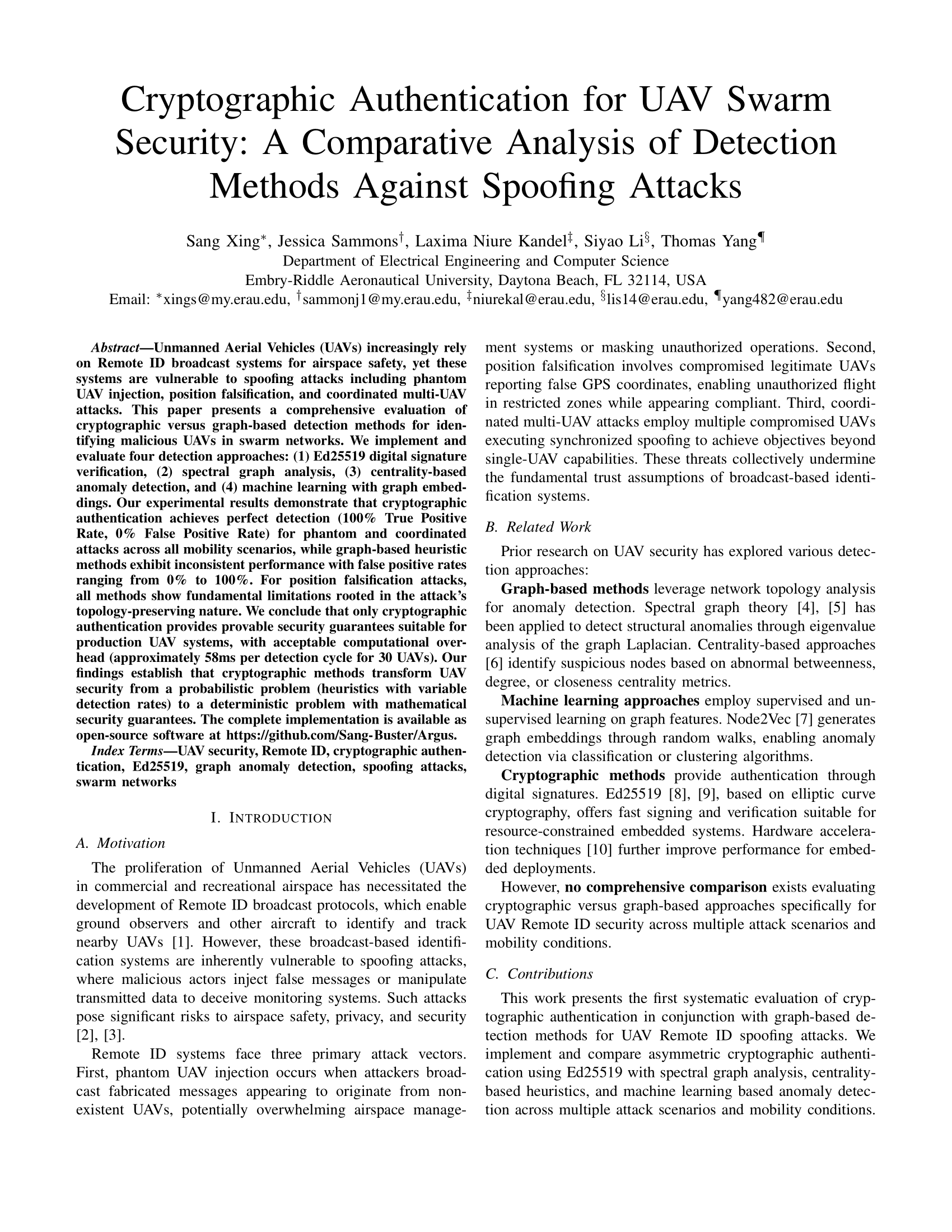

|
|
✨ Key Features
🎮 Simulation & Attacks
- Swarm Simulation — Dynamic graph-based UAV network modeling with configurable parameters
- Attack Injection — Multiple spoofing scenarios with ground truth tracking
⚔️ Attack Types
| Attack Type | Description |
|---|---|
| 🎭 Phantom UAV Injection | Non-existent UAVs broadcasting fake Remote ID messages |
| 📍 Position Falsification | Legitimate UAVs reporting spoofed GPS coordinates |
| 🔀 Coordinated Attacks | Multiple synchronized spoofers disrupting swarm consensus |
🔍 Detection Methods
| Method | Description | Performance |
|---|---|---|
| 📊 Spectral Analysis | Laplacian eigenvalue anomaly detection | Fast & lightweight |
| 🎯 Centrality-Based | Graph centrality metric analysis | Good for structural changes |
| 🤖 Machine Learning | Node2Vec embeddings + Isolation Forests | Adaptive detection |
| 🔐 Cryptographic | Ed25519 signature verification | 100% TPR, 0% FPR! |
📈 Analysis & Visualization
- Consensus Analysis — Quantify attack impact on swarm coordination
- Publication-Quality Plots — ROC curves, heatmaps, comparisons (300 DPI PDF+PNG)
- Live Real-Time Animation — Watch UAVs move and attacks unfold with PySide6 (Qt6)
- Interactive Detection Overlay — Enhanced visualization with detection status
📦 Installation
Prerequisites
🐍 Python 3.10 or higher with pip or uv package manager
From PyPI (Recommended)
# Install from PyPI
pip install argus_uav

# Verify installation
argus --help
From Source (For Development)
# Clone the repository
git clone https://github.com/Sang-Buster/Argus.git
cd Argus

# Create virtual environment
uv sync
source venv/bin/activate  # On Windows: venv\Scripts\activate

# Verify installation
argus --help
pytest tests/ -v
🚀 Quick Start
🎛️ Interactive CLI (Recommended)
The easiest way to get started:
# Launch interactive mode
argus

# Quick command-line usage
argus --attack phantom --detectors all --mode comparison

# See all options
argus --help
📖 See CLI User Guide for complete documentation.
The CLI provides:
- ✨ Interactive mode — Guided experience for beginners
- 🎬 Live visualization — Watch attacks and detection in real-time
- 📊 Performance comparison — Automated benchmarking and plots
- 🎯 Full coverage — Test any combination of 3 attacks × 4 detection methods
1️⃣ Simulate a Clean UAV Swarm
from argus_uav.core.swarm import Swarm
import numpy as np

# Create reproducible simulation
rng = np.random.default_rng(seed=42)
swarm = Swarm(
    num_uavs=20,
    comm_range=100.0,
    bounds=(1000, 1000, 200),
    rng=rng
)

# Run for 10 seconds
for t in range(10):
    swarm.step(dt=1.0)
    print(f"Time {t}s: {swarm.get_graph().number_of_edges()} links")
2️⃣ Inject and Detect Phantom UAVs
from argus_uav.attacks.phantom_uav import PhantomInjector
from argus_uav.attacks import AttackScenario, AttackType
from argus_uav.detection.spectral import SpectralDetector

# Configure phantom attack
attack = AttackScenario(
    attack_type=AttackType.PHANTOM,
    start_time=5.0,
    duration=10.0,
    phantom_count=3
)

# Setup detection
detector = SpectralDetector()
detector.train([swarm.get_graph().copy() for _ in range(20)])

# Run with attack
injector = PhantomInjector()
for t in range(20):
    if attack.is_active(float(t)):
        injector.inject(swarm, attack, float(t))

    swarm.step(dt=1.0)
    result = detector.detect(swarm.get_graph())

    metrics = result.compute_metrics()
    print(f"TPR: {metrics['tpr']:.2%}, FPR: {metrics['fpr']:.2%}")
For advanced experiments with custom configurations, use the Python API directly. See the
examples/directory for comprehensive demonstrations.
3️⃣ Compare All Detection Methods
# Run performance comparison with all detectors
argus --attack phantom --detectors all --mode comparison

# Live visualization with specific detectors
argus --attack coordinated --detectors spectral crypto --mode live

# Both live and comparison modes
argus --attack position --detectors centrality --mode both

# Custom swarm configuration
argus --attack phantom --detectors all --mode comparison \
    --num-uavs 50 --comm-range 150
🧪 Testing
# Run all tests
pytest tests/

# Run with coverage
pytest tests/ --cov=argus --cov-report=html

# Run specific test suites
pytest tests/unit/           # Unit tests only
pytest tests/integration/    # Integration tests only
pytest tests/performance/    # Performance benchmarks
📁 Project Structure
src/argus_uav/
├── 🎮 core/           # Simulation engine (UAV, swarm, Remote ID)
├── ⚔️ attacks/        # Attack injection (phantom, position spoof, coordinated)
├── 🔍 detection/      # Detection algorithms (spectral, centrality, ML)
├── 🔐 crypto/         # Ed25519 signing and verification
├── 🤝 consensus/      # Swarm consensus algorithms
├── 📊 evaluation/     # Metrics, visualizations, ROC curves
├── 🧪 experiments/    # Experiment runner and configuration
└── 🛠️ utils/          # Random seeds, logging

tests/
├── unit/              # Unit tests for individual components
├── integration/       # End-to-end scenario tests
├── contract/          # Interface compliance tests
└── performance/       # Benchmark and profiling tests

assets/                # Images, paper, presentation
docs/                  # Documentation and examples
examples/              # Example demonstrations and scripts
results/               # Experiment outputs (gitignored)
📚 Documentation
📖 Complete Documentation Index
Quick Links
| Guide | Description |
|---|---|
| 🚀 Quickstart Guide | Get started in 10 minutes |
| 📊 Project Status | Complete status & features |
| 🧮 Algorithm Details | Theory and implementation |
| 📋 Data Formats | Specifications and schemas |
| 📖 References | 19 research paper citations |
🔬 Research Background
This project investigates defenses against Remote ID spoofing, a critical security challenge for UAV swarms. Remote ID is mandated by aviation authorities (FAA 14 CFR Part 89) but lacks authentication, making it vulnerable to falsified messages.
🎯 Key Research Questions
- Can graph-theoretic metrics detect topological anomalies from phantom UAVs?
- How effective is machine learning (Node2Vec + Isolation Forests) vs pure graph analysis?
- What is the performance overhead of Ed25519 cryptographic signing for real-time swarms?
- How do spoofing attacks impact swarm consensus algorithms?
🔧 Methodology
| Aspect | Approach |
|---|---|
| Simulation | Software-only UAV swarm modeling (no hardware required) |
| Attack Scenarios | Phantom injection, position falsification, coordinated spoofers |
| Detection | Spectral analysis, centrality metrics, ML embeddings |
| Defense | Ed25519 digital signatures for message authentication |
| Evaluation | TPR, FPR, detection latency, consensus error |
🤝 Contributing
This is a research project. Contributions are welcome!
🌟 Areas of Interest
- 🧠 Additional detection algorithms (GNNs, threshold signatures)
- 📡 Real-world Remote ID traffic datasets
- 🔧 Hardware integration (RTL-SDR, physical UAVs)
- 📈 Scalability optimizations for larger swarms
📖 References
- Peel, L., et al. (2015). "Detecting Change Points in Evolving Networks"
- Olfati-Saber, R., & Murray, R. M. (2004). "Consensus Problems in Networks"
- Grover, A., & Leskovec, J. (2016). "node2vec: Scalable Feature Learning"
- Liu, F. T., et al. (2008). "Isolation Forest"
- Bernstein, D. J., et al. (2012). "High-speed high-security signatures" (Ed25519)
1 maintainer

Metadata
1 maintainer
Release files for argus_uav 0.2.0
For a detailed explanation of source distributions (sdists) and built distributions (wheels), please see the package formats documentation.
Source distribution (sdist)
| File | Size | Uploaded | |
|---|---|---|---|
| argus_uav-0.2.0.tar.gz | 1.6 MB | Details |
Built distribution (wheel)
| File | Interpreter | ABI | Platform | Reset |
|---|---|---|---|---|
| argus_uav-0.2.0-py3-none-any.whl | Python 3 | none | any | Details |
Total release size: 1.7 MB
Release files / argus_uav-0.2.0.tar.gz
| Download URL | argus_uav-0.2.0.tar.gz |
|---|---|
| Size | 1.6 MB |
| Tags | Source |
|
SHA-256 checksum How to use checksums |
26280a90cbeb9847027a5f8369033bdeee9b28758019077357117796cdea244b
|
|
BLAKE2b-256 checksum How to use checksums |
d641c780926c720fea5e3a4675da13117a98b7ca87f70e94d94db39bbca628fb
|
| Upload date | |
|
Uploaded using Trusted Publishing? What is trusted publishing? |
No |
| Uploaded via |
uv/0.8.15
|
Release files / argus_uav-0.2.0-py3-none-any.whl
| Download URL | argus_uav-0.2.0-py3-none-any.whl |
|---|---|
| Size | 69.6 kB |
| Tags | Python 3 |
|
SHA-256 checksum How to use checksums |
ad5b5893ccf552d3189376e0d8ec10d45b3f122a1c634989c994673bbf4866c1
|
|
BLAKE2b-256 checksum How to use checksums |
5cb12df5247d5c4bd79264954c2a90fb7949b811d2c259099c01a6c5d7fe9fd7
|
| Upload date | |
|
Uploaded using Trusted Publishing? What is trusted publishing? |
No |
| Uploaded via |
uv/0.8.15
|














