asgimachine
webmachine for Python — an HTTP decision-graph framework for resources that are correct by construction.
You write a resource as a handful of small async callbacks — is_authorized,
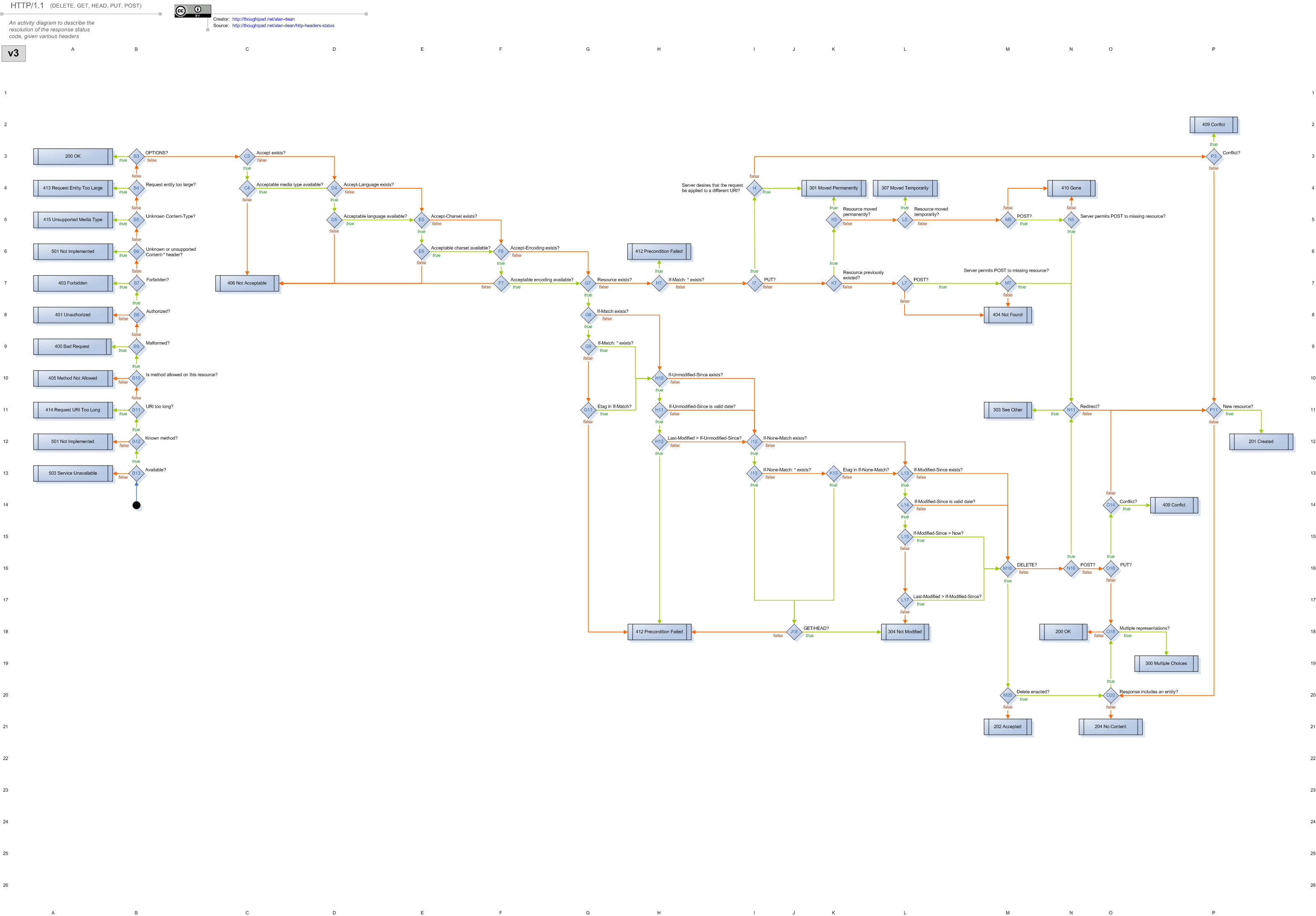
resource_exists, generate_etag, represent — and asgimachine walks the
webmachine v3 decision graph
over them. Content negotiation, conditional requests (ETag / If-None-Match /
If-Modified-Since), 405 + Allow, 406, 304, Vary, caching headers, and the
POST/PUT/PATCH/DELETE write path all fall out of the graph — each with a correct
HTTP default. You override only the callbacks your resource actually cares about.
This is a specialist tool, not a general web framework. It optimizes for the one
thing FastAPI, Flask, and DRF leave to you: getting HTTP semantics right — the
strong-vs-weak ETag comparison, the Vary you forgot, the 304 where you'd have
shipped a 200. Reach for it when correctness at the HTTP layer is the point:
public REST APIs, CDN-cacheable content, feeds and outboxes, conditional-request-
heavy services. If you want the shortest path from idea to a JSON CRUD endpoint, or
a batteries-included stack with an ORM and auth, use FastAPI or Django —
asgimachine has none of that by design. It owns the decision graph and rents
everything else (routing, the server, middleware) from
Starlette, so it composes with that ecosystem instead
of replacing it.
Status: experimental. Requires Python 3.13+ (it uses PEP 695 generics and PEP 696 type-parameter defaults). The decision graph implements the v0–v3 subset of webmachine; see PLAN.md for the design and roadmap.
Design in one breath
- Own Layer 1, rent Layer 2. asgimachine owns the decision graph and the resource conventions; it rents everything else (routing, the server, CORS, middleware) from Starlette. The core is provably Starlette-free — the substrate lives behind a single adapter module, so the graph could sit on another ASGI substrate unchanged.
- Correctness by construction. The right HTTP behavior is the default, not
something you remember to add. A resource that overrides only
representalready answers HEAD, OPTIONS, 405, 406, and 501 correctly. - Two lanes, no cosplay. Resource-shaped endpoints walk the graph; genuinely
command-shaped endpoints (a token exchange, a webhook receiver) use a plain
Commandhandler instead of being forced through a graph that does nothing for them. - Parse, don't validate. A request body is parsed into a typed model at the
boundary (a bad body is a
400); your write handler receives a value it can trust.
Install
Not yet on PyPI. With uv:
uv add "git+https://github.com/declaresub/asgimachine"
# or: pip install "git+https://github.com/declaresub/asgimachine"
Quickstart
# hello.py
from dataclasses import dataclass

from asgimachine.resource import Ctx, Resource
from asgimachine.substrate.starlette import build_app, resource_route


@dataclass(slots=True)
class GreetCtx(Ctx):           # typed per-request state (optional)
    name: str = "world"


class Greeting(Resource[GreetCtx]):
    context_class = GreetCtx
    ALLOWED_METHODS = frozenset({"GET", "HEAD"})

    async def resource_exists(self, ctx: GreetCtx) -> bool:
        ctx.name = ctx.request.path_params.get("name", "world")
        return True

    async def generate_etag(self, ctx: GreetCtx) -> str | None:
        return f'"{ctx.name}"'

    async def represent(self, ctx: GreetCtx) -> object:
        return {"hello": ctx.name}


app = build_app([resource_route("/hello/{name}", Greeting())])
uvicorn hello:app
That handful of callbacks already gets you the full HTTP contract:
$ curl -isS localhost:8000/hello/charles
HTTP/1.1 200 OK
etag: "charles"
content-type: application/json
{"hello": "charles"}

$ curl -isS localhost:8000/hello/charles -H 'If-None-Match: "charles"'
HTTP/1.1 304 Not Modified          # conditional GET, for free

$ curl -isS -X POST localhost:8000/hello/charles
HTTP/1.1 405 Method Not Allowed
allow: GET, HEAD, OPTIONS          # the Allow header, for free

$ curl -isS localhost:8000/hello/charles -H 'Accept: text/csv'
HTTP/1.1 406 Not Acceptable        # content negotiation, for free
What you override
Every callback is async def (self, ctx) -> ... with a correct default. The ones
you reach for most:
| Callback | Controls | Default outcome |
|---|---|---|
service_available |
availability | 503 when False |
allowed_methods / ALLOWED_METHODS |
permitted methods | 405 + Allow |
is_authorized |
authentication | 401 (+ WWW-Authenticate) |
forbidden |
authorization | 403 |
resource_exists |
existence | 404 (or the create/redirect branch) |
generate_etag / last_modified |
validators | 304 / 412 on conditional requests |
PRODUCES + represent |
the GET/HEAD body | 406 on a failed negotiation |
CONSUMES + apply |
the write body | 415 / 400; 201/200/204 |
cache_control / expires |
caching | emitted on cacheable responses |
lifespan |
per-request setup/teardown | acquire a DB connection, released on every exit |
Domain state lives on a Ctx subclass you declare via context_class; resources
hold only their wired collaborators (no dependency-injection framework — you pass
collaborators to __init__).
The command lane
Not everything is a resource. A credential exchange or webhook receiver is a
Command — a plain request→response handler that skips the graph:
from asgimachine.command import Command, json_response
from asgimachine.substrate.starlette import build_app, command_route

class Token(Command):
    async def handle(self, request):
        ...
        return json_response({"token": ...}, status=201)

app = build_app([command_route("/token", Token())])
More
- OpenAPI.
generate_openapi(...)emits an OpenAPI 3.1 document from your resources — the error surface (401/403/404/406/415/…) is derived from which callbacks you overrode, and models are hoisted intocomponents.schemas. - Streaming / SSE.
represent(orprocess_post) may return an async iterator of bytes; the graph decides status and headers, then streams the body. - Decision trace. In debug mode every response carries an
X-Asgimachine-Traceheader listing the exact node path it walked — the graph explains itself.
Examples
Runnable apps in examples/ (uvicorn examples.<name>:app --reload):
| Example | Shows |
|---|---|
accounts |
a pure-read resource with conditional GET |
feed |
immutable, CDN-cacheable feed pages (the outbox case) |
events |
Server-Sent Events streaming through the graph |
unpoly |
HTML fragments for Unpoly: conditional-GET polling (304) + POST-Redirect-Get, one URL negotiated on X-Up-Version |
connection |
per-request DB connection via lifespan |
notes_app |
the full gradient: collection + member resources, the command lane, an auth policy, and self-served OpenAPI |
Development
uv sync
uv run pytest             # test suite
uv run pyright            # strict on src + examples
uv run ruff check .       # lint
uv run ruff format --check .  # style
Enable the pre-push gate once per clone — it runs all four checks (the same as CI) before a push leaves your machine:
git config core.hooksPath .githooks
Bypass a single push with git push --no-verify.
License
MIT © Charles Yeomans
1 maintainer

Metadata
1 maintainer
Release files for asgimachine 0.1.0
For a detailed explanation of source distributions (sdists) and built distributions (wheels), please see the package formats documentation.
Source distribution (sdist)
| File | Size | Uploaded | Provenance | Actions |
|---|---|---|---|---|
| asgimachine-0.1.0.tar.gz | 197.8 kB | With provenance | Details for asgimachine-0.1.0.tar.gz |
Built distribution (wheel)
| File | Interpreter | ABI | Platform | Actions Reset |
|---|---|---|---|---|
| asgimachine-0.1.0-py3-none-any.whl | Python 3 | none | any | Details for asgimachine-0.1.0-py3-none-any.whl |
Total release size: 250.7 kB
Release files / asgimachine-0.1.0.tar.gz
| Download URL | asgimachine-0.1.0.tar.gz |
|---|---|
| Size | 197.8 kB |
| Tags | Source |
|
SHA-256 checksum How to use checksums |
1c410894526038a98ebb82d8c6026fd12d4ea18177881618d9be378da49833cc
|
|
BLAKE2b-256 checksum How to use checksums |
f117e453eede0b37013c1c44a1621fe248ba99626b1ecbf51cdfe9ad3ff2d43b
|
| Upload date | |
|
Uploaded using Trusted Publishing? What is trusted publishing? |
Yes |
| Uploaded via |
twine/6.1.0 CPython/3.13.14
|
Provenance
Provenance describes where a file came from. On PyPI, provenance is shared via attestations, which provide a verifiable record of the build or publishing details. View details, limitations and caveats.


PyPI Publish Attestation
PyPI verified that this artifact, at this checksum, originated from the publisher listed below.
Signed by GitHub Actions, verified by PyPI on Jul 21, 2026.
Transparency logRelease files / asgimachine-0.1.0-py3-none-any.whl
| Download URL | asgimachine-0.1.0-py3-none-any.whl |
|---|---|
| Size | 52.8 kB |
| Tags | Python 3 |
|
SHA-256 checksum How to use checksums |
258baa8c45fda7e28e3654b52cbd71bce73d5dc46e8ed03a2662e387f79941ff
|
|
BLAKE2b-256 checksum How to use checksums |
bcc330e023eb0c44ace910d6d7be4f04c5249bb9122af1eac9b9a60fcd8e7e51
|
| Upload date | |
|
Uploaded using Trusted Publishing? What is trusted publishing? |
Yes |
| Uploaded via |
twine/6.1.0 CPython/3.13.14
|
Provenance
Provenance describes where a file came from. On PyPI, provenance is shared via attestations, which provide a verifiable record of the build or publishing details. View details, limitations and caveats.
PyPI Publish Attestation
PyPI verified that this artifact, at this checksum, originated from the publisher listed below.
Signed by GitHub Actions, verified by PyPI on Jul 21, 2026.
Transparency logSecurity for asgimachine 0.1.0
Provenance
Provenance describes where a file came from. On PyPI, provenance is shared via attestations, which provide a verifiable record of the build or publishing details. View details, limitations and caveats.
Full provenance
All 2 files in this release have been uploaded with provenance metadata.
Attestation for asgimachine-0.1.0.tar.gz
PyPI Publish Attestation
PyPI verified that this artifact, at this checksum, originated from the publisher listed below.
Signed by GitHub Actions, verified by PyPI on Jul 21, 2026.
Transparency logA note on package security
PyPI is a repository for distributing packages, not a service for auditing them. While third-party security researchers and our staff do their best to detect and remove malicious packages, PyPI cannot guarantee the quality, security or suitability of any given package.
To learn more about protecting yourself from malicious actors, visit our package security documentation.