


asilib
asilib is an open source package providing data access and analysis tools for the world's all-sky imager (ASI) data.
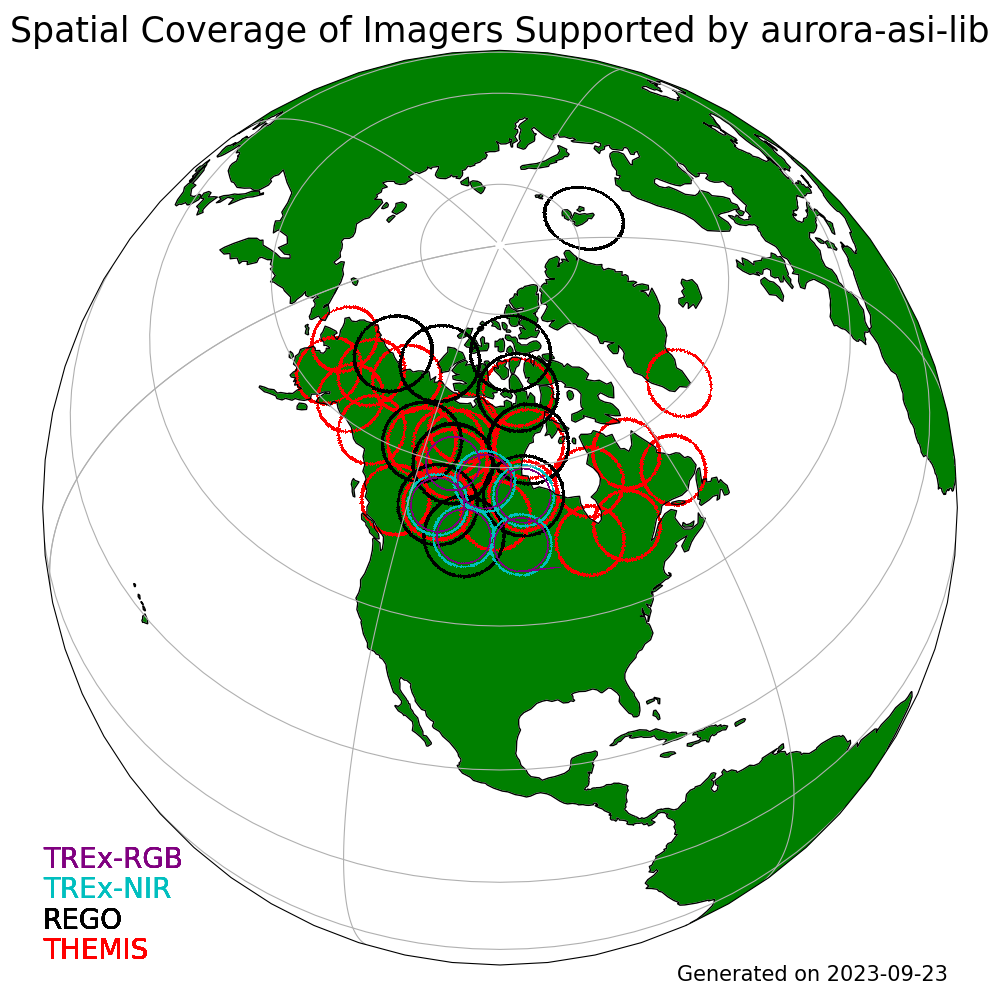
The purpose of this project is to combine data from numerous observational ASI arrays into a single unified framework and is thus not associated with the development and operations of all sky cameras, or the curation of ASI datasets. All data is publicly available and is provided as-is. Please give appropriate credit and coordinate with instrument teams with regards to data issues and/or interpretation. See the Acknowledgements section for more information. Currently the supported camera systems (arrays) are:
- Red-line Emission Geospace Observatory (REGO)
- Time History of Events and Macroscale Interactions during Substorms (THEMIS)
- Transition Region Explorer (TREx)
- Mid-latitude All-sky-imaging Network for Geophysical Observations (MANGO)
- Pulsating Aurora (PsA Project)
Documentation | Code on GitHub | PyPI archive | Zenodo archive
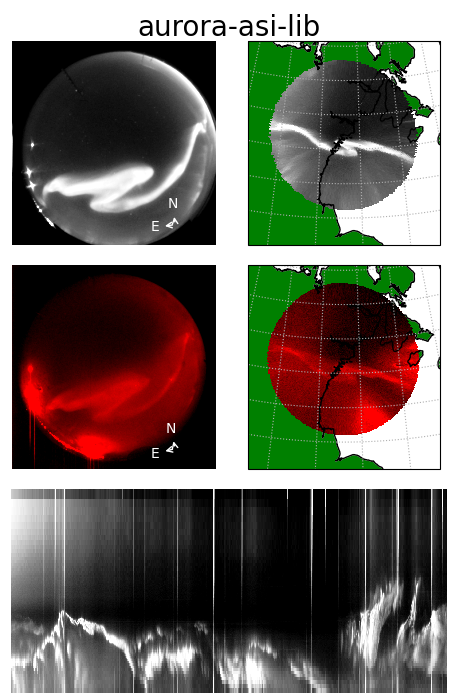
And you can animate images & conjunctions!
See more examples in the online documentation
Your contributions and ideas are always welcome. The easiest way is to submit Issues or Pull Requests.
Acknowledgments
Are in the Acknowledgements section of the online documentation.
1 maintainer

Metadata
1 maintainer
Release files for asilib 0.30.1
For a detailed explanation of source distributions (sdists) and built distributions (wheels), please see the package formats documentation.
Source distribution (sdist)
| File | Size | Uploaded | Provenance | Actions |
|---|---|---|---|---|
| asilib-0.30.1.tar.gz | 3.3 MB | Without provenance | Details for asilib-0.30.1.tar.gz |
Built distribution (wheel)
| File | Interpreter | ABI | Platform | Actions Reset |
|---|---|---|---|---|
| asilib-0.30.1-py3-none-any.whl | Python 3 | none | any | Details for asilib-0.30.1-py3-none-any.whl |
Total release size: 6.7 MB
Release files / asilib-0.30.1.tar.gz
| Download URL | asilib-0.30.1.tar.gz |
|---|---|
| Size | 3.3 MB |
| Tags | Source |
|
SHA-256 checksum How to use checksums |
e7e3d8d8e0e03728663255d15db6ee5a8c5197be180efc187a2e4043d77d5157
|
|
BLAKE2b-256 checksum How to use checksums |
c161438e46ad6e5f9faa1f5df50a6d0b28859afe2a5bb655fa6e45a9fb4ed131
|
| Upload date | |
|
Uploaded using Trusted Publishing? What is trusted publishing? |
No |
| Uploaded via |
uv/0.10.4 {"installer":{"name":"uv","version":"0.10.4","subcommand":["publish"]},"python":null,"implementation":{"name":null,"version":null},"distro":{"name":"Ubuntu","version":"24.04","id":"noble","libc":null},"system":{"name":null,"release":null},"cpu":null,"openssl_version":null,"setuptools_version":null,"rustc_version":null,"ci":true}
|
Release files / asilib-0.30.1-py3-none-any.whl
| Download URL | asilib-0.30.1-py3-none-any.whl |
|---|---|
| Size | 3.4 MB |
| Tags | Python 3 |
|
SHA-256 checksum How to use checksums |
e0c6db21089e36ec48b4c5acb9a3e4e25332ff3bf06cd8672af21d3983d7ccd7
|
|
BLAKE2b-256 checksum How to use checksums |
580bcd0b585109cbc81bc6e151d4a3b483e24d9a30c422ceeec9c1fd4499471f
|
| Upload date | |
|
Uploaded using Trusted Publishing? What is trusted publishing? |
No |
| Uploaded via |
uv/0.10.4 {"installer":{"name":"uv","version":"0.10.4","subcommand":["publish"]},"python":null,"implementation":{"name":null,"version":null},"distro":{"name":"Ubuntu","version":"24.04","id":"noble","libc":null},"system":{"name":null,"release":null},"cpu":null,"openssl_version":null,"setuptools_version":null,"rustc_version":null,"ci":true}
|
Security for asilib 0.30.1
Provenance
Provenance describes where a file came from. On PyPI, provenance is shared via attestations, which provide a verifiable record of the build or publishing details. View details, limitations and caveats.
No provenance found
None of the files in this release were uploaded with provenance metadata.
A note on package security
PyPI is a repository for distributing packages, not a service for auditing them. While third-party security researchers and our staff do their best to detect and remove malicious packages, PyPI cannot guarantee the quality, security or suitability of any given package.
To learn more about protecting yourself from malicious actors, visit our package security documentation.














