
CLI orbital mechanics calculator — J2/J3/J4 propagation, conjunction screening, pass prediction

Project description
Astrosis — orbital mechanics calculator
Batch propagate 5,000 satellites in 75 ms. CLI + TUI with J2/J3/J4 propagation, conjunction screening, pass prediction, and ephemeris. Auto-selects CUDA → C++/OpenMP → NumPy → Python backend. Zero config.




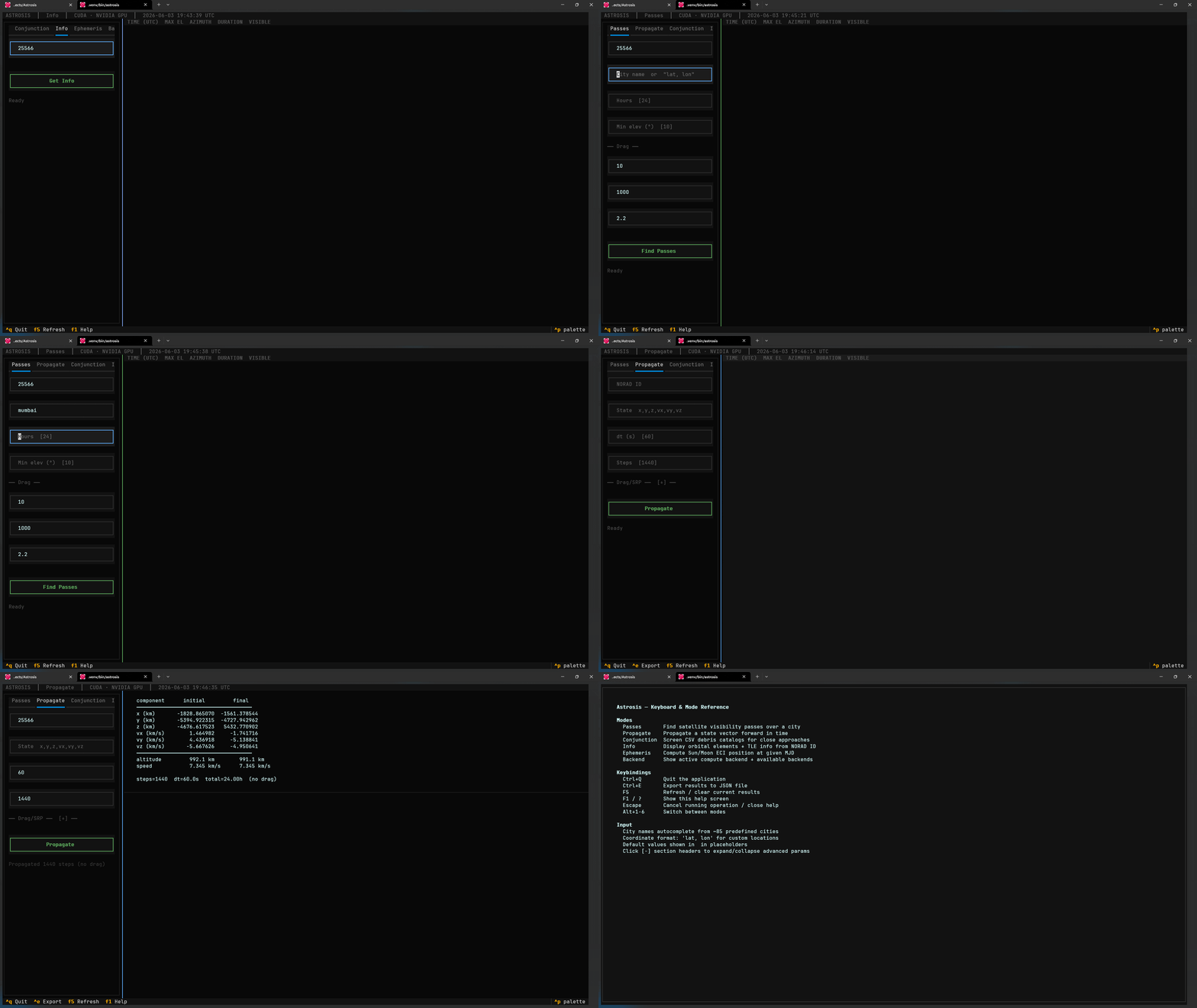
Table of Contents
Why Astrosis?
Stop waiting for Python propagation. Single-threaded Python does one satellite in ~400 ms. Astrosis does 5,000 in 75 ms — a 500× speedup — and you don't have to think about the backend.
- GPU auto-acceleration. CUDA → C++/OpenMP → NumPy → Python fallback. No config required. The router probes your hardware and picks the fastest path.
- Conjunction screening ready. Built-in pairwise collision detection with Brent TCA refinement and Chan probability. 400 × 400 pairs in 125 ms (CUDA).
- TUI + CLI duality. Rich interactive TUI (6 modes, collapsible sections, JSON export) plus full CLI for scripting. Same Python API under both.
If you can pip install, you can use Astrosis.
Quick start
pip install astrosis

# TUI (no args)
astrosis

# CLI
astrosis passes --city Mumbai --id 25544
astrosis info --id 25544
Python API
Use Astrosis as a library in your own scripts:
import astrosis

# Propagate a single satellite 24 hours forward
state = astrosis.propagate(
    [6678, 0, 0, 0, 7.7, 0],  # ECI: x, y, z, vx, vy, vz (km, km/s)
    dt_seconds=86400
)
print(f"After 24 h: {state}")

# Batch propagate 1,000 satellites — auto-picks fastest backend
states = astrosis.propagate_batch(
    initial_states, dt_seconds=60, steps=1440
)

# Conjunction screening
warnings = astrosis.detect_conjunctions(
    satellites, debris, lookahead=86400, step_s=60
)

# Check which backend is active
print(astrosis.backend_info())
Features
| Category | Capabilities |
|---|---|
| Propagation | RK4 with J2/J3/J4, atmospheric drag (US Standard 1976), SRP, lunisolar third-body |
| Auto-backend | CUDA GPU → C++ OpenMP → NumPy batch → Python fallback, transparent fallback |
| Conjunction | KDTree broad-phase, pairwise distance scan, Brent TCA refinement, Chan collision probability |
| Pass prediction | SGP4 → RK4 seamless handoff, elevation/visibility filtering, ~85 cities built-in |
| Ephemeris | Sun/Moon ECI positions via VSOP87/ELP-2000, eclipse state (umbra/penumbra) |
| TUI | 6 modes, help overlay, collapsible advanced sections, JSON export, persistence, autocomplete cities |
| Coordinate frames | ECI ⇄ ECEF, TEME → ECI, geodetic, topocentric (az/el/range), GMST + equation of equinoxes |
Architecture
graph TB
    subgraph UI["User Interface"]
        direction LR
        CLI["main.py / CLI"]
        TUI["astrosis/tui.py<br/>Textual 8.x"]
        API["astrosis.*<br/>Python API"]
    end

    subgraph CORE["Physics Core"]
        direction TB
        PROP["Propagator<br/>RK4 · J2–J4 · Drag · SRP<br/>Lunisolar"]
        CONJ["Conjunction Detector<br/>KDTree · Brent TCA<br/>Chan Pc"]
        PASS["Pass Predictor<br/>SGP4→RK4 · AER<br/>Eclipse check"]
        EPHEM["Ephemeris<br/>Sun VSOP87 · Moon ELP-2000"]
        FRAMES["Frame Transforms<br/>ECI ↔ ECEF ↔ Geodetic<br/>TEME→ECI · Topocentric"]
    end

    subgraph BACKEND["Backend Layer<br/>(auto-selected)"]
        CUDA["CUDA GPU<br/>SoA kernels"]
        CPP["C++ / OpenMP<br/>pybind11"]
        NUMPY["NumPy batch<br/>Vectorised"]
        PYTHON["Python fallback"]
    end

    subgraph DATA["Data Sources"]
        TLE["TLE Ingestor<br/>CelesTrak / Space-Track"]
        CITIES["City Database<br/>~85 cities"]
    end

    CLI --> CORE
    TUI --> API
    API --> CORE
    PROP --> BACKEND
    CONJ --> BACKEND
    PASS --> FRAMES
    PASS --> PROP
    PASS --> EPHEM
    CONJ --> PROP
    TLE --> PROP
    CITIES --> PASS
The router in astrosis/core/accelerator.py probes cuda_available(), C++ module
presence, and falls back through the layers — all transparent to the caller.
Performance
| Operation | Python | C++ | CUDA |
|---|---|---|---|
| Single sat (50k steps) | 391 ms | 21 ms (19×) | N/A |
| Batch 1k sats × 864 steps | 7074 ms | 13 ms (566×) | 245 ms (29×) |
| Batch 5k sats × 864 steps | 36854 ms | 55 ms (676×) | 291 ms (127×) |
| Conjunction 200×200 1h | 6262 ms | 498 ms (13×) | 45 ms (139×) |
| Conjunction 400×400 2h | 26677 ms | 3856 ms (7×) | 125 ms (214×) |
C++ dominates < 500 satellites (no PCIe overhead). CUDA dominates > 500 with up to 66,483 sats/s throughput. See docs/performance.md for full crossover analysis, streamed mode benchmarks, and roofline.
Backend auto-selection
Astrosis automatically picks the fastest backend for each operation: CUDA GPU → C++/OpenMP → NumPy batch → pure Python.
$ astrosis backend
╭─────────────────────────────── Backend Status ───────────────────────────────╮
│ Active backend: CUDA                                                         │
│       ✓ CUDA  ✓ C++/OpenMP  ✓ NumPy batch  ✓ Python fallback                │
│ GPU: NVIDIA GPU                                                              │
╰──────────────────────────────────────────────────────────────────────────────╯
TUI reference
Six modes (switch with Alt+1–Alt+6):
| Mode | What it does |
|---|---|
| passes | Predict satellite passes for a city or lat/lon |
| propagate | Propagate a NORAD ID or state vector forward |
| conjunction | Load CSVs and screen pairs for close approaches |
| info | Orbital elements, current ECI state, ground track |
| ephemeris | Sun/Moon ECI positions and distances |
| backend | Active compute backend and GPU info |
Keybindings:
| Key | Action |
|---|---|
Alt+1–Alt+6 |
Switch mode |
Enter |
Run current mode |
Escape |
Cancel running operation |
Ctrl+E |
Export results to JSON |
F5 |
Refresh / clear results |
F1 / ? |
Show help overlay |
↑↓ |
Select result row (detail strip) |
Ctrl+Q |
Quit |
Drag/SRP parameters and conjunction advanced options are hidden behind
clickable [+] section headers. Input values persist across sessions
via ~/.cache/astrosis/tui_state.json.
CLI reference
| Command | What it does |
|---|---|
astrosis |
Launch interactive TUI |
astrosis passes --city <name> --id <norad> |
Predict satellite passes |
astrosis info --id <norad> |
Orbital elements and current state |
astrosis propagate <state or id> --dt 60 --steps 1440 |
Propagate forward |
astrosis conjunction --primary a.csv --secondary b.csv |
Conjunction screening |
astrosis batch <file.csv> --steps 100 |
Batch propagate from CSV |
astrosis backend |
Show active compute backend |
astrosis fetch --id <norad> |
Fetch and cache TLE data |
astrosis ephemeris --mjd 60000 |
Sun/moon positions |
Contributing
Contributions welcome — whether it's a bug report, feature request, or pull request. See docs/contributing.md for:
- Dev setup and build instructions
- Running tests and physics validation
- Code style (Black, Flake8, clang-format)
- PR workflow
Acknowledgments
Astrosis builds on excellent open-source work:
- SGP4 — Two-line element propagation (python-sgp4)
- VSOP87 / ELP-2000 — Solar and lunar ephemerides
- Textual — TUI framework
- pybind11 — C++/Python bridge
- NumPy / SciPy — Numerical foundation
- CelesTrak / Space-Track — TLE data sources
License
MIT
Release history Release notifications | RSS feed


Download files
Download the file for your platform. If you're not sure which to choose, learn more about installing packages.
Source Distribution
Built Distribution
Filter files by name, interpreter, ABI, and platform.
If you're not sure about the file name format, learn more about wheel file names.
Copy a direct link to the current filters
File details
Details for the file astrosis-0.1.1.tar.gz.
File metadata
- Download URL: astrosis-0.1.1.tar.gz
- Upload date:
- Size: 898.1 kB
- Tags: Source
- Uploaded using Trusted Publishing? No
- Uploaded via: twine/6.2.0 CPython/3.11.15
File hashes
| Algorithm | Hash digest | |
|---|---|---|
| SHA256 |
70a795df1a8a3f848edb77f6080464405c9001fe8da03fd78c057605a34dcf4b
|
|
| MD5 |
fd8479cee1b18c8eccc96cb670915740
|
|
| BLAKE2b-256 |
6319e8d0735d92cbcc5ee99df749a6ba422824f19ec750f78fa358dc16032f04
|
File details
Details for the file astrosis-0.1.1-py3-none-any.whl.
File metadata
- Download URL: astrosis-0.1.1-py3-none-any.whl
- Upload date:
- Size: 903.1 kB
- Tags: Python 3
- Uploaded using Trusted Publishing? No
- Uploaded via: twine/6.2.0 CPython/3.11.15
File hashes
| Algorithm | Hash digest | |
|---|---|---|
| SHA256 |
b879c413815d50c350770dd9aeb96430e6a810e92d6d08ad1ef4f40c28bc3d8a
|
|
| MD5 |
5c5ab438f783a9f619389d7d2ada3e08
|
|
| BLAKE2b-256 |
2e8efe40dba5dcc029c9bed22faccd785a4bd48fe25b02b56f325a543995888c
|






