
AttackBenchLib: Evaluating Gradient-based Attacks for Adversarial Examples
Riccardo Trebiani, Antonio Emanuele Cinà, Jérôme Rony, Maura Pintor, Luca Demetrio, Ambra Demontis, Battista Biggio, Ismail Ben Ayed and Fabio Roli
Leaderboard: https://attackbench.github.io/
Paper: https://arxiv.org/pdf/2404.19460
Changelog: 2.0.1 release notes
Tutorial Notebook:

How it works
AttackBenchLib is a library that implements the framework described in the AttackBench paper in a new modular, user-friendly way in order to make multiple workflows and kinds of analysis possible through the use of a single library.
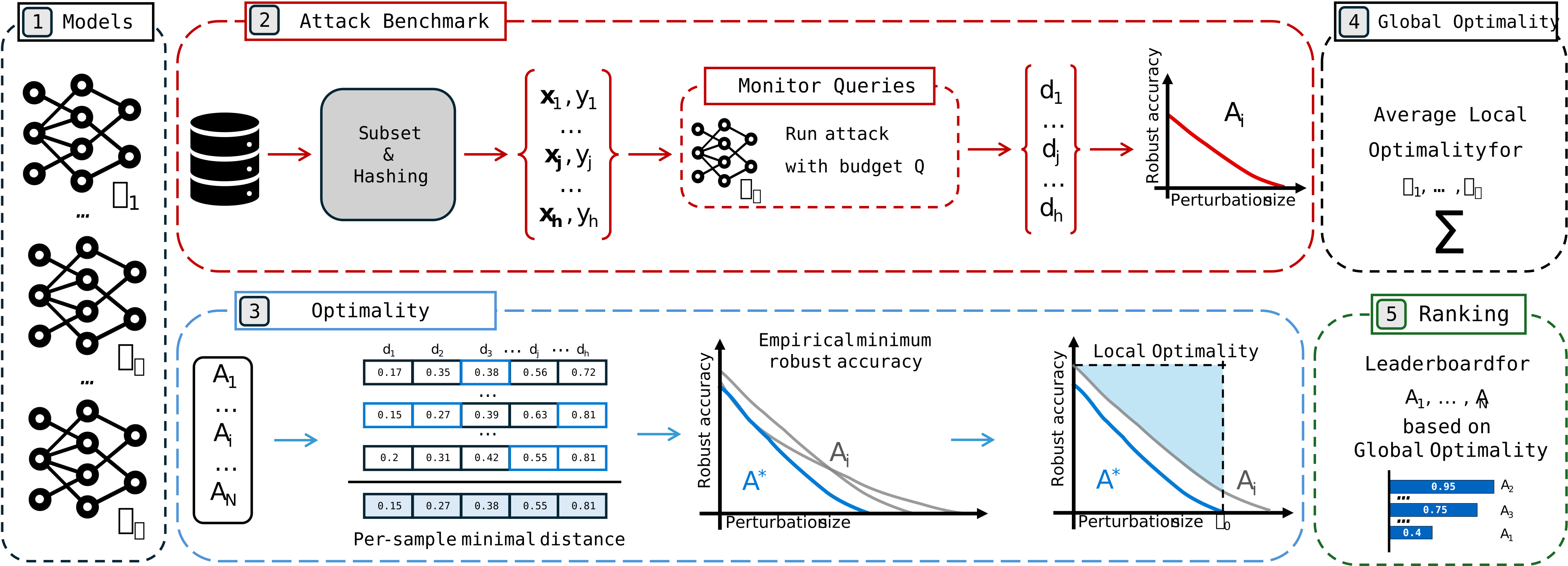
The AttackBench framework aims to fairly compare gradient-based attacks based on their security evaluation curves. To this end, we derive a process involving five distinct stages, as depicted below.
- In stage (1), we construct a list of diverse non-robust and robust models to assess the attacks' impact on various settings, thus testing their adaptability to diverse defensive strategies.
- In stage (2), we define an environment for testing gradient-based attacks under a systematic and reproducible protocol. This step provides common ground with shared assumptions, advantages, and limitations. We then run the attacks against the selected models individually and collect the performance metrics of interest in our analysis, which are perturbation size, execution time, and query usage.
- In stage (3), we gather all the previously-obtained results, comparing attacks with the novel
local optimalitymetric. - Finally, in stage (4), we aggregate the optimality results from all considered models, and in stage (5) we rank the attacks based on their average optimality, namely
global optimality.
Currently implemented
| Attack | Original | Advertorch | Adv_lib | ART | CleverHans | DeepRobust | Foolbox | Torchattacks |
|---|---|---|---|---|---|---|---|---|
| DDN | ☒ | ✓ | ☒ | ☒ | ☒ | ✓ | ☒ | |
| ALMA | ☒ | ☒ | ✓ | ☒ | ☒ | ☒ | ☒ | ☒ |
| FMN | ✓ | ☒ | ✓ | ☒ | ☒ | ☒ | ✓ | ☒ |
| PGD | ☒ | ✓ | ✓ | ✓ | ✓ | |||
| JSMA | ☒ | ☒ | ✓ | ☒ | ☒ | ☒ | ☒ | |
| CW-L2 | ☒ | ✓ | ✓ | ~ | ✓ | ✓ | ||
| CW-LINF | ☒ | ☒ | ✓ | ✓ | ☒ | ☒ | ☒ | ☒ |
| FGSM | ☒ | ☒ | ✓ | ✓ | ||||
| BB | ☒ | ☒ | ☒ | ✓ | ☒ | ☒ | ✓ | ☒ |
| DF | ✓ | ☒ | ☒ | ✓ | ☒ | ~ | ✓ | ✓ |
| SuperDF | ✓ | ☒ | ☒ | ☒ | ☒ | ☒ | ☒ | ☒ |
| APGD | ✓ | ☒ | ✓ | ✓ | ☒ | ☒ | ☒ | ✓ |
| BIM | ☒ | ☒ | ✓ | ☒ | ☒ | |||
| EAD | ☒ | ☒ | ✓ | ☒ | ☒ | ✓ | ☒ | |
| PDGD | ☒ | ☒ | ✓ | ☒ | ☒ | ☒ | ☒ | ☒ |
| PDPGD | ☒ | ☒ | ✓ | ☒ | ☒ | ☒ | ☒ | ☒ |
| TR | ✓ | ☒ | ✓ | ☒ | ☒ | ☒ | ☒ | ☒ |
| FAB | ✓ | ✓ | ☒ | ☒ | ☒ | ☒ | ✓ |
Legend:
- empty : not implemented yet
- ☒ : not available
- ✓ : implemented
- ~ : not functional yet
Requirements and Installation
- Python >= 3.9
- PyTorch >= 2.4
- TorchVision >= 0.19
- CUDA compatible GPU (recommended)
Install from PyPI
pip install attackbenchlib
Optional dependencies
# Compatible attack library wrappers (ART, Foolbox, CleverHans)
pip install "attackbenchlib[attacks]"

# Model loading utilities (RobustBench)
pip install "attackbenchlib[models]"

# Analysis and evaluation tools
pip install "attackbenchlib[metrics]"

# Recommended compatible set (attacks + models + metrics)
pip install "attackbenchlib[all]"

# Torchattacks, when its legacy dependency stack is acceptable
pip install "attackbenchlib[torchattacks]"
Note on
torchattacks: Torchattacks 3.5.1 pinsrequests~=2.25.1, which conflicts with current notebook and dataset packages. It is therefore not included in[attacks]or[all]. Install its dedicated extra in an isolated environment if you need those wrappers; all other wrappers remain available without it.
Note on
adv-lib: The Adversarial Library (adv-lib) is not on PyPI, so it is not part of[all]. Its implementations are among the top-ranked ones in the AttackBench paper, so installing without it leaves you with weaker re-implementations of the same attacks. It needs two extra steps:adv-libdepends onvisdom, whosesetup.pyimportspkg_resources, which setuptools 81+ no longer ships — sovisdomhas to be built against an older setuptools first:pip install "setuptools<81" wheel pip install --no-build-isolation visdom pip install "adv-lib @ git+https://github.com/jeromerony/adversarial-library"Without
adv-libinstalled, its attacks are simply absent fromlist_attacks()instead of failing when you try to build them.
Note on
deeprobust: Requiresscipy<1.8.0and only works on Python 3.9:pip install "attackbenchlib[deeprobust]"
Google Colab
On Google Colab, install the compatible model and attack dependencies:
!pip install "attackbenchlib[models,attacks]>=2.0.2,<2.1" -q
Colab's pre-installed packages can conflict with optional attack/model dependencies. Review any resolver warning and run
pip check; if imports fail, restart the runtime after installation or use a clean virtual environment.
Install from source (development)
git clone https://github.com/sickrichmond/AttackBench.git
cd AttackBench
pip install -e ".[dev]"
Usage
import torch
import attackbench
from attackbench.attacks import apgd

device = torch.device('cuda' if torch.cuda.is_available() else 'cpu')

# Load model and dataset (requires attackbenchlib[models])
model = attackbench.load_model('Standard', dataset='cifar10', threat_model='Linf')
model.to(device)

dataset = attackbench.get_loader(dataset='cifar10', batch_size=128, num_samples=1000)

# Run attack
results = attackbench.run_attack(
    model=model,
    dataset=dataset,
    attack=apgd,
    threat_model='linf',
    device=device
)

# Analyze results (requires attackbenchlib[metrics])
stats = attackbench.get_stats(results, 'linf')
print(f"ASR: {stats['ASR']*100:.1f}%")
Every attack runs under a budget of 2000 forward+backward propagations per sample — the
budget used in the paper, and what makes attacks comparable to each other. Pass
run_attack(..., query_budget=None) to lift it for exploratory runs.
Upgrading from 1.x
Version 2.0 changes what the numbers mean, so results are not comparable with 1.x:
results['distances']is nowd*, the smallest perturbation found during the optimization (as defined in the paper), not the distance of the sample the attack returned last. The last iterate is available asresults['final_distances'].stats['accuracy']is the clean accuracy. In 1.x it reported the fraction of already misclassified samples, i.e. the error rate.optimalityis only computed against a real lower envelope — passed in explicitly or downloaded from W&B. 1.x silently fell back to the attack's own tracked distances, which scored ~1.0 by construction.- W&B lower envelopes without the 2.x protocol marker are rejected. Recompute and
upload them from 2.x
d*results before using automatic optimality. - The query budget is enforced by default (see above); 1.x enforced none.
run_attack(use_cached=...)defaults toFalse, and a cached W&B result is only reused when its full schema, query budget, and per-sample hashes match the requested run.include_metadatais gone: query counts, timings, predictions and the failure indicators are always returned.
Preconfigured attacks available with the base installation: pgd, fgsm, apgd, fab, deepfool, superdeepfool, trust_region. The preconfigured fmn attack additionally requires attackbenchlib[attacks].
To use attacks from external libraries (requires attackbenchlib[attacks]):
# List available attacks
attacks = attackbench.list_attacks(threat_model='linf')

# Load a specific library attack
art_pgd = attackbench.get_attack(lib='art', attack='pgd', threat_model='linf')
results = attackbench.run_attack(model=model, dataset=dataset, attack=art_pgd, threat_model='linf', device=device)
Attack format
The wrappers for all the implementations (including libraries) must have the following format:
- inputs:
model:nn.Moduletaking inputs in the [0, 1] range and returning logits in $\mathbb{R}^K$inputs:FloatTensorrepresenting the input samples in the [0, 1] rangelabels:LongTensorrepresenting the labels of the samplestargets:LongTensororNonerepresenting the targets associated to each samplestargeted:boolflag indicating if a targeted attack should be performed
- output:
adv_inputs:FloatTensorrepresenting the perturbed inputs in the [0, 1] range
Citation
If you use the AttackBench leaderboards or implementation, then consider citing our paper:
@inproceedings{cina2025attackbench,
  title={Attackbench: Evaluating gradient-based attacks for adversarial examples},
  author={Cin{\`a}, Antonio Emanuele and Rony, J{\'e}r{\^o}me and Pintor, Maura and Demetrio, Luca and Demontis, Ambra and Biggio, Battista and Ayed, Ismail Ben and Roli, Fabio},
  booktitle={Proceedings of the AAAI Conference on Artificial Intelligence},
  volume={39},
  number={3},
  pages={2600--2608},
  year={2025},
  DOI={10.1609/aaai.v39i3.32263}
}
Contact
Feel free to contact us about anything related to AttackBench by creating an issue, a pull request or
by email at antonio.cina@unige.it.
License
AttackBench is distributed under the MIT License.
See Third-Party Notices for bundled components and optional
external model assets. The stutz_2020 and xiao_2020 checkpoints are not included
in the MIT distribution and remain subject to their upstream terms.
Acknowledgements
AttackBench has been partially developed with the support of European Union’s ELSA – European Lighthouse on Secure and Safe AI, Horizon Europe, grant agreement No. 101070617, and Sec4AI4Sec - Cybersecurity for AI-Augmented Systems, Horizon Europe, grant agreement No. 101120393.


1 maintainer

Download files
Download the file for your platform. If you're not sure which to choose, learn more about installing packages.
Source Distribution
Built Distribution
Filter files by name, interpreter, ABI, and platform.
If you're not sure about the file name format, learn more about wheel file names.
Copy a direct link to the current filters
File details
Details for the file attackbenchlib-2.0.2.tar.gz.
File metadata
- Download URL: attackbenchlib-2.0.2.tar.gz
- Upload date:
- Size: 164.9 kB
- Tags: Source
- Uploaded using Trusted Publishing? Yes
- Uploaded via:
twine/7.0.0 CPython/3.13.14
File hashes
| Algorithm | Hash digest | |
|---|---|---|
| SHA256 |
00aa203bc62053b9b7e34484ffa3117b7cf2a795b87a3620d4ac769bd7d1a4fb
|
|
| MD5 |
268312f4fee29d468f9811dc84c1d958
|
|
| BLAKE2b-256 |
7b52c08e905d83609aba14fb18fd20a4a2cc1f894b3d64cce7f1bdd2c0b7f5a9
|
Provenance
The following attestation bundles were made for attackbenchlib-2.0.2.tar.gz:
Publisher:
release.yml on sickrichmond/AttackBench
-
Statement:
-
Statement type:
https://in-toto.io/Statement/v1 -
Predicate type:
https://docs.pypi.org/attestations/publish/v1 -
Subject name:
attackbenchlib-2.0.2.tar.gz -
Subject digest:
00aa203bc62053b9b7e34484ffa3117b7cf2a795b87a3620d4ac769bd7d1a4fb - Sigstore transparency entry: 2652127868
- Sigstore integration time:
-
Permalink:
sickrichmond/AttackBench@613b2a4a99b5e2fb6c0d307dd9658099a4177988 -
Branch / Tag:
refs/tags/v2.0.2 - Owner: https://github.com/sickrichmond
-
Access:
public
-
Token Issuer:
https://token.actions.githubusercontent.com -
Runner Environment:
github-hosted -
Publication workflow:
release.yml@613b2a4a99b5e2fb6c0d307dd9658099a4177988 -
Trigger Event:
push
-
Statement type:
File details
Details for the file attackbenchlib-2.0.2-py3-none-any.whl.
File metadata
- Download URL: attackbenchlib-2.0.2-py3-none-any.whl
- Upload date:
- Size: 146.2 kB
- Tags: Python 3
- Uploaded using Trusted Publishing? Yes
- Uploaded via:
twine/7.0.0 CPython/3.13.14
File hashes
| Algorithm | Hash digest | |
|---|---|---|
| SHA256 |
1b1680d1d361698cba94d2816dfa6ddb715df14e98fb9d6270b930ab15abcca2
|
|
| MD5 |
78d7f76dcebe21388efd660892d8ec92
|
|
| BLAKE2b-256 |
659814892c8149435d82bba8d9b3037b7e051dd1e0a7ce9339a78c3fa7aa057c
|
Provenance
The following attestation bundles were made for attackbenchlib-2.0.2-py3-none-any.whl:
Publisher:
release.yml on sickrichmond/AttackBench
-
Statement:
-
Statement type:
https://in-toto.io/Statement/v1 -
Predicate type:
https://docs.pypi.org/attestations/publish/v1 -
Subject name:
attackbenchlib-2.0.2-py3-none-any.whl -
Subject digest:
1b1680d1d361698cba94d2816dfa6ddb715df14e98fb9d6270b930ab15abcca2 - Sigstore transparency entry: 2652128029
- Sigstore integration time:
-
Permalink:
sickrichmond/AttackBench@613b2a4a99b5e2fb6c0d307dd9658099a4177988 -
Branch / Tag:
refs/tags/v2.0.2 - Owner: https://github.com/sickrichmond
-
Access:
public
-
Token Issuer:
https://token.actions.githubusercontent.com -
Runner Environment:
github-hosted -
Publication workflow:
release.yml@613b2a4a99b5e2fb6c0d307dd9658099a4177988 -
Trigger Event:
push
-
Statement type:














