

Augmentrum
A Data Augmentation Package for MR Spectroscopy




Overview
Augmentrum is a modular Python framework designed to help researchers with limited in-vivo MRS data create diverse, physically consistent datasets through flexible augmentation. It supports k-space resampling, coil and average sampling, signal-level perturbations, and synthetic artifact generation, expanding both synthetic and in-vivo data in a realistic and controlled manner.
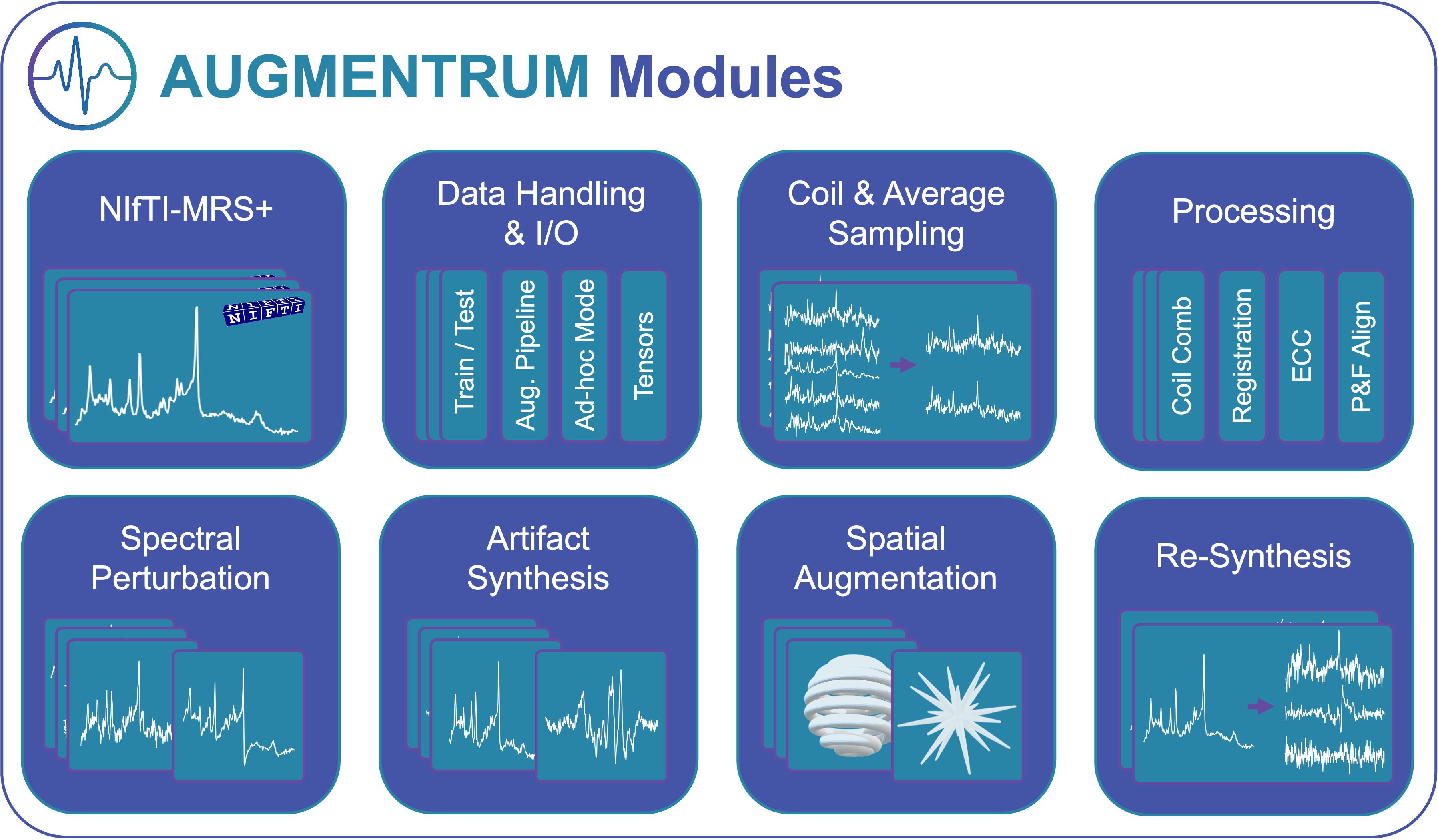
Built for data-driven MRS applications, Augmentrum streamlines the integration of data augmentation into existing workflows. It operates on the NIfTI-MRS standard, making it compatible with any acquisition format. Simply load your data as NIfTI (using spec2nii if needed) and apply either predefined augmentation settings or build a custom pipeline by combining modules. Each augmentation can be parameterized or used with default ranges to populate a dense and diverse dataset environment.
From MRSI reconstruction and acquisition variability to spectral perturbations and artifact synthesis, Augmentrum handles it all in a modular, flexible, and easy-to-use structure. Dataloaders allow on-the-fly augmentation for deep learning backends such as PyTorch, TensorFlow, Keras, and JAX, enabling robust training beyond static datasets.
Note: Augmentrum is currently in alpha development. It is an active research framework and may undergo changes as modules and interfaces evolve.
Features
- Modular augmentation across time, frequency, and k-space domains
- Physically valid transformations for realistic variability
- Native NIfTI-MRS I/O and metadata tracking
- Customizable pipelines with user-defined parameters
- On-the-fly augmentation for machine learning workflows
Installation
pip install augmentrum
or from source:
git clone https://github.com/julianmer/Augmentrum.git
cd Augmentrum
pip install -e .
Quick Start
from augmentrum import Augmentrum

data   # list of NIfTI-MRS files
water   # list of corresponding water reference files (optional)

# initialize Augmentrum with data and optional water references
augmenter = Augmentrum(
    data=data,
    water=water,

    # custom pipeline example
    pipeline = [
        'coil_sampling',
        'average_sampling',
        'processing',
        'line_broadening',
        'baseline',
        'noise',
    ],

    # general settings
    batch_size=16,
    backend='pytorch',  # or 'tensorflow', 'keras', 'jax', 'numpy'
)

# get a dataloader for PyTorch with on-the-fly augmentation
train_data = augmenter.dataloader()
Supervised Pairs: Taps and outputs
Any pipeline stage can be named with a 'tap:<name>' marker and yielded by the
dataloaders through the outputs spec — an arbitrarily nested tuple of stage
tokens ('data' / 'water' for the pipeline end, '<tap>' / '<tap>.water'
for a tapped stage). The classic (data, water) pair stays the default.
augmenter = Augmentrum(
    data=data,
    pipeline=['coil_sampling', 'macromolecules', 'tap:clean', 'undersampling'],
    outputs=(('data', 'water'), ('clean', 'clean.water')),
    backend='pytorch',
)

# supervised reconstruction pairs: input fully augmented, target frozen at the tap
for (x, x_water), (y, y_water) in augmenter.dataloader():
    train_step(x, y)
Per-Step Parameters, Seeds and Subject-Wise Splits
A keyword argument reaches every module whose constructor names it, so
lb_hz=(0, 5) would move LineBroadening and Apodization (you get a
warning). A pipeline entry can carry its own kwargs, which reach that step only
and override the globals there; a kwarg no module accepts raises with the
closest valid names instead of being ignored.
augmenter = Augmentrum(
    data=data,
    groups=subject_ids,                     # one id per item: a subject never straddles splits
    split_fractions={'val': 0.1, 'test': 0.1},
    pipeline=[
        'coil_sampling',
        {'noise': {'sigma_frac': (0.0, 0.02)}},
        {'line_broadening': {'lb_hz': (0.0, 5.0)}},
        ('apodization', {'mode': 'exponential', 'lb_hz': 2.0}),
        'baseline_bspline',                 # registry alias fixing mode='bspline'
    ],
    n_coils=(1, 8),                         # integer-typed ranges are inclusive
    seed=1,                                 # fixes the split, subject draws, ranges and modules
)
augmenter.split_groups['val']               # the subject ids held out for validation
Without groups, a user-defined SubjectID header-extension field is used
when every item carries one. seed makes the whole run replay — including
num_workers > 0 DataLoaders, where each worker is reseeded from it — and
augmenter.reseed(k) restarts every stream; 'fixed' mode draws its ranges
once per split and keeps them across dataloader() calls.
Module Reference & Backend Support
Every module is called as module(nifti_plus, water). When a backend is not
natively supported, the base class automatically routes the call through the
NIfTI-list path and returns the result in the original backend format —
no manual conversion needed.
| Module | Modes / Methods | NIfTI | NumPy | PyTorch | TensorFlow | JAX | Keras |
|---|---|---|---|---|---|---|---|
AmplitudeScaling |
uniform, normal | ✓ | ✓ | ✓ | ✓ | ✓ | ✓ |
Apodization |
exponential, gaussian, hamming, truncate | ✓ | ✓† | ✓† | ✓† | ✓† | ✓† |
ArtificialPeaks |
Lorentzian, Gaussian, Voigt | ✓ | ✓ | ✓ | ✓ | ✓ | ✓ |
AverageSampler |
random, consecutive, strided, deterministic | ✓ | ✓ | ✓ | ✓ | ✓ | ✓ |
BaselineAugmentation |
random_walk, bspline, polynomial | ✓ | ✓ | ✓ | ✓ | ✓ | ✓ |
CoilSampler |
draw random, reweight, grow from CSMs | ✓ | ✓ | ✓ | ✓ | ✓ | ✓ |
EddyCurrent |
synthetic, water (call-time reference or source library) | ✓ | ✓ | ✓ | ✓ | ✓ | ✓ |
EditCombiner |
diff, sum along DIM_EDIT | ~ | ✓ | ✓ | ✓ | ✓ | ✓ |
FrequencyShift |
shift_hz | ✓ | ✓ | ✓ | ✓ | ✓ | ✓ |
Noise |
sigma, sigma_frac, snr, snr_db | ✓ | ✓ | ✓ | ✓ | ✓ | ✓ |
KspaceUndersampling |
cartesian, gridded, nufft, dual trajectory | ~ | ✓ | ✓ | ✓ | ✓ | ✓ |
LineBroadening |
lorentzian, gaussian, voigt | ✓ | ✓ | ✓ | ✓ | ✓ | ✓ |
Macromolecules |
parametrized, measured, supplied | ~ | ✓ | ✓ | ✓ | ✓ | ✓ |
RawProcessor |
coil combination, registration, ECC, ... | ✓ | ✓‡ | ✓‡ | ✓‡ | ✓‡ | ✓‡ |
PhaseShift |
zero_order, first_order | ✓ | ✓ | ✓ | ✓ | ✓ | ✓ |
ResidualWater |
lobes, turco (7-Lorentzian WaterFit) | ✓ | ✓ | ✓ | ✓ | ✓ | ✓ |
SpatialAugmentations |
2-D / 3-D affine, flip, zoom, shear | ✓ | ✓ | ✓ | ✓ | ✓ | ✓ |
SpuriousEchoes |
echo, replica, hybrid | ✓ | ✓ | ✓ | ✓ | ✓ | ✓ |
Tap |
marker: snapshot a stage for outputs |
✓ | ✓ | ✓ | ✓ | ✓ | ✓ |
TransientSynthesizer |
correlated drift, respiration, motion events | ~ | ✓ | ✓ | ✓ | ✓ | ✓ |
ZeroFill |
pad FID to target length | ✓ | ✓† | ✓† | ✓† | ✓† | ✓† |
✓ native — data tensor stays in the target framework throughout.
~ automatic — the base class routes the call through the NIfTI-list path; the result is returned in the original backend format. Functional, but not natively differentiable.
— not supported / not applicable.
Modes that differ in backend support get a row each, named Module[mode].
†
Apodization[truncate]andZeroFillboth changeN_PTS. Becausetarget_pts/n_ptsis a module-level scalar, the same length is applied uniformly to every batch member — the output is still a uniform tensor.
‡
RawProcessor[remove_outliers]on tensor backends zeroes outlier transients instead of dropping them — a batched tensor cannot go ragged.
Contact
For questions, issues, or collaborations:
- GitHub Issues: github.com/julianmer/Augmentrum/issues
- Email: jlamaste@gmail.com, j.p.merkofer@tue.nl, kci2104@columbia.edu
Citation
J. T. LaMaster, J. P. Merkofer, K. C. Igwe, "Augmentrum: A Data Augmentation Package for MR Spectroscopy", International Society for Magnetic Resonance in Medicine (ISMRM), Abstract #05685, Cape Town, South Africa, 2026.
1 maintainer

Metadata
1 maintainer
Release files for augmentrum 0.0.3
For a detailed explanation of source distributions (sdists) and built distributions (wheels), please see the package formats documentation.
Source distribution (sdist)
| File | Size | Uploaded | Provenance | Actions |
|---|---|---|---|---|
| augmentrum-0.0.3.tar.gz | 1.2 MB | Without provenance | Details for augmentrum-0.0.3.tar.gz |
Built distribution (wheel)
| File | Interpreter | ABI | Platform | Actions Reset |
|---|---|---|---|---|
| augmentrum-0.0.3-py3-none-any.whl | Python 3 | none | any | Details for augmentrum-0.0.3-py3-none-any.whl |
Total release size: 1.6 MB
Release files / augmentrum-0.0.3.tar.gz
| Download URL | augmentrum-0.0.3.tar.gz |
|---|---|
| Size | 1.2 MB |
| Tags | Source |
|
SHA-256 checksum How to use checksums |
685754fb678b25fbb224ded4dc0980b978b5919e319411e08c05e7d777702680
|
|
BLAKE2b-256 checksum How to use checksums |
9631d4a41df16b68ccd3dcbea77ce2f040a42478f5d964ab42e905eb4aa5fa29
|
| Upload date | |
|
Uploaded using Trusted Publishing? What is trusted publishing? |
No |
| Uploaded via |
uv/0.11.24 {"installer":{"name":"uv","version":"0.11.24","subcommand":["publish"]},"python":null,"implementation":{"name":null,"version":null},"distro":{"name":"macOS","version":null,"id":null,"libc":null},"system":{"name":null,"release":null},"cpu":null,"openssl_version":null,"setuptools_version":null,"rustc_version":null,"ci":null}
|
Release files / augmentrum-0.0.3-py3-none-any.whl
| Download URL | augmentrum-0.0.3-py3-none-any.whl |
|---|---|
| Size | 404.4 kB |
| Tags | Python 3 |
|
SHA-256 checksum How to use checksums |
f54f44fcc1f00a3d65cfe92e8f90614e1c0847ff2956b65fc466c812b908b5bd
|
|
BLAKE2b-256 checksum How to use checksums |
026ecc8ff27f775a53a6494fb31f74804e087b8fb101addb1751ccb44a735eb4
|
| Upload date | |
|
Uploaded using Trusted Publishing? What is trusted publishing? |
No |
| Uploaded via |
uv/0.11.24 {"installer":{"name":"uv","version":"0.11.24","subcommand":["publish"]},"python":null,"implementation":{"name":null,"version":null},"distro":{"name":"macOS","version":null,"id":null,"libc":null},"system":{"name":null,"release":null},"cpu":null,"openssl_version":null,"setuptools_version":null,"rustc_version":null,"ci":null}
|
Security for augmentrum 0.0.3
Provenance
Provenance describes where a file came from. On PyPI, provenance is shared via attestations, which provide a verifiable record of the build or publishing details. View details, limitations and caveats.
No provenance found
None of the files in this release were uploaded with provenance metadata.
A note on package security
PyPI is a repository for distributing packages, not a service for auditing them. While third-party security researchers and our staff do their best to detect and remove malicious packages, PyPI cannot guarantee the quality, security or suitability of any given package.
To learn more about protecting yourself from malicious actors, visit our package security documentation.














