

Backtesting.py


Backtest trading strategies with Python.
Project website + Documentation
Installation
$ pip install backtesting
Usage
from backtesting import Backtest, Strategy
from backtesting.lib import crossover

from backtesting.test import SMA, GOOG


class SmaCross(Strategy):
    def init(self):
        price = self.data.Close
        self.ma1 = self.I(SMA, price, 10)
        self.ma2 = self.I(SMA, price, 20)

    def next(self):
        if crossover(self.ma1, self.ma2):
            self.buy()
        elif crossover(self.ma2, self.ma1):
            self.sell()


bt = Backtest(GOOG, SmaCross, commission=.002,
              exclusive_orders=True)
stats = bt.run()
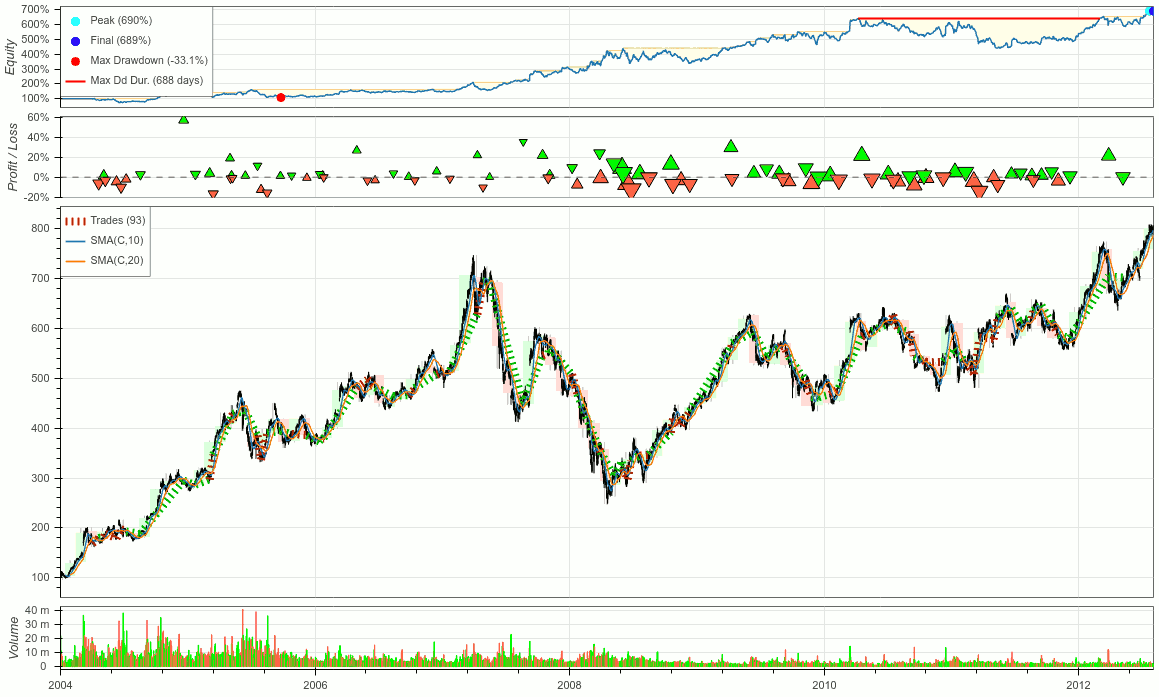
bt.plot()
Results in:
Start                     2004-08-19 00:00:00
End                       2013-03-01 00:00:00
Duration                   3116 days 00:00:00
Exposure Time [%]                       94.27
Equity Final [$]                     68935.12
Equity Peak [$]                      68991.22
Return [%]                             589.35
Buy & Hold Return [%]                  703.46
Return (Ann.) [%]                       25.42
Volatility (Ann.) [%]                   38.43
CAGR [%]                                16.80
Sharpe Ratio                             0.66
Sortino Ratio                            1.30
Calmar Ratio                             0.77
Max. Drawdown [%]                      -33.08
Avg. Drawdown [%]                       -5.58
Max. Drawdown Duration      688 days 00:00:00
Avg. Drawdown Duration       41 days 00:00:00
# Trades                                   93
Win Rate [%]                            53.76
Best Trade [%]                          57.12
Worst Trade [%]                        -16.63
Avg. Trade [%]                           1.96
Max. Trade Duration         121 days 00:00:00
Avg. Trade Duration          32 days 00:00:00
Profit Factor                            2.13
Expectancy [%]                           6.91
SQN                                      1.78
Kelly Criterion                        0.6134
_strategy              SmaCross(n1=10, n2=20)
_equity_curve                          Equ...
_trades                       Size  EntryB...
dtype: object
Find more usage examples in the documentation.
Features
- Simple, well-documented API
- Blazing fast execution
- Built-in optimizer
- Library of composable base strategies and utilities
- Indicator-library-agnostic
- Supports any financial instrument with candlestick data
- Detailed results
- Interactive visualizations
Bugs
Before reporting bugs or posting to the
discussion board,
please read contributing guidelines, particularly the section
about crafting useful bug reports and ```-fencing your code. We thank you!
Alternatives
See alternatives.md for a list of alternative Python backtesting frameworks and related packages.
1 maintainer

Metadata
1 maintainer
Release files for backtesting 0.6.1
For a detailed explanation of source distributions (sdists) and built distributions (wheels), please see the package formats documentation.
Source distribution (sdist)
| File | Size | Uploaded | Provenance | Actions |
|---|---|---|---|---|
| backtesting-0.6.1.tar.gz | 180.5 kB | Without provenance | Details for backtesting-0.6.1.tar.gz |
Built distribution (wheel)
| File | Interpreter | ABI | Platform | Actions Reset |
|---|---|---|---|---|
| backtesting-0.6.1-py3-none-any.whl | Python 3 | none | any | Details for backtesting-0.6.1-py3-none-any.whl |
Total release size: 361.2 kB
Release files / backtesting-0.6.1.tar.gz
| Download URL | backtesting-0.6.1.tar.gz |
|---|---|
| Size | 180.5 kB |
| Tags | Source |
|
SHA-256 checksum How to use checksums |
570b3d395a6c7c58a4ad3534b6b3ba69e35845f25e1e7c6f73944abd5bb554a9
|
|
BLAKE2b-256 checksum How to use checksums |
c5d4c0a8b02fe561f17d80e3e2c23ec2ac4e5f9b7b918db1a64aca0d4c4aa148
|
| Upload date | |
|
Uploaded using Trusted Publishing? What is trusted publishing? |
No |
| Uploaded via |
twine/6.0.1 CPython/3.11.2
|
Release files / backtesting-0.6.1-py3-none-any.whl
| Download URL | backtesting-0.6.1-py3-none-any.whl |
|---|---|
| Size | 180.7 kB |
| Tags | Python 3 |
|
SHA-256 checksum How to use checksums |
7d02df9610b1d0f7bfe53e2dab9453de71741ba323348dc7e2f77f0594bb8fa3
|
|
BLAKE2b-256 checksum How to use checksums |
81341e0ebe8e4e42e36bb55ef4785facc83c3507f18a26ea9411f64d74d36ea7
|
| Upload date | |
|
Uploaded using Trusted Publishing? What is trusted publishing? |
No |
| Uploaded via |
twine/6.0.1 CPython/3.11.2
|
Security for backtesting 0.6.1
Provenance
Provenance describes where a file came from. On PyPI, provenance is shared via attestations, which provide a verifiable record of the build or publishing details. View details, limitations and caveats.
No provenance found
None of the files in this release were uploaded with provenance metadata.
A note on package security
PyPI is a repository for distributing packages, not a service for auditing them. While third-party security researchers and our staff do their best to detect and remove malicious packages, PyPI cannot guarantee the quality, security or suitability of any given package.
To learn more about protecting yourself from malicious actors, visit our package security documentation.














