
GPGO - Gaussian Process GO
My own implementation of a Bayesian Black box Optimization with Gaussian Process as a surrogate model. It is still in development but it was successfully used to achieve a bottom up optimization of the Dissipative Particle Dynamics force field for a complex system of polymers chains functionalized gold nanoparticles in a water solvent.
Hyperparameters
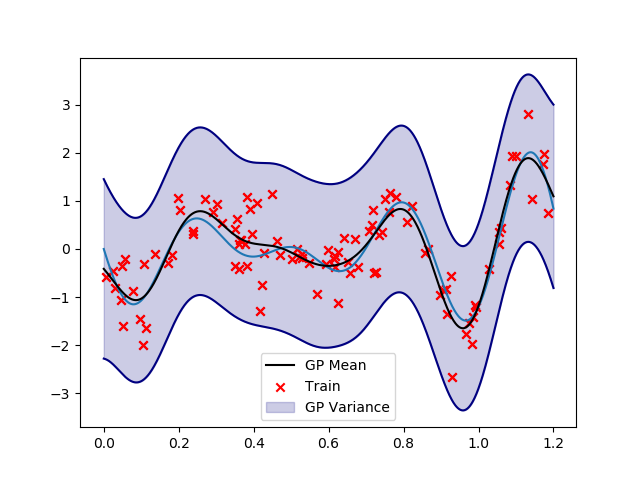
The Hyperparameters of the GP are optimized by the common technique of maximizing the Log Marginal Likelihood. In this repository this is achieved by using a search grid (although not in an efficient way) or by using the scipy optimizer module (L-BFGS-B, TNC, SLSCP). The analytical gradient is implemented for the Radial Basis Function kernel and it is possible to use the derivate of the Log Marginal Likelihood to optimize the hyperparameters.
Acquisition function
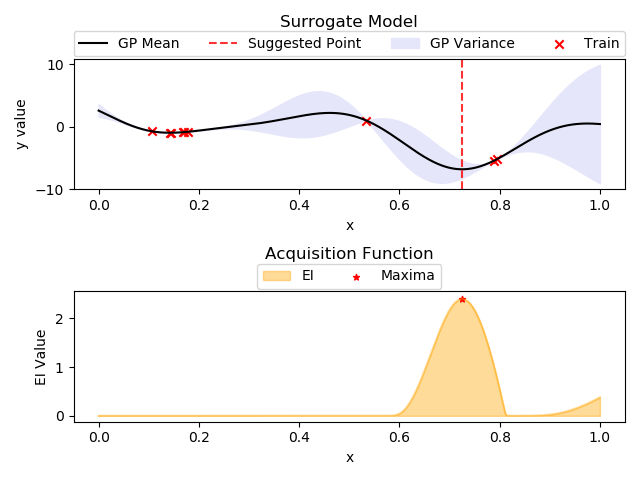
As it is there are two different acquisition function implemented right now:
-Expected Improvement (EI)
-UCB (Upper Confidence Bound)
Maximizing the Acquisition function
In this little package right now there are 3 ways to run an optimization task with Gaussian Processes:
-NAIVE : AkA sampling the acquisition function with a grid of some kind or a quasi random methods as LHS (require smt package)
-BFGS : optimize the Acquisition function by using the L-BFGS-B optimizer
-DIRECT : optimize the Acquisition function by using the DIRECT optimizer (require DIRECT python package)
-PSO : optimize the Acquisition function by a Particle Swarm Optimization genetic algorithm
Made for experiments
Easy to use it with a shell procedure! Load the data and just .suggest_location() to get the next points of your experiment!
Multi Objective
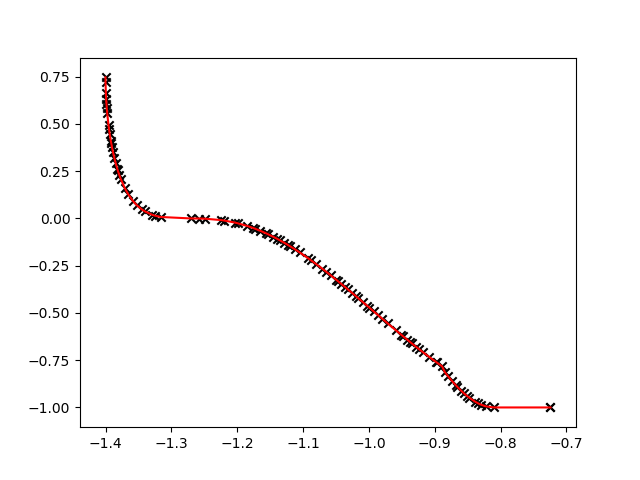
Right now the package contains an implementation of the NSGAII genetic solver that allows to solve multi objective problems. It has also an early version of a Multi Objective Bayesian optimization that uses the NSGAII and optimize the Acquisition function EI or the mean function of the GP. It will follow a more precise implementation of the Hypervolume improvement.
TODO
-Load data routines
-Good code practice maybe
-Easy routines for LAMMPS (at least DPD and BD)
1 maintainer

Metadata
1 maintainer
Release files for BayGPGO 0.3.2
For a detailed explanation of source distributions (sdists) and built distributions (wheels), please see the package formats documentation.
Source distribution (sdist)
| File | Size | Uploaded | Provenance | |
|---|---|---|---|---|
| BayGPGO-0.3.2.tar.gz | 30.9 kB | Without provenance | Details |
Release files / BayGPGO-0.3.2.tar.gz
| Download URL | BayGPGO-0.3.2.tar.gz |
|---|---|
| Size | 30.9 kB |
| Tags | Source |
|
SHA-256 checksum How to use checksums |
d1bea558896482f6770ae0bb6293e3f36b371e13e5e0eed57454c5c3422b7d0f
|
|
BLAKE2b-256 checksum How to use checksums |
00b863a4fa07aa8db0099d18fac558dbcdd94a052afd66b8b3f8fee42c920fa7
|
| Upload date | |
|
Uploaded using Trusted Publishing? What is trusted publishing? |
No |
| Uploaded via |
twine/3.2.0 pkginfo/1.5.0.1 requests/2.22.0 setuptools/45.2.0.post20200210 requests-toolbelt/0.9.1 tqdm/4.46.0 CPython/3.7.6
|
Security for BayGPGO 0.3.2
Provenance
Provenance describes where a file came from. On PyPI, provenance is shared via attestations, which provide a verifiable record of the build or publishing details. View details, limitations and caveats.
No provenance found
None of the files in this release were uploaded with provenance metadata.
A note on package security
PyPI is a repository for distributing packages, not a service for auditing them. While third-party security researchers and our staff do their best to detect and remove malicious packages, PyPI cannot guarantee the quality, security or suitability of any given package.














