
This release is a pre-release and may not be stable for production use.
python-bibtexparser v2
Welcome to python-bibtexparser, a parser for .bib files with a long history and wide adaption.
Bibtexparser is available in two versions: V1 and V2. For new projects, we recommend using v2 which, in the long run, will provide an overall more robust and faster experience. For now, however, note that v2 is an early beta, and does not contain all features of v1. Install v2 using pip:
pip install bibtexparser --pre
Or you can install the latest development version directly from the main branch:
pip install --no-cache-dir --force-reinstall git+https://github.com/sciunto-org/python-bibtexparser@main
If instead, you want to use v1, install it using:
pip install bibtexparser~=1.0
Note that all development and maintenance effort is focussed on v2. Small PRs for v1 are still accepted, but only as long as they are backwards compatible and don't introduce much additional technical debt. Development of version one happens on the dedicated v1 branch.
The remainder of this README is specific to v2.
Documentation
Go check out our documentation on https://bibtexparser.readthedocs.io/en/main/.
Advantages of V2
- 🚀 Order of magnitudes faster
- 🔧 Easily customizable parsing and writing
- 🌿 Access to raw, unparsed bibtex.
- 💩 Fault-Tolerant: Able to parse files with syntax errors
- 🀄 Massively simplified, robuster handling of de- and encoding (special chars, ...).
- ©️ Permissive MIT license
TLDR Usage Example
# Parsing a bibtex string with default values
bib_database = bibtexparser.parse_string(bibtex_string)
# Converting it back to a bibtex string, again with default values
new_bibtex_string = bibtexparser.write_string(bib_database)
Slightly more involved example:
# Lets parse some bibtex string.
bib_database = bibtexparser.parse_string(bibtex_string,
    # Middleware layers to transform parsed entries.
    # Here, we split multiple authors from each other and then extract first name, last name, ... for each
    append_middleware=[SeparateCoAuthors(), SplitNameParts()],
)

# Here you have a `bib_database` with all parsed bibtex blocks.

# Let's transform it back to a bibtex_string.
new_bibtex_string = bibtexparser.write_string(bib_database,
    # Revert aboves transfomration
    prepend_middleware=[MergeNameParts(), MergeCoAuthors()]
)
These examples really only show the bare minimum. Consult the documentation for a list of available middleware, parsing options and write-formatting options.
V2 Architecture and Terminology
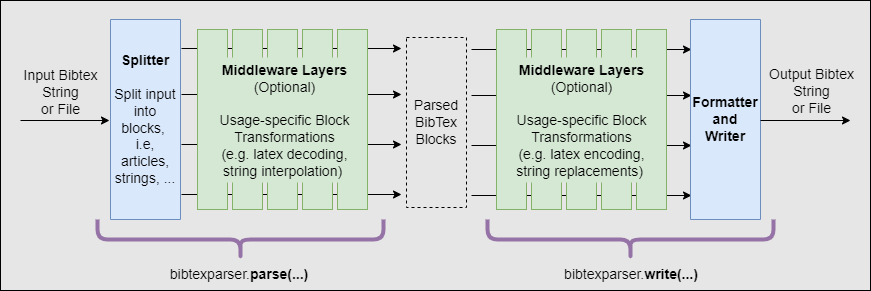
The architecture consists of the following components:
Library
Reflects the contents of a parsed bibtex files, including all comments, entries, strings, preamples and their metadata (e.g. order).
A Splitter
Splits a bibtex string into basic blocks (Entry, String, Preamble, ...), with correspondingly split content (e.g. fields on Entry, key-value on String, ...).
The splitter aims to be forgiving when facing invalid bibtex: A line starting with a block definition (@....) ends the previous block, even if not yet every bracket is closed, failing the parsing of the previous block. Correspondingly, one block type is "ParsingFailedBlock".
Middleware
Middleware layers transform a library and its blocks, for example by decoding latex special characters, interpolating string references, resoling crossreferences or re-ordering blocks. Thus, the choice of middleware allows to customize parsing and writing to ones specific usecase. Note: Middlewares, by default, no not mutate their input, but return a modified copy.
Writer
Writes the content of a bibtex library to a .bib file. Optional formatting parameters can be passed using a corresponding dedicated data structure.
About
Since 2022, bibtexparser is primarily written and maintained by Michael Weiss (@MiWeiss). In 2024, Tom de Geus (@tdegeus) joined as co-maintainer.
Credits and thanks to the many contributors who helped creating this library, including François Boulogne (@sciunto, creator of the first version) and Olivier Mangin (@omangin, long-term contributor).


Release files for bibtexparser 2.0.0b8
For a detailed explanation of source distributions (sdists) and built distributions (wheels), please see the package formats documentation.
Source distribution (sdist)
| File | Size | Uploaded | Provenance | |
|---|---|---|---|---|
| bibtexparser-2.0.0b8.tar.gz | 37.7 kB | Without provenance | Details |
Built distribution (wheel)
| File | Interpreter | ABI | Platform | Reset |
|---|---|---|---|---|
| bibtexparser-2.0.0b8-py3-none-any.whl | Python 3 | none | any | Details |
Total release size: 77.4 kB
Release files / bibtexparser-2.0.0b8.tar.gz
| Download URL | bibtexparser-2.0.0b8.tar.gz |
|---|---|
| Size | 37.7 kB |
| Tags | Source |
|
SHA-256 checksum How to use checksums |
11eaaa1fe80154f70092e91fa7e3fed5e5c81021f6c6c09151e36b8533f36994
|
|
BLAKE2b-256 checksum How to use checksums |
a3b6967e030d0f8359b912a64ce7447db485064862a4d3980cac07b398bc95be
|
| Upload date | |
|
Uploaded using Trusted Publishing? What is trusted publishing? |
No |
| Uploaded via |
twine/5.1.1 CPython/3.12.7
|
Release files / bibtexparser-2.0.0b8-py3-none-any.whl
| Download URL | bibtexparser-2.0.0b8-py3-none-any.whl |
|---|---|
| Size | 39.6 kB |
| Tags | Python 3 |
|
SHA-256 checksum How to use checksums |
eda1e6dbc7bbc040d351c926ead97a36f4734858656f3514a933259878bd37f1
|
|
BLAKE2b-256 checksum How to use checksums |
cb4e226cfbf6c61c38399fc19e5f46db755ffea32f77ef078982c953031c8a3c
|
| Upload date | |
|
Uploaded using Trusted Publishing? What is trusted publishing? |
No |
| Uploaded via |
twine/5.1.1 CPython/3.12.7
|
Security for bibtexparser 2.0.0b8
Provenance
Provenance describes where a file came from. On PyPI, provenance is shared via attestations, which provide a verifiable record of the build or publishing details. View details, limitations and caveats.
No provenance found
None of the files in this release were uploaded with provenance metadata.
A note on package security
PyPI is a repository for distributing packages, not a service for auditing them. While third-party security researchers and our staff do their best to detect and remove malicious packages, PyPI cannot guarantee the quality, security or suitability of any given package.
To learn more about protecting yourself from malicious actors, visit our package security documentation.














