
boyle
Run the model you want at the memory pressure you specify.
Declare a memory budget; boyle runs mixture-of-experts models inside it on Apple silicon — including models far larger than RAM — with decode outputs bit-identical to the fully-resident model, a speed forecast before you download anything, and an OpenAI- and Ollama-compatible server your existing tools connect to.
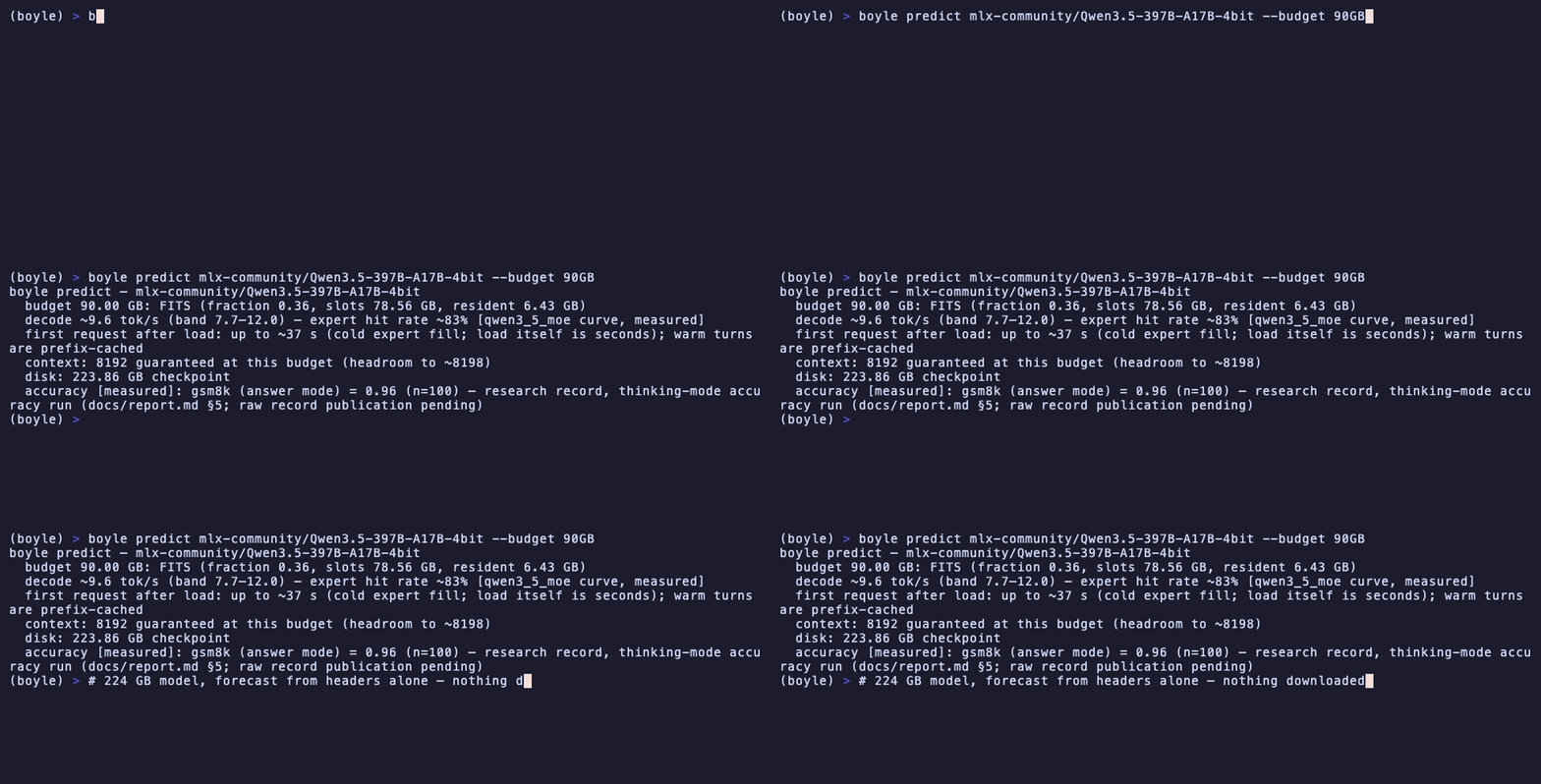
boyle predict mlx-community/Qwen3.5-397B-A17B-4bit --budget 90GB   # before downloading
boyle serve   mlx-community/Qwen3-30B-A3B-Instruct-2507-4bit --budget 12GB
Named for Robert Boyle: PV = k. What you trade for pressure here is speed, and the exchange rate is measured.
Status: v0.1. Working today:
predict,run,serve,bench,build. Landing in v0.2:trace(routing capture that adds unmeasured families topredict's curves and orders stores by co-activation).
What a budget buys you — measured on real hardware
Two machines: an M5 Max (128 GB) and a 2021 M1 Pro MacBook Pro (32 GB) —
the second bought nothing but a git clone, a forecast, and a bench
that landed 1.4% from it.
| model | on disk | budget | decode | how verified |
|---|---|---|---|---|
| Qwen3-30B-A3B-4bit | 17 GB | 12 GB | ~18 tok/s | real OpenCode session; warm agent turn 3.3 s (cold 28.7 s) |
| Qwen3-30B-A3B-4bit, 2021 M1 Pro 32 GB | 17 GB | 12 GB | 14.5 tok/s | bench vs a forecast made before the machine was ever measured: predicted 14.7 — off by 1.4%. At 20 GB: 17.5 vs 19.3 predicted, in band |
| Qwen3-235B-A22B-4bit | 132 GB | 70 GB | 11.7 tok/s | bench, within the pre-run forecast band (12.5 ± 25%) |
| Qwen3-235B-A22B-4bit | 132 GB | 90 GB | ~15.5 tok/s | research-record anchor |
| Qwen3.5-397B-A17B-4bit | 224 GB | 90 GB | 7.2 tok/s | live agent tool-exchange behind serve; load 1.5 s; forecast band 7.6–11.9 |
Decode is bit-identical to the resident model at any budget (asserted token-by-token in the test suite); over-capacity prefill is rounding-equivalent (same math, different batching — text has matched resident output on every model measured). Accuracy is therefore a property of the model, not the budget: an exact-offload 397B at 90 GB scored 0.96 on gsm8k (n=100) because that is what the model scores.
The load time is real: boyle wraps expert layers before weights
materialize, so a 224 GB checkpoint is serving requests ~2 seconds after
you hit enter — the first request then pays the expert fill (~35 s on the
397B; forecast up front by predict).
predict — know before you download
$ boyle predict mlx-community/Qwen3.5-397B-A17B-4bit --budget 90GB --max-context 16384
boyle predict — mlx-community/Qwen3.5-397B-A17B-4bit
  budget 90.00 GB: FITS (fraction 0.36, slots 77.29 GB, resident 6.43 GB)
  decode ~9.5 tok/s (band 7.6–11.9) — expert hit rate ~83% [qwen3_5_moe curve, measured]
  first request after load: up to ~37 s (cold expert fill; load itself is seconds)
  context: 16384 guaranteed at this budget (headroom to ~18566)
  disk: 223.86 GB checkpoint
  accuracy [measured]: gsm8k (answer mode) = 0.96 (n=100)
Reads only the checkpoint headers (a few hundred KB over ranged HTTP —
never the weights), resolves your budget against exact tensor shapes,
applies a routing curve distilled from measured traces, and calibrates to
your disk with a one-time cold-read probe. boyle bench then measures the
truth on your machine and tells you whether it landed in the band —
the 235B row above is exactly that loop, closed at a fraction nobody had
measured before.
Forecasts are honest about their provenance: measured family curve vs flat-routing prior, compute anchor vs I/O-only upper bound — the output says which you're getting. Accuracy is never forecast; the accuracy line is lookup into measured rows, or silence.
The rest of the CLI
run — one-shot or scripted generation, with the honest footer:
$ boyle run mlx-community/Qwen3-30B-A3B-Instruct-2507-4bit --budget 12GB \
    -p "In one sentence: what does a hash table do?" --max-tokens 40
[boyle] fraction=0.387 slots=6.24 GB max_context=8192
A hash table stores key-value pairs and uses a hash function to quickly map
keys to indices in an array, enabling fast data retrieval. [...]
[boyle] 40 tokens in 1.8s (21.8 tok/s) — expert cache hit rate 78.9%
bench — the trust loop, measured on this machine vs the forecast
(output below is the real run from a 2021 M1 Pro 32 GB):
$ boyle bench mlx-community/Qwen3-30B-A3B-Instruct-2507-4bit --budget 12GB
[bench] predicted 14.7 tok/s (band 11.8–18.4); loading...
[bench] measured 14.5 tok/s steady (TTFT 2.8s, hit rate 87.3%) — WITHIN the predicted band 11.8–18.4
build — a colocated expert store: one contiguous read per cache miss
instead of nine scattered ones (+13% on the measured serving ceiling;
outputs verified token-identical to direct checkpoint reads):
$ boyle build mlx-community/Qwen3-30B-A3B-Instruct-2507-4bit
[build] layer 48/48: 16.3 GB written
[build] colo store: 16.31 GB -> ~/.cache/boyle/stores/mlx-community--Qwen3-30B-A3B-Instruct-2507-4bit
$ boyle serve mlx-community/Qwen3-30B-A3B-Instruct-2507-4bit --budget 12GB --colo ~/.cache/boyle/stores/...
Stacked checkpoints only (Qwen, gemma lineage); per-expert-scheme checkpoints (OLMoE) are read directly by the runtime and need no store.
Works with your tools
boyle serve exposes two API surfaces from one model: OpenAI-compatible
(/v1, SSE streaming, tool calls) and Ollama-compatible (/api/*, NDJSON,
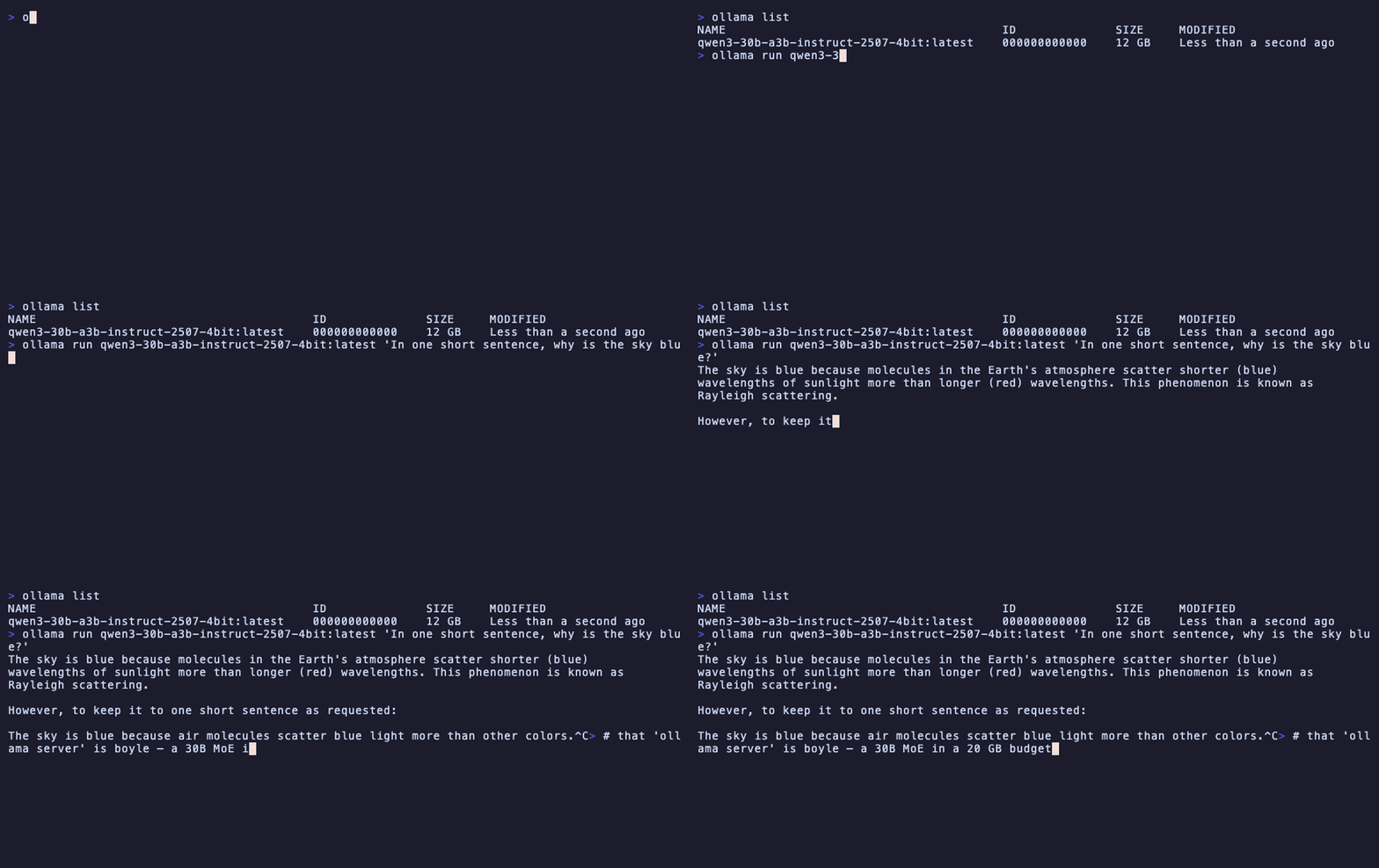
real timing fields so UIs show true tok/s). It binds port 11434 when free,
so Ollama-first apps discover it with zero config; if a real Ollama is
running it politely falls back and prints the URL.
| harness | connect via | config |
|---|---|---|
| Ollama CLI & Python library | native | zero config — ollama list/ps/show/run and ollama.chat(...) (incl. tools) verified against boyle |
| OpenCode | OpenAI-compatible | provider block below |
| Cline / Continue (VS Code) | OpenAI-compatible | base URL http://127.0.0.1:11434/v1, any API key |
| Open WebUI | Ollama connector | zero config when boyle holds port 11434 |
| SillyTavern | Custom OpenAI | API URL http://127.0.0.1:11434/v1 |
| aider, Zed, Goose, LibreChat, LangChain, … | OpenAI-compatible | same base URL |
OpenCode (~/.config/opencode/opencode.json):
{
  "provider": {
    "boyle": {
      "npm": "@ai-sdk/openai-compatible",
      "name": "boyle (local)",
      "options": { "baseURL": "http://127.0.0.1:11434/v1" },
      "models": {
        "mlx-community/Qwen3-30B-A3B-Instruct-2507-4bit": {
          "name": "Qwen3-30B via boyle",
          "limit": { "context": 32768, "output": 4096 }
        }
      }
    }
  }
}
Tool calls are parsed for the Qwen family — both dialects (Qwen3 hermes JSON and Qwen3.5/Coder XML blocks); other families stream text through untouched, and the matrix below says which is which. Conversations are prefix-cached, aligned against the chat template's own history rendering: an agent's warm turns re-prefill only the new suffix.
Support matrix
| tier | models | tool calls | prefix cache |
|---|---|---|---|
| measured | Qwen3-30B/235B (4/8-bit), Qwen3.5-397B (4-bit), gemma-4-26B MoE, OLMoE | Qwen: parsed | full |
| measured, hybrid-cache | Qwen3.5 family | parsed | warm within a user turn; each new user turn re-prefills once (~35 s at 397B) — hybrid attention caches cannot rewind |
| expected-works | other Qwen3-MoE-family variants | parsed | full |
| experimental | GLM-4.x/5.x MoE | passthrough | blocked on upstream mlx-lm support |
| out of scope (v1) | dense models, CUDA/Linux, multi-user batching |
Untested models are announced, not undefined: serve probes every model
at startup (template roundtrip, cache rewindability) and tells you which
prefix-cache class you're getting; predict labels measured curves vs
priors. The exact tested list, what "tested" means, and the one-command
qualification procedure for new releases live in
COMPATIBILITY.md — new notable MoE releases get
qualified promptly, and a release needing code (new tool dialect, new
cache type) gets a tracking issue.
Honest limits
- Single-stream by design. Diverse-prompt batching is drive-bound (~9.5 tok/s aggregate regardless of batch size — measured); concurrency would move latency around, not create throughput. Requests queue FIFO.
- The speed floor is architectural: per-layer expert residency requires a sync per MoE layer per token (~50 ms/token at 397B scale). Polling, event tricks, and speculative decoding were measured and lost — the research record has the receipts.
- Small-expert models (records under ~2 MB, e.g. OLMoE) are per-read
latency-bound; forecasts there are upper bounds, and
predictsays so. - Capture-quality quantization matters: 4-bit is the measured sweet spot;
the cliff to 3-bit is severe on some tasks (see the accuracy notes
predictprints).
Why it works — the 30-second version
Expert routing is flat: across three model families there is no hot set — LFU loses to LRU everywhere, and a clairvoyant cache beats LRU by 0.07 hit rate. That kills clever prefetching, but it makes speed a function of two numbers only: budget fraction (via one reusable hit curve) and bytes per miss. That is why a forecast from checkpoint headers plus a 10-second disk probe lands within a ±25% band, and why the levers that survived measurement are exactly three: direct I/O with parallel installs, a colocated expert store, and expert-major prefill. The full research record — every lever tried, every dead end, every number — is in docs/report.md.
Lineage
The runtime descends from the expert-offload patch developed for omlx (PR #2595, Apache-2.0 — see NOTICE), by way of a measurement program whose adopted levers this package ships. Related upstream work: mlx PR #4249 (GPU-visible mmap weights), mlx issue #2878.
License
Apache-2.0. Portions derive from omlx — see NOTICE.
1 maintainer

Metadata
1 maintainer
Release files for boyle 0.1.0
For a detailed explanation of source distributions (sdists) and built distributions (wheels), please see the package formats documentation.
Source distribution (sdist)
| File | Size | Uploaded | |
|---|---|---|---|
| boyle-0.1.0.tar.gz | 386.4 kB | Details |
Built distribution (wheel)
| File | Interpreter | ABI | Platform | Reset |
|---|---|---|---|---|
| boyle-0.1.0-py3-none-any.whl | Python 3 | none | any | Details |
Total release size: 440.5 kB
Release files / boyle-0.1.0.tar.gz
| Download URL | boyle-0.1.0.tar.gz |
|---|---|
| Size | 386.4 kB |
| Tags | Source |
|
SHA-256 checksum How to use checksums |
52584a2f0a08897e7342df86d93041b18a4236eba295e5c28ebf72d89a62b52f
|
|
BLAKE2b-256 checksum How to use checksums |
ba44d31b207df58f67a481d9587100fbeb58096d46ca7086582d4e5465cb0b70
|
| Upload date | |
|
Uploaded using Trusted Publishing? What is trusted publishing? |
Yes |
| Uploaded via |
twine/7.0.0 CPython/3.13.14
|
Provenance
Provenance describes where a file came from. On PyPI, provenance is shared via attestations, which provide a verifiable record of the build or publishing details. View details, limitations and caveats.


PyPI Publish Attestation
PyPI verified that this artifact, at this checksum, originated from the publisher listed below.
Signed by GitHub Actions, verified by PyPI on Aug 16, 2026.
Transparency logRelease files / boyle-0.1.0-py3-none-any.whl
| Download URL | boyle-0.1.0-py3-none-any.whl |
|---|---|
| Size | 54.1 kB |
| Tags | Python 3 |
|
SHA-256 checksum How to use checksums |
46ab4bfe28ac2e639e4f2907374653a6238787fe90322e5901447ba17830bcf6
|
|
BLAKE2b-256 checksum How to use checksums |
0f68b65ebfd869b98e3df654a35977cc78279e2bcc79224dd1d80c4e64f3b67b
|
| Upload date | |
|
Uploaded using Trusted Publishing? What is trusted publishing? |
Yes |
| Uploaded via |
twine/7.0.0 CPython/3.13.14
|
Provenance
Provenance describes where a file came from. On PyPI, provenance is shared via attestations, which provide a verifiable record of the build or publishing details. View details, limitations and caveats.
PyPI Publish Attestation
PyPI verified that this artifact, at this checksum, originated from the publisher listed below.
Signed by GitHub Actions, verified by PyPI on Aug 16, 2026.
Transparency log












