
CAUSTIC
Conformation-Aware Uncertainty and Shift predicTion from proteIn Conformer ensembles
Predicts protein backbone NMR chemical shifts (H, HA, N, CA, CB, C') with per-residue uncertainties from a PDB, mmCIF or AlphaFold structure. A 741,024-parameter PaiNN equivariant graph neural network, trained on 3,433 BMRB-linked experimental structures with carbon-aggressive label-noise cleaning; NMR ensembles are predicted as the median over conformers.



Try it in your browser — no install needed.
Install
pip install caustic-nmr
Python ≥ 3.10; Linux, macOS and Windows. The model weights and calibrator are inside the package — nothing is downloaded at run time. PyTorch is a dependency (graph construction uses it; inference itself runs on ONNX Runtime).
60-second example
caustic --version                      # package version, model SHA-256, calibrator
caustic 1ubq.pdb                       # writes 1ubq.nef next to the input
caustic 1ubq.pdb --format csv -o 1ubq_shifts.csv
caustic AF-P01112-F1-model_v6.cif      # AlphaFold model: pLDDT read from the B-factor column
caustic ensemble.pdb --ensemble median # NMR ensemble: median over conformers (default)
from caustic import predict_shifts_onnx
from importlib.resources import files

result = predict_shifts_onnx("1ubq.pdb", str(files("caustic.data") / "best_v2_carbons.onnx"))
result.mean["CA"]        # CA shifts (ppm), one per residue
result.std["CA"]         # per-residue sigma (ppm)
result.residue_names     # ['MET', 'GLN', 'ILE', ...]
result.provenance        # package version, model SHA-256, calibrator, date
Every output file carries the same provenance stamp in its header:
# caustic-nmr 0.4.0 model=best_v2_carbons.onnx sha256=ebc7bbc2fc59 calibrator=sa16_v2_carbons_slim date=2026-08-30T16:27:19Z
Inputs and outputs for ubiquitin and an AlphaFold model are in examples/.
Accuracy
Measured through this exact package (the released wheel, bundled weights, default settings) on the 735-protein held-out test split, against SPARTA+ 2.90, LEGOLAS and UCBShift2 in full mode (transfer module on), paired per residue:
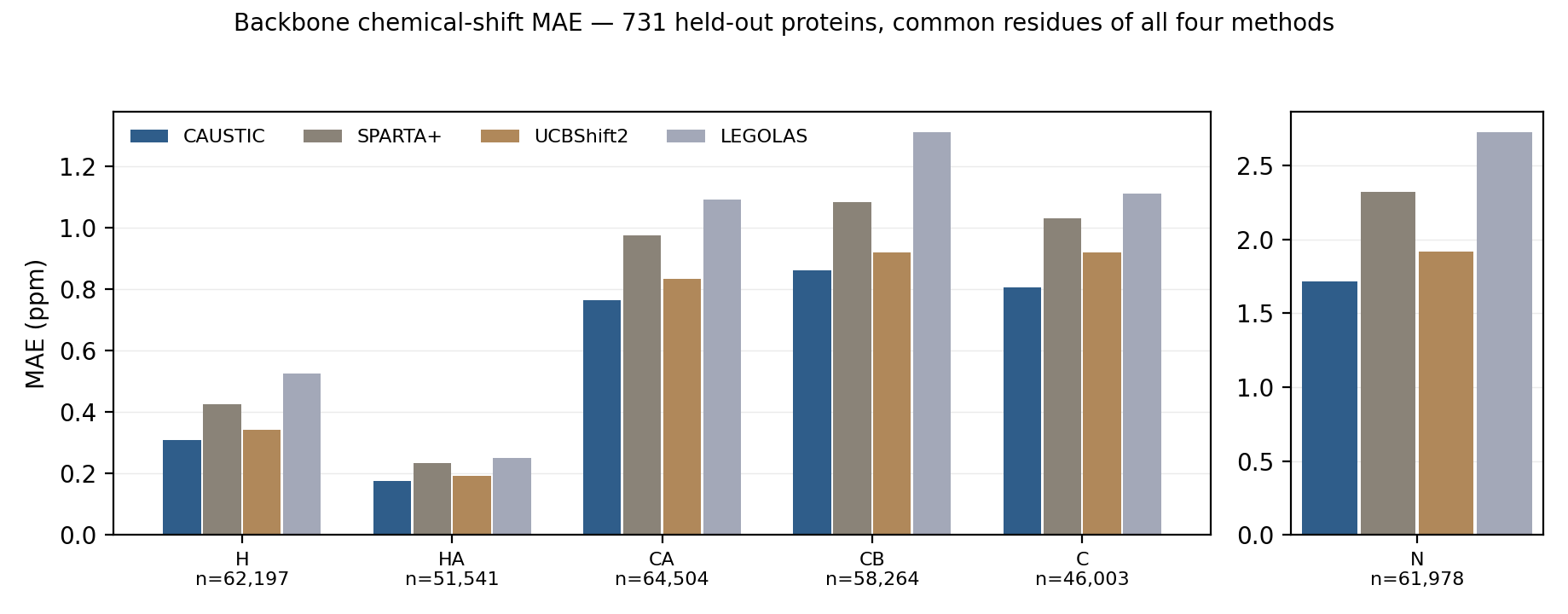
| Nucleus (n residues) | CAUSTIC | SPARTA+ | LEGOLAS | UCBShift2 |
|---|---|---|---|---|
| H (62,197) | 0.309 | 0.426 | 0.525 | 0.343 |
| HA (51,541) | 0.175 | 0.233 | 0.251 | 0.192 |
| N (61,978) | 1.713 | 2.321 | 2.727 | 1.918 |
| CA (64,504) | 0.764 | 0.975 | 1.091 | 0.834 |
| CB (58,264) | 0.860 | 1.082 | 1.311 | 0.920 |
| C (46,003) | 0.804 | 1.029 | 1.109 | 0.919 |
MAE in ppm on the 344,487 residues all four methods predicted (731 proteins). Per-protein
composite, paired, with protein-level bootstrap CIs (Δ in ppm): −25.9 % vs SPARTA+
(Δ −0.276 [−0.318, −0.243]), −35.3 % vs LEGOLAS (Δ −0.429 [−0.450, −0.412]),
−11.5 % vs full UCBShift2 (Δ −0.102 [−0.127, −0.083]) — every per-nucleus CI
excludes zero. 67 of 693 test structures are
in UCBShift2's own reference database (where its transfer module excels); they are
included, so the UCBShift2 comparison is conservative against CAUSTIC. Protocol,
competitor versions, crash accounting and the fairness slices:
docs/BENCHMARKS.md; regenerate everything with
python benchmarks/rescore.py --bootstrap 2000.
Where the details are
| Question | Document |
|---|---|
| How does the model work, how was it trained? | docs/METHOD.md |
| What data, what split, what licences? | docs/DATA.md |
| How were the numbers above measured, against which versions of which tools? | docs/BENCHMARKS.md |
| What does it not do? | docs/LIMITATIONS.md |
| Regenerate every table from the per-residue results | benchmarks/README.md |
| One protein end to end | benchmarks/WALKTHROUGH.md |
| What changed between versions | CHANGELOG.md |
Output formats
| Format | Flag | For |
|---|---|---|
| NEF 1.1 (default) | --format nef |
CCPN Analysis v3 and other NEF-aware software |
| NMR-STAR 3.x | --format star |
BMRB deposition |
| CSV | --format csv |
pandas / spreadsheets (pd.read_csv(path, comment="#")) |
| JSON | --format json |
programmatic use (provenance object included) |
Things to know
- One chain per call (
--chain); other chains, ligands and waters are not in the graph. - Missing backbone H/HA are synthesised from geometry (X-ray and AlphaFold inputs).
- Thirty non-standard residue names (MSE, HYP, SEP, TPO, PTR, CSO, PCA, …) are mapped to their parent residue; the modification itself is invisible to the model.
- Temperature is fixed at 298 K at inference; pH is not an input.
- σ comes from the network's uncertainty head; there is no pLDDT-dependent widening and no post-hoc isotonic calibration. See LIMITATIONS.md §4–5.
- The shipped model is ONNX-only; the
--backend torchpath cannot load it (CHANGELOG, Known issues).
Licence
Code: MIT. Model weights and calibrator (caustic/data/):
CC BY 4.0 — attribution CAUSTIC model weights, Maximilian Zinke, 2026,
https://github.com/maxzinke/caustic-nmr. Training data come from the BMRB and the wwPDB;
no BMRB records are redistributed (DATA.md §6).
Citation
Zinke, M. CAUSTIC: conformation-aware uncertainty and shift prediction from protein conformer ensembles. Zenodo. https://doi.org/10.5281/zenodo.22213167
That is the concept DOI — it always resolves to the latest version. Each release also has its own version DOI, shown on the Zenodo record. Machine-readable metadata is in CITATION.cff, which GitHub's "Cite this repository" button renders.
1 maintainer

Metadata
1 maintainer
Release files for caustic-nmr 0.4.1
For a detailed explanation of source distributions (sdists) and built distributions (wheels), please see the package formats documentation.
Source distribution (sdist)
| File | Size | Uploaded | Provenance | Actions |
|---|---|---|---|---|
| caustic_nmr-0.4.1.tar.gz | 3.0 MB | Without provenance | Details for caustic_nmr-0.4.1.tar.gz |
Built distribution (wheel)
| File | Interpreter | ABI | Platform | Actions Reset |
|---|---|---|---|---|
| caustic_nmr-0.4.1-py3-none-any.whl | Python 3 | none | any | Details for caustic_nmr-0.4.1-py3-none-any.whl |
Total release size: 5.9 MB
Release files / caustic_nmr-0.4.1.tar.gz
| Download URL | caustic_nmr-0.4.1.tar.gz |
|---|---|
| Size | 3.0 MB |
| Tags | Source |
|
SHA-256 checksum How to use checksums |
19e20f50e64be17ba6eb8163f6461d1f8065d0de6d28dd8c9ee57a84b8877417
|
|
BLAKE2b-256 checksum How to use checksums |
bc62485598163f66aafabada770715a0f472b1c4b022c6364525302314d13fbc
|
| Upload date | |
|
Uploaded using Trusted Publishing? What is trusted publishing? |
No |
| Uploaded via |
twine/7.0.0 CPython/3.13.3
|
Release files / caustic_nmr-0.4.1-py3-none-any.whl
| Download URL | caustic_nmr-0.4.1-py3-none-any.whl |
|---|---|
| Size | 2.9 MB |
| Tags | Python 3 |
|
SHA-256 checksum How to use checksums |
0c0feeca008ca6da738e1653590c518583938a104207c828301f1652847b8bbb
|
|
BLAKE2b-256 checksum How to use checksums |
2a182d7e2566810bc946346b0d3dc2f3035db390a8fbad1c0818909f4ed09f0f
|
| Upload date | |
|
Uploaded using Trusted Publishing? What is trusted publishing? |
No |
| Uploaded via |
twine/7.0.0 CPython/3.13.3
|
Security for caustic-nmr 0.4.1
Provenance
Provenance describes where a file came from. On PyPI, provenance is shared via attestations, which provide a verifiable record of the build or publishing details. View details, limitations and caveats.
No provenance found
None of the files in this release were uploaded with provenance metadata.
A note on package security
PyPI is a repository for distributing packages, not a service for auditing them. While third-party security researchers and our staff do their best to detect and remove malicious packages, PyPI cannot guarantee the quality, security or suitability of any given package.
To learn more about protecting yourself from malicious actors, visit our package security documentation.














