
Microblogging for Plone
collective.kwetter provides a Plone-integrated frontend for the kwetter microblogging engine.
The goal of collective.kwetter + kwetter is to provide Twitter-like microblogging capabilities inside of Plone.
Status
Initial prototype release.
Currently all users get all messages from all users.
Follow/Unfollow functionality is present in the backend but not yet exposed in collective.kwetter.
TODO:
full dashboard
follow/unfollow
@attribution and #hashtag linking
Plone Member profile integration
etc…
Installation
Installation is two-part.
1. Plone
Just depend in your buildout on the egg collective.kwetter.
Install it as an addon in Plone control-panel or portal_setup.
Reference target is Plone4, untested in Plone3.
Collective.kwetter itself contains a minimal plone4 buildout configuration so you can quickly test and evaluate it.
An example minimal Plone4 buildout configuration with collective.kwetter:
[buildout]
parts = instance
extends = http://dist.plone.org/release/4.0-latest/versions.cfg
find-links =
    http://dist.repoze.org/

[instance]
recipe = plone.recipe.zope2instance
eggs =
    PIL
    collective.kwetter

zcml =
    collective.kwetter
2. Kwetter backend
Use the kwetter buildout.
This will install and run the various kwetter backend daemons.
Note that this is not a Plone buildout, but a separate standalone buildout.
Architecture
As a Plone developer, you can use the kwetter backend as a ‘black box’ by just using the JSON API.
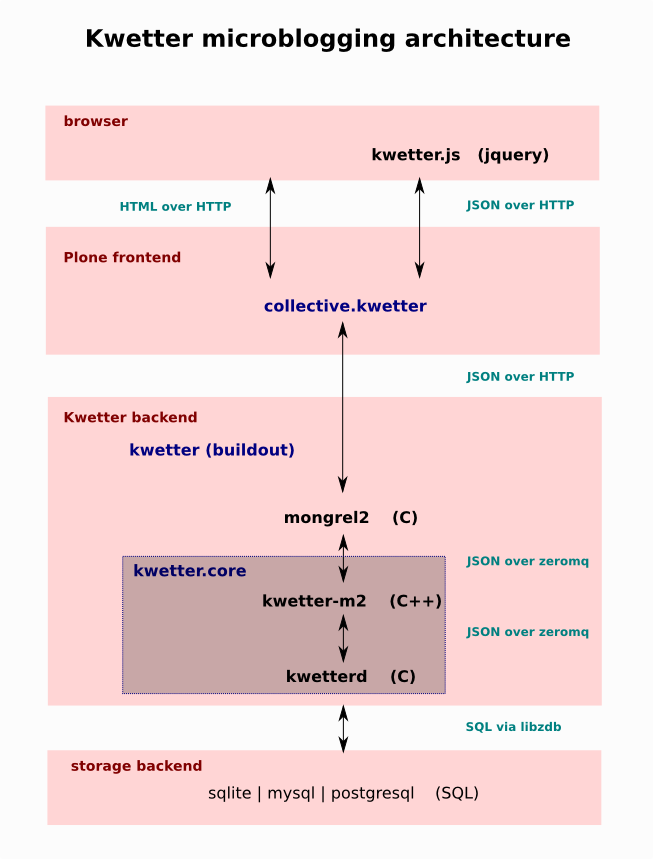
The kwetter system consists of the following components:
collective.kwetter. The Plone frontend, which contains: - kwetter.js AJAX browser component - Plone integration and view logic - backend gateway client
kwetter backend. Buildout-driven installer for the kwetter backend. This installs: - mongrel2 - kwetter.core
kwetter.core. The actual messaging backend logic. This runs: - kwetter-m2 mongrel request handler - kwetterd message routing and storage
Collective.kwetter communicates with JSON over HTTP with both the web browser and with the kwetter backend.
The various kwetter backend components communicate with JSON over ZeroMQ.
Source Code and Contributions
Contributions are welcome. The source is hosted on github collective.
You can clone it or get access to the github-collective and work directly on the project.
Maintainers of collective.kwetter are Guido Stevens and Paul Stevens. We appreciate any contribution and if a release is needed to be done on pypi, please just contact one of us.
Contributors
Paul Stevens <paul@nfg.nl>
Guido Stevens <guido.stevens@cosent.net>
1 maintainer

Metadata
1 maintainer
Release files for collective.kwetter 0.1.1
For a detailed explanation of source distributions (sdists) and built distributions (wheels), please see the package formats documentation.
Source distribution (sdist)
| File | Size | Uploaded | |
|---|---|---|---|
| collective.kwetter-0.1.1.zip | 104.6 kB | Details |
Release files / collective.kwetter-0.1.1.zip
| Download URL | collective.kwetter-0.1.1.zip |
|---|---|
| Size | 104.6 kB |
| Tags | Source |
|
SHA-256 checksum How to use checksums |
cd3f52dd209211f53ee86d94379e9f8bbd06cf010755929bd1a7ad7f38635dd6
|
|
BLAKE2b-256 checksum How to use checksums |
802a0481342b5f54050c08e3b6af9e7b61c76c5bdcac2ed3a4de3f8c4d75115b
|
| Upload date | |
|
Uploaded using Trusted Publishing? What is trusted publishing? |
No |














