
This release is a pre-release and may not be stable for production use.
Twitter Widget Portlet
Life, the Universe, and Everything
This portlet allows you to easily embed and customise JavaScript-based Twitter widgets into your Plone site.
To read and understand more about such widgets, and to create your own, visit https://twitter.com/settings/widgets.
Mostly Harmless


Got an idea? Found a bug? Let us know by opening a support ticket.
Don’t Panic
Installation
To enable this package in a buildout-based installation:
Edit your buildout.cfg and add add the following to it:
[buildout]
...
eggs =
    collective.portlet.twitter
After updating the configuration you need to run ‘’bin/buildout’’, which will take care of updating your system.
Go to the ‘Site Setup’ page in a Plone site and click on the ‘Add-ons’ link.
Check the box next to collective.portlet.twitter and click the ‘Activate’ button.
Usage
Create twitter widget:
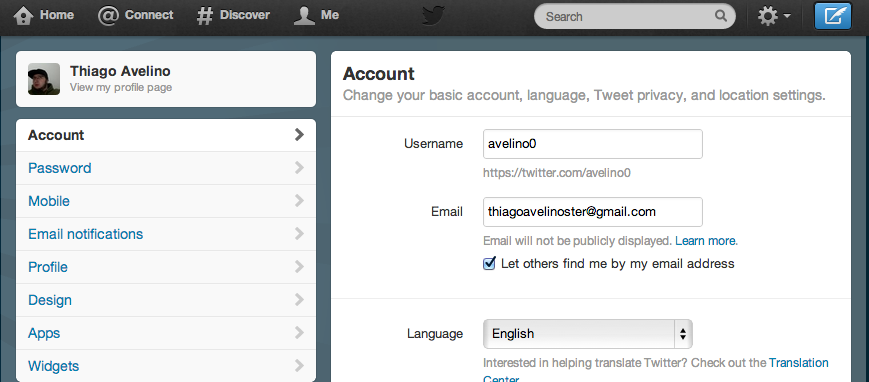
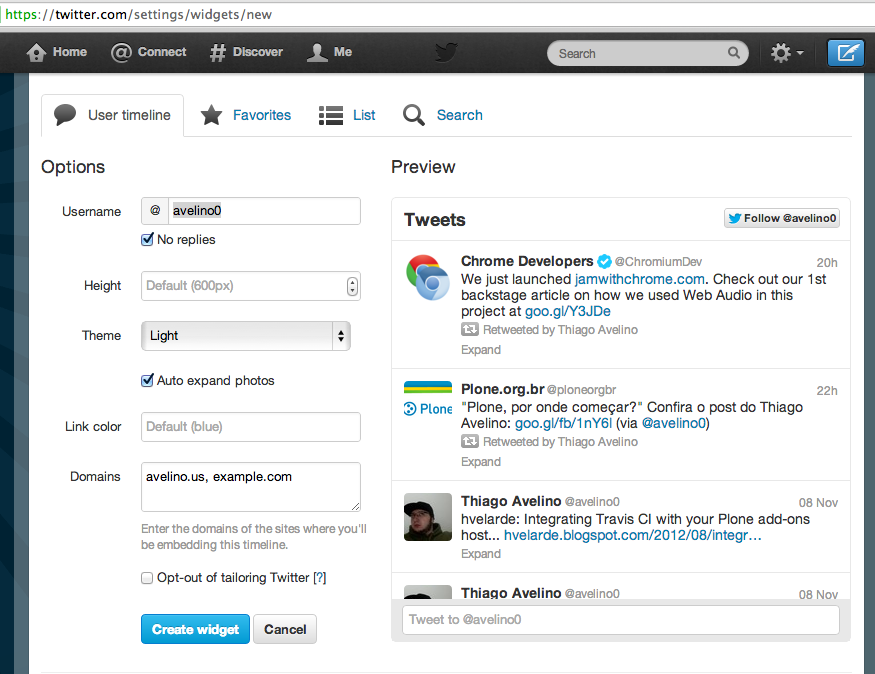
Configure widget:
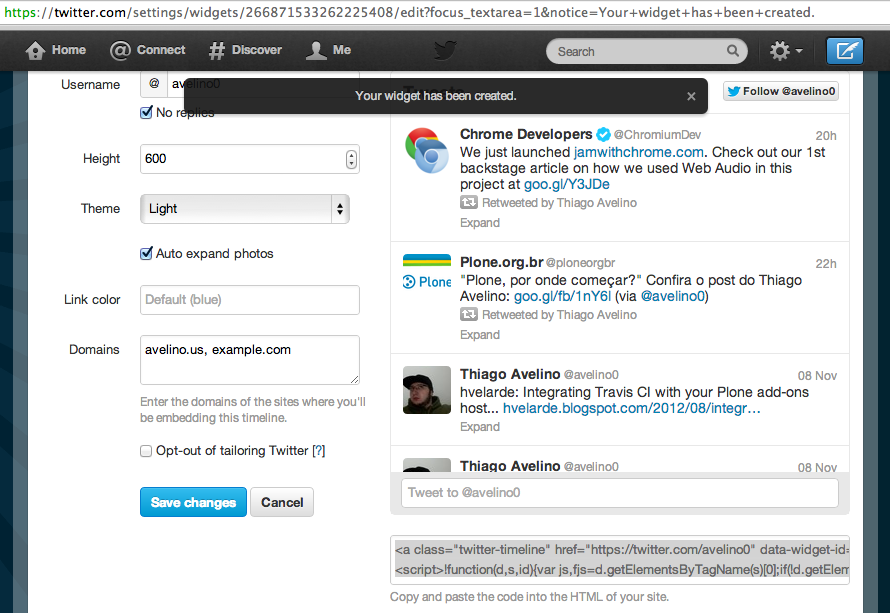
Saved:
Get widget id:
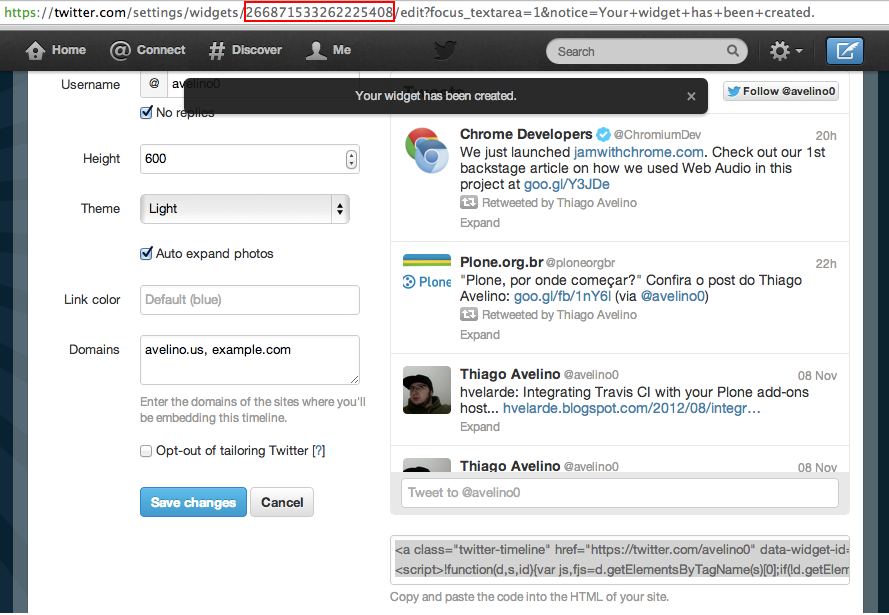
Add your widget ID into the Data Widget ID field as follows:
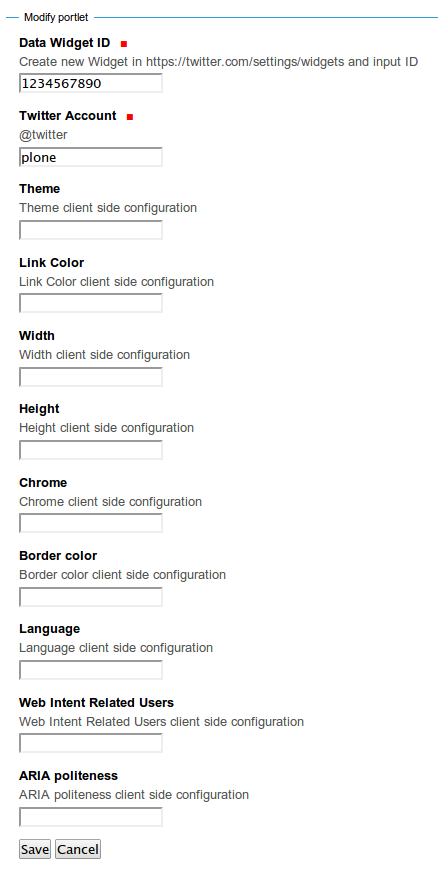
For more information on the variety of client-side options (such as theme, link color, width, height, and so forth) that can be configured within this portlet’s settings, see Twitter’s development documentation at https://dev.twitter.com/docs/embedded-timelines#customization.
Make any customisations you’d like and click Save.
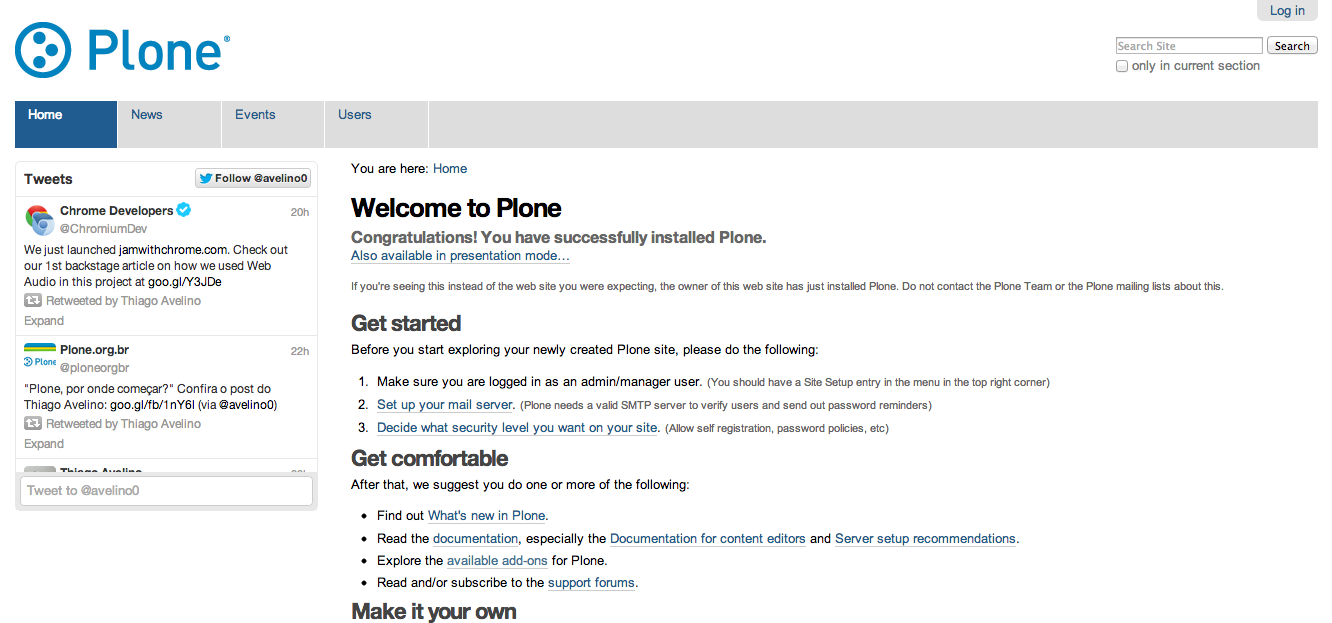
That’s it!
Changelog
There’s a frood who really knows where his towel is.
1.0rc1 (2014-09-10)
Add Brazilian Portuguese and Spanish translations. [hvelarde]
Fix issue with escaping non-basestring values [enkidulan]
1.0b3 (2013-10-09)
Fix package distribution; we are not including anymore the screenshots used in the documentation reducing significatively the egg size. [hvelarde]
Fix potential XSS (arbitrary injection) issue by escaping and quoting all attributes being set on the rendered portlet. [davidjb]
1.0b2 (2013-06-28)
Fix specifying the data-related attribute without a value. [davidjb]
Add ability to customise portlet header text and ability to show just the Twitter widget (omit border). [davidjb]
Link portlet title to the user’s Twitter timeline. [davidjb]
Update descriptions for Twitter client configuration to be end-user readable and add examples. [davidjb]
Add tweet-limit client-side configuration option to control the number of tweets displayed. [davidjb]
Add titles and descriptions to the portlet add and edit pages. [davidjb]
Remove tal:attributes specification from Twitter link in portlet page template. This is already handled by the HTML tag creation code, and lead to rendering failure in some cases (see https://bugs.launchpad.net/zope2/+bug/1004588). [davidjb]
1.0b1 (2013-04-24)
Initial release.
3 maintainers


Metadata
3 maintainers
Release files for collective.portlet.twitter 1.0rc1
For a detailed explanation of source distributions (sdists) and built distributions (wheels), please see the package formats documentation.
Source distribution (sdist)
| File | Size | Uploaded | Provenance | Actions |
|---|---|---|---|---|
| collective.portlet.twitter-1.0rc1.zip | 1.0 MB | Without provenance | Details for collective.portlet.twitter-1.0rc1.zip |
Release files / collective.portlet.twitter-1.0rc1.zip
| Download URL | collective.portlet.twitter-1.0rc1.zip |
|---|---|
| Size | 1.0 MB |
| Tags | Source |
|
SHA-256 checksum How to use checksums |
17307424b3282dcb933bb00b53e645322905c3cf468b20812eddf1c8c09f3f61
|
|
BLAKE2b-256 checksum How to use checksums |
f77aa98f85d12b2d872aaee19700378159bf4378154947ffc7f3a4b168ddc9c0
|
| Upload date | |
|
Uploaded using Trusted Publishing? What is trusted publishing? |
No |
Security for collective.portlet.twitter 1.0rc1
Provenance
Provenance describes where a file came from. On PyPI, provenance is shared via attestations, which provide a verifiable record of the build or publishing details. View details, limitations and caveats.
No provenance found
None of the files in this release were uploaded with provenance metadata.
A note on package security
PyPI is a repository for distributing packages, not a service for auditing them. While third-party security researchers and our staff do their best to detect and remove malicious packages, PyPI cannot guarantee the quality, security or suitability of any given package.
To learn more about protecting yourself from malicious actors, visit our package security documentation.














