

Commit Helper


What does it do?
The commit-helper do exactly what it's name suggest: helps you create and maintain your commit policy by tailoring your commit message into a commit convention.
Why should I use this?
Keeping a commit policy may sound like an easy thing to do, but in reality we both know that it isn't.
Sometimes we, the developers, go full-loco while programming and make mistakes when commiting. That's fine, everyone makes mistakes. But, what if those mistakes could be avoided?
Screenshots
Initial commit
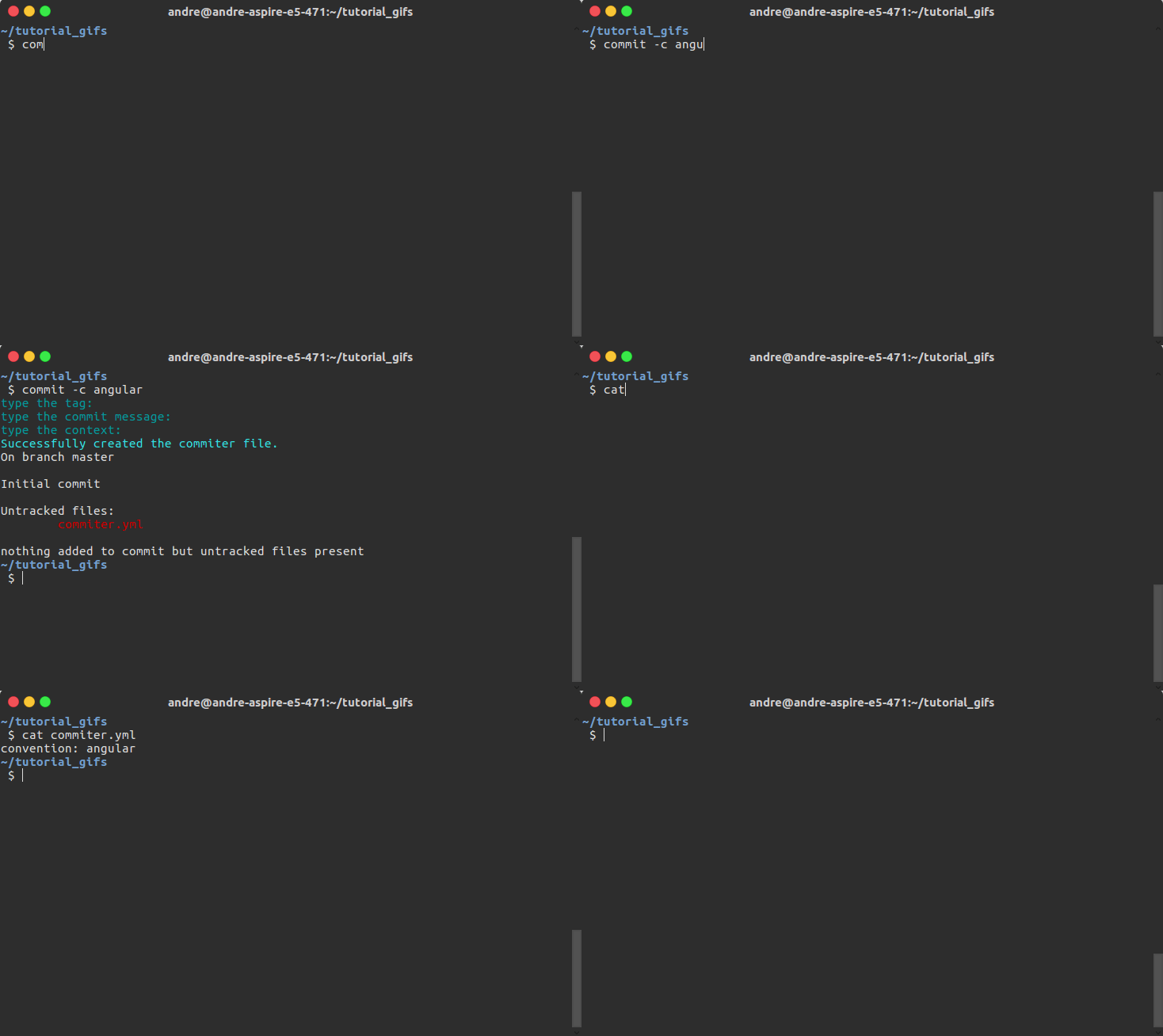
Normal commit
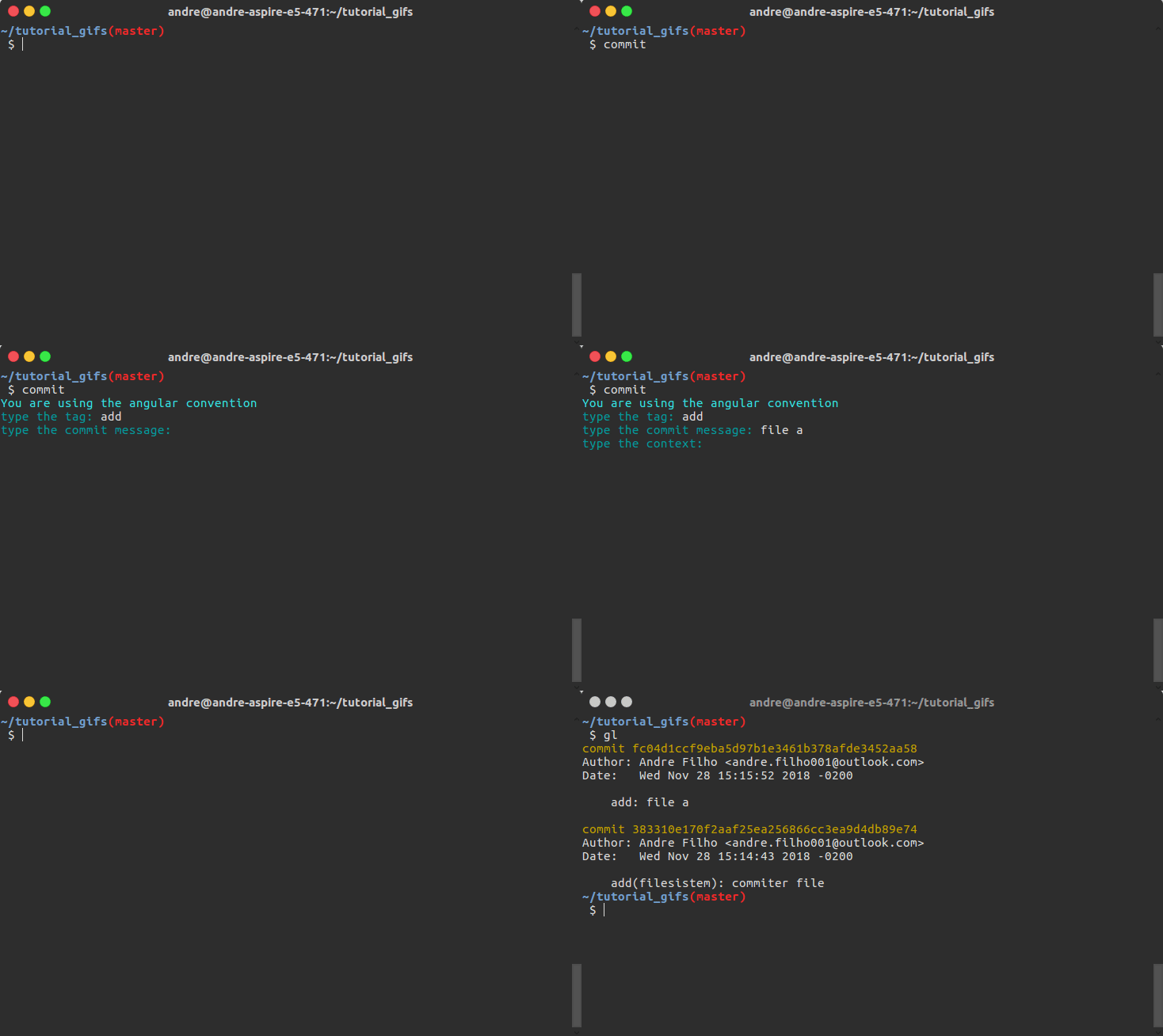
Commit without generating a configuration file

Co-authored commit
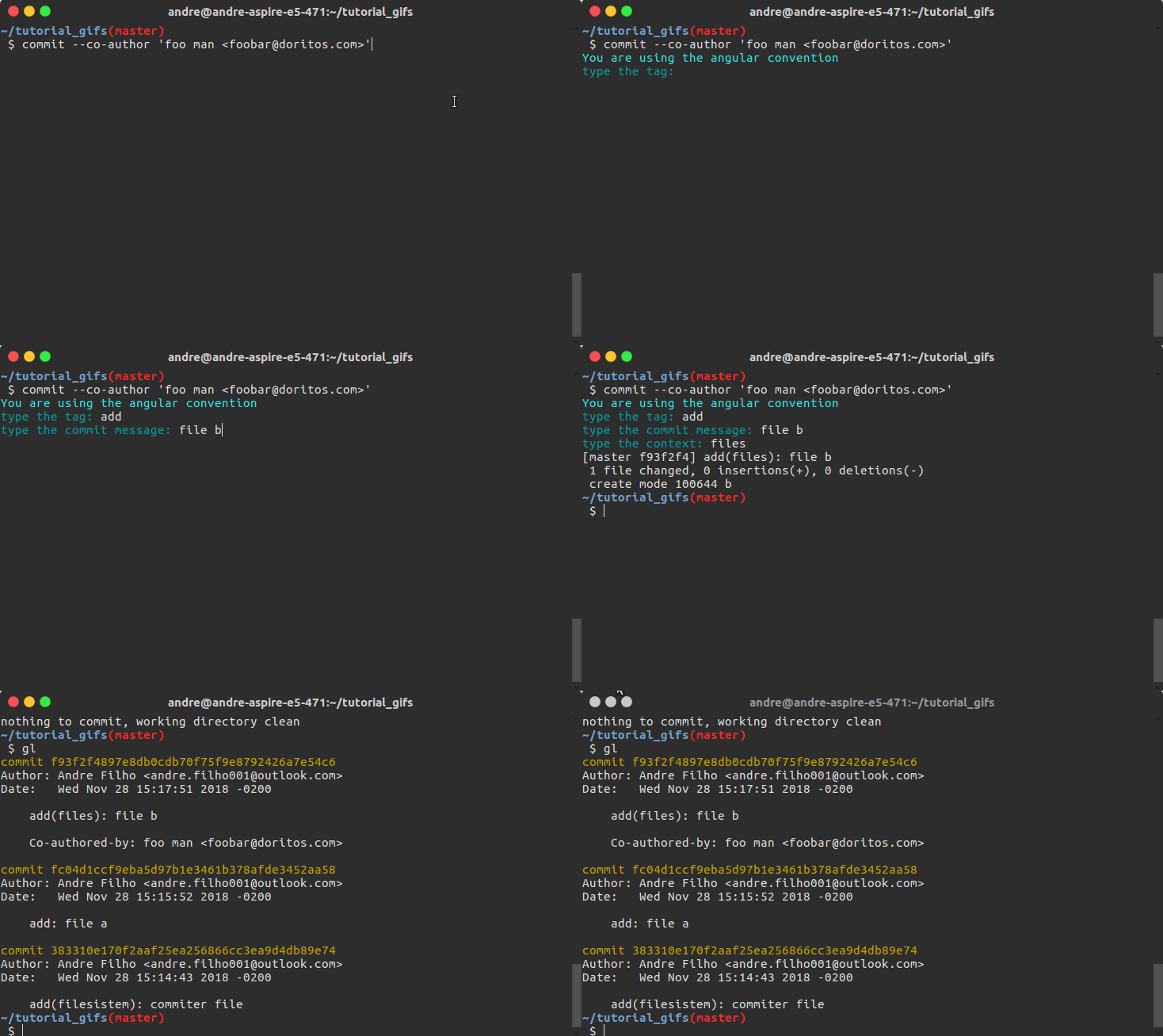
Fast commit

Debugging and commiting

All-in-one commit
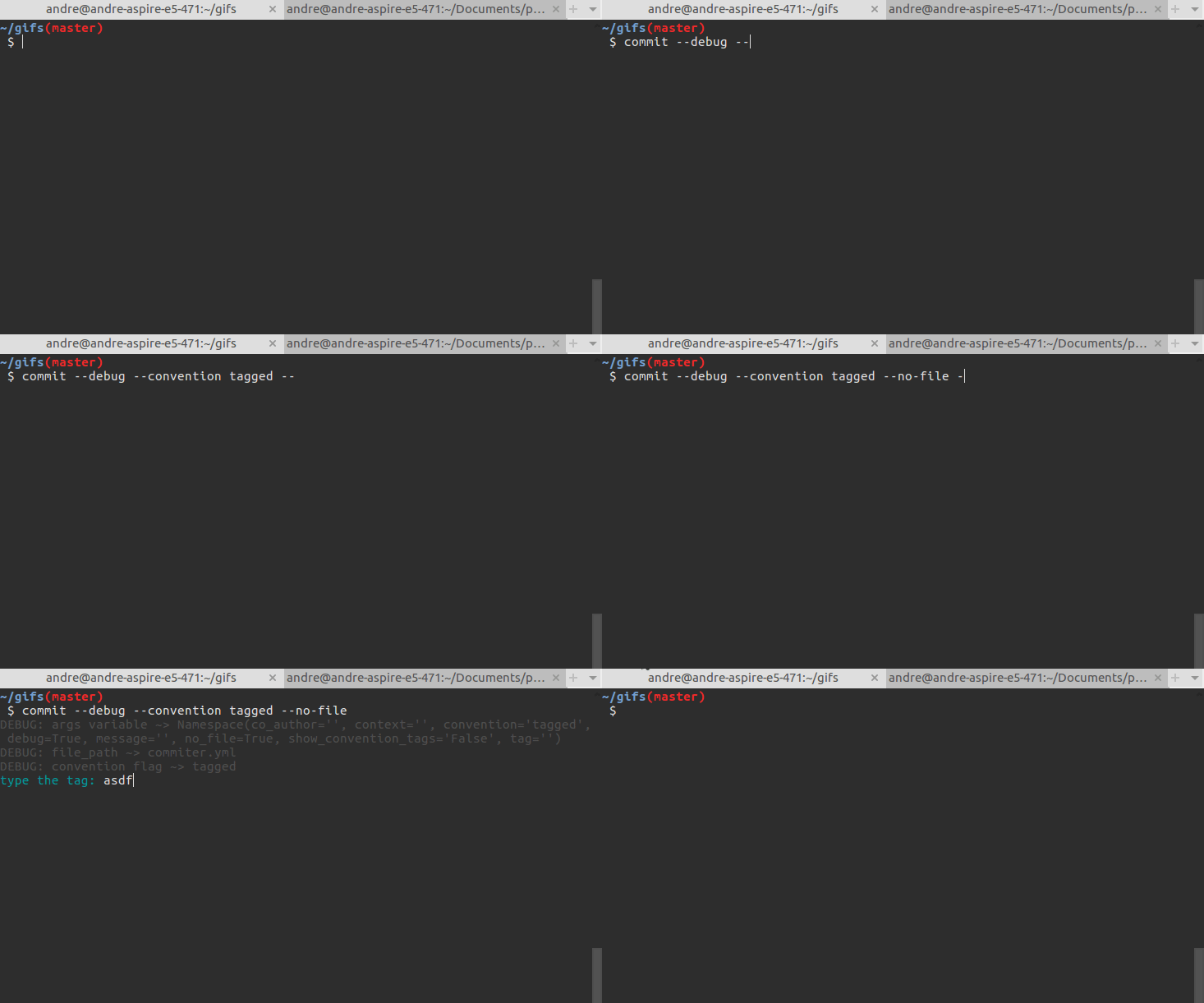
Help
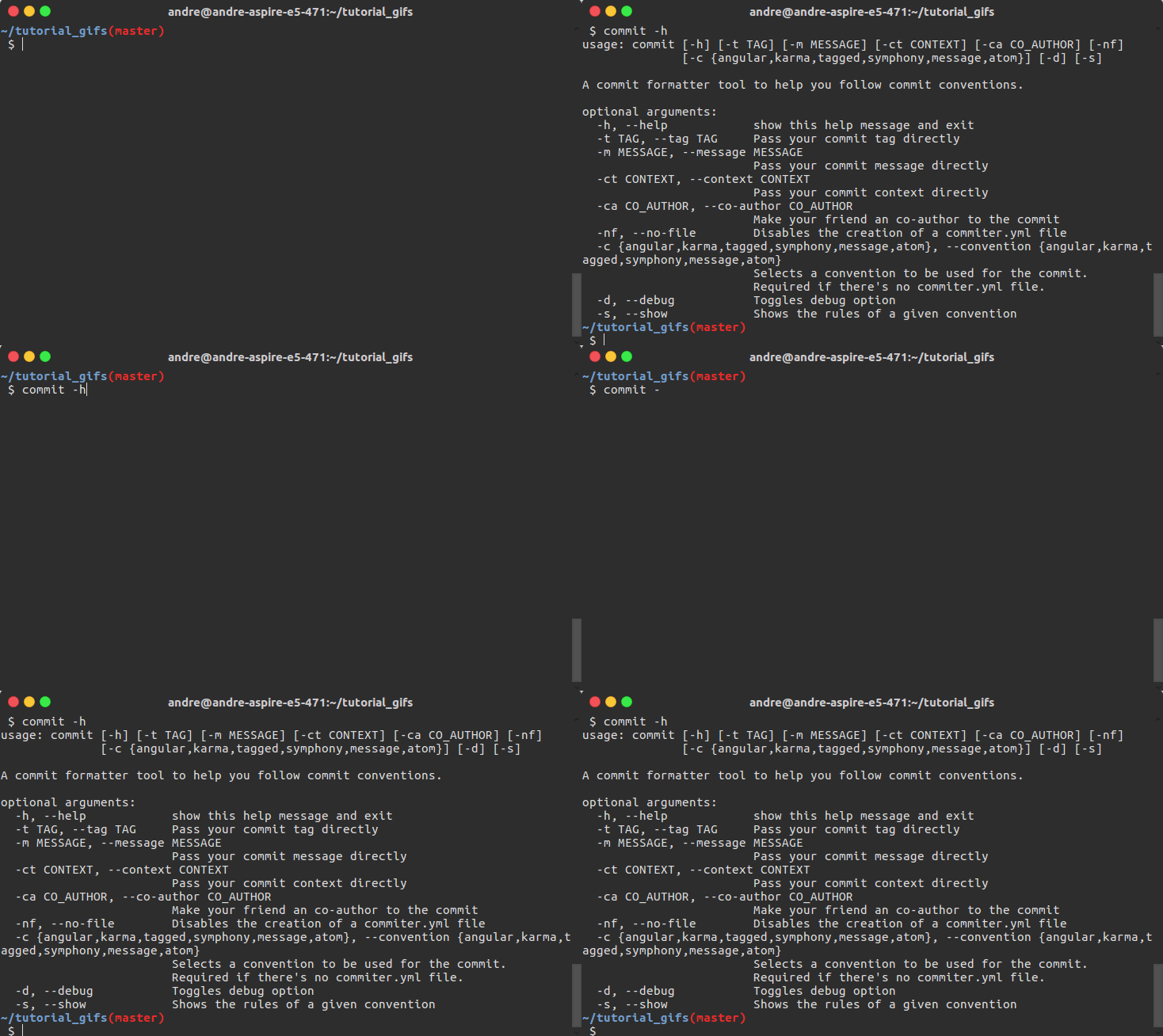
Getting help for writing in a convention

Installation
In order to install one of our older versions, check our previous releases. To install the latest (pip) version, just follow the commands below:
$ pip3 install commit-helper
Updating your current version
If you already have one of our pip releases installed in your machine and want to update to the latest version, use the command:
$ pip3 install --upgrade commit-helper
Usage and configuration
This program has a cli that you can take advantage of. Running commit --help
will show you the usage and options for your commit. All of them are optional
for the sake of not losing your precious time.
 $ commit -h
usage: commit [-h] [-t TAG] [-m MESSAGE] [-ct CONTEXT] [-ca CO_AUTHOR] [-nf]
              [-c {angular,karma,tagged,symphony,message}] [-d]

A commit formatter tool to help you follow commit conventions.

optional arguments:
  -h, --help            show this help message and exit
  -t TAG, --tag TAG     Pass your commit tag directly
  -m MESSAGE, --message MESSAGE
                        Pass your commit message directly
  -ct CONTEXT, --context CONTEXT
                        Pass your commit context directly
  -ca CO_AUTHOR, --co-author CO_AUTHOR
                        Make your friend an co-author to the commit
  -nf, --no-file        Disables the creation of a commiter.yml file
  -c {angular,karma,tagged,symphony,message}, --convention {angular,karma,tagged,symphony,message}
                        Selects a convention to be used for the commit.
                        Required if there's no commiter.yml file.
  -d, --debug           Toggles debug option
So, if you want to write a co-authored commit, you should use:
$ commit --co-author "foo bar doritous <foobar@douritos.com>"
Or if you are using this for the first time in your project:
$ commit --convention tagged
To work even more smoothly, have in your working directory a file named commiter.yml. In this file you must pass the commit convention that you want to use, following the example:
convention: angular   # tag(context): commit message

# or

convention: karma   # tag(context): commit message

# or

convention: tagged # TAG: commit message

# or

convention: symphony  # [Tag] commit message

# and if you're feeling adventurous

convention: none      # Commit message
In case that you or your organization does already have a commit convention that is not listed above, you can configure it in the commiter.yml file as following:
convention: custom
# considering a commit message like '{add} (stuff) ~> in file foo.br'
commit_pattern: '{tag} (context) ~> message'
# tag, message and context are reserved words that will be replaced in your commit message
context: true # this is a must have field! If your pattern doesn't have one, assign false to it
Supported conventions available:
- angular
- karma
- tagged
- symphony
- atom
- only message (no convention)
- a custom one that you may create :)
Troubleshooting
If after you've installed commit-helper the commit or commit-helper commands are not usable at the command line, check if $HOME/.local/bin is on your PATH. If not, add it on your .bashrc file by running:
$ echo "export PATH=$HOME/.local/bin:$PATH" >> .bashrc
Project's maintainers
| Name | Username |
|---|---|
| André de Sousa Costa Filho | @andre-filho |
Our collaborators
| Name | Username |
|---|---|
| Arthur José Benedito de Oliveira Assis | @arthur0496 |
| Matheus Richard Torres Gomes de Melo | @MatheusRich |
1 maintainer

Metadata
1 maintainer
Release files for commit-helper 3.4.16
For a detailed explanation of source distributions (sdists) and built distributions (wheels), please see the package formats documentation.
Source distribution (sdist)
| File | Size | Uploaded | Provenance | Actions |
|---|---|---|---|---|
| commit-helper-3.4.16.tar.gz | 25.7 kB | Without provenance | Details for commit-helper-3.4.16.tar.gz |
Built distribution (wheel)
| File | Interpreter | ABI | Platform | Actions Reset |
|---|---|---|---|---|
| commit_helper-3.4.16-py2.py3-none-any.whl | Python 3, Python 2 | none | any | Details for commit_helper-3.4.16-py2.py3-none-any.whl |
Total release size: 53.0 kB
Release files / commit-helper-3.4.16.tar.gz
| Download URL | commit-helper-3.4.16.tar.gz |
|---|---|
| Size | 25.7 kB |
| Tags | Source |
|
SHA-256 checksum How to use checksums |
32e38b82c5a5e622c06b5f7f6c748a2f4bf641a68f753602f7da6a6eb26612ba
|
|
BLAKE2b-256 checksum How to use checksums |
1fb3a69477dbb146238b7fd27c14b346aaff3531501ccd564633ebd8ad9d8fa6
|
| Upload date | |
|
Uploaded using Trusted Publishing? What is trusted publishing? |
No |
| Uploaded via |
twine/1.13.0 pkginfo/1.5.0.1 requests/2.21.0 setuptools/40.8.0 requests-toolbelt/0.9.1 tqdm/4.31.1 CPython/3.5.6
|
Release files / commit_helper-3.4.16-py2.py3-none-any.whl
| Download URL | commit_helper-3.4.16-py2.py3-none-any.whl |
|---|---|
| Size | 27.3 kB |
| Tags | Python 2 Python 3 |
|
SHA-256 checksum How to use checksums |
b8313e79efaf99e9ed60186bd567a472b5e200f4c1ad02ad088da89494ac2c43
|
|
BLAKE2b-256 checksum How to use checksums |
9cbb9150e2dc9652b3ee8a9de2d89190a3cc432d26f58ea4a74c42de7b8f3f9c
|
| Upload date | |
|
Uploaded using Trusted Publishing? What is trusted publishing? |
No |
| Uploaded via |
twine/1.13.0 pkginfo/1.5.0.1 requests/2.21.0 setuptools/40.8.0 requests-toolbelt/0.9.1 tqdm/4.31.1 CPython/3.5.6
|
Security for commit-helper 3.4.16
Provenance
Provenance describes where a file came from. On PyPI, provenance is shared via attestations, which provide a verifiable record of the build or publishing details. View details, limitations and caveats.
No provenance found
None of the files in this release were uploaded with provenance metadata.
A note on package security
PyPI is a repository for distributing packages, not a service for auditing them. While third-party security researchers and our staff do their best to detect and remove malicious packages, PyPI cannot guarantee the quality, security or suitability of any given package.
To learn more about protecting yourself from malicious actors, visit our package security documentation.














