
content-extractor-pi is a Python module which aims to extract a certain piece of content defined by the user in a set of documents. This piece of content can be a paragraph that deals with a certain topic, headers, page numbers et cetera. content-extractor-pi does need some examples of the desired content, supplied by a domain expert, but our focus on few shot learning means ~10 examples is usually enough out a corpus that may contain 1000s of documents.
Installation
The easiest way to install content-extractor-pi is using pip:
pip install content-extractor-pi
Documentation
The main object of content-extractor-pi is ContentExtractor and its only attribute that it expects is a pre-trained word embedding model. In the example I'm using the pre-trained google news word-2-vec model available here.
ContentExtractor.train_model method
The train_model method extracts and scales features for the provided text examples contained in train_df, creates synthetic samples of the target class, and trains the model at the core of content_extractor.
Parameters
- train_df: pandas DataFrame containing the text examples in one column and the corresponding labels in the other one
- train_additional_features, default=None: pandas DataFrame containing additional features describing the text examples contained in train_df
- y_name, default="label": column name of train_df where the labels are stored
- text_name, default="text": column name of train_df where the text examples are stored
- use_pca, default=False: apply Principal component analysis to the scaled extracted features, more info can be find here.
- gamma, default=1: Kernel coefficient for sklearn.svm.SVC
- C, default=0.1: Regularization parameter for sklearn.svm.SVC
ContentExtractor.extract_content method
The extract_content method extracts and scales features for the provided text examples contained in target_df and returns the ones labeled as 1 by the model.
Parameters
- target_df: pandas DataFrame containing all the text examples that we have at disposal
- target_additional_features, default=None: pandas DataFrame containing additional features describing the text examples contained in target_df
- text_name, default="text": column name of target_df where the text examples are stored
Example
In the following example we have a full implementation that leads to extracting the desired content from a set of more than 62000 paragraphs originated from the World Bank Loan Agreements Corpus, using just 11 examples manually labeled as 1. We aim to extract the objective paragraph that is a short segment describing how the the loan it's going to be spent, below you can find an example.
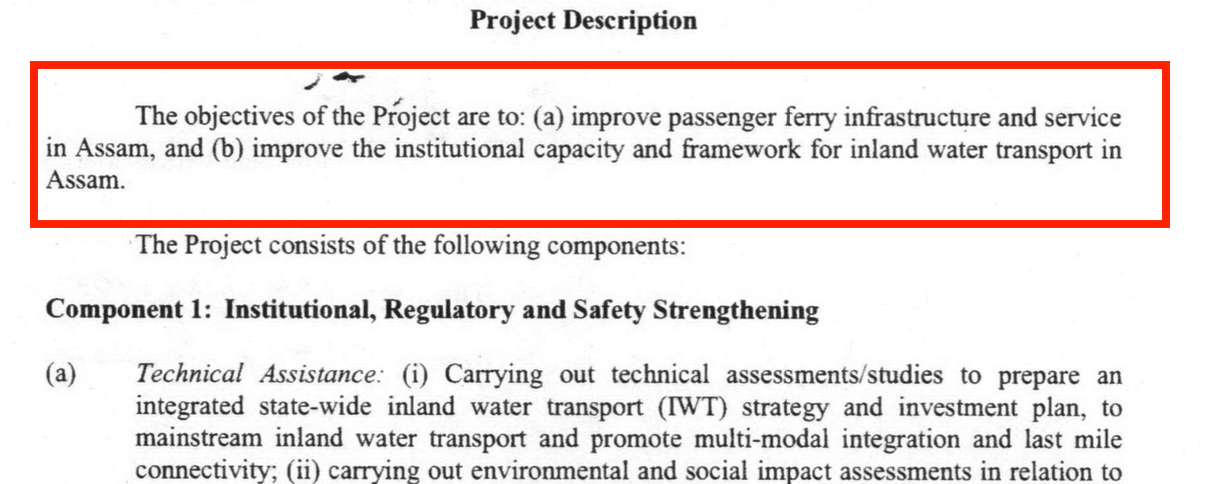
The desired paragraphs are stored in the target_examples list. You can find train_df.csv and target_df.csv here
from content_extractor import contextractor as cte
from gensim.models import KeyedVectors
import pandas as pd

W2V_MODEL = KeyedVectors.load_word2vec_format('/your/path/to/GoogleNews-vectors-negative300.bin.gz',
                                              binary=True)
train_df = pd.read_csv("data/train_df.csv")
target_df = pd.read_csv("data/target_df.csv")

cont_ext = cte.ContentExtractor(W2V_MODEL)
cont_ext.train_model(train_df)
target_examples = cont_ext.extract_content(target_df)
1 maintainer

Metadata
1 maintainer
Release files for content-extractor-pi 0.1.0
For a detailed explanation of source distributions (sdists) and built distributions (wheels), please see the package formats documentation.
Source distribution (sdist)
| File | Size | Uploaded | Provenance | Actions |
|---|---|---|---|---|
| content_extractor-pi-0.1.0.tar.gz | 5.1 kB | Without provenance | Details for content_extractor-pi-0.1.0.tar.gz |
Release files / content_extractor-pi-0.1.0.tar.gz
| Download URL | content_extractor-pi-0.1.0.tar.gz |
|---|---|
| Size | 5.1 kB |
| Tags | Source |
|
SHA-256 checksum How to use checksums |
bb3ba6b056bce4abda3f4647b1ba094520e89151d681b4ceef2df8e96b397c0b
|
|
BLAKE2b-256 checksum How to use checksums |
6addbe571d2efb313b1d884c1caf0076b0a11b3fb169c2f3801506405ee50916
|
| Upload date | |
|
Uploaded using Trusted Publishing? What is trusted publishing? |
No |
| Uploaded via |
twine/3.4.2 importlib_metadata/4.6.4 pkginfo/1.7.1 requests/2.26.0 requests-toolbelt/0.9.1 tqdm/4.62.1 CPython/3.8.2
|
Security for content-extractor-pi 0.1.0
Provenance
Provenance describes where a file came from. On PyPI, provenance is shared via attestations, which provide a verifiable record of the build or publishing details. View details, limitations and caveats.
No provenance found
None of the files in this release were uploaded with provenance metadata.
A note on package security
PyPI is a repository for distributing packages, not a service for auditing them. While third-party security researchers and our staff do their best to detect and remove malicious packages, PyPI cannot guarantee the quality, security or suitability of any given package.
To learn more about protecting yourself from malicious actors, visit our package security documentation.














