





CrystOD
The offline symmetry lab for crystals and molecules.
CrystOD answers questions like:
- "Which irreps do the Ti d orbitals belong to in SrTiO₃?"
- "What space groups can this imaginary phonon condense into?"
- "What symmetry-adapted spin bases does this magnetic structure have?"
- "Show me the MO diagram of this molecule from symmetry alone."
It replaces clicking through Bilbao / ISOTROPY / AMPLIMODES with a single
pip-installable Python package and nine CLI commands — fully scriptable,
cross-validated against the reference servers, and offline: every calculation
runs locally, and the only command that goes online is crystod-search, which
fetches structures from the Materials Project. Viewing some of the HTML output
does need a network connection: the 3D viewers written by crystod --visualize,
crystod-bz and crystod-mol --visualize load plotly.js from cdn.plot.ly
when the page is opened. The crystal-orbital and MO diagram pages are
self-contained.
Documentation: https://mochizuki-tus.github.io/CrystOD/
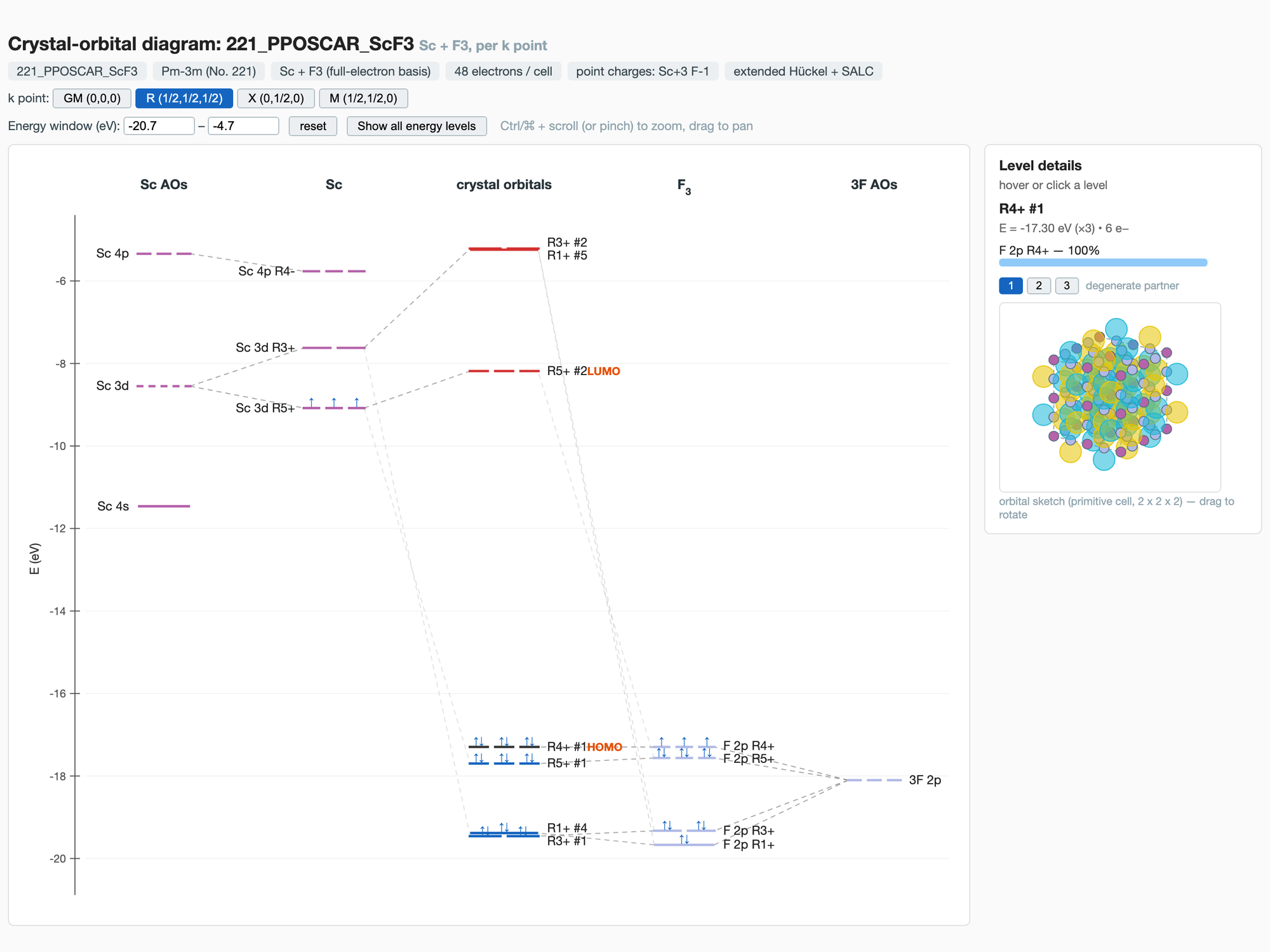
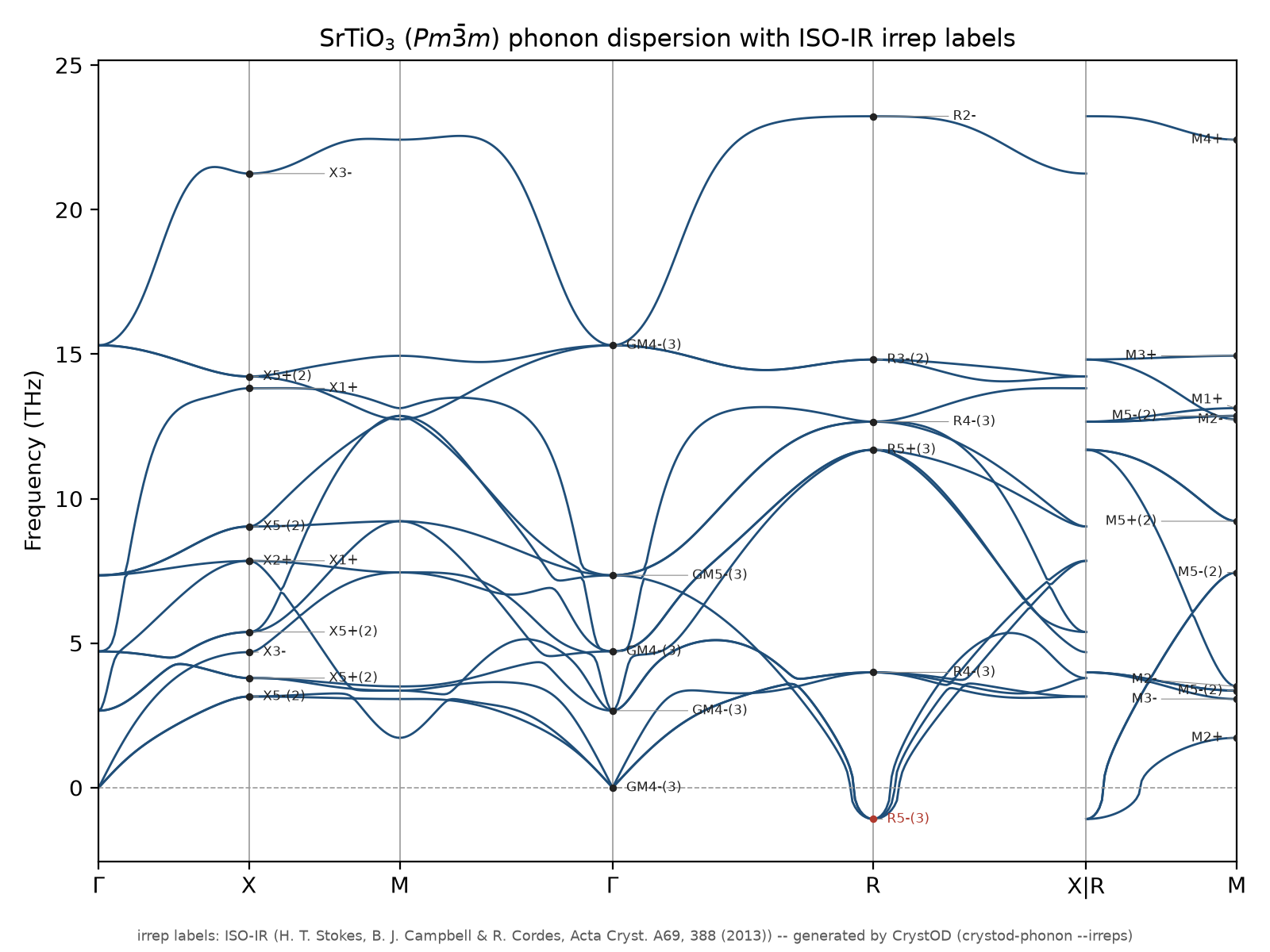
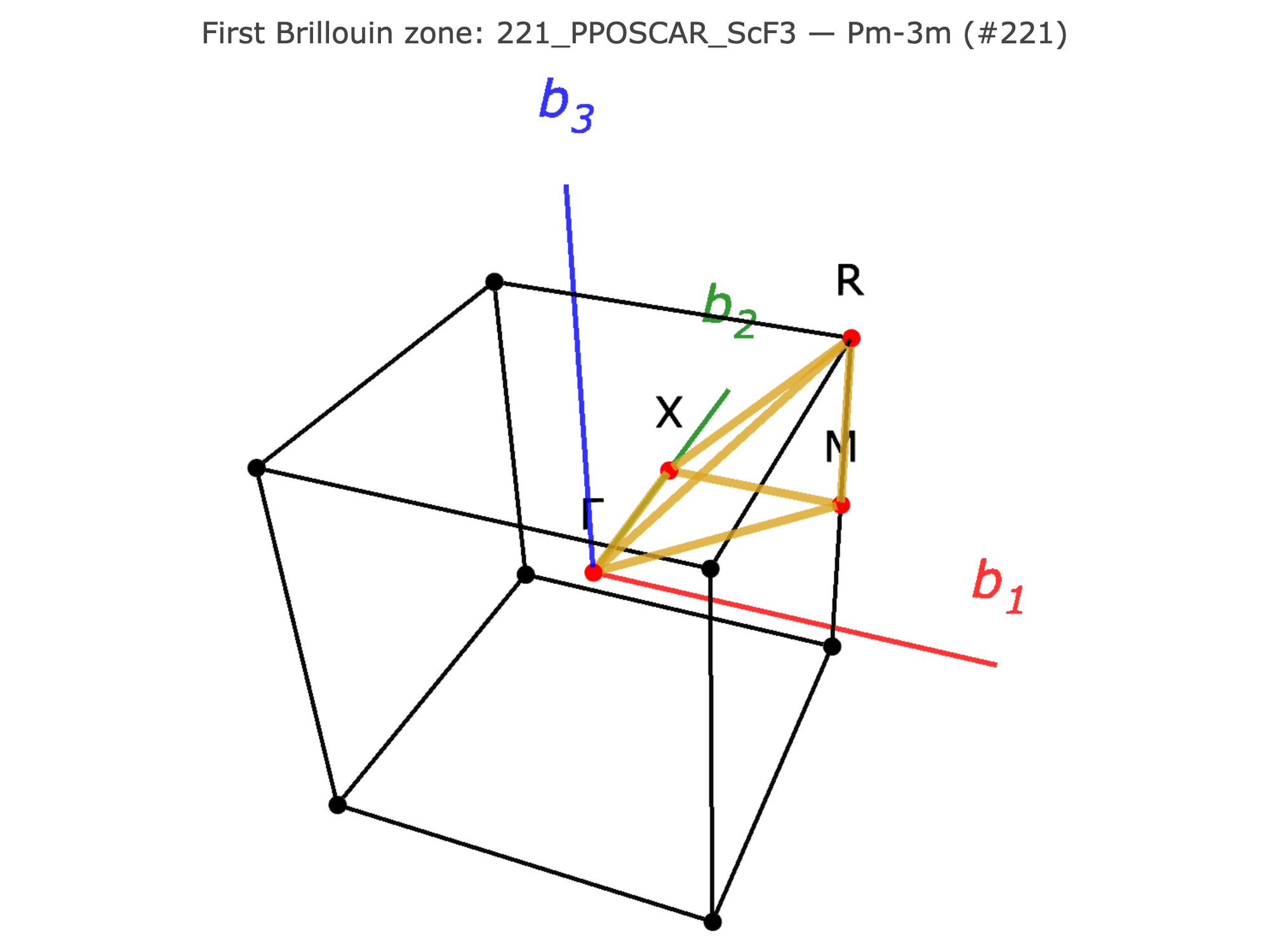
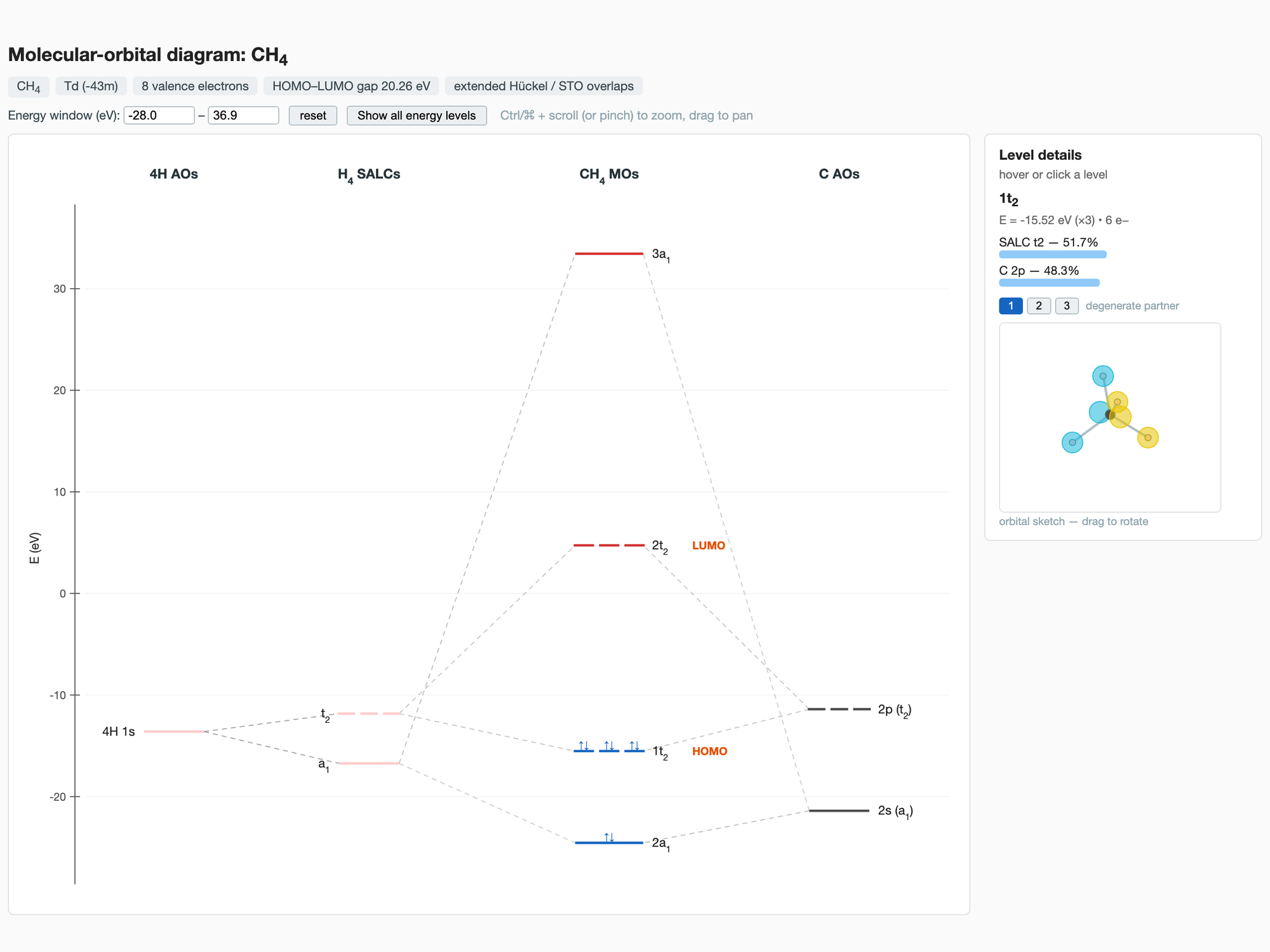
Top row: crystod --diagram -c 221_PPOSCAR_ScF3 --co-left Sc --co-right F3 and
crystod-phonon --irreps -c 221_PPOSCAR_SrTiO3 --dim "4 4 4" (the labels drawn on a phonopy dispersion);
bottom row: crystod-bz -c 221_PPOSCAR_ScF3 and
crystod-mol --diagram --xyz XYZ_CH4.xyz. Every input is bundled with the package (see below).
Every irrep label follows one convention throughout — the ISO-IR (ISOTROPY, Miller–Love) tables, which ship inside the package — at the special k points and equally on symmetry lines, planes and general points.
The nine commands
| command | what it gives you |
|---|---|
crystod |
crystal-orbital / SALC irreps from atomic orbitals, orbital hybridization, crystal-orbital diagrams (extended Hückel, PySCF, or finished VASP runs — PROCAR projections, or WAVECAR overlaps with no energy alignment and spin-orbit runs included) with dipole selection rules between levels, band structure, DOS, 3D SALC viewers |
crystod-group |
direct products of point- and space-group irreps and their symmetric and antisymmetric squares, Jahn-Teller active modes, reducible-representation decomposition, ligand-field splitting, polynomial basis functions, property-tensor forms (Neumann's principle), coset decompositions, point-group correlation tables, compatibility relations along symmetry lines and the subduction of parent irreps to the Gamma point of an isotropy subgroup, isotropy subgroups, their group-subgroup graph and the reverse lookup of the irreps (or pairs of irreps) giving a subgroup, invariant polynomials and secondary order parameters, multi-electron terms, POSCAR ↔ CIF, axis settings of a CIF / POSCAR, symmetry-mode (AMPLIMODES-style) analysis with the parent-to-child transformation matrix |
crystod-bz |
interactive 3D Brillouin zones, automatic or manual k-paths, supercell (folded) BZs, special k points of any space group |
crystod-phonon |
phonon irrep labeling, IR/Raman activity and Raman tensors, dielectric response from Born charges, element-projected fatbands, longitudinal/transverse bands, eigenvector VESTA export, symmetry-adapted modulations, symmetry-only vibration bases, isotropy subgroups of imaginary modes |
crystod-mag |
symmetry-adapted spin bases (cluster multipoles / SAMM) with ready-to-paste VASP MAGMOM or Quantum ESPRESSO input; magnetic space group (BNS), magnetic point group, responses allowed by symmetry and FM / AFM / altermagnet (d/g/i-wave) class of every basis vector |
crystod-md |
atomic displacement parameters (ADPs) and time-averaged cells from an MD trajectory; projection onto the symmetry-adapted modes of the parent (order-parameter time series Q(t) per irrep) or onto the phonon eigenvectors, with effective frequencies |
crystod-mol |
molecular point groups, molecular SALCs, and MO diagrams from symmetry + overlap (or PySCF) |
crystod-xrd |
powder X-ray diffraction patterns: Bragg peak list (hkl, d, 2θ, intensity) and the broadened pattern, for Cu/Mo/Ag/Co/Fe/Cr radiation or neutrons; superlattice reflections of a distorted phase indexed on the parent lattice and assigned to parent k points and irreps (--parent) |
crystod-search |
Materials Project search by formula (SrTiO3), chemical system (Sr-Ti-O), elements or ID, listing space group, band gap, energy above hull and sites with the experimentally observed entries starred; --get mp-5532 downloads the POSCAR |
Several of these are offline counterparts of the Bilbao Crystallographic Server and ISOTROPY tools (DIRPRO, ISOSUBGROUP, AMPLIMODES) and were cross-validated against them; see the documentation for the validation details.
Installation
pip install CrystOD
This installs the nine commands with everything needed for the symmetry analysis, the
extended-Hückel crystal-orbital diagrams, the phonon irreps and the MO diagrams.
Requires Python 3.10 or later. The dependencies (phonopy, spglib, spgrep, ase,
seekpath, pymatgen, numpy, scipy, sympy, pandas, matplotlib, requests) are
installed automatically; openpyxl is not among them, so install it yourself if you use
crystod --show-irrep-table, which also writes the table to irrep_table.xlsx.
crystod-search also needs a free Materials Project API key, from
https://next-gen.materialsproject.org/api: export MP_API_KEY=<your key>, or store it once
with pmg config --add PMG_MAPI_KEY <your key>.
pip install "CrystOD[quantum]"
This adds PySCF for the quantitative engines — crystod --diagram/--band/--dos/--visualize --pyscf and crystod-mol --diagram --pyscf. PySCF is about 500 MB with its dependencies,
which is why it is an extra; a --pyscf run without it stops with a one-line error that
names this command.
To also get the worked examples and the full test suite, clone the repository instead:
conda create -n crystod python=3.11 && conda activate crystod
git clone https://github.com/ahntaeyoung1212/CrystOD.git && cd CrystOD && pip install -e ".[quantum]"
Quick start
With your own structure
# Your POSCAR -> crystal-orbital irreps of the Ti d orbitals
crystod -c POSCAR --element Ti --orbital d

# Your POSCAR + FORCE_SETS (phonopy, 2x2x2 supercell) -> phonon irrep labels
# (--dim is the supercell the forces were computed in)
crystod-phonon --irreps -c POSCAR --dim "2 2 2"

# Space-group algebra (no structure file needed)
crystod-group --parent Pm-3m --irrep R4+      # isotropy subgroups of one irrep
crystod-group --parent Pm-3m --kpoint GM      # ... of every irrep at a k point

# No POSCAR yet? Search the Materials Project and download one
crystod-search Sr-Ti-O            # the Sr-Ti-O compounds; * = experimentally observed
crystod-search --get mp-5532      # -> POSCAR_Sr2TiO4_I4mmm_mp-5532
Try it without any input file
A few small inputs ship inside the package, so the first run needs nothing but the
pip install:
crystod --example ScF3_d          # Sc 3d crystal-orbital irreps of ScF3
crystod-phonon --example SrTiO3   # phonon irrep labels of SrTiO3 (4x4x4 FORCE_SETS; writes phonon_irreps.yaml)
crystod-mol --example CH4         # MO diagram of methane (writes MolOD_XYZ_CH4.html)
crystod-bz --example ScF3         # 3D Brillouin zone of ScF3 (writes BZ_221_PPOSCAR_ScF3.html)
crystod-xrd --example ScF3        # powder XRD pattern of ScF3 for Cu K-alpha (table + PDF)
--example NAME copies the input files of that example into the working directory,
prints the equivalent ordinary command line (Running: crystod -c 221_PPOSCAR_ScF3 --element Sc --orbital d) and runs it, so the files are there to edit and re-run.
--example alone lists the examples bundled with that command.
More
Which space groups the imaginary phonons of cubic SrTiO₃ can condense into — and the distorted structures themselves:
crystod-phonon --subgroup -c 221_PPOSCAR_SrTiO3 --dim "4 4 4" --qpoint R --modulate
Freeze a chosen mode combination into a structure (a unit cell plus FORCE_SETS is all
you need):
crystod-phonon --modulation -c 221_PPOSCAR_ScF3 --qpoint 0.5 0.5 0.5 --mode 1 2 3 --amplitude 0.3
An MO diagram of a molecule from symmetry and overlap alone:
crystod-mol --diagram --xyz XYZ_CH4.xyz
Every command prints its own examples with --help, and the documentation shows the
output of each one.
Python API
Every analysis is also a Python function, grouped into one module per command, so a part of CrystOD can be used inside another program:
import crystod

subgroups = crystod.group.isotropy_subgroups("Pm-3m", "R4+")
by_irrep = crystod.group.isotropy_subgroups_at_kpoint("Pm-3m", "GM")   # {irrep label: subgroups}
results = crystod.phonon.scan_imaginary_modes(phonon)   # a live phonopy object
crystod.salc, crystod.group, crystod.phonon, crystod.bz, crystod.mag,
crystod.md, crystod.mol, crystod.xrd, crystod.search. Attribute access is lazy, so
import crystod plus all nine domains costs ~0.09 s and pulls in nothing heavier than NumPy —
phonopy, spgrep, PySCF and matplotlib load only when a function that needs them is called.
The API reference is at https://mochizuki-tus.github.io/CrystOD/api/. Three Jupyter
notebooks in tutorials/ walk through one workflow each, on the bundled
example inputs and with the Python API and the command line side by side:
01_phonon_irrep_labeling.ipynb,
02_isotropy_subgroup_search.ipynb and
03_mo_diagram.ipynb.
MCP server
crystod-mcp/ in this repository packages the same analyses as the tools
of a Model Context Protocol server, so that an LLM client can run CrystOD on local
structure files; see the
crystod-mcp page of the
documentation for the setup.
Testing
python testsuite.py
Runs the full regression suite (48 sections) against the data in example/; a section
can be run alone with python testsuite.py 35. The --pyscf checks are skipped when
PySCF is not installed. GitHub Actions runs the suite on every push
(test.yml) and ruff (lint.yml).
Contributing
Bug reports, questions and pull requests are welcome; CONTRIBUTING.md describes the development setup, the code style and the pull-request process.
Data sources and acknowledgements
- Irrep tables: ISO-IR dataset of the ISOTROPY Software Suite, shipped as
crystod/CIR_data.txt.gz— H. T. Stokes, B. J. Campbell and R. Cordes, Acta Cryst. A69, 388–395 (2013), https://iso.byu.edu. - Isotropy subgroups validated against ISOSUBGROUP — H. T. Stokes, S. van Orden and B. J. Campbell, J. Appl. Cryst. 49, 1849–1853 (2016).
- Symmetry-mode analysis validated against AMPLIMODES — D. Orobengoa, C. Capillas, M. I. Aroyo and J. M. Perez-Mato, J. Appl. Cryst. 42, 820–833 (2009).
- Structures and properties of
crystod-search: the Materials Project — A. Jain et al., APL Mater. 1, 011002 (2013), https://doi.org/10.1063/1.4812323; the data are licensed under CC BY 4.0. - Built on phonopy, spglib, spgrep, ASE, seekpath and pymatgen, and optionally on PySCF.
Contributors
- Yasuhide Mochizuki — Tokyo University of Science (mochizuki@rs.tus.ac.jp)
- Hiroki Koiso — Institute of Science Tokyo
Citation
If you use CrystOD in your research, please cite:
H. Koiso, S. Yoshida, T. Nagai, T. Isobe, A. Nakajima, and Y. Mochizuki, "Thermal expansion and phase stability of BF3 (B = Sc, Y, La, Al, Ga, In) from first principles", Physical Review B 110, 064104 (2024).
@article{CrystOD,
  title   = {Thermal expansion and phase stability of $B$F$_3$ ($B$ = Sc, Y, La, Al, Ga, In) from first principles},
  author  = {Koiso, Hiroki and Yoshida, Suguru and Nagai, Takayuki and Isobe, Toshihiro and Nakajima, Akira and Mochizuki, Yasuhide},
  journal = {Phys. Rev. B},
  volume  = {110},
  pages   = {064104},
  year    = {2024},
  doi     = {10.1103/PhysRevB.110.064104},
}
License
MIT License — see LICENSE.
1 maintainer

Metadata
1 maintainer
Release files for CrystOD 0.4.4
For a detailed explanation of source distributions (sdists) and built distributions (wheels), please see the package formats documentation.
Source distribution (sdist)
| File | Size | Uploaded | |
|---|---|---|---|
| crystod-0.4.4.tar.gz | 2.1 MB | Details |
Built distribution (wheel)
| File | Interpreter | ABI | Platform | Reset |
|---|---|---|---|---|
| crystod-0.4.4-py3-none-any.whl | Python 3 | none | any | Details |
Total release size: 4.3 MB
Release files / crystod-0.4.4.tar.gz
| Download URL | crystod-0.4.4.tar.gz |
|---|---|
| Size | 2.1 MB |
| Tags | Source |
|
SHA-256 checksum How to use checksums |
088bc2ed844161234317b847c025075a65ed340f16f07ebe4e8d7bdd0d574dcf
|
|
BLAKE2b-256 checksum How to use checksums |
431010ad658dca30370dec1897f0d67cbe18e9b1afb888d67958eae0bd438ed1
|
| Upload date | |
|
Uploaded using Trusted Publishing? What is trusted publishing? |
No |
| Uploaded via |
twine/7.0.0 CPython/3.11.15
|
Release files / crystod-0.4.4-py3-none-any.whl
| Download URL | crystod-0.4.4-py3-none-any.whl |
|---|---|
| Size | 2.2 MB |
| Tags | Python 3 |
|
SHA-256 checksum How to use checksums |
bb7120484a106171291151aac1b2467afa61c924807cc5786bb5caefc93d229e
|
|
BLAKE2b-256 checksum How to use checksums |
2d1e37f86236b78a3ef393c3253621dc404101fbd6e7fbffa9581a960a1d5597
|
| Upload date | |
|
Uploaded using Trusted Publishing? What is trusted publishing? |
No |
| Uploaded via |
twine/7.0.0 CPython/3.11.15
|














