
dataframe_image


A package to convert Jupyter Notebooks to PDF and/or Markdown embedding pandas DataFrames as images.
Overview
When converting Jupyter Notebooks to pdf using nbconvert, pandas DataFrames appear as either raw text or as simple LaTeX tables. The left side of the image below shows this representation.
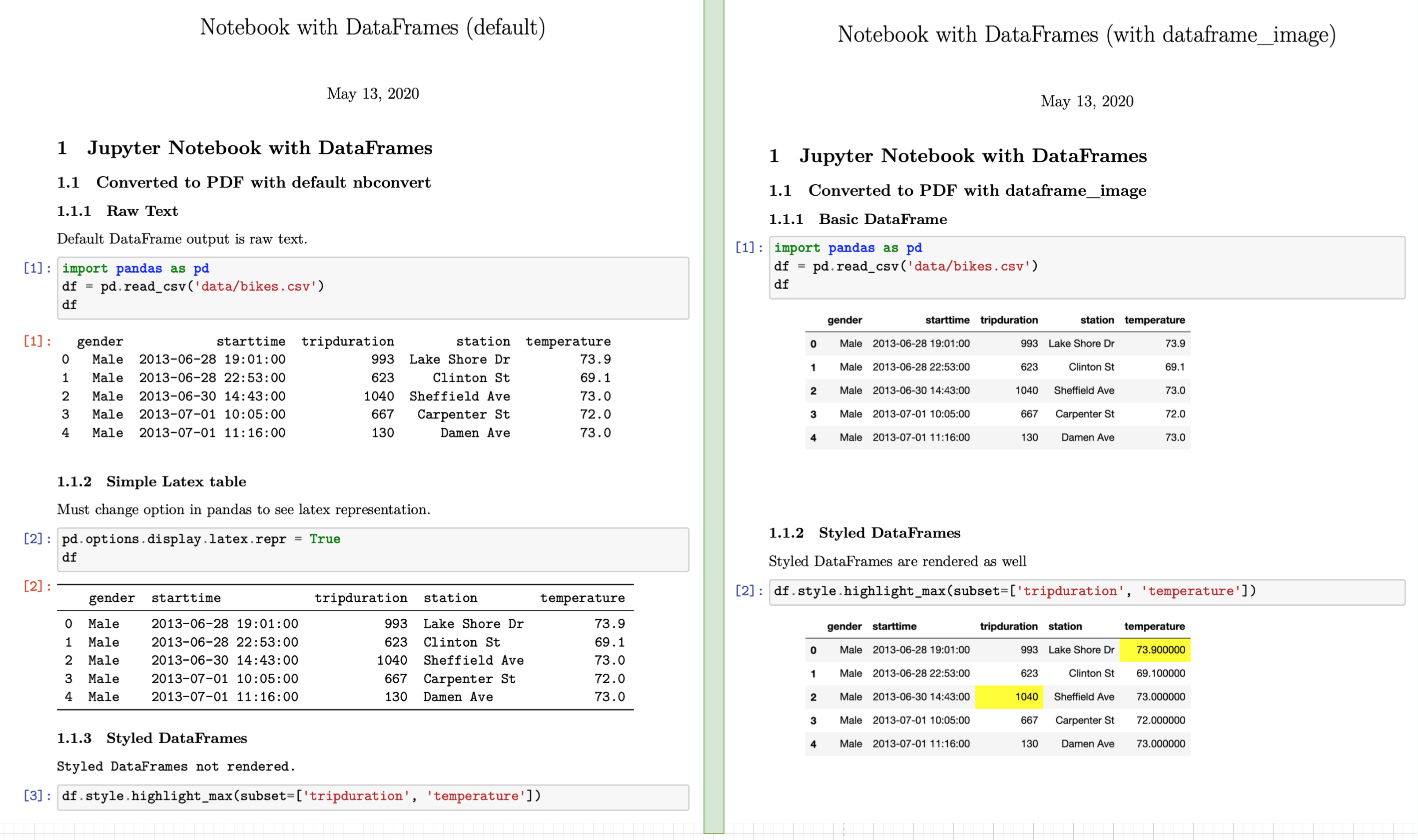
This package was first created to embed DataFrames into pdf and markdown documents as images so that they appear exactly as they do in Jupyter Notebooks, as seen from the right side of the image above. It has since added much more functionality.
Usage
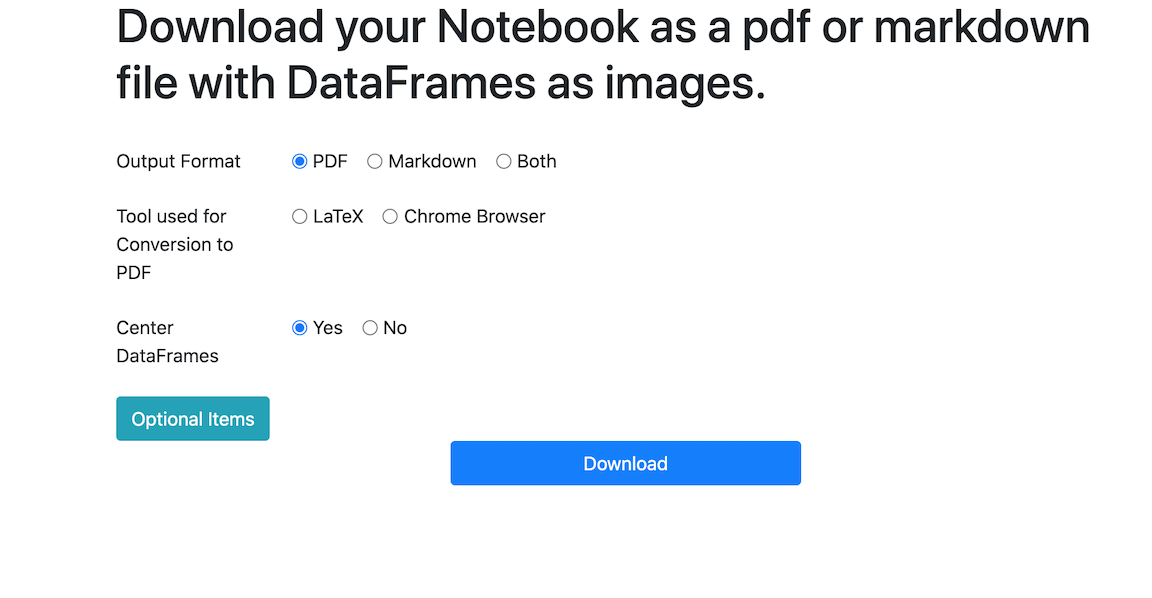
Upon installation, the option DataFrame as Image (PDF or Markdown) will appear in the menu File -> Download as. Clicking this option will open up a new browser tab with a short form to be completed.
Exporting individual DataFrames
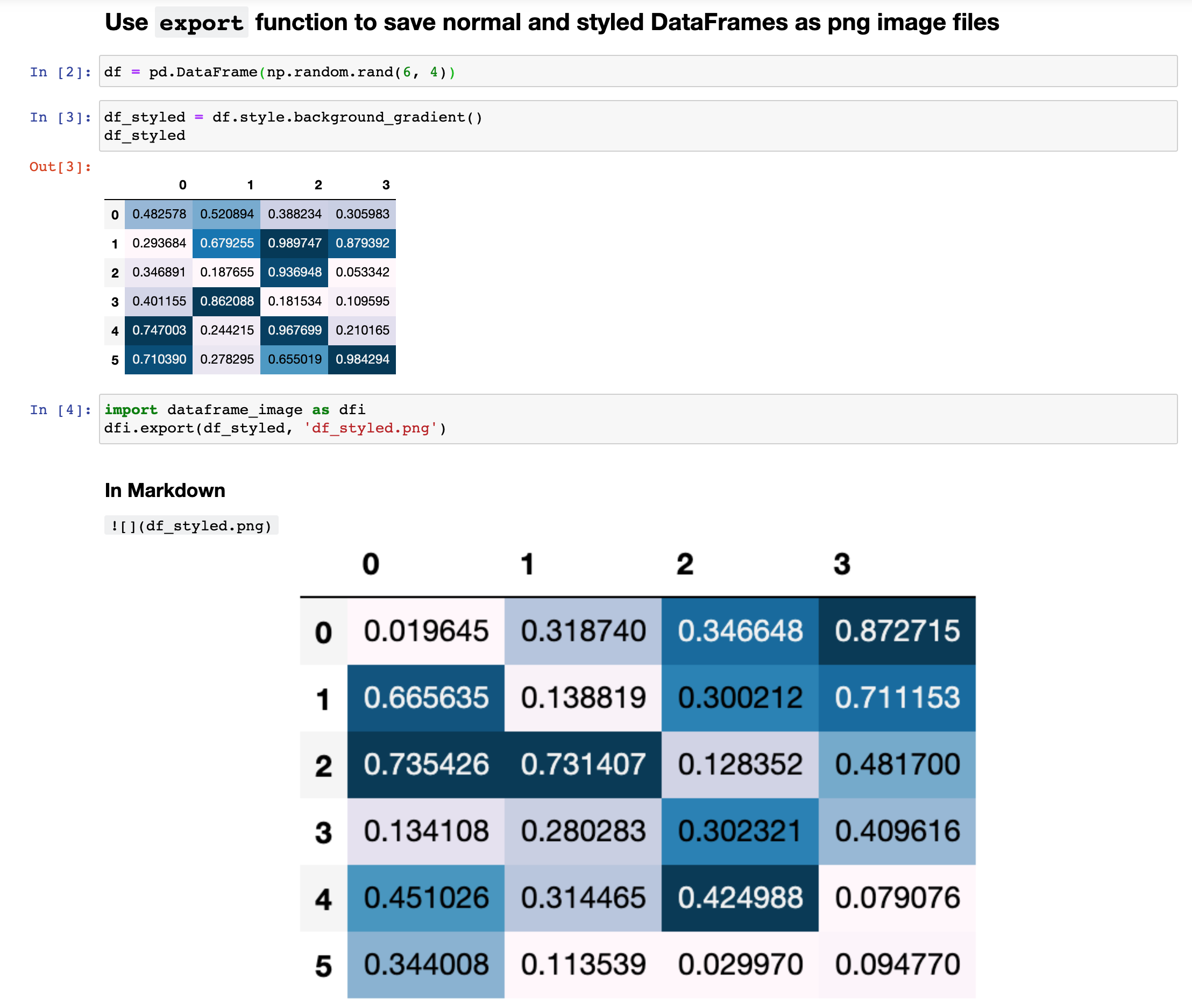
dataframe_image has the ability to export both normal and styled DataFrames as images from within a Python script. Pass your normal or styled DataFrame to the export function along with a file location to save it as an image.
>>> import dataframe_image as dfi
>>> dfi.export(df_styled, 'df_styled.png')
You may also export directly from the DataFrame or styled DataFrame using the dfi.export and export_png methods, respectively.
>>> df.dfi.export('df.png')
>>> df_styled.export_png('df_styled.png)
Here, an example of how exporting a DataFrame would look like in a notebook.
Installation
Install with either:
pip install dataframe_imageconda install -c conda-forge dataframe_image
PDF Conversion - LaTeX vs Chrome Browser
By default, conversion to pdf happens via LaTeX, which you must have pre-installed on your machine. If you do not have the correct LaTeX installation, you'll need to select the Chrome Browser option to make the conversion.
Conversion via Chrome browser is much quicker and will look very different than the LaTeX rendition. The chrome browser version will look nearly the same as it does in your browser, while the LaTeX version looking more like a book/article.
Consult nbconvert's documentation to learn how to get latex installed correctly on your machine.
More features
Below, is a description of other features from dataframe_image:
- Embeds all images from markdown cells (inline, reference, attachments, and
<img>tags) into the pdf - Saves the new documents anywhere in your filesystem and correctly link the resources
- Converts gifs to single-frame png files allowing them to be embedded into the pdf
As a Python Library
dataframe_image can also be used outside of the notebook as a normal Python library. In a separate Python script, import the dataframe_image package and pass the file name of your notebook to the convert function.
>>> import dataframe_image as dfi
>>> dfi.convert('path/to/your_notebook.ipynb',
                to='pdf',
                use='latex',
                center_df=True,
                max_rows=30,
                max_cols=10,
                execute=False,
                save_notebook=False,
                limit=None,
                document_name=None,
                table_conversion='chrome'
                chrome_path=None,
                latex_command=None,
                output_dir=None,
                )
By default, the new file(s) will be saved in the same directory where the notebook resides. Do not run this command within the same notebook that is being converted.
From the Command Line
The command line tool dataframe_image will be available upon installation with the same options as the convert function from above.
dataframe_image --to=pdf "my notebook with dataframes.ipynb"
Finding Google Chrome
You must have Google Chrome (or Brave) installed in order for dataframe_image to work. The path to Chrome should automatically be found. If Chrome is not in a standard location, set it with the chrome_path parameter.
Using matplotlib instead of Chrome
If you do not have Chrome installed or cannot get it to work properly, you can alternatively use matplotlib to convert the DataFrames to images. Select this option by setting the table_conversion parameter to 'matplotlib'.
Publish to Medium
Closely related to this package is jupyter_to_medium, which publishes your notebooks directly and quickly as Medium blog posts.
Dependencies
You must have the following Python libraries installed:
1 maintainer

Release files for dataframe-image-cn 0.1.1
For a detailed explanation of source distributions (sdists) and built distributions (wheels), please see the package formats documentation.
Source distribution (sdist)
| File | Size | Uploaded | |
|---|---|---|---|
| dataframe_image_cn-0.1.1.tar.gz | 27.1 kB | Details |
Release files / dataframe_image_cn-0.1.1.tar.gz
| Download URL | dataframe_image_cn-0.1.1.tar.gz |
|---|---|
| Size | 27.1 kB |
| Tags | Source |
|
SHA-256 checksum How to use checksums |
974d447552333e71e527ccb16440c99887d2acc27d50760985a5b6b285af39b6
|
|
BLAKE2b-256 checksum How to use checksums |
c7d28369cda6ecb7a5b8c0cb0dd633d0665d4ed66771479f228d729e901d3e48
|
| Upload date | |
|
Uploaded using Trusted Publishing? What is trusted publishing? |
No |
| Uploaded via |
twine/3.7.1 importlib_metadata/4.8.1 pkginfo/1.8.2 requests/2.27.1 requests-toolbelt/0.9.1 tqdm/4.62.2 CPython/3.7.6
|













