
DEFER
DEnsity Function Estimation using Recursive partitioning
Approximate any black-box unnormalised density from point evaluations alone, and get samples, the normalising constant, and more. Runs on PyTorch or NumPy.


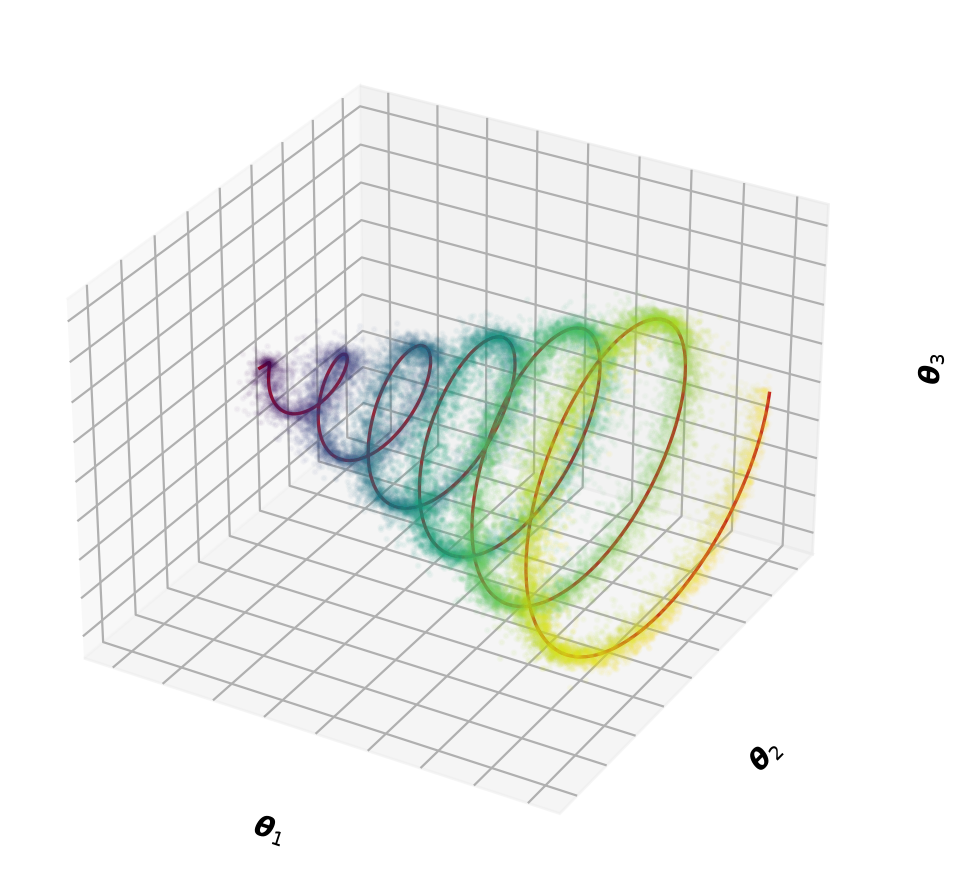
200k samples drawn from a DEFER approximation of a density concentrated on a 3-D spiral.
Overview
DEFER approximates an arbitrary unnormalised (log-)density over a bounded box using only pointwise evaluations: no gradients, no closed form, no conjugacy. It recursively partitions the domain, spending evaluations where probability mass concentrates, and returns a single object that provides:
- fast, constant-time sampling (via the alias method),
- the normalising constant
Z, i.e. the model evidence, which DEFER approximates, - closed-form expectations under the approximation, including the mean, variance, and differential entropy.
It is robust and fast, and applies to problems of up to around 20 dimensions. The budget is a
number of function evaluations: each evaluation adds one partition, so an approximation
with N partitions costs N evaluations of your density and takes O(N log N) time and
O(N) space. Every numerical step runs through a PyTorch backend (on a chosen device) or
NumPy. The method is described in Black-box density function estimation using recursive
partitioning (arXiv:2010.13632, ICML 2021).
Install
Managed with uv (Python 3.13):
uv sync
Quickstart
import numpy as np
from defer import defer

# Any unnormalised log-density you can evaluate pointwise (here a 2-D Gaussian).
def log_density(x):
    return -0.5 * (x**2).sum(-1)

approx = defer(
    log_density,
    lower=np.array([-5.0, -5.0]),
    upper=np.array([5.0, 5.0]),
    num_fn_calls=2000,       # density evaluations; one partition is added per evaluation
    use_numpy=True,          # or use_numpy=False, device="cpu" / "cuda"
)

approx.log_z                 # log normalising constant (the evidence)
approx.mean()                # posterior mean
samples = approx.sampler()(10_000)   # (10000, 2) samples, O(1) each
Set use_numpy=False, device="cuda" to run the same code on a GPU with PyTorch.
Examples
Runnable notebooks live in examples/ (uv sync installs the plotting extras):
Gaussian-process kernel selectionInfer each kernel's hyperparameter posterior and use the evidence 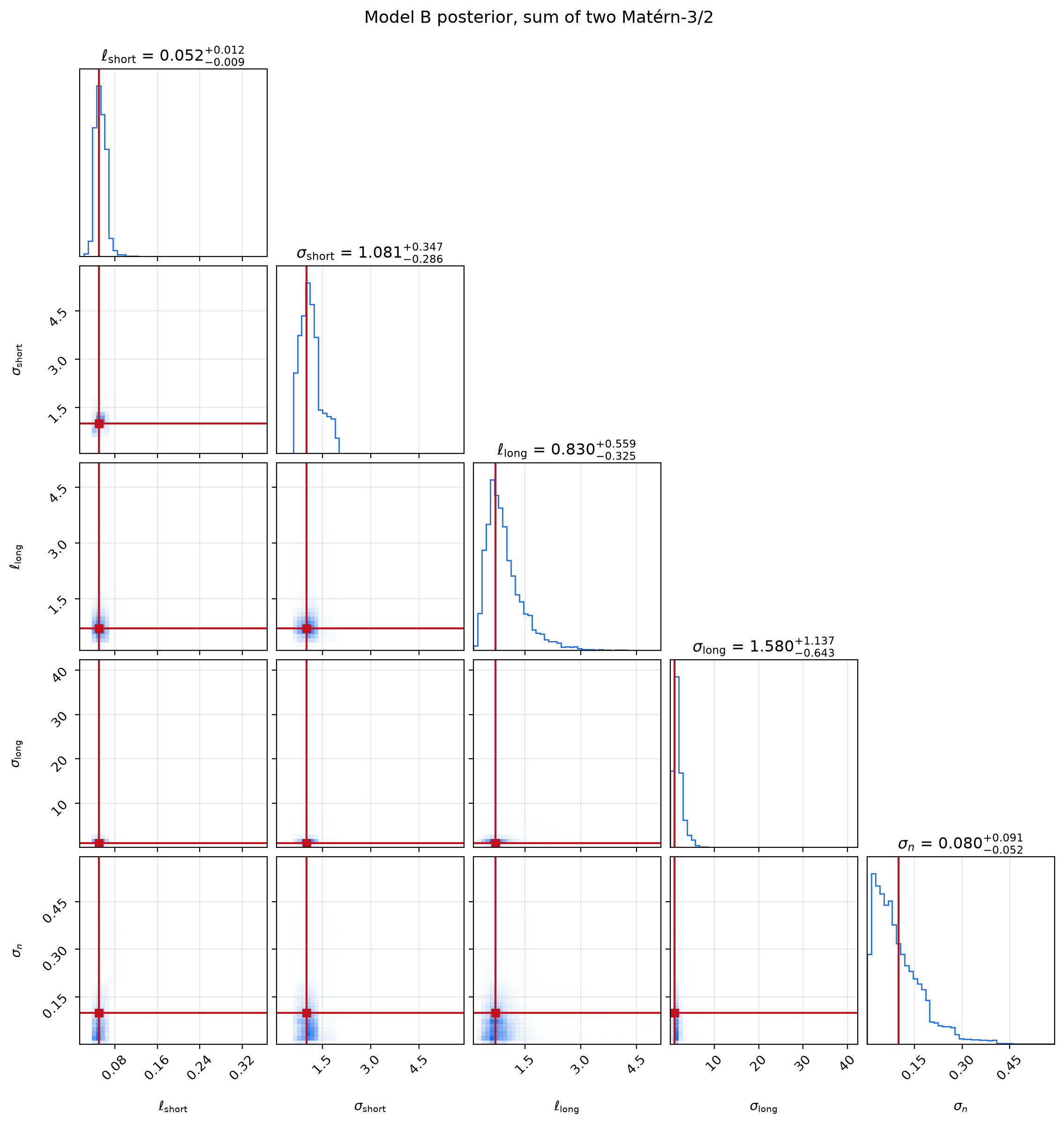
|
Black-box Gibbs density on a spiralA density concentrated on a 3-D spiral, defined only by distance to the curve. DEFER recovers a sampler, the normalising constant, and the shape itself. 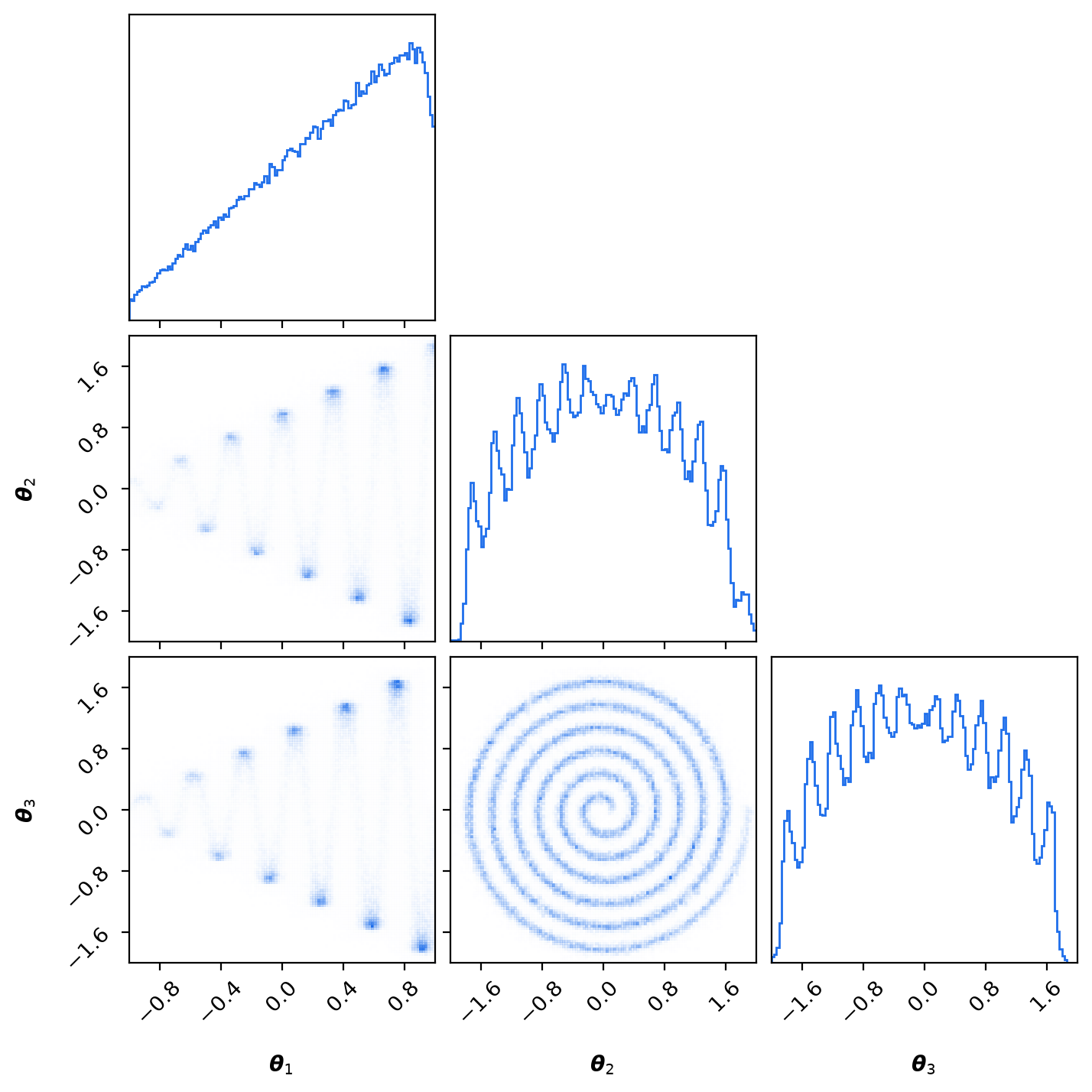
|
Development
make lint        # ruff check + format
make typecheck   # pyright
make test        # pytest (numpy and torch backends)
License
MIT, see LICENSE.
1 maintainer

Metadata
1 maintainer
Release files for deference 0.2.0
For a detailed explanation of source distributions (sdists) and built distributions (wheels), please see the package formats documentation.
Source distribution (sdist)
| File | Size | Uploaded | Provenance | Actions |
|---|---|---|---|---|
| deference-0.2.0.tar.gz | 2.1 MB | Without provenance | Details for deference-0.2.0.tar.gz |
Built distribution (wheel)
| File | Interpreter | ABI | Platform | Actions Reset |
|---|---|---|---|---|
| deference-0.2.0-py3-none-any.whl | Python 3 | none | any | Details for deference-0.2.0-py3-none-any.whl |
Total release size: 2.2 MB
Release files / deference-0.2.0.tar.gz
| Download URL | deference-0.2.0.tar.gz |
|---|---|
| Size | 2.1 MB |
| Tags | Source |
|
SHA-256 checksum How to use checksums |
541a3e979b766deb3741f50f674c4e21cb507c788488a63088d54fa1c642c712
|
|
BLAKE2b-256 checksum How to use checksums |
a40da3430cd3ca7ca025b65a19a59fb4bfc869eb1a8bd8960ecd0eefb8b731eb
|
| Upload date | |
|
Uploaded using Trusted Publishing? What is trusted publishing? |
No |
| Uploaded via |
uv/0.10.12 {"installer":{"name":"uv","version":"0.10.12","subcommand":["publish"]},"python":null,"implementation":{"name":null,"version":null},"distro":{"name":"macOS","version":null,"id":null,"libc":null},"system":{"name":null,"release":null},"cpu":null,"openssl_version":null,"setuptools_version":null,"rustc_version":null,"ci":null}
|
Release files / deference-0.2.0-py3-none-any.whl
| Download URL | deference-0.2.0-py3-none-any.whl |
|---|---|
| Size | 20.7 kB |
| Tags | Python 3 |
|
SHA-256 checksum How to use checksums |
2977d464b7d55abe1aff4efdd40568bca13cc0e1bdb5df098961a10b35aab27d
|
|
BLAKE2b-256 checksum How to use checksums |
ad57f497e4b200e9179e3ce4cd7a9cf86175299540ac829c8171ec025a3c20fe
|
| Upload date | |
|
Uploaded using Trusted Publishing? What is trusted publishing? |
No |
| Uploaded via |
uv/0.10.12 {"installer":{"name":"uv","version":"0.10.12","subcommand":["publish"]},"python":null,"implementation":{"name":null,"version":null},"distro":{"name":"macOS","version":null,"id":null,"libc":null},"system":{"name":null,"release":null},"cpu":null,"openssl_version":null,"setuptools_version":null,"rustc_version":null,"ci":null}
|
Security for deference 0.2.0
Provenance
Provenance describes where a file came from. On PyPI, provenance is shared via attestations, which provide a verifiable record of the build or publishing details. View details, limitations and caveats.
No provenance found
None of the files in this release were uploaded with provenance metadata.
A note on package security
PyPI is a repository for distributing packages, not a service for auditing them. While third-party security researchers and our staff do their best to detect and remove malicious packages, PyPI cannot guarantee the quality, security or suitability of any given package.
To learn more about protecting yourself from malicious actors, visit our package security documentation.














