
MIFARE DESFire for Python


This package provides MIFARE DESFire native communication protocol for NFC cards.
Source code: https://github.com/miohtama/desfire
Documentation: https://desfire.readthedocs.org
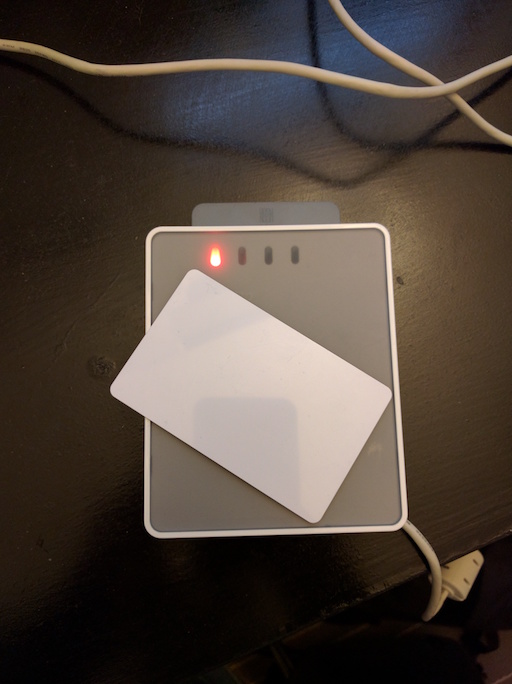
In photo: MIFARE DESFire EV1 8kB blank card with Identive CLOUD 4500 F Dual Interface Reader
Features
Compatibile with USB-based NFC readers via PCSC interface. PCSC API is available on Linux, OSX and Windows. Linux support includes support for Raspberry Pi.
Compatibile with Android mobile phones and their built-in NFC readers. This is done using Kivy cross application Python framework and native Android APIs via pyjnius Python to Java bridging.
Only some of the commands are implemented in the current alpha quality version, please feel free to add more.
Compatible with Python 2 and Python 3
Background
The communication protocol specification is not public. The work is based on reverse engineering existing open source DESFire projects, namely Android host card emulation for DESFire and MIFARE SDK.
Credits
This package was created with Cookiecutter and the audreyr/cookiecutter-pypackage project template.
History
0.2 (2016-03-30)
Added data file read and write
0.1 (2016-03-07)
First release on PyPI.
1 maintainer

Metadata
1 maintainer
Release files for desfire 0.2
For a detailed explanation of source distributions (sdists) and built distributions (wheels), please see the package formats documentation.
Source distribution (sdist)
| File | Size | Uploaded | Provenance | |
|---|---|---|---|---|
| desfire-0.2.tar.gz | 121.2 kB | Without provenance | Details |
Release files / desfire-0.2.tar.gz
| Download URL | desfire-0.2.tar.gz |
|---|---|
| Size | 121.2 kB |
| Tags | Source |
|
SHA-256 checksum How to use checksums |
4314be80f8969cf326d4e58c9e314823782f1d8a1f9e36eb759dfb2f914d8cd5
|
|
BLAKE2b-256 checksum How to use checksums |
360651e05b494294284d923eef5d351e9cfd1078ea66acd988da7060f78cf9b9
|
| Upload date | |
|
Uploaded using Trusted Publishing? What is trusted publishing? |
No |
Security for desfire 0.2
Provenance
Provenance describes where a file came from. On PyPI, provenance is shared via attestations, which provide a verifiable record of the build or publishing details. View details, limitations and caveats.
No provenance found
None of the files in this release were uploaded with provenance metadata.
A note on package security
PyPI is a repository for distributing packages, not a service for auditing them. While third-party security researchers and our staff do their best to detect and remove malicious packages, PyPI cannot guarantee the quality, security or suitability of any given package.














