
django-lucus
django-lucus is a custom theme for Django’s built-in admin (django.contrib.admin): refreshed layout, bundled color schemes, and a multi-column dashboard on /admin/ by default (not the stock flat app list). You shape columns and links with LUCUS_DASHBOARD; leave it unset and Lucus builds columns from your registered apps. Install the lucus app. Admin URLs stay the same as in your project (often /admin/, from urls.py).
- Appearance: Lucus replaces the admin “chrome” templates and loads CSS in order:
lucus/css/style.css→lucus-admin.css→ the selected palette filelucus/css/schemes/<slug>.css. - Navigation: Django’s default admin app sidebar is turned off (
AdminSite.enable_nav_sidebar = False). - Per signed-in user: chosen palette and light / dark / system appearance are stored in
LucusAdminUiPreference. - Nav inside the admin: with
LUCUS_SIDE_DASHBOARD_NAV(on by default), pages other than the index get a side or off-canvas menu in the same spirit as the home dashboard. - Lists and edit forms: bulk-action bars default to both above and below the changelist; save / delete controls on object forms can sit in a fixed bar at the bottom of the viewport. Project-wide toggles are
LUCUS_ACTIONS_ON_TOPandLUCUS_ACTIONS_ON_BOTTOMin the settings table below; eachModelAdminsubclass can still override behavior the usual Django way.
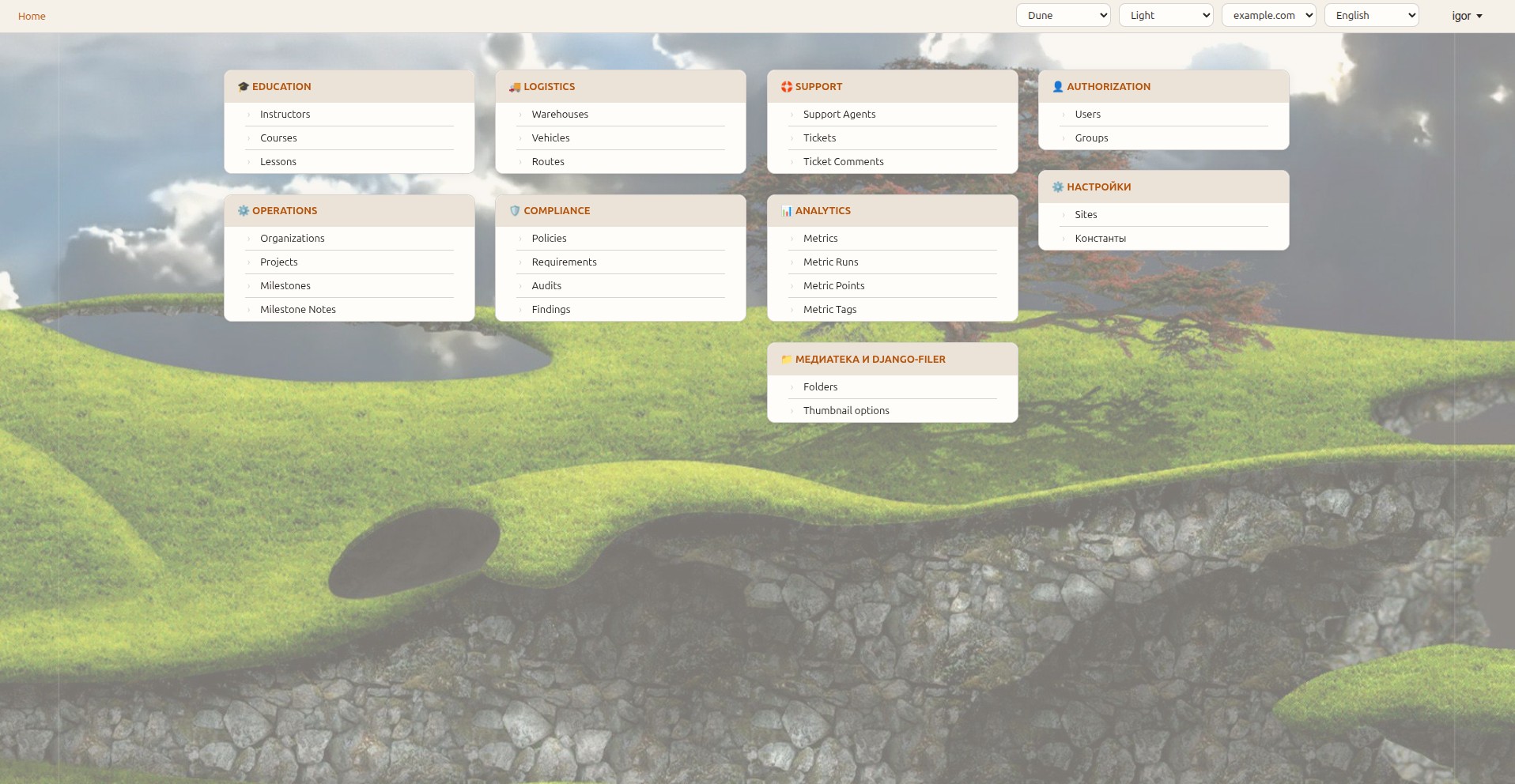
Index: multi-column LUCUS_DASHBOARD cards; header — palette, appearance, optional site / language selectors, user menu.
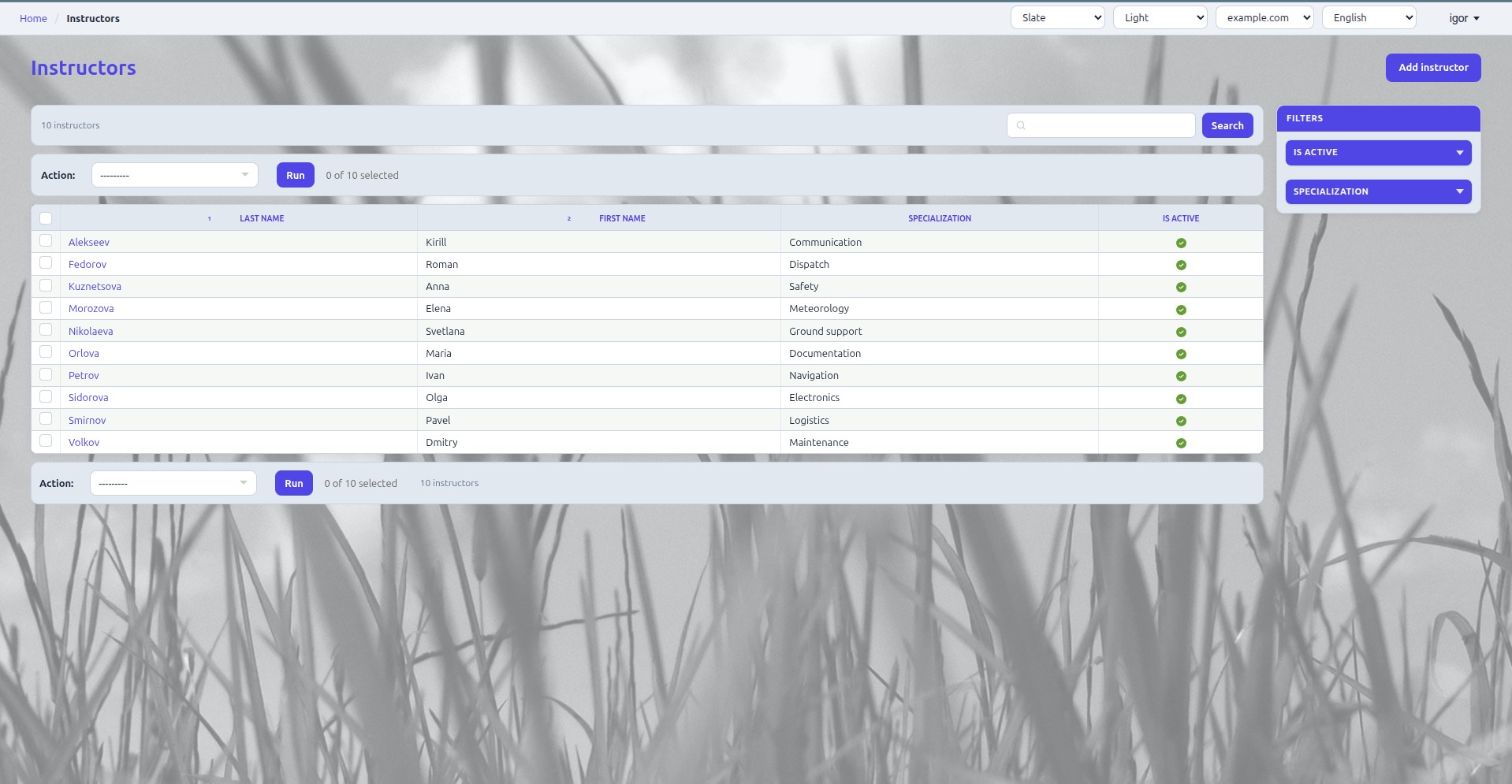
Changelist: breadcrumbs, toolbar (pagination + search), bulk actions, results table, filter aside.
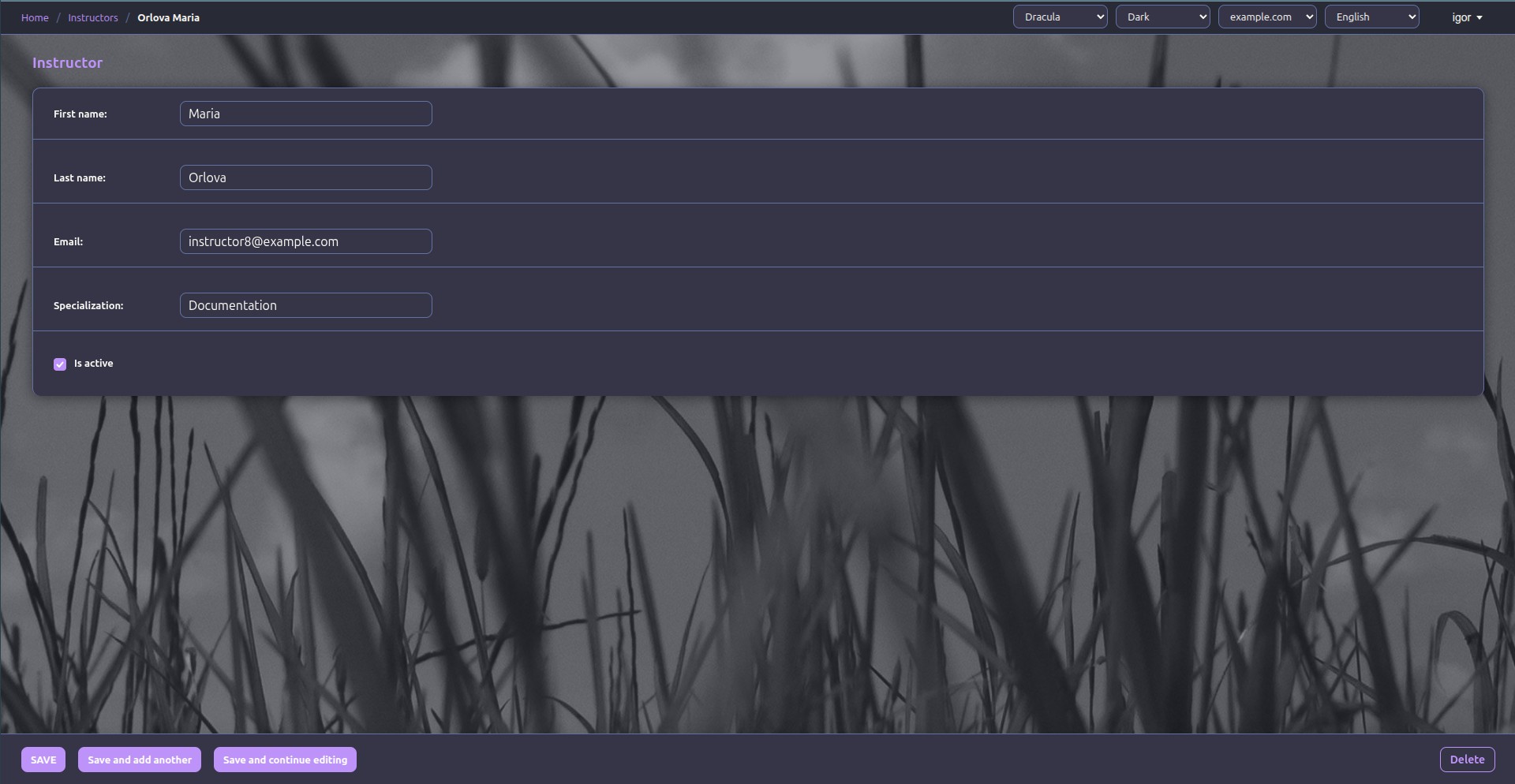
Change form: fieldsets; fixed bottom action bar (save / delete). Palette and appearance are per-user (LucusAdminUiPreference).
Requirements
- Python ≥ 3.10
- Django:
>=5.2,<7(pyproject.toml)
Install
pip install django-lucus
Setup
Add lucus to INSTALLED_APPS and place it above django.contrib.admin:
INSTALLED_APPS = [
    # ...
    "lucus",
    "django.contrib.admin",
]
If another installed app defines the same template path as Lucus, lucus must come before it in the list; otherwise Django will load the wrong template. A common case is Rosetta: Lucus ships lucus/templates/rosetta/…. If rosetta appears earlier, those pages won’t use Lucus’s wrappers.
Then:
python manage.py migrate lucus
In production, run collectstatic so lucus/static/ is served.
Settings
| Setting | Type | Default | Effect |
|---|---|---|---|
SITE_NAME |
str |
"Site" |
LUCUS_ADMIN_SITE_HEADER_TEMPLATE / site_title |
LUCUS_ADMIN_SITE_HEADER_TEMPLATE |
str |
"Administration — {site}" |
admin.site.site_header = .format(site=SITE_NAME); only {site} or escape other {} |
LUCUS_ADMIN_SITE_TITLE_USE_SITE_NAME |
bool |
True |
admin.site.site_title = SITE_NAME if true |
LUCUS_ADMIN_BACKGROUND_IMAGE |
str / Path |
"" |
Full-page background: http(s)://, //, site path /…, or static path (no ..) |
LUCUS_ADMIN_BACKGROUND_SCRIM_OPACITY |
float |
0.88 |
Overlay on image, 0.0…1.0 |
LUCUS_ADMIN_LANGUAGE_SELECTOR |
bool |
(auto) | False → hide header language <select>. Shown only if USE_I18N, len(LANGUAGES) > 1, LocaleMiddleware, set_language URL exists |
LUCUS_ADMIN_SITE_SELECTOR |
bool |
(auto) | False → hide django.contrib.sites header switcher. Shown if sites app + ≥2 Site rows |
LUCUS_ADMIN_SITES |
AdminSite / list / tuple |
None |
AdminSite instances Lucus patches (each_context, get_urls, headers, …). Default: django.contrib.admin.site only. Example: LUCUS_ADMIN_SITES = (admin.site, my_site). base.html forms use {% url 'admin:lucus_save_ui' %}; other namespaces may need template overrides. |
LUCUS_STAFF_THEME_PATH_PREFIXES |
tuple / list / str |
see below | Staff: merge AdminSite.each_context on these URL prefixes (admin-like templates without admin_view). Default: /logs/, /rosetta/, /explorer/. () disables. |
LUCUS_UI |
dict |
{} |
See below |
LUCUS_EXTRA_STATIC_CSS |
str / list / tuple |
() |
Extra CSS after palette; no .., no leading / |
LUCUS_EMPTY_VALUE_DISPLAY_WRAP |
bool |
True |
Wrap empty changelist cells in lucus-admin-empty |
LUCUS_EMPTY_VALUE_PLACEHOLDER |
str |
"—" |
empty_value_display text |
LUCUS_ACTIONS_ON_BOTTOM |
bool |
True |
Default ModelAdmin.actions_on_bottom at class level; override per subclass |
LUCUS_ACTIONS_ON_TOP |
bool |
True |
Default ModelAdmin.actions_on_top at class level |
LUCUS_DASHBOARD |
list / None |
None |
Dashboard; None → built-in grouped layout |
LUCUS_DASHBOARD_APPEND_UNCOVERED |
bool |
True |
Grouped mode: append uncovered apps to last column |
LUCUS_SIDE_DASHBOARD_NAV |
bool |
True |
Non-index admin: collapsible left nav from LUCUS_DASHBOARD column order. Off on index, popups, no permission |
Palette / appearance: not in settings; stored per user. Slugs → lucus/static/lucus/css/schemes/<slug>.css. Context: lucus.theme.lucus_admin_extra_context via admin.site.each_context.
LUCUS_UI
| Key | Default | Effect |
|---|---|---|
help_as_icon |
True |
Field help_text behind ? / <details> |
high_contrast_toggle |
False |
User menu: high contrast (localStorage, data-lucus-contrast on <html>) |
clean_input_types |
False |
Map common HTML5 input types to text in admin (cf. Grappelli GRAPPELLI_CLEAN_INPUT_TYPES) |
LUCUS_UI = {
    "help_as_icon": True,
    "high_contrast_toggle": False,
    "clean_input_types": False,
}
With help_as_icon: True, inline ? help closes when you click outside the popover (Lucus JS on all admin pages).
Changelist pagehead actions
Lucus renders the changelist title row in admin/change_list.html (.lucus-changelist__pagehead). Extra controls belong there, not in the stock object-tools block (which Lucus leaves empty by default).
Without overriding templates: set a class attribute on your ModelAdmin:
| Key | Meaning |
|---|---|
label |
Visible caption |
method |
"get" (default) or "post" |
url |
Absolute or site-relative URL for GET / POST target |
urlname |
Django URL name passed to {% url %} (e.g. admin:myapp_mymodel_myaction) |
js_handler |
Name of a global window.<name>(button, event) for a <button type="button"> |
event |
If set, clicking dispatches CustomEvent("lucus:pagehead-action", { detail: { action, element } }) on document |
POST actions render a small form with {% csrf_token %}. For layout next to links, you may add CSS class lucus-changelist__pagehead-form--contents on <form> (display: contents) when you inject markup via {% block object-tools-items %}.
Template hook: override {% block object-tools-items %} in admin/change_list.html (same row as “Add”, inside .lucus-changelist__pagehead-actions). Use class lucus-changelist__addlink on <a> / <button> for matching chrome.
class MyModelAdmin(admin.ModelAdmin):
    lucus_changelist_pagehead_actions = (
        {"label": "Export CSV", "method": "get", "urlname": "admin:myapp_mymodel_export"},
        {"label": "Rebuild", "method": "post", "urlname": "admin:myapp_mymodel_rebuild"},
        {"label": "Client action", "js_handler": "myPageheadHandler"},
    )
Run python manage.py migrate lucus so LucusAdminUiPreference exists; if the table is missing, Lucus still saves palette / appearance via cookies for POST /admin/lucus/save-ui/, but DB persistence needs the migration applied.
Sortable tabular inlines & placeholder inlines
- Drag-sort rows —
lucus.inlines.LucusSortableTabularInlineorLucusSortableTabularInlineMixin+admin.TabularInline.sortable_field_name, optionalsortable_excludes. Docstring:lucus/inlines.py. - Inline between fieldsets —
fieldsetsentry withfields: (),classescontaining"placeholder"and inline wrapper id (<formset.prefix>-group, e.g.items_set-group).
Third-party CSS (lucus/static/lucus/css/third_party/)
No extra Python deps. Non-admin/base.html staff views: LUCUS_STAFF_THEME_PATH_PREFIXES + lucus.context_processors.staff_integrations_theme.
| Package | File | Included from |
|---|---|---|
| django-constance | lucus/css/third_party/constance.css |
admin/base.html |
| django-filer | lucus/css/third_party/filer.css |
admin/base.html |
| django-parler | lucus/css/third_party/parler.css |
admin/base.html |
| django-rosetta | lucus/css/third_party/rosetta.css |
rosetta/base.html |
| django-log-viewer (compatible) | lucus/css/third_party/log_viewer.css |
log_viewer/logfile_viewer.html |
LUCUS_DASHBOARD
Context: lucus_dashboard_columns from get_dashboard_for_request. Section link: {"label", "url"} or {"label", "admin_urlname"}. Section omitted if no link resolves.
Layout: [{ "column"?: 1–4, "classes"?: str, "sections": [{ "title", "links": [...] }] }, …]. Same column merges sections; classes from first dict.
Groups: [{ "column", "title", "links"?: [...], "app_labels"?: set|list|tuple|frozenset }, …]. links then models from app_labels; duplicate URLs dropped. list/tuple app_labels preserves order; set uses get_app_list order.
LUCUS_DASHBOARD_APPEND_UNCOVERED: True → unreferenced apps to last column; False → configured only.
LUCUS_DASHBOARD = [
    {
        "column": 1,
        "classes": "lucus-dashboard__col lucus-grid__col lucus-grid__col--3 lucus-grid__col--md-6 lucus-grid__col--sm-12 lucus-grid__col--xs-12",
        "sections": [
            {
                "title": "Education",
                "links": [
                    {"label": "Instructors", "admin_urlname": "admin:academy_instructor_changelist"},
                    {"label": "Courses", "url": "/admin/academy/course/"},
                ],
            },
        ],
    },
]
LUCUS_DASHBOARD = [
    {"column": 1, "title": "Authorization", "app_labels": {"auth"}},
]
LUCUS_DASHBOARD = [
    {
        "column": 2,
        "title": "Auth",
        "links": [{"label": "Users", "admin_urlname": "admin:auth_user_changelist"}],
        "app_labels": ("auth",),
    },
]
Stylesheet order
lucus/css/style.css → lucus/css/lucus-admin.css → lucus/css/schemes/<slug>.css → LUCUS_EXTRA_STATIC_CSS. Admin widget/inline/action JS: django.contrib.admin.
Custom palette: static lucus/css/<slug>.css + extend lucus.theme.BUNDLED_COLOR_SCHEMES.
admin/change_list_results.html overridden: .text before .sortoptions inside .lucus-th-heading-inner (replaces stock float sort icon layout).
Tests
pip install -r requirements-dev.txt
pytest
Python modules
| Module | Role |
|---|---|
lucus.apps.LucusConfig |
ready(): headers, each_context, dashboard context, lucus_save_ui / lucus_save_site, enable_nav_sidebar, empty_value_display, ModelAdmin action defaults, changelist_view injects lucus_changelist_pagehead_actions |
lucus.dashboard |
Normalize LUCUS_DASHBOARD |
lucus.models |
LucusAdminUiPreference |
lucus.theme |
Bundled schemes, lucus_admin_extra_context |
lucus.views |
POST handlers UI / site |
If you use the header site switcher and want request.site on each request to match that choice, register lucus.sites_panel.LucusAdminSiteMiddleware immediately after SessionMiddleware. Setup details are in the lucus.sites_panel module.
This repo includes an integration/ demo app and requirements-integration.txt; optional pip install -e ".[integration]". Use the root manage.py with core.settings; some demos expect sorl.thumbnail to be installed.
1 maintainer

Metadata
1 maintainer
Release files for django-lucus 0.1.10
For a detailed explanation of source distributions (sdists) and built distributions (wheels), please see the package formats documentation.
Source distribution (sdist)
| File | Size | Uploaded | Provenance | Actions |
|---|---|---|---|---|
| django_lucus-0.1.10.tar.gz | 108.7 kB | Without provenance | Details for django_lucus-0.1.10.tar.gz |
Built distribution (wheel)
| File | Interpreter | ABI | Platform | Actions Reset |
|---|---|---|---|---|
| django_lucus-0.1.10-py3-none-any.whl | Python 3 | none | any | Details for django_lucus-0.1.10-py3-none-any.whl |
Total release size: 236.5 kB
Release files / django_lucus-0.1.10.tar.gz
| Download URL | django_lucus-0.1.10.tar.gz |
|---|---|
| Size | 108.7 kB |
| Tags | Source |
|
SHA-256 checksum How to use checksums |
d5c9c1b90cff2a914872caa3e2acb8f337923dafa8d2ac31883fbc6a6fa763cf
|
|
BLAKE2b-256 checksum How to use checksums |
42951fa50ffc2705d44d97c7bf3c9e656834fe3f21d02aa5a07c7c064c6a243f
|
| Upload date | |
|
Uploaded using Trusted Publishing? What is trusted publishing? |
No |
| Uploaded via |
twine/6.2.0 CPython/3.12.3
|
Release files / django_lucus-0.1.10-py3-none-any.whl
| Download URL | django_lucus-0.1.10-py3-none-any.whl |
|---|---|
| Size | 127.8 kB |
| Tags | Python 3 |
|
SHA-256 checksum How to use checksums |
3438e89dfc8c59888d3a49ba5dfdf3edffd2a60a700d6efdd5658eea2eee3a57
|
|
BLAKE2b-256 checksum How to use checksums |
23a40b66fd586b05588cef55cda1819d595490535629301b402ec16d048f9ccd
|
| Upload date | |
|
Uploaded using Trusted Publishing? What is trusted publishing? |
No |
| Uploaded via |
twine/6.2.0 CPython/3.12.3
|
Security for django-lucus 0.1.10
Provenance
Provenance describes where a file came from. On PyPI, provenance is shared via attestations, which provide a verifiable record of the build or publishing details. View details, limitations and caveats.
No provenance found
None of the files in this release were uploaded with provenance metadata.
A note on package security
PyPI is a repository for distributing packages, not a service for auditing them. While third-party security researchers and our staff do their best to detect and remove malicious packages, PyPI cannot guarantee the quality, security or suitability of any given package.
To learn more about protecting yourself from malicious actors, visit our package security documentation.














