
django-tables2 - An app for creating HTML tables


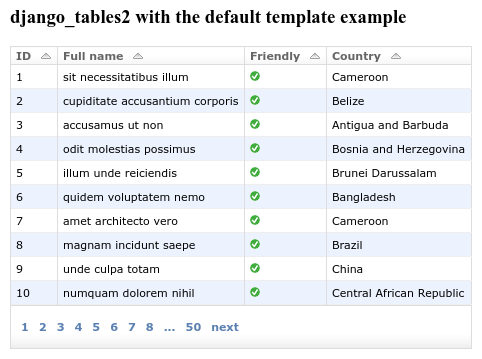
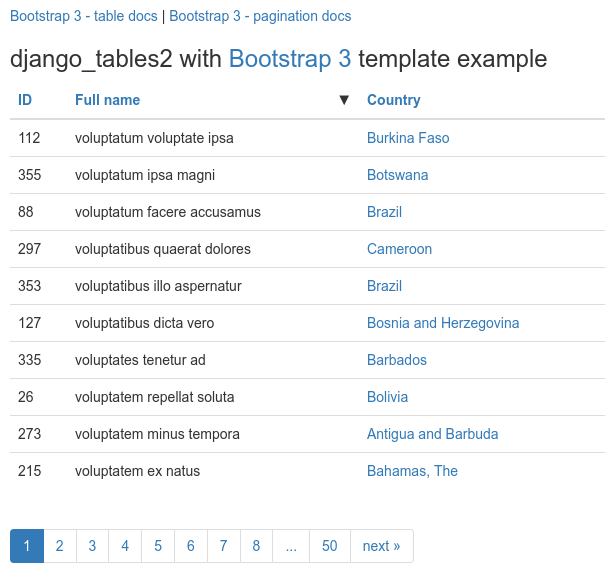
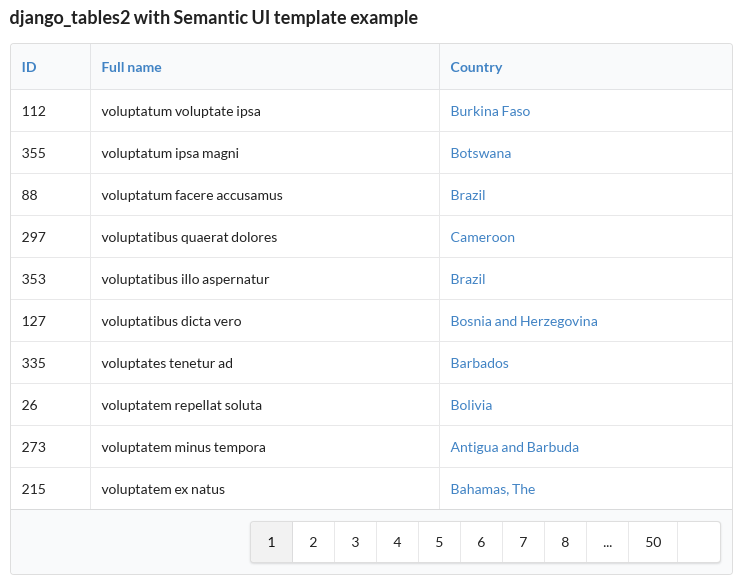
django-tables2 simplifies the task of turning sets of data into HTML tables. It
has native support for pagination and sorting. It does for HTML tables what
django.forms does for HTML forms. e.g.
- Available on pypi as django-tables2
- Tested against currently supported versions of Django and supported python 3 versions Django supports.
- Documentation on readthedocs.org
- Bug tracker
Features:
- Any iterable can be a data-source, but special support for Django
QuerySetsis included. - The builtin UI does not rely on JavaScript.
- Support for automatic table generation based on a Django model.
- Supports custom column functionality via subclassing.
- Pagination.
- Column based table sorting.
- Template tag to enable trivial rendering to HTML.
- Generic view mixin.
Example
Start by adding django_tables2 to your INSTALLED_APPS setting like this:
INSTALLED_APPS = (
    ...,
    "django_tables2",
)
Creating a table for a model Simple is as simple as:
import django_tables2 as tables

class SimpleTable(tables.Table):
    class Meta:
        model = Simple
This would then be used in a view:
class TableView(tables.SingleTableView):
    table_class = SimpleTable
    queryset = Simple.objects.all()
    template_name = "simple_list.html"
And finally in the template:
{% load django_tables2 %}
{% render_table table %}
This example shows one of the simplest cases, but django-tables2 can do a lot more! Check out the documentation for more details.
2 maintainers


Metadata
2 maintainers
Release files for django-tables2 3.0.1
For a detailed explanation of source distributions (sdists) and built distributions (wheels), please see the package formats documentation.
Source distribution (sdist)
| File | Size | Uploaded | Provenance | |
|---|---|---|---|---|
| django_tables2-3.0.1.tar.gz | 130.3 kB | Without provenance | Details |
Built distribution (wheel)
| File | Interpreter | ABI | Platform | Reset |
|---|---|---|---|---|
| django_tables2-3.0.1-py3-none-any.whl | Python 3 | none | any | Details |
Total release size: 226.7 kB
Release files / django_tables2-3.0.1.tar.gz
| Download URL | django_tables2-3.0.1.tar.gz |
|---|---|
| Size | 130.3 kB |
| Tags | Source |
|
SHA-256 checksum How to use checksums |
5a8b51b6c18ce5ec4edd4d0f23c55a8b15590854168b2e5c734118ee369dcbfd
|
|
BLAKE2b-256 checksum How to use checksums |
87c4ac3eee8fb075e0b945452780f876cdad72caff38dba84df7df42c9cc8763
|
| Upload date | |
|
Uploaded using Trusted Publishing? What is trusted publishing? |
No |
| Uploaded via |
Hatch/1.18.0 {"ci":null,"cpu":"arm64","distro":{"name":"macOS","version":"15.5"},"implementation":{"name":"CPython","version":"3.14.6"},"installer":{"name":"hatch","version":"1.18.0"},"openssl_version":"OpenSSL 3.6.3 9 Jun 2026","python":"3.14.6","system":{"name":"Darwin","release":"24.5.0"}} HTTPX2/2.12.0
|
Release files / django_tables2-3.0.1-py3-none-any.whl
| Download URL | django_tables2-3.0.1-py3-none-any.whl |
|---|---|
| Size | 96.4 kB |
| Tags | Python 3 |
|
SHA-256 checksum How to use checksums |
cfabaeeb4b5c4df0844ab0b3f634263deeb131ba2f3174fa5d3e15975047e881
|
|
BLAKE2b-256 checksum How to use checksums |
43e76a75201123d94d0644588b40cc759dc88df50fa917d121046de5b182ec43
|
| Upload date | |
|
Uploaded using Trusted Publishing? What is trusted publishing? |
No |
| Uploaded via |
Hatch/1.18.0 {"ci":null,"cpu":"arm64","distro":{"name":"macOS","version":"15.5"},"implementation":{"name":"CPython","version":"3.14.6"},"installer":{"name":"hatch","version":"1.18.0"},"openssl_version":"OpenSSL 3.6.3 9 Jun 2026","python":"3.14.6","system":{"name":"Darwin","release":"24.5.0"}} HTTPX2/2.12.0
|
Security for django-tables2 3.0.1
Provenance
Provenance describes where a file came from. On PyPI, provenance is shared via attestations, which provide a verifiable record of the build or publishing details. View details, limitations and caveats.
No provenance found
None of the files in this release were uploaded with provenance metadata.
A note on package security
PyPI is a repository for distributing packages, not a service for auditing them. While third-party security researchers and our staff do their best to detect and remove malicious packages, PyPI cannot guarantee the quality, security or suitability of any given package.
To learn more about protecting yourself from malicious actors, visit our package security documentation.














