
DLens
GPS for your data: trace any dbt column to its source, see what breaks before you change it, with the file and line for every step.



Live demo: https://dlens-lineage.streamlit.app/. Ask where a column comes from or what it affects in a 15-model dbt project. It needs no install and no key.
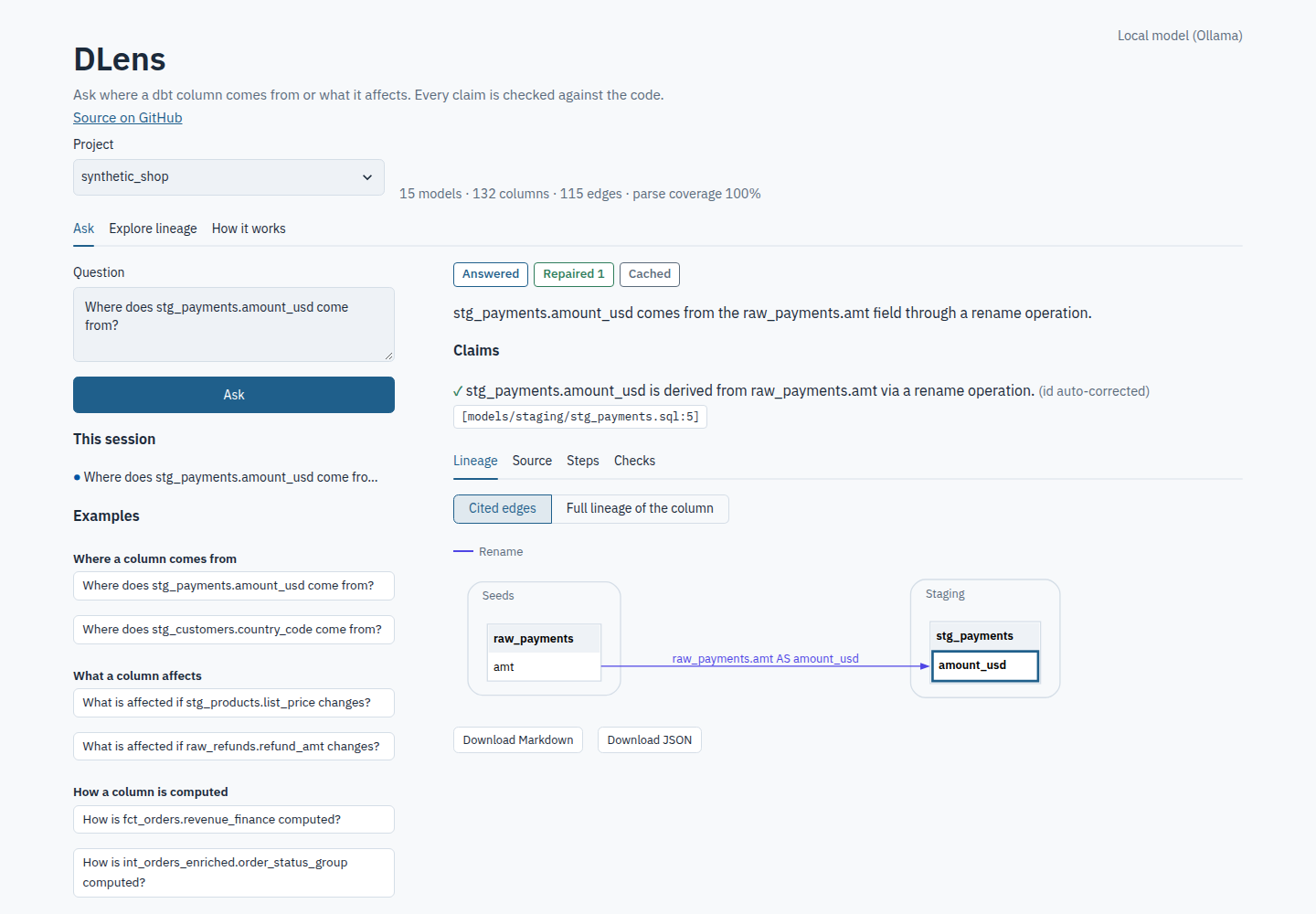
How the agent works, in three lines:
- Tools query the lineage graph (trace, impact, model SQL) and return ids; code attaches each id's file and line.
- The model only narrates those tool results, citing the ids.
- A validator checks every claim against the graph and the files on disk (nine rules) and removes what fails, so what you see is what the code supports.
DLens reads a dbt project, parses the compiled SQL with sqlglot against the real warehouse schema, and builds a column-level lineage graph. Every edge records how a column is derived (rename, transformation, aggregation, ...), the expression, and where in the model file it lives.
Status
v0.2.0: lineage CLI + cited Q&A agent + UI. It works on DuckDB dbt projects (dbt-core 1.12, dbt-duckdb 1.11), Python 3.12 and 3.13. The agent runs on a local model (Ollama) or Gemini. On the 20 hand-written dev questions it passes 18 with local qwen3:4b; that is a dev check, not the benchmark, which is v1.0 (see the roadmap).
Quickstart
pip install dlens-lineage
git clone --depth 1 https://github.com/harshith769/dlens.git   # for the example projects
cd dlens

dlens ingest corpora/jaffle_shop                      # runs dbt, shows what DLens will see
dlens trace customers.customer_lifetime_value -p corpora/jaffle_shop
dlens impact stg_orders.order_id -p corpora/jaffle_shop
dlens report -p corpora/jaffle_shop                   # parse quality per model
Use your own project the same way: dlens ingest path/to/dbt_project (DuckDB profile in the project
directory). ingest runs dbt, so it needs the project's seeds and sources to be buildable. The first
run takes about 10 seconds on jaffle_shop; after that the graph is cached in
target/dlens_graph.json and rebuilt when the manifest, your SQL, or the DLens version changes
(--rebuild forces it). Column ids are model.column.
Example output
The commands below ran on corpora/synthetic_shop, a
15-model project built to contain traps (renames, CASE, multi-hop joins, aggregates). Paths are
relative to the project; long lines are real, not wrapped.
dlens ingest corpora/synthetic_shop
models:      15
seeds:       6
sources:     0
exposures:   0
columns:     132
unmapped relations: 0
dlens trace fct_orders.revenue_finance -p corpora/synthetic_shop
fct_orders.revenue_finance
├─ int_customer_order_history.items_subtotal  [TRANSFORMATION]  int_customer_order_history.items_subtotal - int_customer_or…  models/marts/fct_orders.sql:13-13
│  └─ int_order_financials.items_subtotal  [IDENTITY]  int_order_financials.items_subtotal AS items_subtotal  models/intermediate/int_customer_order_history.sql:2-2
│     └─ int_orders_enriched.items_subtotal  [IDENTITY]  orders.items_subtotal AS items_subtotal  models/intermediate/int_order_financials.sql:23-23
│        └─ int_order_items_enriched.line_amount  [AGGREGATION]  COALESCE(item_agg.items_subtotal, 0) AS items_subtotal <- S…  models/intermediate/int_orders_enriched.sql:24-24
│           ├─ stg_order_items.quantity  [TRANSFORMATION]  items.quantity * items.unit_price AS line_amount  models/intermediate/int_order_items_enriched.sql:8-8
│           │  └─ raw_order_items.quantity  [IDENTITY]  raw_order_items.quantity AS quantity  models/staging/stg_order_items.sql:5-5
│           └─ stg_order_items.unit_price  [TRANSFORMATION]  items.quantity * items.unit_price AS line_amount  models/intermediate/int_order_items_enriched.sql:8-8
│              └─ raw_order_items.unit_price  [IDENTITY]  raw_order_items.unit_price AS unit_price  models/staging/stg_order_items.sql:6-6
└─ int_customer_order_history.refund_amount  [TRANSFORMATION]  int_customer_order_history.items_subtotal - int_customer_or…  models/marts/fct_orders.sql:13-13
   └─ int_order_financials.refund_amount  [IDENTITY]  int_order_financials.refund_amount AS refund_amount  models/intermediate/int_customer_order_history.sql:2-2
      └─ stg_refunds.refund_amt  [AGGREGATION]  COALESCE(refunds_per_order.refund_amount, 0) AS refund_amou…  models/intermediate/int_order_financials.sql:26-26
         └─ raw_refunds.refund_amt  [IDENTITY]  raw_refunds.refund_amt AS refund_amt  models/staging/stg_refunds.sql:4-4

3 path(s), deepest 6 hop(s), 3 origin column(s)
dlens impact raw_orders.tax_usd -p corpora/synthetic_shop
raw_orders.tax_usd
└─ stg_orders.tax_amount  [RENAME]  raw_orders.tax_usd AS tax_amount  models/staging/stg_orders.sql:6-6
   └─ int_orders_enriched.order_tax  [RENAME]  orders.tax_amount AS order_tax  models/intermediate/int_orders_enriched.sql:22-22
      ├─ int_order_financials.order_total  [TRANSFORMATION]  orders.items_subtotal + orders.order_tax AS order_total  models/intermediate/int_order_financials.sql:25-25
      │  └─ int_customer_order_history.order_total  [IDENTITY]  int_order_financials.order_total AS order_total  models/intermediate/int_customer_order_history.sql:2-2
      │     └─ fct_orders.order_total  [IDENTITY]  int_customer_order_history.order_total AS order_total  models/marts/fct_orders.sql:10-10
      └─ int_order_financials.sales_tax  [RENAME]  orders.order_tax AS sales_tax  models/intermediate/int_order_financials.sql:24-24
         └─ int_customer_order_history.sales_tax  [IDENTITY]  int_order_financials.sales_tax AS sales_tax  models/intermediate/int_customer_order_history.sql:2-2
            ├─ fct_orders.revenue_marketing  [TRANSFORMATION]  int_customer_order_history.items_subtotal + int_customer_or…  models/marts/fct_orders.sql:14-14
            │  └─ fct_daily_revenue.revenue_marketing  [AGGREGATION]  SUM(fct_orders.revenue_marketing) AS revenue_marketing  models/marts/fct_daily_revenue.sql:5-5
            └─ fct_orders.sales_tax  [IDENTITY]  int_customer_order_history.sales_tax AS sales_tax  models/marts/fct_orders.sql:9-9
               └─ dim_customers.lifetime_value  [AGGREGATION]  COALESCE(order_agg.lifetime_value, 0) AS lifetime_value <- …  models/marts/dim_customers.sql:21-21

11 affected column(s), 7 model(s)
  depth 1: 1 column(s)
  depth 2: 1 column(s)
  depth 3: 2 column(s)
  depth 4: 2 column(s)
  depth 5: 3 column(s)
  depth 6: 2 column(s)
models: dim_customers, fct_daily_revenue, fct_orders, int_customer_order_history, int_order_financials, int_orders_enriched, stg_orders
exposures: none
dlens report -p corpora/synthetic_shop
Parse quality per model:
  dim_customers               FULL
  fct_daily_revenue           FULL
  fct_orders                  FULL
  fct_payment_events          FULL
  int_customer_order_history  FULL
  int_order_financials        FULL
  int_order_items_enriched    FULL
  int_orders_enriched         FULL
  int_payment_events          FULL
  stg_customers               FULL
  stg_order_items             FULL
  stg_orders                  FULL
  stg_payments                FULL
  stg_products                FULL
  stg_refunds                 FULL

Models: 15 FULL, 0 TABLE_ONLY, 0 FAILED
Edges: 115  (AGGREGATION 14, IDENTITY 58, RENAME 22, TRANSFORMATION 21)
Model-level citations: 0
Low-confidence edges: 0
Deferred indirect (window keys, v0.3): 2
Constant columns (no edges): 0
Ask a question
pip install "dlens-lineage[agent]"
ollama pull qwen3:4b-instruct-2507-q4_K_M        # the default local model
dlens ask "Where does fct_orders.net_paid_usd come from?" -p corpora/synthetic_shop
The answer lists each claim with its file:line citations; --json gives the structured answer.
Each run writes one JSONL record (the draft before validation and the validator's verdict) to
~/.local/state/dlens/runs/.
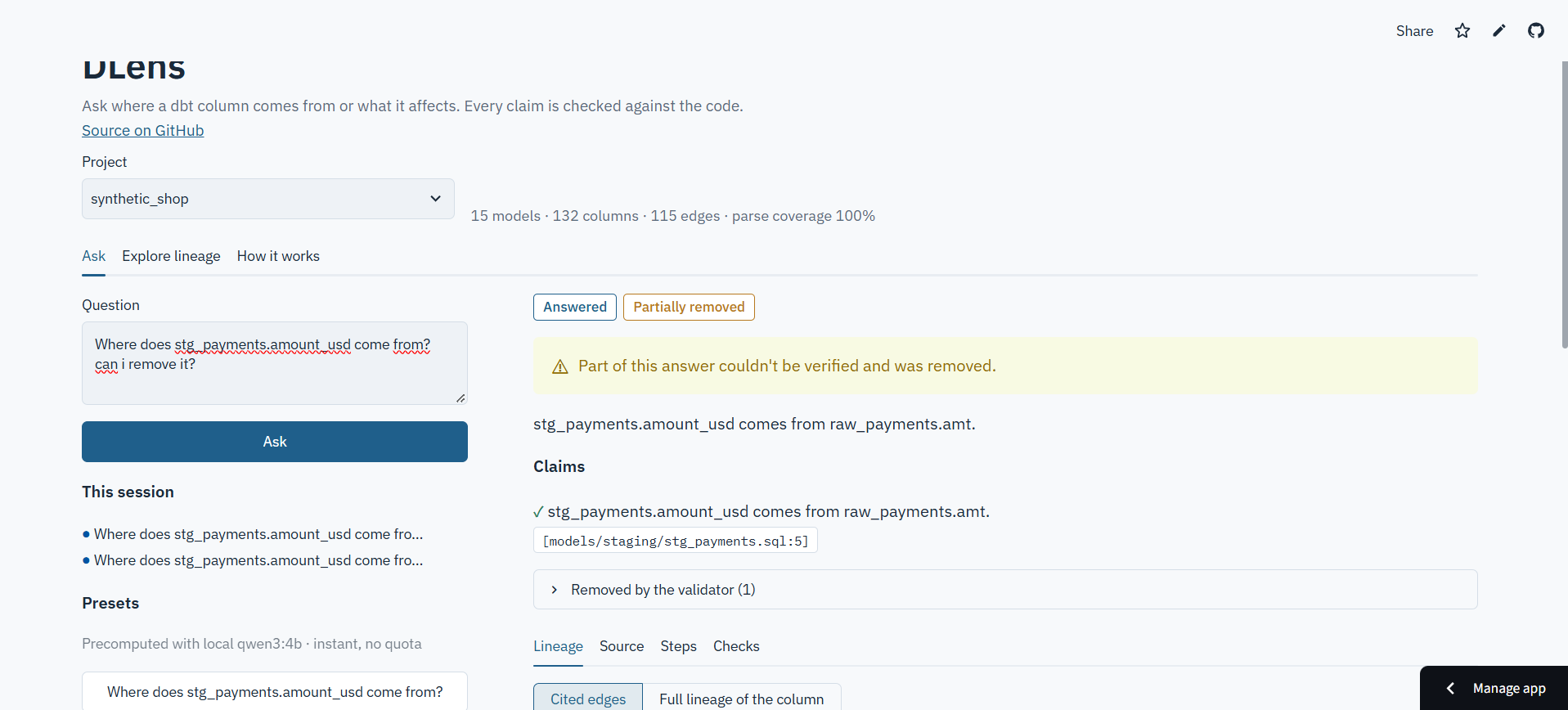
When part of an answer fails a check, that part is removed and the rest stays. The CLI prints "⚠ Part of this answer couldn't be verified and was removed."; the UI marks the answer Partially removed and lists the dropped claims with the rules they failed. This happens, for example, with a two-part question such as "Where does X come from? Can I remove it?", where the second part goes beyond what the lineage tools can show.
Local UI
uv sync --extra agent --extra ui
make ui          # Ask | Explore lineage | How it works (needs Ollama for Ask)
Ask answers a lineage question with a verdict badge, a verification badge, per-claim checks, citation chips that open the cited source lines, a column-level lineage diagram, the agent's steps and the validator's checks. Explore lineage browses the graph directly, with no LLM and no quota. How it works shows the pipeline, the nine validator rules and the current dev score.
The live demo is the same app in demo mode: a prebuilt
graph, 10 precomputed answers that replay with no model call, and live questions on Gemini within
a daily budget. See docs/deploy.md.
Support matrix
DLens is tested construct by construct against golden files. The table, including what is partial, unsupported and untested, is in the construct support matrix.
How it works
 dbt project ──dbt build --empty + docs generate──▶ manifest.json + catalog.json + target/compiled/*.sql
                                                   │
                       catalog columns ──▶ sqlglot schema (every parse is schema-aware)
                                                   │
        compiled SQL (one model) ──sqlglot lineage──▶ column edges + kind + file:lines
                                                   │
                         LineageGraph (NetworkX) ◀─┘──▶ target/dlens_graph.json (cache)
                                  │
                    dlens trace · dlens impact · dlens report
Design notes for each part are in docs/explain/.
Roadmap
- v0.1: lineage CLI.
- v0.2 (this release): a Q&A agent that answers lineage questions by calling these graph tools; every claim carries a file/line citation checked by a validator. A local UI and a public demo.
- v0.3: hybrid retrieval (graph + RAG) and window/join-key (indirect) edges.
- v1.0: a published benchmark against vector-only RAG, with design-authored gold labels.
Limitations
- DuckDB only. Other warehouses may work through sqlglot dialects but are untested.
- Python 3.12 and 3.13 only; dbt-core is pinned to 1.12.x and dbt-duckdb to 1.11.x.
ingestruns dbt in the project directory (it writestarget/andlogs/).- Only value dependencies are edges. Join, filter, GROUP BY and window keys are not edges yet (window keys are recorded as deferred).
- Some constructs are partial or unsupported;
SELECT *over a join with duplicate column names is untested. See the support matrix. - Jinja is handled by dbt, not by DLens: DLens only parses the compiled SQL. If dbt cannot build
the project,
dlens ingestfails with dbt's error. - Diff (comparing the lineage of two columns, e.g. two revenue definitions) is planned for v1.x; comparing two versions of a project is out of scope.
- The agent answers lineage questions only (where a column comes from, what it affects, how it is computed). Other parts of a question are dropped by the validator rather than answered; an explicit "can't answer that part" is planned for v0.3.
- The live demo is capped (50 model calls a day for everyone, 5 questions per visit); the presets always work.
- Pre-1.0: the CLI output and the Python API may change between minor versions.
Credits
sqlglot does the SQL parsing and scope analysis. dbt and dbt-duckdb produce the manifest, catalog and compiled SQL. jaffle_shop is vendored as an example corpus. dbt-colibri is prior art for dbt column lineage and the comparison point for the v1.0 benchmark.
Contributing
See CONTRIBUTING.md. Changes are listed in CHANGELOG.md.
Licence
Apache-2.0. See LICENSE. The vendored jaffle_shop keeps its own licence in
corpora/jaffle_shop/LICENSE.
1 maintainer

Metadata
1 maintainer
Release files for dlens-lineage 0.2.0
For a detailed explanation of source distributions (sdists) and built distributions (wheels), please see the package formats documentation.
Source distribution (sdist)
| File | Size | Uploaded | |
|---|---|---|---|
| dlens_lineage-0.2.0.tar.gz | 113.5 kB | Details |
Built distribution (wheel)
| File | Interpreter | ABI | Platform | Reset |
|---|---|---|---|---|
| dlens_lineage-0.2.0-py3-none-any.whl | Python 3 | none | any | Details |
Total release size: 236.6 kB
Release files / dlens_lineage-0.2.0.tar.gz
| Download URL | dlens_lineage-0.2.0.tar.gz |
|---|---|
| Size | 113.5 kB |
| Tags | Source |
|
SHA-256 checksum How to use checksums |
5e6c1fbfa4e28aef567e62574759e4585bea41a309530e3fc40952a77762cf15
|
|
BLAKE2b-256 checksum How to use checksums |
29ffff184f809430f1afced16baed2b98edaa4987cab7a119d7dfb61fc79f7e7
|
| Upload date | |
|
Uploaded using Trusted Publishing? What is trusted publishing? |
Yes |
| Uploaded via |
twine/7.0.0 CPython/3.13.14
|
Provenance
Provenance describes where a file came from. On PyPI, provenance is shared via attestations, which provide a verifiable record of the build or publishing details. View details, limitations and caveats.


PyPI Publish Attestation
PyPI verified that this artifact, at this checksum, originated from the publisher listed below.
Signed by GitHub Actions, verified by PyPI on Oct 4, 2026.
Transparency logRelease files / dlens_lineage-0.2.0-py3-none-any.whl
| Download URL | dlens_lineage-0.2.0-py3-none-any.whl |
|---|---|
| Size | 123.1 kB |
| Tags | Python 3 |
|
SHA-256 checksum How to use checksums |
bacfd5980423bd8388eb18700ef7d26a6bbf0f4dfbdce6365be13960cd5ee1a4
|
|
BLAKE2b-256 checksum How to use checksums |
e3888a1122bd4f71574b41be436edb79454a303795c12c605eeaf81c4547ab14
|
| Upload date | |
|
Uploaded using Trusted Publishing? What is trusted publishing? |
Yes |
| Uploaded via |
twine/7.0.0 CPython/3.13.14
|
Provenance
Provenance describes where a file came from. On PyPI, provenance is shared via attestations, which provide a verifiable record of the build or publishing details. View details, limitations and caveats.
PyPI Publish Attestation
PyPI verified that this artifact, at this checksum, originated from the publisher listed below.
Signed by GitHub Actions, verified by PyPI on Oct 4, 2026.
Transparency log













