
Documentation | Try it Now | Blog | Join our Community











Easily build agents for the Encord echo system. With just few lines of code, you can take automation to the next level.
python -m pip install encord-agents
Key features:
- ⚡ Easy: Multiple template agents to be adapted and hosted via GCP, own infra, or cloud.
- ⏩ Convenient: The library conveniently loads data via the Encord SDK upon request.
- 👨💻 Focused: With essential resources readily available, you can focus on what matters. Create agents with pre-existing (or custom) dependencies for loading labels and data.
- 🤏 Slim: the library is slim at it's
coreand should not conflict with the dependencies of most projects.
💡 For the full documentation and end-to-end examples, please see here.
Here are some use-cases:
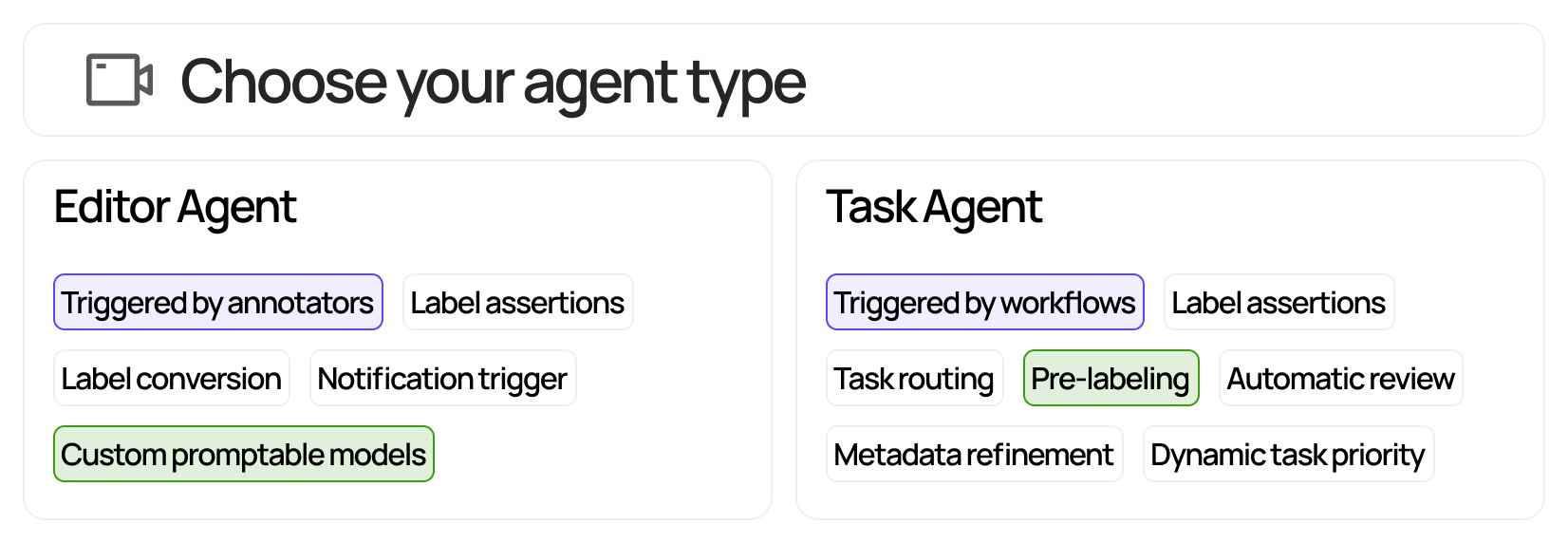
Here's how to build an Agent:
from uuid import UUID
from encord.objects.ontology_labels_impl import LabelRowV2
from encord_agents.tasks import Runner

runner = Runner(project_hash="<your_project_hash>")


@runner.stage("<your_agent_stage_uuid>")
def by_file_name(lr: LabelRowV2) -> UUID | None:
    # Assuming the data_title is of the format "%d.jpg"
    # and in the range [0; 100]
    priority = int(lr.data_title.split(".")[0]) / 100
    lr.set_priority(priority=priority)
    return "<your_pathway_uuid>"


if __name__ == "__main__":
    runner.run()
You can also inject dependencies:
from typing_extensions import Annotated

from encord.objects import LabelRowV2
from encord_agents.tasks import Runner, Depends

runner = Runner(project_hash="<your_project_hash>")

def my_custom_dependency(label_row: LabelRowV2) -> dict:
    # e.g., look up additional data in own db
    return db.query("whatever")

@runner.stage(stage="<my_stage_name>")
def by_custom_data(
    custom_data: Annotated[dict, Depends(my_custom_dependency)]
) -> str:
    # `custom_data` automatically injected here.
    # ... do your thing
    # then, return name of task pathway.


if __name__ == "__main__":
    runner.run()
Please visit our 📖 Documentation for a complete reference to how to use the agents library.
1 maintainer

Metadata
1 maintainer
Release files for encord-agents 0.1.6
For a detailed explanation of source distributions (sdists) and built distributions (wheels), please see the package formats documentation.
Source distribution (sdist)
| File | Size | Uploaded | Provenance | |
|---|---|---|---|---|
| encord_agents-0.1.6.tar.gz | 43.0 kB | Without provenance | Details |
Built distribution (wheel)
| File | Interpreter | ABI | Platform | Reset |
|---|---|---|---|---|
| encord_agents-0.1.6-py3-none-any.whl | Python 3 | none | any | Details |
Total release size: 98.2 kB
Release files / encord_agents-0.1.6.tar.gz
| Download URL | encord_agents-0.1.6.tar.gz |
|---|---|
| Size | 43.0 kB |
| Tags | Source |
|
SHA-256 checksum How to use checksums |
fa8a5e394adfdc8321bfe686834d593af8109e1059be395f02c462b1d7ad21ee
|
|
BLAKE2b-256 checksum How to use checksums |
839e78cba833b7f98049042b239f47e49cf7eafa7c62e4a459cd6367d48d8f2e
|
| Upload date | |
|
Uploaded using Trusted Publishing? What is trusted publishing? |
No |
| Uploaded via |
poetry/1.8.3 CPython/3.11.6 Linux/6.8.0-1017-azure
|
Release files / encord_agents-0.1.6-py3-none-any.whl
| Download URL | encord_agents-0.1.6-py3-none-any.whl |
|---|---|
| Size | 55.3 kB |
| Tags | Python 3 |
|
SHA-256 checksum How to use checksums |
d7e2b91cf328050c1503bb4c4a31b6eb3f148f508eda5459e47f9fc33a902514
|
|
BLAKE2b-256 checksum How to use checksums |
ed7c80fd0713a2cdf01ac3f3e0d2373209e64e0a4999a33e79144b2ce65c53cc
|
| Upload date | |
|
Uploaded using Trusted Publishing? What is trusted publishing? |
No |
| Uploaded via |
poetry/1.8.3 CPython/3.11.6 Linux/6.8.0-1017-azure
|
Security for encord-agents 0.1.6
Provenance
Provenance describes where a file came from. On PyPI, provenance is shared via attestations, which provide a verifiable record of the build or publishing details. View details, limitations and caveats.
No provenance found
None of the files in this release were uploaded with provenance metadata.
A note on package security
PyPI is a repository for distributing packages, not a service for auditing them. While third-party security researchers and our staff do their best to detect and remove malicious packages, PyPI cannot guarantee the quality, security or suitability of any given package.
To learn more about protecting yourself from malicious actors, visit our package security documentation.














