flexible-clustering-tree
What’s this?
In the context of clustering task, flexible-clustering-tree
provides you easy and controllable clustering framework.
|image0|
Background
Let’s suppose, you have huge data. You’d like to observe data as easy as possible.
Hierarchical clustering is a way to see clustering tree. However, hierarchical clustering tends to fall into local optimization.
So, you need other clustering method. But at the same time, you wanna observe your data with tree structure style.
here, flexible-clustering-tree could give you simple way from data
into tree viewer(d3 based)
You could set any kinds of clustering algorithm such as Kmeans, DBSCAN, Spectral-Clustering.
Multi feature and Multi clustering
During making a tree, you might want use various kind of clustering algorithm. For example, you use Kmeans for the 1st later of a tree, and DBSCAN for the 2nd layer of a tree.
And you might also use various kind of feature type depending on a layer of a tree. For example, in the context of document clustering, “title” of news for the 1st layer, and “whole text” for the 2nd layer.
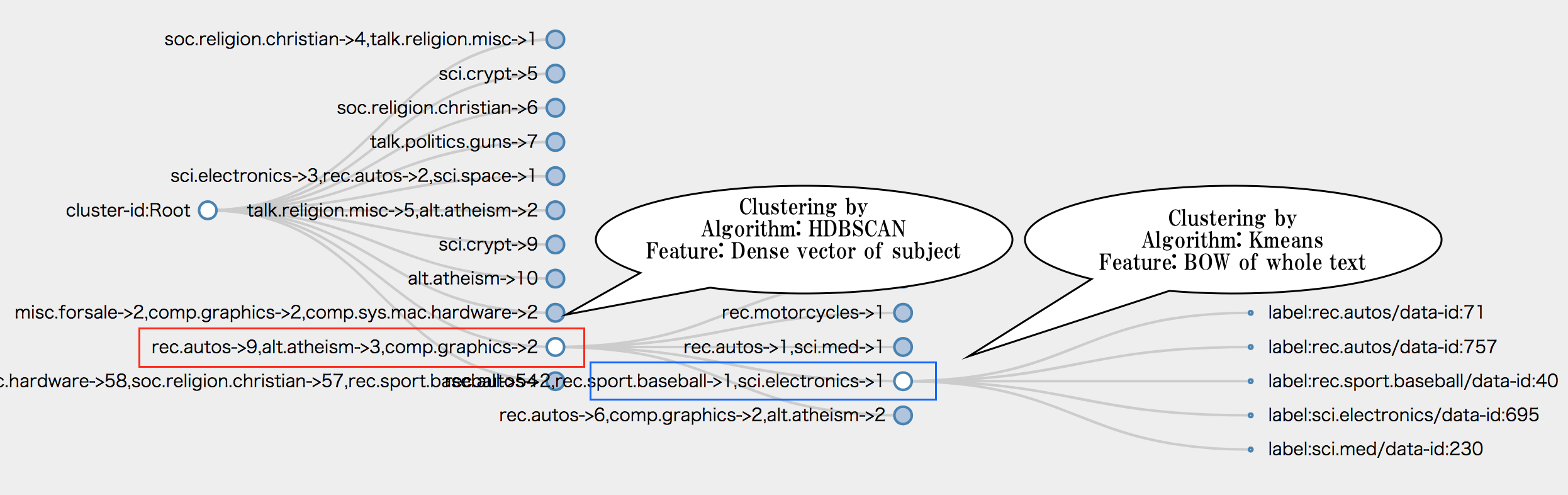
The example below, this is a clustering tree of 20-news data set.
- 1st layer(red highlight) is done with HDBSCAN clustering, and feature
is dense vector of
Subjecttext, which is converted by word2vec model. - 2nd layer(blue highlight) is done with Kmeans, and feature is sparse vector of whole text(BOW).
You could design your clustering tree as you want!
|image1|
Both are possible flexible-clustering-tree!
Contribution
- Easy interface(scikit-learn way) from data(feature matrix) into a tree viewer
- Possible to make various clustering algorithms ensemble
- Possible to set various feature types
How to use?
.. code:: python
from flexible_clustering_tree import FeatureMatrixObject, MultiFeatureMatrixObject from flexible_clustering_tree import ClusteringOperator, MultiClusteringOperator from flexible_clustering_tree import FlexibleClustering import numpy import codecs
set feature matrix
an input of 1st layer is list of string
input_string = ['d'] * 10 + ['e'] * 10 + ['c'] * 10 + ['a'] * 10 + ['b'] * 10 + ['f'] * 50 f_obj_1st = FeatureMatrixObject(0, feature_strings=input_string)
an input of 2nd layer is the dense matrix (100, 300)
f_obj_2nd = FeatureMatrixObject(1, matrix_object=numpy.random.rand(100, 300))
an input of 3rd layer is the dense matrix (100, 50)
f_obj_3rd = FeatureMatrixObject(2, matrix_object=numpy.random.rand(100, 50)) dict_index2label = {i: "label-{}".format(i) for i in range(0, 100)} multi_feature_matrix = MultiFeatureMatrixObject( [f_obj_1st, f_obj_2nd, f_obj_3rd], dict_index2label=dict_index2label )
set clustering operation
from sklearn.cluster.k_means_ import KMeans from hdbscan.hdbscan_ import HDBSCAN from flexible_clustering_tree import StringAggregation c_operation_1st = ClusteringOperator(0, -1, StringAggregation()) c_operation_2nd = ClusteringOperator(1, 10, KMeans(10)) c_operation_3rd = ClusteringOperator(2, -1, HDBSCAN()) multi_clustering = MultiClusteringOperator([c_operation_1st, c_operation_2nd])
run flexible clustering
clustering_runner = FlexibleClustering(max_depth=5) index2cluster_no = clustering_runner.fit_transform(multi_feature_matrix, multi_clustering) html = clustering_runner.clustering_tree.to_html()
output to html
with codecs.open("out.html", "w", "utf-8") as f: f.write(html)
you're also able to generate tables via Pandas.
import pandas table_objects = clustering_runner.clustering_tree.to_objects() print(pandas.DataFrame(table_objects['cluster_information'])) print(pandas.DataFrame(table_objects['leaf_information']))
The output of pandas table is below.
The relation-table of clusters is in cluster_information.
::
cluster_id parent_id depth_level clustering_method
0 0 -1 1 StringAggregation 1 1 -1 1 StringAggregation 2 2 -1 1 StringAggregation 3 3 -1 1 StringAggregation 4 4 -1 1 StringAggregation 5 5 -1 1 StringAggregation 6 6 5 2 KMeans 7 7 5 2 KMeans 8 8 5 2 KMeans 9 9 5 2 KMeans 10 10 5 2 KMeans 11 11 5 2 KMeans 12 12 5 2 KMeans 13 13 5 2 KMeans 14 14 5 2 KMeans 15 15 5 2 KMeans
The relation-table of leaf nodes is in leaf_information.
::
leaf_id cluster_id label args
0 0 0 label-0 None 1 1 0 label-1 None 2 2 0 label-2 None 3 3 0 label-3 None 4 4 0 label-4 None .. ... ... ... ... 95 95 14 label-95 None 96 96 8 label-96 None 97 97 13 label-97 None 98 98 10 label-98 None 99 99 12 label-99 None [100 rows x 4 columns]
You could see examples at /examples.
setup
.. code:: bash
pip install flexible_clustering_tree
or close this repository
.. code:: bash
python setup.py install
For Developers
Environment
- Python >= 3.x
Dev/Test environment by Docker
You build dev/test environment with Docker container. Here is simple procedure,
- build docker image
- start docker container
- run test in the container
.. code:: bash
$ cd tests
$ docker-compose build
$ docker-compose up
$ docker run --name test-container -v pwd:/codes/flexible-clustering-tree/ -dt tests_dev_env
$ docker exec -it test-container python /codes/flexible-clustering-tree/setup.py test
If you’re using pycharm professional edition, you could call a docker-compose file as Python interpreter.
.. |image0| image:: https://user-images.githubusercontent.com/1772712/47308081-9980cd00-d66b-11e8-98c0-a275db021cd7.gif .. |image1| image:: https://user-images.githubusercontent.com/1772712/47308468-abaf3b00-d66c-11e8-9a08-26facc39e80e.png
1 maintainer

Metadata
1 maintainer
Release files for flexible-clustering-tree 0.21
For a detailed explanation of source distributions (sdists) and built distributions (wheels), please see the package formats documentation.
Source distribution (sdist)
| File | Size | Uploaded | Provenance | |
|---|---|---|---|---|
| flexible_clustering_tree-0.21.tar.gz | 51.1 kB | Without provenance | Details |
Built distribution (wheel)
| File | Interpreter | ABI | Platform | Reset |
|---|---|---|---|---|
| flexible_clustering_tree-0.21-py3-none-any.whl | Python 3 | none | any | Details |
Total release size: 100.3 kB
Release files / flexible_clustering_tree-0.21.tar.gz
| Download URL | flexible_clustering_tree-0.21.tar.gz |
|---|---|
| Size | 51.1 kB |
| Tags | Source |
|
SHA-256 checksum How to use checksums |
bf15002fe0edd6d3b1a580e536c4cf356a63e0167eba8b133e55d449d3cc9550
|
|
BLAKE2b-256 checksum How to use checksums |
1a82bdf9309d0cd4f8a0c6d356feb76889faba81ad36429552451c64e6824c74
|
| Upload date | |
|
Uploaded using Trusted Publishing? What is trusted publishing? |
No |
| Uploaded via |
twine/2.0.0 pkginfo/1.5.0.1 requests/2.22.0 setuptools/41.4.0 requests-toolbelt/0.9.1 tqdm/4.32.2 CPython/3.6.8
|
Release files / flexible_clustering_tree-0.21-py3-none-any.whl
| Download URL | flexible_clustering_tree-0.21-py3-none-any.whl |
|---|---|
| Size | 49.3 kB |
| Tags | Python 3 |
|
SHA-256 checksum How to use checksums |
b9d320b32dc9c90f9d35fc4c8d60f21a027b77f59abc257891511eda7a73cd14
|
|
BLAKE2b-256 checksum How to use checksums |
a7433672c1b458afaec869351c5a1e32a0d095ee5585bb4c2c9d2cd50ca9ae95
|
| Upload date | |
|
Uploaded using Trusted Publishing? What is trusted publishing? |
No |
| Uploaded via |
twine/2.0.0 pkginfo/1.5.0.1 requests/2.22.0 setuptools/41.4.0 requests-toolbelt/0.9.1 tqdm/4.32.2 CPython/3.6.8
|
Security for flexible-clustering-tree 0.21
Provenance
Provenance describes where a file came from. On PyPI, provenance is shared via attestations, which provide a verifiable record of the build or publishing details. View details, limitations and caveats.
No provenance found
None of the files in this release were uploaded with provenance metadata.
A note on package security
PyPI is a repository for distributing packages, not a service for auditing them. While third-party security researchers and our staff do their best to detect and remove malicious packages, PyPI cannot guarantee the quality, security or suitability of any given package.
To learn more about protecting yourself from malicious actors, visit our package security documentation.