










FlexMeasures is an intelligent EMS (energy management system) to optimize behind-the-meter energy flexibility. Build your smart energy apps & services with FlexMeasures as backend for real-time orchestration!
In a nutshell, FlexMeasures turns data into optimized schedules for flexible assets like batteries and heat pumps, or for flexible industry processes:
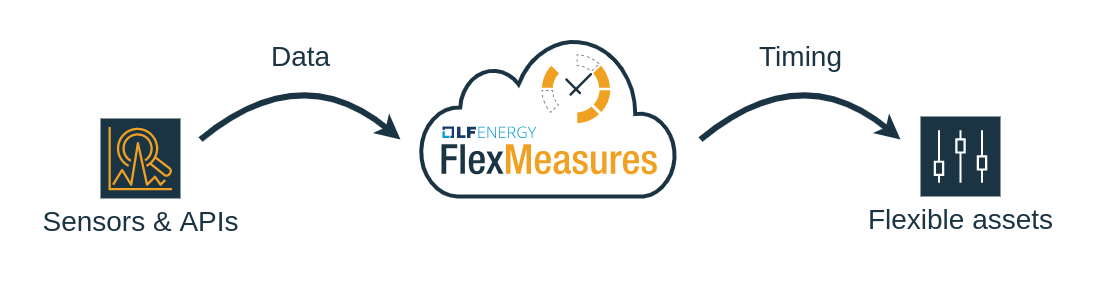
FlexMeasures was created by and continues to be maintained by Seita Energy Flexibility BV in The Netherlands. The vision of the project is to make sure that smart backend software is available to all parties working with energy flexibility, no matter where they are working on their local energy transition.
Here is why using FlexMeasures is a great idea:
- Developing energy flexibility apps & services (e.g. to enable demand response) is crucial, but expensive.
- FlexMeasures reduces development costs with real-time data intelligence & integrations, uncertainty models and developer support such as API/UI and plugins.

So why optimise the schedules of flexible assets? Because planning ahead allows flexible assets to serve the whole system with their flexibility, e.g. by shifting energy consumption to other times. For the asset owners, this creates CO₂ savings but also monetary value (e.g. through self-consumption, dynamic tariffs and grid incentives). FlexMeasures thrives to be applicable in cases with multiple sources of value ("value stacking") and multiple types of assets (e.g. home/office/factory).
As possible users, we see energy service companies (ESCOs) who want to build real-time apps & services around energy flexibility for their customers, or medium/large industrials who are looking for support in their internal digital tooling. However, even small companies and hobby projects might find FlexMeasures useful!
How does FlexMeasures enable rapid development of energy flexibility apps?
FlexMeasures is designed to help with three basic needs of developers in the energy flexibility domain:
I need help with integrating real-time data and continuously computing new data
FlexMeasures is designed to make decisions based on data in an automated way. Data pipelining and dedicated machine learning tooling is crucial.
- API/CLI functionality to read in time series data
- Extensions/Plugins for integrating 3rd party data (e.g. from ENTSO-E, OpenWeatherMap/WeatherAPI) or protocols (e.g. OpenADR)
- Forecasting for the upcoming hours
- Schedule optimization for flexible assets
It's hard to correctly model data with different sources, resolutions, horizons and even uncertainties
Much developer time is spent correcting data and treating it correctly, so that you know you are computing on the right knowledge.
FlexMeasures is built on the timely-beliefs framework, so we model this real-world aspect accurately:
- Expected data properties are explicit (e.g. unit, time resolution)
- Incoming data is converted to fitting unit and time resolution automatically
- FlexMeasures also stores who thought that something happened (or that it will happen), and when they thought so
- Uncertainty can be modelled (useful for forecasting)
I want to build new features quickly, not spend days solving basic problems
Building customer-facing apps & services is where developers make impact. We make their work easy.
- FlexMeasures has well-documented API endpoints and CLI commands to interact with its model and data
- You can extend it easily with your own logic by writing plugins
- A backend UI shows you your assets in maps and your data in plots (try the Replay button!). There is also support for plots to be available per API, for integration in your own frontend
- Multi-tenancy ― model multiple accounts on one server. Data is only seen/editable by authorized users in the right account
Getting started
Head over to our documentation, e.g. the getting-started guide or the 5-minute tutorial. Or find more information on FlexMeasures.io.
See also Seita's Github profile, e.g. for FlexMeasures plugin examples.
Development & community
FlexMeasures is available under the permissive Apache2.0 licence and it is an incubation project at the Linux Energy Foundation.
Within the FlexMeasures project, we welcome contributions. A list of contributing organizations:
- Seita Energy Flexibility (NL, maintainer)
- Thiink (US)
- ELaad (NL)
- LUO (BE)
You can also learn more about our governance.
You can connect with the community here on GitHub (e.g. by creating an issue), on the FlexMeasures channel within the LF Energy Slack, on the mailing list or by contacting the current maintainers.


Release files for flexmeasures 1.0.1
For a detailed explanation of source distributions (sdists) and built distributions (wheels), please see the package formats documentation.
Source distribution (sdist)
| File | Size | Uploaded | |
|---|---|---|---|
| flexmeasures-1.0.1.tar.gz | 3.1 MB | Details |
Built distribution (wheel)
| File | Interpreter | ABI | Platform | Reset |
|---|---|---|---|---|
| flexmeasures-1.0.1-py3-none-any.whl | Python 3 | none | any | Details |
Total release size: 6.0 MB
Release files / flexmeasures-1.0.1.tar.gz
| Download URL | flexmeasures-1.0.1.tar.gz |
|---|---|
| Size | 3.1 MB |
| Tags | Source |
|
SHA-256 checksum How to use checksums |
89b3d189482165cfbf4c951128d40a3da6f05ba3435182f07c668bb99b058ce0
|
|
BLAKE2b-256 checksum How to use checksums |
77122667957263b0fd9ac1d755cadaf8b035d8f2e379509f6de2df41029f1ba5
|
| Upload date | |
|
Uploaded using Trusted Publishing? What is trusted publishing? |
Yes |
| Uploaded via |
twine/7.0.0 CPython/3.13.14
|
Provenance
Provenance describes where a file came from. On PyPI, provenance is shared via attestations, which provide a verifiable record of the build or publishing details. View details, limitations and caveats.


PyPI Publish Attestation
PyPI verified that this artifact, at this checksum, originated from the publisher listed below.
Signed by GitHub Actions, verified by PyPI on Sep 9, 2026.
Transparency logRelease files / flexmeasures-1.0.1-py3-none-any.whl
| Download URL | flexmeasures-1.0.1-py3-none-any.whl |
|---|---|
| Size | 2.9 MB |
| Tags | Python 3 |
|
SHA-256 checksum How to use checksums |
72dc8779344f908c19bb589d184394567f45a25dda3e3d8956f2e25036fd8386
|
|
BLAKE2b-256 checksum How to use checksums |
814c8280154de985e9a7f18d07e480acdfcbb85a0cdd9864add086e6f7a764af
|
| Upload date | |
|
Uploaded using Trusted Publishing? What is trusted publishing? |
Yes |
| Uploaded via |
twine/7.0.0 CPython/3.13.14
|
Provenance
Provenance describes where a file came from. On PyPI, provenance is shared via attestations, which provide a verifiable record of the build or publishing details. View details, limitations and caveats.
PyPI Publish Attestation
PyPI verified that this artifact, at this checksum, originated from the publisher listed below.
Signed by GitHub Actions, verified by PyPI on Sep 9, 2026.
Transparency log













