
flyleaf





flyleaf is a local documentation clerk for AI code. It inventories the AI libraries in a repository, cites the EU AI Act provisions a person should read, and reports when a model card is missing or has fallen behind the code.
A flyleaf is the blank page bound in front of a book, the page where you say what the book is. This tool prepares that page and keeps a record of when the book moves on.
Legal classification depends on the use case. The use case is not in the import. flyleaf prepares the inventory and the questions. A person decides what the law requires. This output is not legal advice.
Architecture
Detection rules and the citation pack are separate. The scanner names what it found in the tree. The pack names the provision to read, the Official Journal text, and the date that text was current. Every report copies the pack version, so a later edit to the pack does not rewrite an older run.
flowchart TD
  repo[Repository]
  rules[Detection rules]
  pack[Citation pack]
  declared[Declared systems]
  scan[flyleaf scan]
  inventory[Inventory]
  brief[flyleaf brief]
  card[flyleaf card]
  cite[flyleaf cite]
  person[Person decides]

  repo --> scan
  rules --> scan
  pack --> scan
  declared --> scan
  scan --> inventory
  repo --> brief
  pack --> brief
  inventory --> card
  pack --> cite
  inventory --> person
  brief --> person
  card --> person
  cite --> person
brief scans the same rules at two states and diffs the inventories. Line numbers can move without a finding. A finding appears when a component is added or removed, when the import or dependency text changes, or when the model card content changes. The base is a git ref, or the recorded baseline.
flowchart LR
  baseRef[Base git ref or baseline]
  headRef[Head git ref or working tree]
  scanBase[Scan base]
  scanHead[Scan head]
  diff[Diff inventories]
  graded[Grade impact and severity]
  waivers[Apply waivers]
  rollup[Roll up declared systems]
  memo[Brief with citations]

  baseRef --> scanBase
  headRef --> scanHead
  scanBase --> diff
  scanHead --> diff
  diff --> graded --> waivers --> rollup --> memo
Waivers are applied to components first, then to systems, so a waiver on one file shrinks a system finding rather than silencing it.
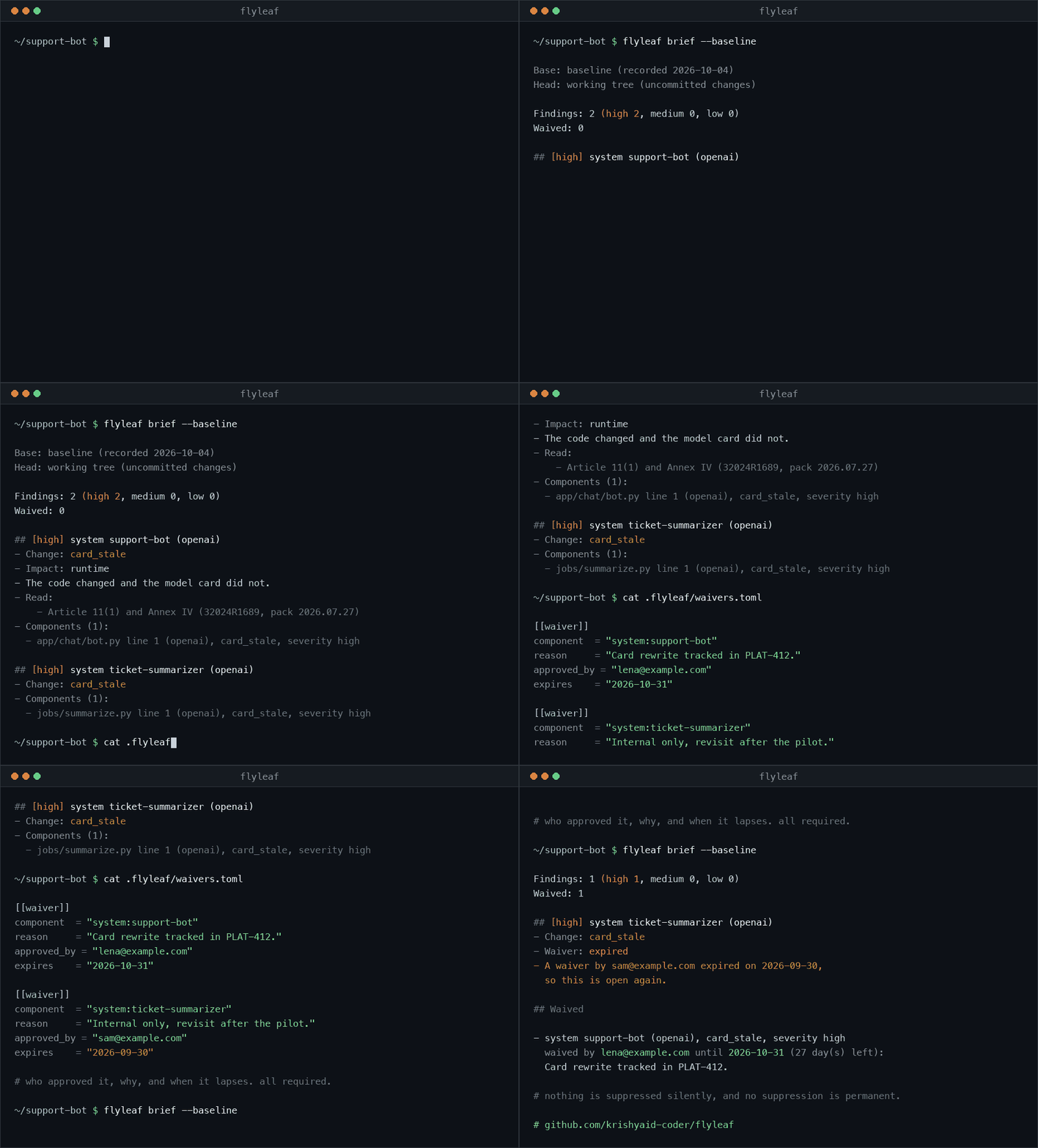
A waiver suppresses a finding for a stated reason, until a stated date. It is never silent and never permanent. An expired waiver puts the finding back in front of a person.
flowchart LR
  finding[Finding]
  check{Covering waiver?}
  valid{Still in date?}
  active[Active finding]
  waived[Waived and logged]
  reopened[Reopened, waiver expired]

  finding --> check
  check -->|no| active
  check -->|yes| valid
  valid -->|yes| waived
  valid -->|no| reopened
The pack moves only when you publish a new version. A scan does not fetch the law.
flowchart LR
  official[Official Journal text]
  edit[Edit the citation pack]
  version[New pack version and changelog entry]
  report[Reports record that version]

  official --> edit --> version --> report
What a component is
A component is one detected framework in one file: app.py importing openai, or pyproject.toml depending on scikit-learn. That is evidence. An AI system is a grouping a person makes from those components. flyleaf does not invent that grouping, and it does not assign a risk tier.
You can declare the grouping yourself. See Systems below. Once declared, a system is what the brief reports and what card scaffolds, so one system needs one card rather than one per file.
Status values on a finding are missing and needs_review. missing means a model card file was not found, or was removed. needs_review means a person should read the cited provision against the change. The tool does not declare that a law was breached.
Impact and severity
Every finding carries an impact and a severity.
impact is runtime when the detected code changed, and documentation when only the model card did. A new dependency behaves differently from a reworded card, so the two are not mixed.
severity is high, medium, or low. It ranks how much engineering attention a change deserves. It is not a legal risk tier and says nothing about whether an obligation applies.
| Change | Impact | Severity |
|---|---|---|
added with no model card |
runtime | high |
added with a model card |
runtime | medium |
removed |
runtime | medium |
evidence_changed |
runtime | high |
card_stale |
runtime | high |
evidence_and_card_changed |
runtime | medium |
card_removed |
documentation | high |
card_added |
documentation | low |
card_changed |
documentation | low |
A system finding takes the severity of its worst component, and its impact is runtime when any component inside it changed code.
Install
uv tool install flyleaf
flyleaf --help
pipx install flyleaf and pip install flyleaf work too. Python 3.11 or later. The only runtime dependency is typer.
To work on flyleaf itself:
git clone https://github.com/krishyaid-coder/flyleaf
cd flyleaf
uv sync
uv run pytest
Scan
uv run flyleaf scan .
uv run flyleaf scan . --format markdown
uv run flyleaf scan . -o inventory.json
scan exits 0 when it finishes, including when it finds AI libraries. Using PyTorch is not a failed build.
Python files and code cells in .ipynb notebooks are read with the standard-library AST. requirements*.txt, pyproject.toml, and package.json are read as dependency lists. A keyword that happens to match a package name is not treated as a dependency. JavaScript imports inside .ts and .js files are not parsed yet. Scoped packages such as @anthropic-ai/sdk are recognized when they appear in package.json.
A model card counts as present when MODEL_CARD.md (or model_card.md / modelcard.md, markdown or yaml) sits next to the file or at the repository root. A component in a declared system uses that system's card instead.
JSON is the default. Every inventory includes:
citation_pack.versionandcitation_pack.as_ofcitations, the entries this report actually used, each with pinpoint, quote, note, CELEX, and source URLcomponents[]withpath,framework,category,role_hint,system,evidence,review_hints,model_card_status, anddocumentation_citation_idssystems[], the groupings you declared, each with its owner, card status, and component ids- a disclaimer
warningsfor files that could not be parsed
role_hint is one of api_client, orchestration, or local_ml. It tells you which definition to read. It is not a finding that you are a provider or a deployer.
Systems
One library used in three files is three components. Whether it is one system or three depends on who the output reaches and what for, and that is not in the import. flyleaf will not guess it, so you declare it in .flyleaf/systems.toml. Commit that file.
[[system]]
name = "support-bot"
owner = "platform@example.com"
card = "docs/cards/support-bot.md"
includes = ["app/chat/*", "pyproject.toml"]

[[system]]
name = "ticket-summarizer"
owner = "support@example.com"
card = "docs/cards/ticket-summarizer.md"
includes = ["jobs/summarize.py"]
name and includes are required. card and owner are optional. An entry missing a required field is ignored, reported as a warning, and its files fall back to standing alone.
An include is an exact path, a glob, or a directory prefix, all relative to the repository root and written with forward slashes. A * spans separators, so app/* claims everything beneath app. A file claimed by two systems goes to the first one declared, and the scan warns that it was contested. A system that claims no detected component also warns, because that usually means a pattern is wrong.
flowchart LR
  fileA[app/chat/bot.py]
  fileB[pyproject.toml]
  fileC[jobs/summarize.py]
  compA[Component openai]
  compB[Component openai]
  compC[Component openai]
  sysA[System support-bot]
  sysC[System ticket-summarizer]
  cardA[One card]
  cardC[One card]

  fileA --> compA --> sysA
  fileB --> compB --> sysA
  fileC --> compC --> sysC
  sysA --> cardA
  sysC --> cardC
Declaring a system changes three things. The declared card becomes the card for every component in the system, so one file documents the whole thing. The brief reports one finding per system instead of one per file, listing the components inside it as evidence. flyleaf card writes one scaffold per system.
Components you do not claim are still reported individually. Nothing is hidden by leaving the file out.
Who owns a finding
A finding that names nobody is a finding nobody does. Every finding in a brief carries two names, and they answer different questions.
owner is the owner field of the declared system. It is accountable for the system whoever happened to type the change.
author is read from git blame on the evidence line that changed. It is whoever last touched that line, which is usually the person who can answer the question fastest.
flowchart TD
  finding[Finding]
  blame{Author from git blame?}
  bot{Is it a bot?}
  owner{Declared owner?}
  askAuthor[Ask the author]
  askOwner[Ask the owner]
  unassigned[Unassigned, and says so]

  finding --> blame
  blame -->|yes| bot
  blame -->|no| owner
  bot -->|no| askAuthor
  bot -->|yes| owner
  owner -->|yes| askOwner
  owner -->|no| unassigned
The brief opens with a "Who should look at this" section grouping the findings by person. A bot is never asked to review, so a Dependabot bump falls through to the declared owner. An uncommitted edit has no author yet and says so rather than guessing. A finding with neither name reads unassigned, which is a true statement about your repository and not a gap in the tool.
Blame names a line, not a fault. A reformat, a file move, or a bulk upgrade will put the wrong name on a finding, so the report always says where the name came from. Pass --no-blame to leave authors out entirely, for example if you would rather not have committer emails in a report that leaves the repository.
Brief
uv run flyleaf brief main~1
uv run flyleaf brief v0.1.0 HEAD --format markdown
uv run flyleaf brief --baseline
The first form compares a git ref with the working tree. The second compares two refs. The third compares the working tree against the approved baseline. brief exits 2 when the path is not a git repository, the ref does not resolve, or no baseline has been recorded.
A quiet brief means no component was added or removed, no detected evidence text changed, and no model card content changed. An unchanged missing card stays in scan. brief reports the delta.
Baseline
A baseline is the inventory as it stood at the last sign-off.
uv run flyleaf baseline --approved-by you@example.com --rev v1.2.0
uv run flyleaf brief --baseline
This writes .flyleaf/baseline.json. Commit it. Drift is then measured against an approved state rather than an arbitrary pair of commits, and the brief records who approved it and when.
Waivers
A finding is suppressed only by a written waiver in .flyleaf/waivers.toml. Commit that file too. It is the audit trail.
[[waiver]]
component = "app.py:openai"
reason = "Internal prototype, not shipped. Card lands with the 1.3 release."
approved_by = "you@example.com"
expires = "2026-12-31"

[[waiver]]
component = "notebooks/train.ipynb:torch"
change = "card_stale"
reason = "Card rewrite tracked in issue 42."
approved_by = "you@example.com"
expires = "2026-11-15"
component, reason, approved_by, and expires are all required. An entry missing any of them is ignored, reported as a warning, and the finding stays active. Omit change to cover every change on that component, or name one change to be narrower.
To waive a whole declared system, name it as system:<name>:
[[waiver]]
component = "system:support-bot"
reason = "Card rewrite tracked in issue 42."
approved_by = "you@example.com"
expires = "2026-11-15"
A waived finding is not deleted. It moves to the waived list in the output, with the reason, the approver, the expiry date, and the days remaining. When the date passes, the finding returns to findings with waiver_state set to expired, and the summary names the lapsed waiver. A waiver inside 14 days of expiry raises a warning so renewal is not a surprise.
Continuous integration
uv run flyleaf brief --baseline --fail-on high --format sarif -o flyleaf.sarif
--fail-on takes none, low, medium, or high, and defaults to none. The command exits 1 when an active finding reaches that severity, and 0 otherwise. Waived findings never trigger the exit code. A team picks its own policy, for example failing on runtime drift while only warning on documentation changes.
--format sarif writes SARIF 2.1.0, so GitHub renders the findings as annotations on the pull request. High maps to error, medium to warning, and low to note.
On GitHub, use the action:
permissions:
  contents: read
  pull-requests: write
  security-events: write

steps:
  - uses: actions/checkout@v7
    with:
      fetch-depth: 0
  - uses: krishyaid-coder/flyleaf@v0.5.0
    id: flyleaf
    with:
      baseline: "true"
      fail-on: high
  - uses: github/codeql-action/upload-sarif@v3
    if: always()
    with:
      sarif_file: ${{ steps.flyleaf.outputs.sarif-file }}
The action posts the brief as a pull request comment and edits that same comment on every later push, because a fresh comment per push is how a review bot teaches people to scroll past it. Set comment: "false" to turn it off. It needs pull-requests: write.
Every artefact is produced before the severity threshold is applied, so a failing check still leaves the comment and the annotations behind for the author to read.
fetch-depth: 0 gives the action the history it needs for git blame and for comparing two refs. Without it, authors come back unknown.
SARIF annotations through upload-sarif are free on public repositories but need GitHub Advanced Security on private ones. The pull request comment works everywhere, which is why the action posts one rather than relying on annotations alone.
Pass base and head instead of baseline to compare two refs.
Render
uv run flyleaf brief --baseline --format json -o brief.json
uv run flyleaf render brief.json --format markdown
uv run flyleaf render brief.json --format sarif -o brief.sarif
render re-renders a saved report without scanning or reading git, so a pipeline that wants three formats pays for one scan, and an archived brief can be read back long after the branch is gone.
Card
uv run flyleaf card . -o flyleaf-cards
This writes one markdown scaffold per declared system, then one per component that no system claimed. The file is a draft with blanks for purpose, role, data, limitations, oversight, and the Annex III use case. A system scaffold lists every component inside it so the evidence is in one place. Existing scaffolds are kept unless you pass --force.
Scaffolds land under --output and never at a declared card path, so an empty draft is never counted as documentation. Move the file into place once it says something. A per-component scaffold has to be renamed to MODEL_CARD.md to count.
Cite
uv run flyleaf cite
uv run flyleaf cite art-11-annex-iv
uv run flyleaf cite --changelog
The current pack is 2026.07.27. It cites Regulation (EU) 2024/1689 (CELEX 32024R1689) as amended by Regulation (EU) 2026/1744 (CELEX 32026R1744), in force 27 July 2026. The amendment deferred Chapter III, Sections 1, 2, and 3: 2 December 2027 for Annex III systems, and 2 August 2028 for Annex I systems. That date is citation art-113-application.
To record a later change in the law:
- Edit
src/flyleaf/citations.py. - Keep a superseded entry in place when a quote is replaced, and point the hint at the new id.
- Bump
PACK_VERSIONand add aCHANGELOGline that names which hint ids a person should re-read.
What it detects
Hosted model clients: OpenAI, Anthropic, Google GenAI, Mistral, Cohere.
Orchestration: LangChain, LlamaIndex, LangGraph.
Machine learning: PyTorch, TensorFlow, scikit-learn, Transformers, XGBoost.
Known limits
Detection is Python and notebooks only. TypeScript and JavaScript source files are not parsed, though their dependencies are read from package.json.
A component is one framework in one file, so a dependency entry and the import that uses it are two components. Declare a system to group them. Without a declaration they stay separate, because the grouping is a human judgement and flyleaf does not guess it.
A declared system is only as good as its includes patterns. A new file that no pattern covers is reported as a loose component, not quietly added to the nearest system.
brief compares the text of detected evidence, not line numbers, so moving code does not raise a finding. A change elsewhere in a manifest does not raise one either. A rename does count as a removal plus an addition.
Privacy
Scanning reads the local tree and, for brief, local git history including git blame. There is no telemetry, no account, and no network call. The GitHub Action is the one place anything is sent anywhere, and it posts to your own repository with your own token. Use --no-blame to keep committer names out of a report.
1 maintainer

Metadata
1 maintainer
Release files for flyleaf 0.5.0
For a detailed explanation of source distributions (sdists) and built distributions (wheels), please see the package formats documentation.
Source distribution (sdist)
| File | Size | Uploaded | |
|---|---|---|---|
| flyleaf-0.5.0.tar.gz | 41.2 kB | Details |
Built distribution (wheel)
| File | Interpreter | ABI | Platform | Reset |
|---|---|---|---|---|
| flyleaf-0.5.0-py3-none-any.whl | Python 3 | none | any | Details |
Total release size: 83.5 kB
Release files / flyleaf-0.5.0.tar.gz
| Download URL | flyleaf-0.5.0.tar.gz |
|---|---|
| Size | 41.2 kB |
| Tags | Source |
|
SHA-256 checksum How to use checksums |
78f2814e14d103f544f62a437847e1ad12f7cb1bc76e10dcc8a032788794c095
|
|
BLAKE2b-256 checksum How to use checksums |
9433fbb3312194fb5e72a59e6966e41103d50ce5df3a9e72f9f1d372d28ad225
|
| Upload date | |
|
Uploaded using Trusted Publishing? What is trusted publishing? |
Yes |
| Uploaded via |
twine/7.0.0 CPython/3.13.14
|
Provenance
Provenance describes where a file came from. On PyPI, provenance is shared via attestations, which provide a verifiable record of the build or publishing details. View details, limitations and caveats.


PyPI Publish Attestation
PyPI verified that this artifact, at this checksum, originated from the publisher listed below.
Signed by GitHub Actions, verified by PyPI on Oct 9, 2026.
Transparency logRelease files / flyleaf-0.5.0-py3-none-any.whl
| Download URL | flyleaf-0.5.0-py3-none-any.whl |
|---|---|
| Size | 42.3 kB |
| Tags | Python 3 |
|
SHA-256 checksum How to use checksums |
f2ce2135798ac80cc8f08669e63db988a07221898d04cb879faccbb8373299d2
|
|
BLAKE2b-256 checksum How to use checksums |
c0c8297c3e46e34dae20b5130ba8b6234a8c2d482520d2bc384d4d9095614e9f
|
| Upload date | |
|
Uploaded using Trusted Publishing? What is trusted publishing? |
Yes |
| Uploaded via |
twine/7.0.0 CPython/3.13.14
|
Provenance
Provenance describes where a file came from. On PyPI, provenance is shared via attestations, which provide a verifiable record of the build or publishing details. View details, limitations and caveats.
PyPI Publish Attestation
PyPI verified that this artifact, at this checksum, originated from the publisher listed below.
Signed by GitHub Actions, verified by PyPI on Oct 9, 2026.
Transparency log












