

gelanis
Gelanis is an enhanced version of pysparkling.
List of improvements:
Data types of the resulting dataframes are equal to pyspark
List of todos:
Implemented since/until + be able to target a certain pyspark version
Get a drop-in API compatibility with pyspark (auto-injector is written, but more tests are needed here).
Test the tests against both pyspark & pysparkling & compare the outputs so we’re 100% certain both libraries are API equal.
Achieve API equality between pyspark & pysparkling (meaning that any public symbol should exist in both libraries).
Increase tests to ensure 100% compatibility with pyspark.
pysparkling
Pysparkling provides a faster, more responsive way to develop programs for PySpark. It enables code intended for Spark applications to execute entirely in Python, without incurring the overhead of initializing and passing data through the JVM and Hadoop. The focus is on having a lightweight and fast implementation for small datasets at the expense of some data resilience features and some parallel processing features.
How does it work? To switch execution of a script from PySpark to pysparkling, have the code initialize a pysparkling Context instead of a SparkContext, and use the pysparkling Context to set up your RDDs. The beauty is you don’t have to change a single line of code after the Context initialization, because pysparkling’s API is (almost) exactly the same as PySpark’s. Since it’s so easy to switch between PySpark and pysparkling, you can choose the right tool for your use case.
When would I use it? Say you are writing a Spark application because you need robust computation on huge datasets, but you also want the same application to provide fast answers on a small dataset. You’re finding Spark is not responsive enough for your needs, but you don’t want to rewrite an entire separate application for the small-answers-fast problem. You’d rather reuse your Spark code but somehow get it to run fast. Pysparkling bypasses the stuff that causes Spark’s long startup times and less responsive feel.
Here are a few areas where pysparkling excels:
Small to medium-scale exploratory data analysis
Application prototyping
Low-latency web deployments
Unit tests
Install
pip install pysparkling[s3,hdfs,streaming]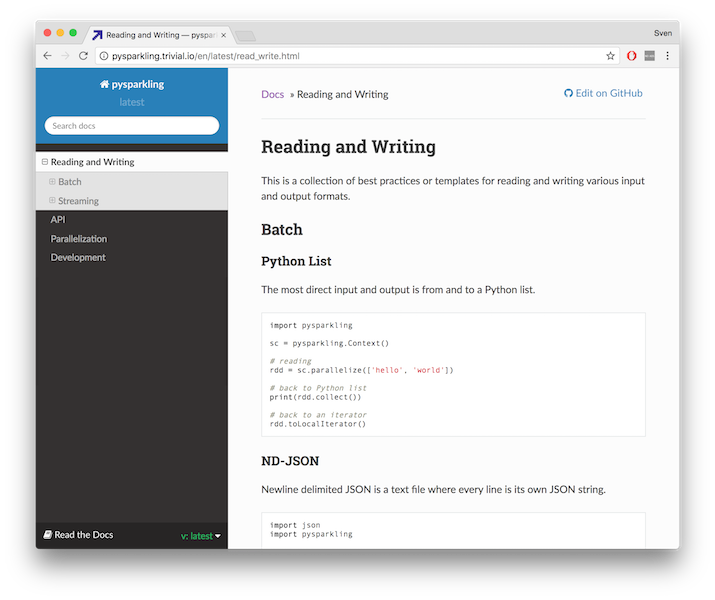
Other links:
Github,


Features
Supports URI schemes s3://, hdfs://, gs://, http:// and file:// for Amazon S3, HDFS, Google Storage, web and local file access. Specify multiple files separated by comma. Resolves * and ? wildcards.
Handles .gz, .zip, .lzma, .xz, .bz2, .tar, .tar.gz and .tar.bz2 compressed files. Supports reading of .7z files.
Parallelization via multiprocessing.Pool, concurrent.futures.ThreadPoolExecutor or any other Pool-like objects that have a map(func, iterable) method.
Plain pysparkling does not have any dependencies (use pip install pysparkling). Some file access methods have optional dependencies: boto for AWS S3, requests for http, hdfs for hdfs
Examples
Some demos are in the notebooks docs/demo.ipynb and docs/iris.ipynb .
Word Count
from pysparkling import Context

counts = (
    Context()
    .textFile('README.rst')
    .map(lambda line: ''.join(ch if ch.isalnum() else ' ' for ch in line))
    .flatMap(lambda line: line.split(' '))
    .map(lambda word: (word, 1))
    .reduceByKey(lambda a, b: a + b)
)
print(counts.collect())
which prints a long list of pairs of words and their counts.
1 maintainer

Metadata
1 maintainer
Release files for gelanis 0.6.2
For a detailed explanation of source distributions (sdists) and built distributions (wheels), please see the package formats documentation.
Source distribution (sdist)
| File | Size | Uploaded | Provenance | Actions |
|---|---|---|---|---|
| gelanis-0.6.2.tar.gz | 165.3 kB | Without provenance | Details for gelanis-0.6.2.tar.gz |
Release files / gelanis-0.6.2.tar.gz
| Download URL | gelanis-0.6.2.tar.gz |
|---|---|
| Size | 165.3 kB |
| Tags | Source |
|
SHA-256 checksum How to use checksums |
8ca45aa644d6937eba3747e5f31e7340b42ce69228e4fc49aa5b789f7e75d623
|
|
BLAKE2b-256 checksum How to use checksums |
7342254071fb89b7224517973c53833063fda2617329c49c6ef782f8ae4a6d56
|
| Upload date | |
|
Uploaded using Trusted Publishing? What is trusted publishing? |
No |
| Uploaded via |
twine/3.4.1 importlib_metadata/3.7.3 pkginfo/1.7.0 requests/2.25.1 requests-toolbelt/0.9.1 tqdm/4.59.0 CPython/3.9.2
|
Security for gelanis 0.6.2
Provenance
Provenance describes where a file came from. On PyPI, provenance is shared via attestations, which provide a verifiable record of the build or publishing details. View details, limitations and caveats.
No provenance found
None of the files in this release were uploaded with provenance metadata.
A note on package security
PyPI is a repository for distributing packages, not a service for auditing them. While third-party security researchers and our staff do their best to detect and remove malicious packages, PyPI cannot guarantee the quality, security or suitability of any given package.
To learn more about protecting yourself from malicious actors, visit our package security documentation.













