
GeN: Generalized Newton's Method for Learning-Rate-Free Optimization 🚀
Paper: Gradient Descent with Generalized Newton’s Method (ICLR 2024)
📦 Repository Overview
This repository contains the code and examples for Generalized Newton's method as a learning-rate-free optimization. It supports a wide range of models and tasks, including:
- 🖼️ Image classification (CIFAR10/CIFAR100/ImageNet... datasets with ViT/ResNet models)
- 📝 Natural language generation (E2E/DART... datasets with GPT2 models)
- 📊 Natural language understanding (SST2/QNLI/MNLI... datasets with BERT/RoBERTa models)
- 🕵️♂️ Object detection / Instance segmentation
- 🎯 Recommendation system
Example scripts are provided for each task in the examples/ directory. The core implementation of GeN optimizer can be found in GeN/, which roughly has the same speed and memory cost as the base optimizers.
⚡ Quickstart
🛠️ Installation
Install the package from PyPI:
pip install gen-optim
🏃 Minimal Training Loop
To use GeN in your PyTorch training loop, simply add two lines between backward() and optimizer.step():
from GeN import lr_parabola
optimizer = AdamW(model.parameters(), lr=1e-4)
tr_iter = iter(train_loader)

# Standard training pipeline
loss = F.cross_entropy(model(batch), labels)
loss.backward()
if (batch_idx+1) % lazy_freq == 0:
    lr_parabola(model, optimizer, tr_iter=tr_iter, task='image_cls', scale=scale)
optimizer.step()
optimizer.zero_grad()
scalecan be used to enable the horizon-aware learning rate (e.g.,np.linspace(1,0,epochs+1)).- Call
lr_parabolainfrequently (a.k.a. lazy update) by setting lazy_freq>=4 for efficiency. - Different
taskvalues need different forward passes. Can be customized.
🧩 Function Overview
The main function is lr_parabola, which adapts the learning rate based on a quadratic curve fitting to the loss landscape, with minimal code changes and computational overhead. This enables learning-rate-free optimization and leverages the Hessian information, like the Newton–Raphson method.
Mathematically, we turn any base optimizer (e.g. SGD or AdamW) to the GeN optimizer by
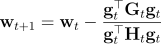
To enable the horizon-aware GeN, like cosine or linear decay learning rates, we use hyperparameter-free one-to-zero decay (controlled by `scale`):


📚 Citation
If you use GeN in your research, please cite:
@inproceedings{bu2024gradient,
  title={Gradient descent with generalized newton’s method},
  author={Bu, Zhiqi and Xu, Shiyun},
  booktitle={The Thirteenth International Conference on Learning Representations},
  year={2024}
}
1 maintainer

Release files for gen-optim 0.1.1
For a detailed explanation of source distributions (sdists) and built distributions (wheels), please see the package formats documentation.
Source distribution (sdist)
| File | Size | Uploaded | |
|---|---|---|---|
| gen_optim-0.1.1.tar.gz | 5.8 kB | Details |
Built distribution (wheel)
| File | Interpreter | ABI | Platform | Reset |
|---|---|---|---|---|
| gen_optim-0.1.1-py3-none-any.whl | Python 3 | none | any | Details |
Total release size: 11.8 kB
Release files / gen_optim-0.1.1.tar.gz
| Download URL | gen_optim-0.1.1.tar.gz |
|---|---|
| Size | 5.8 kB |
| Tags | Source |
|
SHA-256 checksum How to use checksums |
77d98963c1c6c52d47130bef616283155b7a55d401a174dbf8d8277ab0151ab3
|
|
BLAKE2b-256 checksum How to use checksums |
daac16c140e5ba2587d5de7999309d3b53649842c506cfe54783257b92ec22a6
|
| Upload date | |
|
Uploaded using Trusted Publishing? What is trusted publishing? |
No |
| Uploaded via |
twine/6.1.0 CPython/3.11.5
|
Release files / gen_optim-0.1.1-py3-none-any.whl
| Download URL | gen_optim-0.1.1-py3-none-any.whl |
|---|---|
| Size | 6.1 kB |
| Tags | Python 3 |
|
SHA-256 checksum How to use checksums |
5a61e6d194cf151ae504d5c1f609bb16ec816526ec11740c9d1bdc998456b861
|
|
BLAKE2b-256 checksum How to use checksums |
026202030d5e33c800bd7d07530d94afe8c2c6f7c1721b70e0463e52a9f838f2
|
| Upload date | |
|
Uploaded using Trusted Publishing? What is trusted publishing? |
No |
| Uploaded via |
twine/6.1.0 CPython/3.11.5
|













