
glanceable
A layout and typography engine for round, glanceable near-eye displays.
Developed against Brilliant Labs Halo's 256×256 circular microOLED. Nothing
above surface.py contains a Halo-specific call.
Why
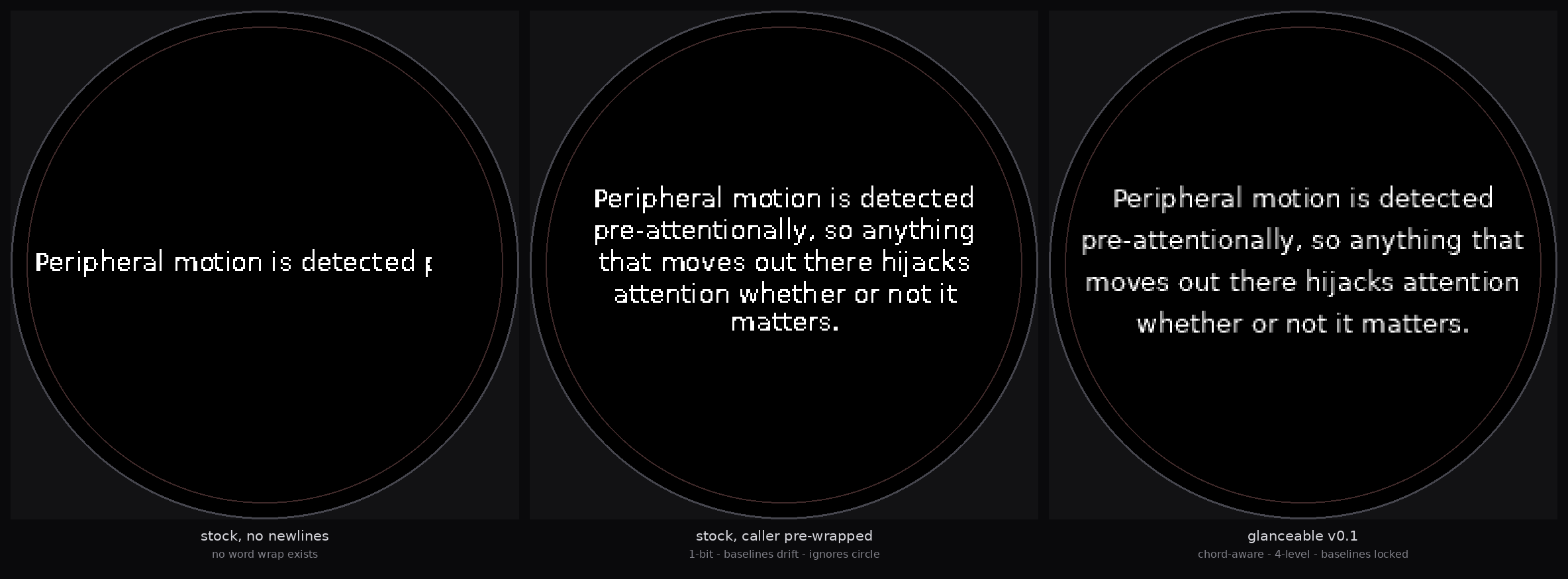
The Brilliant SDK ships TxTextSpriteBlock, which rasterizes TTF text
host-side and sends it as sprites. The primitive is the right idea and is
under-specified.
Fair comparison caveat: stock's contract is that the caller pre-wraps and
passes \n. The middle panel above does exactly that, and it is perfectly
usable. The honest gap is narrower than "the SDK is broken" — measured on the
sample string at 13px, glanceable fits the same text in 4 lines instead of 5
and uses 16% more width (223px vs 193px), because the equator chord is 240px
while the largest inscribed square is only 169px.
Verified against brilliant-msg 7.0.0:
| stock | glanceable | |
|---|---|---|
| word wrap | none — caller must pre-wrap; width merely sizes the scratch buffer, and no metrics are exposed to wrap with |
greedy wrap, hyphenates over-wide words |
| line origin | each line cropped to its own ink bbox → baselines drift | single face-derived ascent → baselines exactly line_height apart |
| coverage | hard threshold >127, 1-bit |
N-level quantization (default 4 of Halo's 16 palette entries) |
| bad font path | silent load_default(), font_size ignored |
raises FontLoadError |
| overflow | clipped | surfaced in Layout.leftover |
| display shape | unaware — TxPlainText documents x:1-640, y:1-400 (Frame's panel) |
chord-aware |
Nothing in the published SDK knows the display is round. Zero occurrences of circle, radius, or a 256 display bound.
The circular claim
On a round panel usable line width is a function of vertical position. Every text engine ever written wraps to a rectangle, so apps either waste the middle third of the glass or clip against the curve.
A line box is a rectangle, so it is constrained by whichever of its two
horizontal edges sits farther from the equator — not by its midpoint. Using
the midpoint is the intuitive move and it clips descenders near the poles.
test_line_width_uses_narrow_edge_not_midpoint pins this.
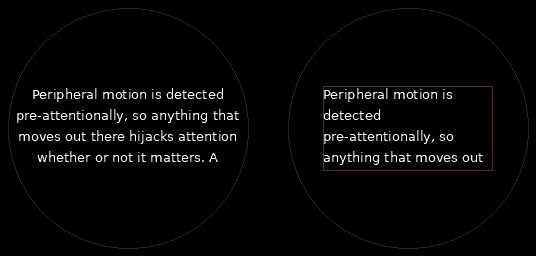
Left is glanceable. Right is the same text, same face, same size, wrapped to
the largest inscribed square — what a rectangular layout engine does when you
point it at a circle. Both are centred on their widest band. The right-hand
panel runs out of budget mid-sentence.
How much that is worth depends on the line budget, and the tighter the budget the more it matters — a longer block puts more of its lines near the poles where the chord is narrow:
| line budget | chord-aware | inscribed square | gain |
|---|---|---|---|
| 3 | 97 chars | 49 | +98% |
| 4 | 125 | 72 | +74% |
| 5 | 154 | 95 | +62% |
| 6 | 185 | 121 | +53% |
DejaVu Sans 13px on Halo's 256×256 with an 8px safe inset. Equator chord 240px;
largest inscribed square 169px. Regenerate with python tools/comparison.py,
re-measure with python tools/measure_table.py.
Identical to four decimal places on Python 3.10.20, 3.12.3 and 3.14.4 — the
interpreter is not a variable. What would move these is FreeType or the
DejaVu build, since the counts come out of font rasterization, and all three
runs shared Pillow 12.3.0 and FreeType 2.14.3. So tests/test_circular_claim.py
asserts the geometry exactly and the typography as floors, rather than letting
this table drift from the code the way earlier figures here did.
A glanceable display is read in a second or two, so a small fixed line budget is the design constraint — the regime where this gap is widest.
Install
pip install -e ".[dev]"
pytest -q                      # 273 passed  (268 + 1 skip without dev extras)
python examples/compare.py     # regenerates docs/comparison.png
Core depends only on Pillow. The markdown renderer needs a CommonMark parser, so it lives behind an extra:
pip install "glanceable[markdown]" # adds markdown-it-py
Use
from glanceable import (Font, PILSurface, find_system_font,
                        ramp_palette, render_text)

surface = PILSurface(256, 256, ramp_palette(4))
layout = render_text(surface, Font(find_system_font(), 13), "…", levels=4)

if layout.truncated:
    ...  # paginate; never silently cut off
surface.to_rgb().save("frame.png")
Swap PILSurface for SpriteSurface to emit TxSprite-shaped payloads.
Markdown
Markdown assumes a wide rectangular viewport and rich typography. A 256px circle at a legible size gives roughly five to seven usable lines, the first and last chord-narrowed. So most markdown syntax has to degrade, not render.
from glanceable import HALO, Font, find_system_font
from glanceable.markdown import layout_markdown

page = layout_markdown(source, HALO, Font(find_system_font(), 13), page=0)

for line in page.lines:
    ...                          # line.run, line.kind, line.font
page.metadata.wikilinks          # [[Target]] retained for a caller to act on
page.metadata.dropped            # images, embeds, opaque fences — named, not lost
page.leftover_source             # hand back in to continue; no hidden cursor
Pagination is a discrete index and a pure function of its inputs — no cursor, no
scroll, no auto-advance. Every piece of source ends up in exactly one of three
places: on the glass, in leftover_source, or named in metadata.
Degradation policy, in brief: headings get one emphasis tier; bold and italic
drop their markup and keep the text (Font has no style axis to collapse to);
tables render as header: cell records, which is lossless at any column count
and degenerates to plain key: value at two; fenced code is never reflowed but
is broken at the chord with a visible continuation marker, in a rectangular
sub-viewport so it keeps one left edge; frontmatter is stripped before the
parser sees it. Full table in core concepts.
examples/obsidian_bridge.py renders notes from a vault directory to PNGs and
prints everything that did not reach the glass. It exists to run the renderer
against markdown written as notes rather than as test fixtures — it is evidence,
not a product, and nothing in glanceable/ imports it:
python examples/obsidian_bridge.py --query chord
Retrieval is deliberately not implemented: --query is a fifteen-line substring
match, there to be deleted and replaced by an Obsidian MCP server or the Local
REST API plugin. examples/vault/ is a committed corpus of deliberately ugly
notes — nested callouts, Dataview blocks, ragged tables, a 200-character token,
CJK, emoji, CRLF — and tests/test_vault_corpus.py asserts the three-way
guarantee over every one of them.
Docs
- Getting started
- Core concepts — display model, legibility rules
- API reference
- Troubleshooting
- CLAUDE.md — constraints for contributors and AI assistants
Status — v0.2, never run on hardware
Stated plainly because the point of this project is being the implementation you can trust. 273 tests pass on Python 3.10.20, 3.12.3 and 3.14.4 with the dev extras installed; 268 pass and the emulator round-trip skips without them. All of them are host-side; none of them is a device.
- The device-agnostic boundary is untested.
PILSurfaceandSpriteSurfacewere written by one author against one mental model, which is not independent evidence that theSurfaceABC is the right abstraction. Getting a second, non-Brilliant backend running is roadmap item 1 for exactly that reason — it is the claim this project most needs to test. SpriteSurfaceemits against publishedbrilliant_msg7.0.0 shapes but has not been round-tripped on a physical Halo. The wire format is unconfirmed.- No device-side Lua counterpart yet: port the dirty-flag tree from
CitizenOneX's
base_layout.luaand validate against the emulator's PIL framebuffer. - CJK renders as tofu with the default face. DejaVu Sans has no CJK glyphs;
every missing character is reported in
metadata.unrenderable, but you need a CJK-capable face to read it. blit_coveragewrites palette indices rather than alpha-blending, so it is correct only over a background matchingpalette_base. OnSpriteSurfacea non-zeropalette_baseraises — the sprite wire format cannot carry it.- Latin only. No BiDi, no shaping. CJK is conserved by the markdown renderer but broken on the wrong boundaries — there is no dictionary breaking.
- No glyph atlas caching; every run rasterizes fresh.
markdown.pyhas no widow control: a heading or a single list item can strand alone at a page boundary.
Deliberately omitted: animation
Peripheral motion detection is pre-attentional — anything that moves out there hijacks attention involuntarily, whether or not it matters. Animation in a glanceable-display toolkit encourages the exact failure mode the toolkit exists to prevent. This is a design decision, not a missing feature.
License
MIT. Layout-tree lineage credited to CitizenOneX on adoption.
1 maintainer

Metadata
1 maintainer
Release files for glanceable 0.2.0
For a detailed explanation of source distributions (sdists) and built distributions (wheels), please see the package formats documentation.
Source distribution (sdist)
| File | Size | Uploaded | Provenance | Actions |
|---|---|---|---|---|
| glanceable-0.2.0.tar.gz | 137.2 kB | Without provenance | Details for glanceable-0.2.0.tar.gz |
Built distribution (wheel)
| File | Interpreter | ABI | Platform | Actions Reset |
|---|---|---|---|---|
| glanceable-0.2.0-py3-none-any.whl | Python 3 | none | any | Details for glanceable-0.2.0-py3-none-any.whl |
Total release size: 180.1 kB
Release files / glanceable-0.2.0.tar.gz
| Download URL | glanceable-0.2.0.tar.gz |
|---|---|
| Size | 137.2 kB |
| Tags | Source |
|
SHA-256 checksum How to use checksums |
f6e96c4abe5cf586e5f976e0b432b5289577abb7d35a3b3f288b0319423007d3
|
|
BLAKE2b-256 checksum How to use checksums |
7ab13a7728225891d41be0cf8871e19ea8048ffb6f2e225e3f3afb443e9cd325
|
| Upload date | |
|
Uploaded using Trusted Publishing? What is trusted publishing? |
No |
| Uploaded via |
twine/7.0.0 CPython/3.12.13
|
Release files / glanceable-0.2.0-py3-none-any.whl
| Download URL | glanceable-0.2.0-py3-none-any.whl |
|---|---|
| Size | 42.9 kB |
| Tags | Python 3 |
|
SHA-256 checksum How to use checksums |
263d5dadf658e4e2c961fad25cec0728dabc0e7955f4bd06c0613677a5e2a283
|
|
BLAKE2b-256 checksum How to use checksums |
aeafe69833055652884e422492532a82c86b543a58e8e4bbe00001fbca8dfd5a
|
| Upload date | |
|
Uploaded using Trusted Publishing? What is trusted publishing? |
No |
| Uploaded via |
twine/7.0.0 CPython/3.12.13
|
Security for glanceable 0.2.0
Provenance
Provenance describes where a file came from. On PyPI, provenance is shared via attestations, which provide a verifiable record of the build or publishing details. View details, limitations and caveats.
No provenance found
None of the files in this release were uploaded with provenance metadata.
A note on package security
PyPI is a repository for distributing packages, not a service for auditing them. While third-party security researchers and our staff do their best to detect and remove malicious packages, PyPI cannot guarantee the quality, security or suitability of any given package.
To learn more about protecting yourself from malicious actors, visit our package security documentation.













