
This release is a pre-release and may not be stable for production use.
imio.emailkit











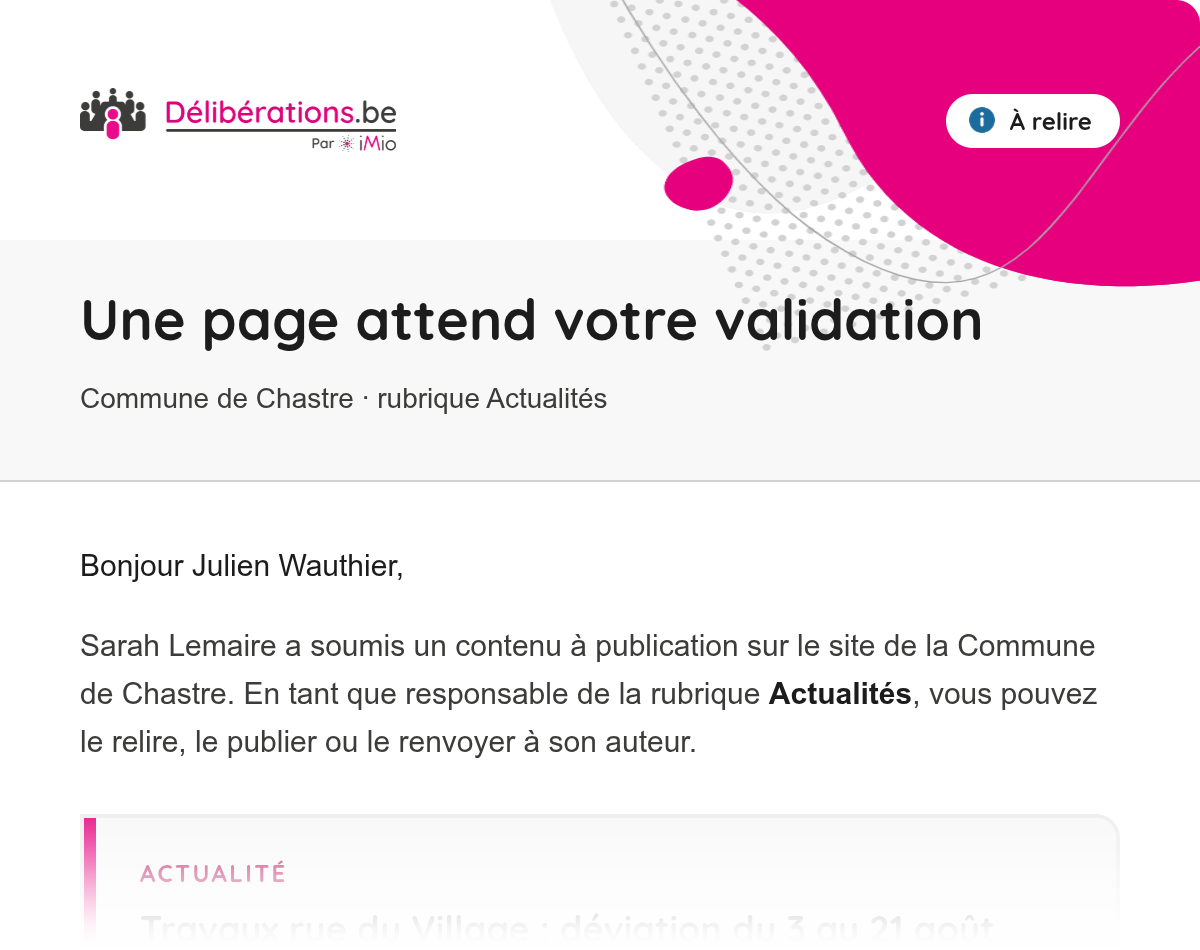
Transactional email templating for iMio's Plone ecosystem: author HTML mails with Maizzle 6 (Vue SFC + Tailwind CSS 4), rendered at runtime by Chameleon. No Node.js runs in production.
Installing it restyles Plone's password-reset, registration and username-reminder mails.
Documentation
https://imio.github.io/imio.emailkit/
Covers the quickstart, architecture, API reference, authoring rules, shipping, and overrides:
| Quickstart | install, send a mail |
| Architecture | the build-time / runtime seam |
Email builder |
recipients, attachments, per-language |
| Authoring rules | eight ways to silently break a template |
| Shipping templates | get your templates discovered |
| Migrating a mail | already building HTML bodies |
| Overrides & theming | three levels, full opt-out |
Installation
pip install imio.emailkit
Install the add-on in Site Setup, or apply imio.emailkit:default for
Plone's transactional mails; imio.emailkit:base is runtime-only.
from imio.emailkit import Email

Email("imio.emailkit:notification").to(member).with_context(
    title=title, intro=intro, cta_url=url
).send()
Compatibility
Plone 6.0–6.2 on Python 3.10–3.13.
Contribute
Prerequisites
- An operating system meeting these requirements.
- uv
- Make
- Git
- Node.js 22+, only for building templates
Installation
-
Clone this repository and enter it.
git clone git@github.com:IMIO/imio.emailkit.git
cd imio.emailkit
-
Install it.
make install
make help lists every target; common ones: make test, make check
(format then lint), make start, make create-site, make build-emails,
make check-emails, make preview-emails.
Working on the docs
SKILL.md covers authoring conventions for AI-assisted work;
the documentation site lives in docs/site/ — see
its README to add a page.
License
Licensed under GPLv2.
1 maintainer

Metadata
1 maintainer
Release files for imio.emailkit 1.0.0b3
For a detailed explanation of source distributions (sdists) and built distributions (wheels), please see the package formats documentation.
Source distribution (sdist)
| File | Size | Uploaded | Provenance | Actions |
|---|---|---|---|---|
| imio_emailkit-1.0.0b3.tar.gz | 376.6 kB | Without provenance | Details for imio_emailkit-1.0.0b3.tar.gz |
Built distribution (wheel)
| File | Interpreter | ABI | Platform | Actions Reset |
|---|---|---|---|---|
| imio_emailkit-1.0.0b3-py3-none-any.whl | Python 3 | none | any | Details for imio_emailkit-1.0.0b3-py3-none-any.whl |
Total release size: 653.8 kB
Release files / imio_emailkit-1.0.0b3.tar.gz
| Download URL | imio_emailkit-1.0.0b3.tar.gz |
|---|---|
| Size | 376.6 kB |
| Tags | Source |
|
SHA-256 checksum How to use checksums |
a71dae2f0e25124edacce50db7001101f5f61bdb5cd239e18383869bf75261cb
|
|
BLAKE2b-256 checksum How to use checksums |
210bb6fccfd6a279919ec1c11ce4cc43a16abb8ecd8b17011326eca940a5f926
|
| Upload date | |
|
Uploaded using Trusted Publishing? What is trusted publishing? |
No |
| Uploaded via |
twine/7.0.0 CPython/3.12.8
|
Release files / imio_emailkit-1.0.0b3-py3-none-any.whl
| Download URL | imio_emailkit-1.0.0b3-py3-none-any.whl |
|---|---|
| Size | 277.2 kB |
| Tags | Python 3 |
|
SHA-256 checksum How to use checksums |
73c3a29ef4a6a1a3781a8eb8603da3cb50413c519dc833884429c94f5a1a1e78
|
|
BLAKE2b-256 checksum How to use checksums |
363daac4923c1e3e68f93ddff82b1698f607d8a1a931e71c853a5fd992928add
|
| Upload date | |
|
Uploaded using Trusted Publishing? What is trusted publishing? |
No |
| Uploaded via |
twine/7.0.0 CPython/3.12.8
|
Security for imio.emailkit 1.0.0b3
Provenance
Provenance describes where a file came from. On PyPI, provenance is shared via attestations, which provide a verifiable record of the build or publishing details. View details, limitations and caveats.
No provenance found
None of the files in this release were uploaded with provenance metadata.
A note on package security
PyPI is a repository for distributing packages, not a service for auditing them. While third-party security researchers and our staff do their best to detect and remove malicious packages, PyPI cannot guarantee the quality, security or suitability of any given package.
To learn more about protecting yourself from malicious actors, visit our package security documentation.














