
Into


Data migration in Python
Example
Into migrates data between different containers
>>> from into import into

>>> into(list, (1, 2, 3))
[1, 2, 3]
It operates on small, in-memory containers (as above) and large, out-of-core containers (as below)
>>> into('postgresql://user:pass@host::my-table', 'myfile.hdf5::/data')
Table('my-table', MetaData(bind=Engine(postgresql://user:****@host)), ...)
Into leverages the existing Python ecosystem. The example above uses sqlalchemy for SQL interation and h5py for HDF5 interaction.
Method
Into migrates data using network of small data conersion functions between type pairs. That network is below:
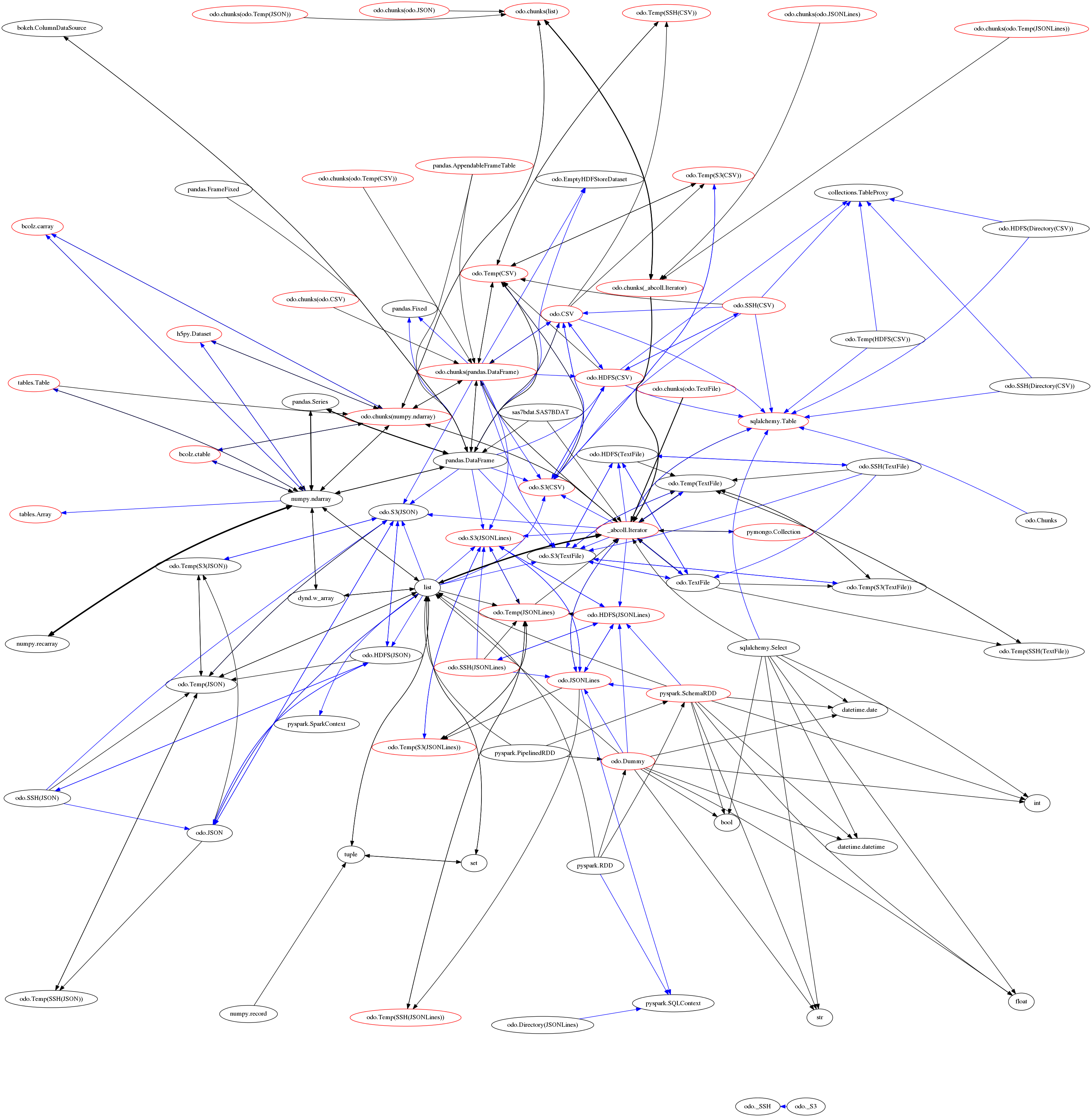
Each node is a container type (like pandas.DataFrame or sqlalchemy.Table) and each directed edge is a function that transforms or appends one container into or onto another. We annotate these functions/edges with relative costs.
This network approach allows into to select the shortest path between any two types (thank you networkx). For performance reasons these functions often leverage non-Pythonic systems like NumPy arrays or native CSV->SQL loading functions. Into is not dependent on only Python iterators.
This network approach is also robust. When libraries go missing or runtime errors occur into can work around these holes and find new paths.
This network approach is extensible. It is easy to write small functions and register them to the overall graph. In the following example showing how we convert from pandas.DataFrame to a numpy.ndarray.
from into import convert

@convert.register(np.ndarray, pd.DataFrame, cost=1.0)
def dataframe_to_numpy(df, **kwargs):
    return df.to_records(index=False)
We decorate convert functions with the target and source types as well as a relative cost. This decoration establishes a contract that the underlying function must fulfill, in this case with the fast DataFrame.to_records method. Similar functions exist for append, to add to existing data, and resource for URI resolution.
convert: Transform dataset into new container
append: Add dataset onto existing container
resource: Given a URI find the appropriate data resource
into: Call one of the above based on inputs. E.g. into(list, (1, 2, 3)) -> convert(list, (1, 2, 3)) while L = []; into(L, (1, 2, 3)) -> append(L, (1, 2, 3))
Finally, into is also aware of which containers must reside in memory and which do not. In the graph above the red-colored nodes are robust to larger-than-memory datasets. Transformations between two out-of-core datasets operate only on the subgraph of the red nodes.
LICENSE
New BSD. See License File.
History
Into was factored out from the Blaze project.
1 maintainer

Metadata
1 maintainer
Release files for into 0.2.2
For a detailed explanation of source distributions (sdists) and built distributions (wheels), please see the package formats documentation.
Source distribution (sdist)
| File | Size | Uploaded | |
|---|---|---|---|
| into-0.2.2.tar.gz | 85.0 kB | Details |
Release files / into-0.2.2.tar.gz
| Download URL | into-0.2.2.tar.gz |
|---|---|
| Size | 85.0 kB |
| Tags | Source |
|
SHA-256 checksum How to use checksums |
8a6d5595625a1c2de0732ba4448c554b707a8259b477c9b0b7bb94a1f1ca887b
|
|
BLAKE2b-256 checksum How to use checksums |
d819b8ae3ef5df6288c42f1c119b2607825469bb4e155f4d49b714743a71af53
|
| Upload date | |
|
Uploaded using Trusted Publishing? What is trusted publishing? |
No |














