
Inverse Optical Flow

A Python library for estimating inverse optical flow and the disocclusion mask from optical flow.
Unofficial implementation of "An Efficient Algorithm for Estimating the Inverse Optical Flow" (public full-text).
/inverse_flow folder contains original source code from the paper. This library does not have implemented filling disocclusion. For this purpose, you can use original implementation from the paper at /inverse_flow/fill_disocclusions.h.
Glossary
-
Optical flow - the pattern of apparent motion of objects, surfaces, or edges in a visual scene, caused by the relative motion between an observer and the scene.
Optical flow is used in computer vision to detect and describe the motion of objects and surfaces in sequential images. It represents the displacement of points between two consecutive frames, caused by the movement of the object or the camera.
-
Forward flow - optical flow computed from the $I_1$ to $I_2$ image.
Forward flow represents the movement of pixels from the $I_1$ to the $I_2$ image.
-
Backward flow - optical flow computed from the $I_2$ to the $I_1$ image.
Backward flow traces the origins of pixels from image $I_2$ back to their positions in image $I_1$.
-
Inverse optical flow - a technique or process that reverses the direction of optical flow.
While traditional optical flow estimates the movement of pixels from a first image to a second image (forward flow), inverse optical flow inverts this process. It aims to estimate the movement from the second image back to the first (backward flow), essentially reversing the flow direction.
-
Disocclusion mask - a mask identifying regions of an image that are visible in one frame but not in the next due to occlusion.
Disocclusion masks are crucial in optical flow for identifying areas where objects have moved in or out of the frame, thereby revealing or hiding parts of the scene.
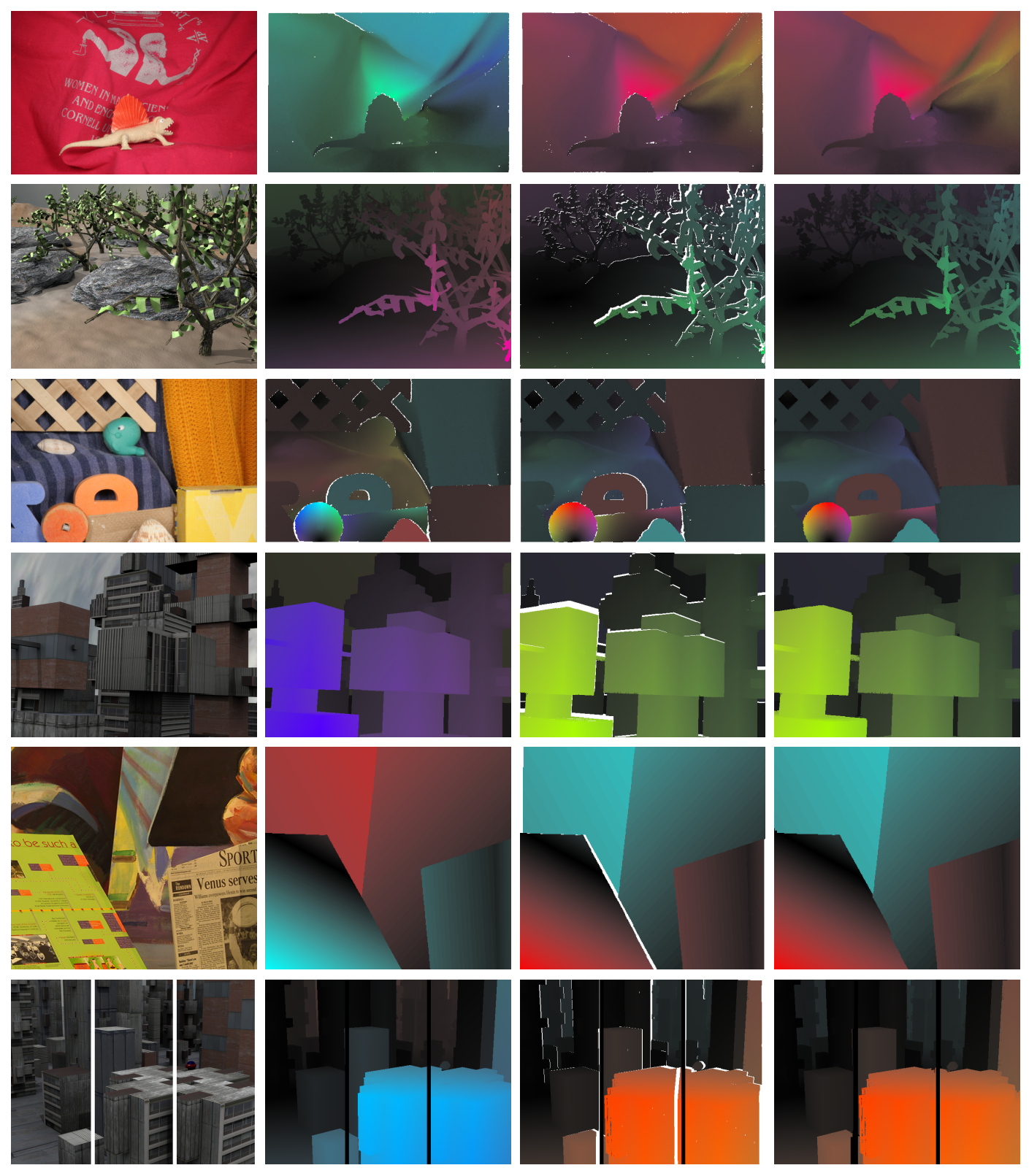
Installation
Prerequisites
- C++ compiler
- Python 3.7+
- pip
Install
pip install -U inverse_optical_flow
Usage
import numpy as np
import inverse_optical_flow

# Shape of the flow is (2, height, width).
# The first channel is horizontal, x-axis flow. The second channel is vertical, y-axis flow.
forward_flow = np.array([
    [[0, 0, 0],
     [0, 1, 0],
     [0, 0, 0]],

    [[0, 2, 0],
     [0, 1, 0],
     [0, 0, 0]],
], dtype=np.float32)

# Compute backward flow using max method
backward_flow, disocclusion_mask = inverse_optical_flow.max_method(forward_flow)

# See results
assert np.allclose(backward_flow, np.array([
    [[0,  0,  0],
     [0,  0,  0],
     [0,  0, -1]],

    [[0,  0,  0],
     [0,  0,  0],
     [0, -2, -1]]
])), backward_flow

assert np.allclose(disocclusion_mask, np.array([
    [0, 1, 0],
    [0, 1, 0],
    [0, 0, 0]
])), disocclusion_mask
Alternatives
https://github.com/sniklaus/softmax-splatting
License
Licensed under either of
- Apache License, Version 2.0, (LICENSE-APACHE or http://www.apache.org/licenses/LICENSE-2.0)
- MIT license (LICENSE-MIT or http://opensource.org/licenses/MIT)
at your option.
Contribution
Unless you explicitly state otherwise, any contribution intentionally submitted for inclusion in the work by you, as defined in the Apache-2.0 license, shall be dual licensed as above, without any additional terms or conditions.
Acknowledgements
Sánchez, J., Salgado, A., Monzón, N. (2013). An Efficient Algorithm for Estimating the Inverse Optical Flow. In: Sanches, J.M., Micó, L., Cardoso, J.S. (eds) Pattern Recognition and Image Analysis. IbPRIA 2013. Lecture Notes in Computer Science, vol 7887. Springer, Berlin, Heidelberg. https://doi.org/10.1007/978-3-642-38628-2_46
1 maintainer

Metadata
1 maintainer
Release files for inverse-optical-flow 0.0.2
For a detailed explanation of source distributions (sdists) and built distributions (wheels), please see the package formats documentation.
Source distribution (sdist)
| File | Size | Uploaded | |
|---|---|---|---|
| inverse_optical_flow-0.0.2.tar.gz | 10.8 kB | Details |
Release files / inverse_optical_flow-0.0.2.tar.gz
| Download URL | inverse_optical_flow-0.0.2.tar.gz |
|---|---|
| Size | 10.8 kB |
| Tags | Source |
|
SHA-256 checksum How to use checksums |
81a035c58b4d1367708ebfce0f452ce0db02c265fd136e40d02ecba887432f57
|
|
BLAKE2b-256 checksum How to use checksums |
ff5662e572947332e0af6ff5b133854d38fc160d67ae581b5d60542f654efdde
|
| Upload date | |
|
Uploaded using Trusted Publishing? What is trusted publishing? |
No |
| Uploaded via |
twine/4.0.2 CPython/3.12.1
|













