















What is Kedro?
Kedro is a toolbox for production-ready data science. It uses software engineering best practices to help you create data engineering and data science pipelines that are reproducible, maintainable, and modular. You can find out more at kedro.org.
Kedro is an open-source Python framework hosted by the LF AI & Data Foundation.
How do I install Kedro?
To install Kedro from the Python Package Index (PyPI) run:
pip install kedro
It is also possible to install Kedro using conda:
conda install -c conda-forge kedro
Our Get Started guide contains full installation instructions, and includes how to set up Python virtual environments.
What are the main features of Kedro?
| Feature | What is this? |
|---|---|
| Project Template | A standard, modifiable and easy-to-use project template based on Cookiecutter Data Science. |
| Data Catalog | A series of lightweight data connectors used to save and load data across many different file formats and file systems, including local and network file systems, cloud object stores, and HDFS. The Data Catalog also includes data and model versioning for file-based systems. |
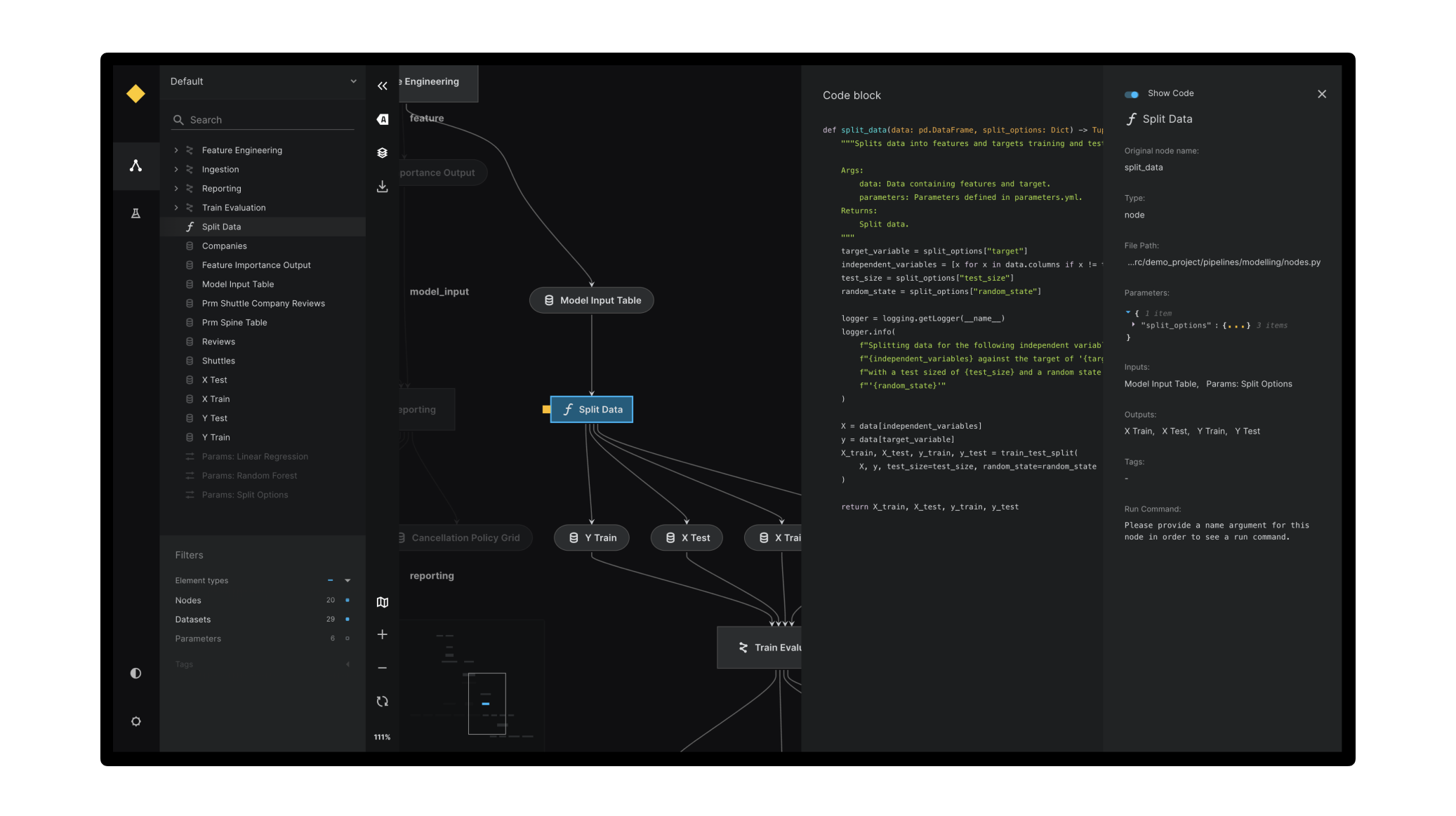
| Pipeline Abstraction | Automatic resolution of dependencies between pure Python functions and data pipeline visualisation using Kedro-Viz. |
| Coding Standards | Test-driven development using pytest, produce well-documented code using Sphinx, create linted code with support for flake8, isort and black and make use of the standard Python logging library. |
| Flexible Deployment | Deployment strategies that include single or distributed-machine deployment as well as additional support for deploying on Argo, Prefect, Kubeflow, AWS Batch and Databricks. |
How do I use Kedro?
The Kedro documentation first explains how to install Kedro and then introduces key Kedro concepts.
You can then review the spaceflights tutorial to build a Kedro project for hands-on experience
For new and intermediate Kedro users, there's a comprehensive section on how to visualise Kedro projects using Kedro-Viz.
Additional documentation explains how to work with Kedro and Jupyter notebooks, and there are a set of advanced user guides for advanced for key Kedro features. We also recommend the API reference documentation for further information.
Why does Kedro exist?
Kedro is built upon our collective best-practice (and mistakes) trying to deliver real-world ML applications that have vast amounts of raw unvetted data. We developed Kedro to achieve the following:
- To address the main shortcomings of Jupyter notebooks, one-off scripts, and glue-code because there is a focus on creating maintainable data science code
- To enhance team collaboration when different team members have varied exposure to software engineering concepts
- To increase efficiency, because applied concepts like modularity and separation of concerns inspire the creation of reusable analytics code
Find out more about how Kedro can answer your use cases from the product FAQs on the Kedro website.
The humans behind Kedro
The Kedro product team and a number of open source contributors from across the world maintain Kedro.
Can I contribute?
Yes! We welcome all kinds of contributions. Check out our guide to contributing to Kedro.
Where can I learn more?
There is a growing community around Kedro. We encourage you to ask and answer technical questions on Slack and bookmark the Linen archive of past discussions.
We keep a list of technical FAQs in the Kedro documentation and you can find a growing list of blog posts, videos and projects that use Kedro over on the awesome-kedro GitHub repository. If you have created anything with Kedro we'd love to include it on the list. Just make a PR to add it!
How can I cite Kedro?
If you're an academic, Kedro can also help you, for example, as a tool to solve the problem of reproducible research. Use the "Cite this repository" button on our repository to generate a citation from the CITATION.cff file.
Python version support policy
- The core Kedro Framework supports all Python versions that are actively maintained by the CPython core team. When a Python version reaches end of life, support for that version is dropped from Kedro. This is not considered a breaking change.
- The Kedro Datasets package follows the NEP 29 Python version support policy. This means that
kedro-datasetsgenerally drops Python version support beforekedro. This is becausekedro-datasetshas a lot of dependencies that follow NEP 29 and the more conservative version support approach of the Kedro Framework makes it hard to manage those dependencies properly.
4 maintainers


Metadata
4 maintainers
Release files for kedro 0.19.0
For a detailed explanation of source distributions (sdists) and built distributions (wheels), please see the package formats documentation.
Source distribution (sdist)
| File | Size | Uploaded | |
|---|---|---|---|
| kedro-0.19.0.tar.gz | 133.4 kB | Details |
Built distribution (wheel)
| File | Interpreter | ABI | Platform | Reset |
|---|---|---|---|---|
| kedro-0.19.0-py3-none-any.whl | Python 3 | none | any | Details |
Total release size: 294.7 kB
Release files / kedro-0.19.0.tar.gz
| Download URL | kedro-0.19.0.tar.gz |
|---|---|
| Size | 133.4 kB |
| Tags | Source |
|
SHA-256 checksum How to use checksums |
9586be0d02bfb3135801c90585fd54961dfe113ef2400c4bd4dc85bab83d8501
|
|
BLAKE2b-256 checksum How to use checksums |
b1bfe603ae61773495598bb1ff7ef397feaeecd990c5b4ac240d55dcf39eadba
|
| Upload date | |
|
Uploaded using Trusted Publishing? What is trusted publishing? |
No |
| Uploaded via |
twine/4.0.2 CPython/3.11.0
|
Release files / kedro-0.19.0-py3-none-any.whl
| Download URL | kedro-0.19.0-py3-none-any.whl |
|---|---|
| Size | 161.2 kB |
| Tags | Python 3 |
|
SHA-256 checksum How to use checksums |
7101e99906b29a05c0eaac9cb18856bd79e6e2cb2bdd533a82b291c74ba80744
|
|
BLAKE2b-256 checksum How to use checksums |
2d4d5fb351535b5c651cbd737e030ec34417a2a7eb76e9d2f54aedf181bde948
|
| Upload date | |
|
Uploaded using Trusted Publishing? What is trusted publishing? |
No |
| Uploaded via |
twine/4.0.2 CPython/3.11.0
|














