






LTNtorch: PyTorch implementation of Logic Tensor Networks
Welcome to the PyTorch's implementation of Logic Tensor Networks!
Basic idea of the framework
Logic Tensor Network (LTN) is a Neural-Symbolic (NeSy) framework which supports learning of neural networks using the satisfaction of a first-order logic knowledge base as an objective. In other words, LTN uses logical reasoning on the knowledge base to guide the learning of a potentially deep neural network.
The idea of the framework is simple:
- we have a first-order logic knowledge base containing a set of axioms;
- we have some predicates, functions, or logical constants appearing in these axioms that we want to learn;
- we have some data available that we can use to learn the parameters of those symbols.
The idea is to use the logical axioms as a loss function for our Logic Tensor Network. The objective is to find solutions in the hypothesis space that maximally satisfy all the axioms contained in our knowledge base.
Learning in LTN
In LTN, the learnable parameters are contained in the predicates, functions, and possibly learnable logical constants that appear in the logical axioms of the knowledge base.
During the forward step of the back-propagation algorithm, LTN computes the truth values of the logical formulas contained in the knowledge base, using the available data to ground (or instantiate) the logical formulas. As we have already said, these formulas will contain some predicates and functions which are represented as learnable models.
At the end of the forward phase, the truth values computed for the formulas are aggregated and used in the loss function. Our objective is to maximize the aggregated truth value, namely maximally satisfy all the axioms.
During the backward step, the learnable parameters of predicates, functions, and possibly learnable logical constants are changed in such a way to move towards a solution in the hypothesis space which better satisfies all the axioms in the knowledge base.
At the end of the training, the parameters of predicates, functions, and constants will have been updated in such a way the logical formulas in the knowledge base are maximally satisfied. In particular, the parameters will have been learned by using both data (to ground the formulas) and logical reasoning (at the loss function).
After learning, it is possible to query predicates and functions on new data which was not available during training. Also, it is possible to query the truth values of new formulas which were not included in the knowledge base during training. In addition, if some logical constants have been learned, their parameters can be interpreted as embeddings.
Real Logic logical language
To make this learning possible, LTN uses a differentiable first-order logic language, called Real Logic, which enables the incorporation of data and logic.
Real Logic defines the concept of grounding (different from the grounding of logic), which is a mapping from the logical domain (i.e., constants, variables, and logical symbols)
to tensors in the Real field or operations based on tensors. These operations could be, for instance, mathematical functions or learnable neural networks. In other words,
a grounding, denoted as 𝒢, is a function which maps a logical symbol into a real tensor or an operation on tensors.
In particular, the grounding is defined as follows. Let us assume that c is a constant, x is a logical
variable, P is a predicate, and f is a logical function:
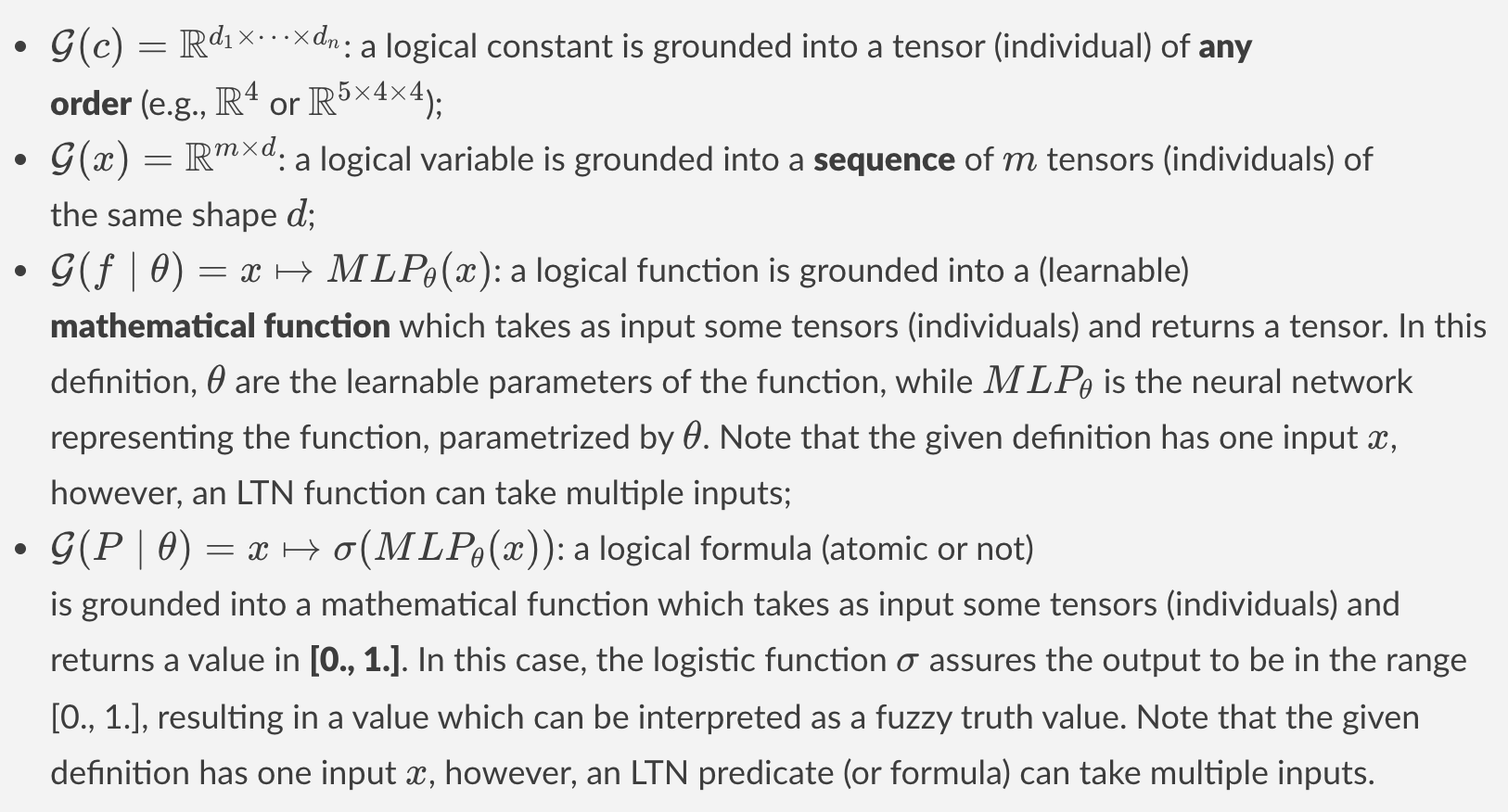
The grounding defines also how the logical connectives (∧, ∨, ¬, ⇒, ↔) and quantifiers
(∀, ∃) are mapped in the Real domain. In particular, logical connectives are grounded using fuzzy logic semantics, while
quantifiers are grounded using fuzzy aggregators. Please, carefully read the paper if you have some doubts on these notions.
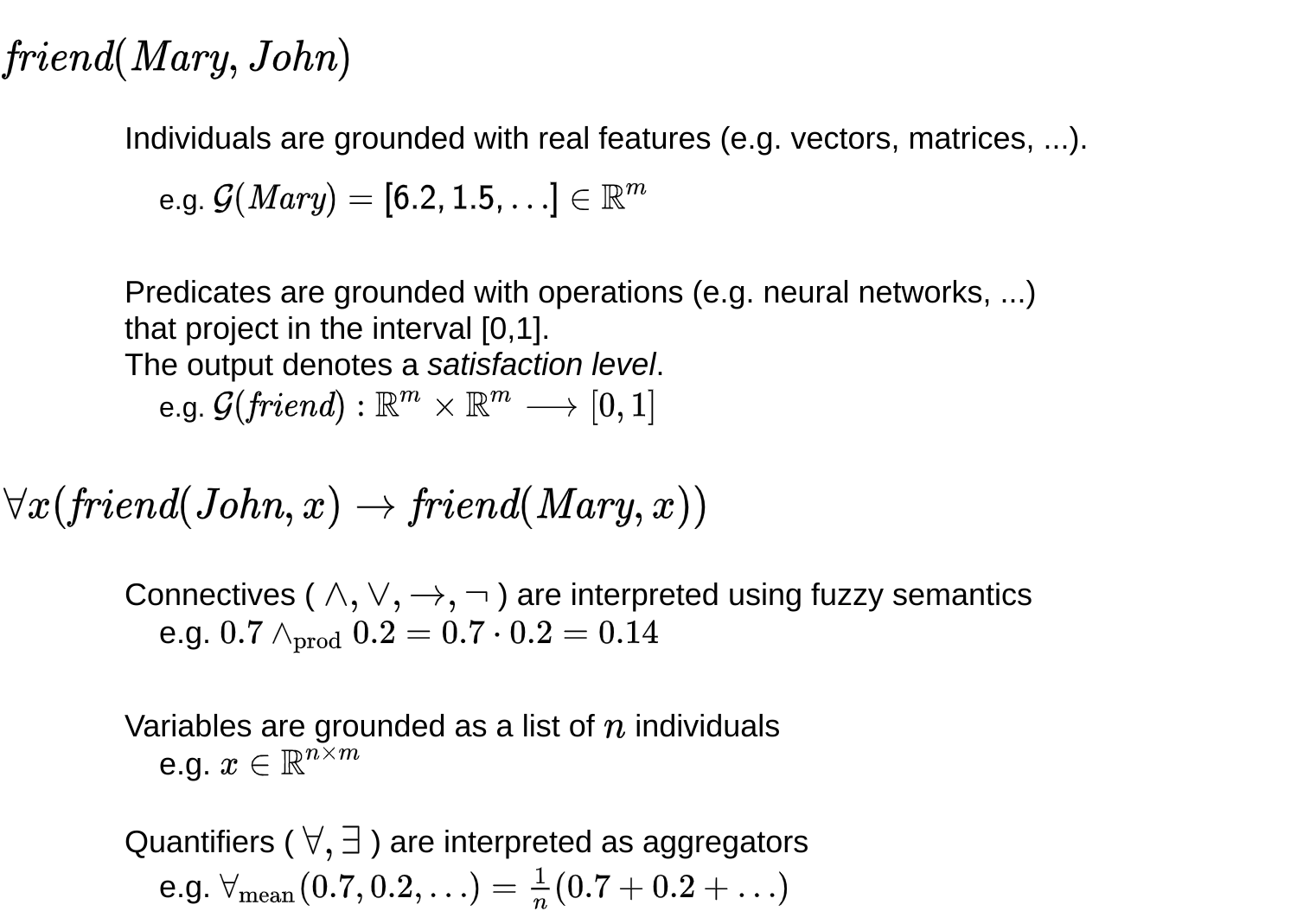
Examples of possible groundings are showed in the following figure. In the figure, friend(Mary, John) is an
atomic formula (predicate), while ∀x(friend(John, x) ⇒ friend(Mary, x)) is a closed formula (all the variables are
quantified). The letter 𝒢, again, is the grounding, the function which maps the logical domain into the Real domain.
LTN as PyTorch computational graphs
In practice, LTN converts Real Logic formulas (e.g., ∀x∃y(friend(x,y) ∧ italian(y)), which states that everybody has a friend that is Italian) into PyTorch
computational graphs. Such formulas can express complex queries about the data, prior knowledge to satisfy during
learning, statements to prove, etc. The following figure shows an example of how LTN converts such formulas into PyTorch
computational graphs.
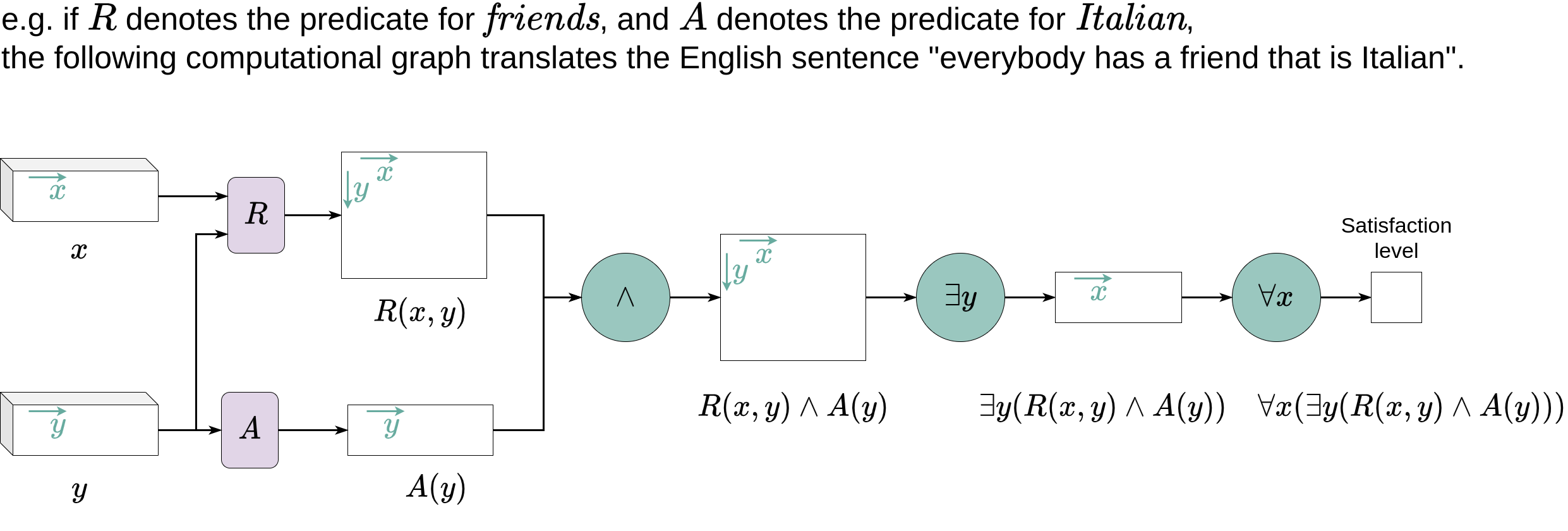
Let us assume we have 6 people which are denoted using 4 real-valued features.
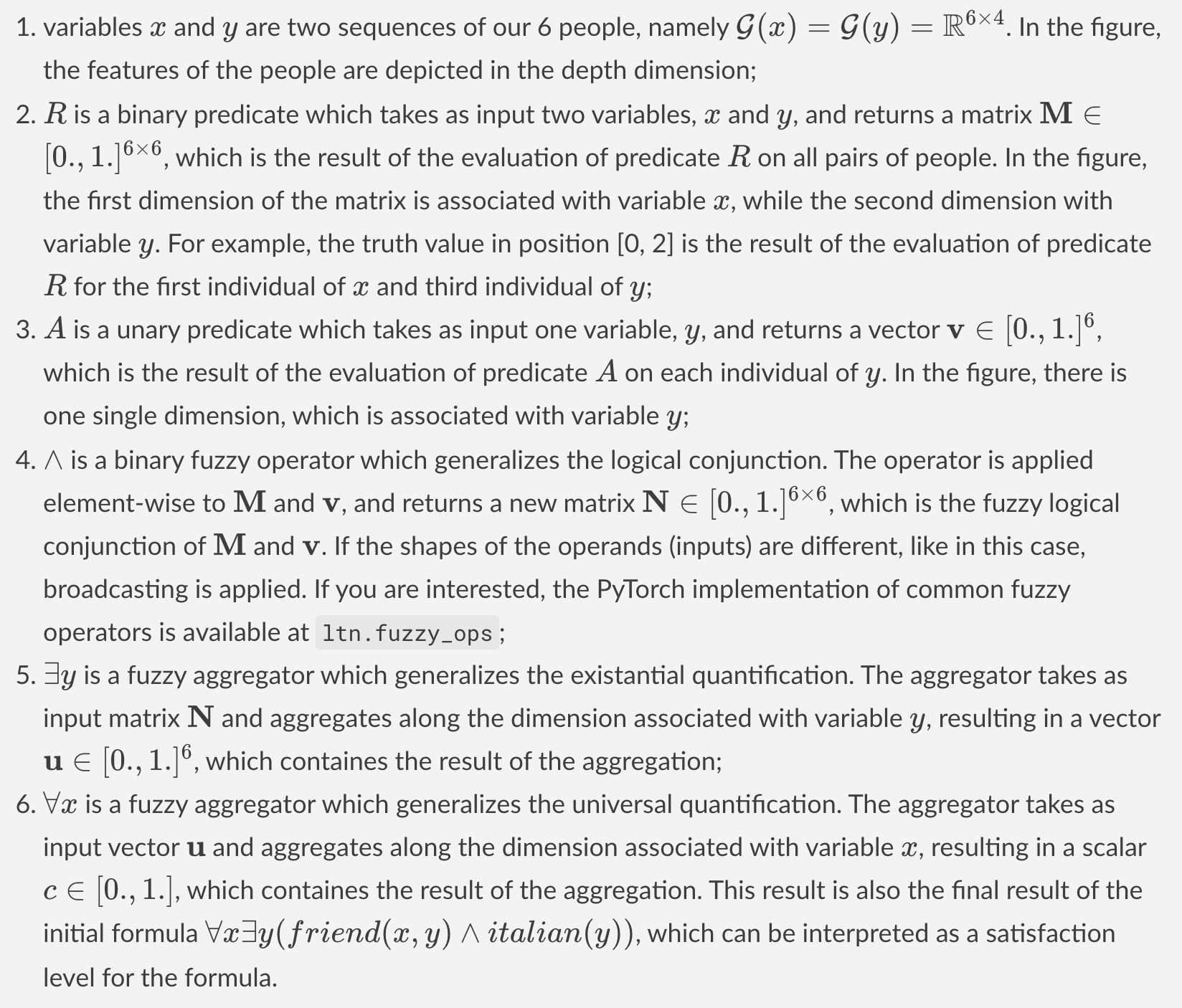
The previous figure illustrates the following:
Conclusion
Using LTN, one can represent and effectively compute some of the most important tasks of deep learning. Examples of such tasks are classification, regression, clustering, and so on.
The Getting Started section of the README links to tutorials and examples to learn how to code Logic Tensor Networks in PyTorch.
However, we suggest to carefully read the paper before going through the tutorials and examples.
Installation
It is possible to install LTNtorch using pip.
pip install LTNtorch
Alternatively, it is possible to install LTNtorch by cloning this repository. In this case, make sure to install all the requirements.
pip3 install -r requirements.txt
Structure of repository
ltn/core.py: this module contains the implementation of the LTN framework. In particular, it contains the definition of constants, variables, predicates, functions, connectives and quantifiers;ltn/fuzzy_ops.py: this module contains the implementation of common fuzzy logic semantics using PyTorch primitives;tutorials/: this folder contains some important tutorials to getting started with coding in LTN;examples/: this folder contains various problems approached using LTN and presented in the "Reach of Logic Tensor Networks" section of the paper;tests/: this folder contains unit tests that have been used to test thecoreandfuzzy_opsmodules. The coverage is 100%.
Tests
The core and fuzzy_ops modules of this repository have been entirely tested using pytest, with a coverage of 100%.
The examples included in the documentation have also been tested, using doctest.
Documentation
The documentation has been created with Sphinx, using the Read the Docs Sphinx Theme.
Getting Started
Tutorials
tutorials/ contains some important tutorials to getting started with coding in LTN. We suggest completing the tutorials in order.
The tutorials cover the following topics:
- Grounding in LTN (part 1): Real Logic, constants, predicates, functions, variables;
- Grounding in LTN (part 2): connectives and quantifiers (+ complement: choosing appropriate operators for learning);
- Learning in LTN: using satisfiability of LTN formulas as a training objective.
The tutorials are implemented using jupyter notebooks.
Examples
examples/ contains the series of examples included in the "Reach of Logic Tensor Networks" section of the paper. Their objective
is to show how the language of Real Logic can be used to specify a number of tasks that involve learning from data and
reasoning about logical knowledge.
The examples covered are the following:
- Binary classification: illustrates, in the simplest setting, how to ground a binary classifier as a predicate in LTN;
- Multi-class single-label classification: illustrate how to ground predicates that can classify samples in several mutually-exclusive classes;
- Multi-class multi-label classification: illustrate how to ground predicates that can classify samples in several classes which are not mutually-exclusive;
- Semi-supervised pattern recognition: showcases the power of LTN in dealing with semi-supervised learning tasks;
- Regression: illustrates how to ground a regressor as a function symbol in LTN;
- Clustering: illustrates how LTN can solve a unsupervised tasks using first-order logical constraints;
- Learning embeddings with LTN: illustrates how LTN can learn embeddings using learnable logical constants.
The examples are presented using jupyter notebooks.
License
This project is licensed under the MIT License - see the LICENSE file for details.
Acknowledgements
LTN has been developed thanks to active contributions and discussions with the following people (in alphabetical order):
- Alessandro Daniele (FBK)
- Artur d’Avila Garcez (City)
- Benedikt Wagner (City)
- Emile van Krieken (VU Amsterdam)
- Francesco Giannini (UniSiena)
- Giuseppe Marra (UniSiena)
- Ivan Donadello (FBK)
- Lucas Bechberger (UniOsnabruck)
- Luciano Serafini (FBK)
- Marco Gori (UniSiena)
- Michael Spranger (Sony AI)
- Michelangelo Diligenti (UniSiena)
- Samy Badreddine (Sony AI)
- Tommaso Carraro (FBK)
Citing this repo
If you are using LTNtorch in your work, please consider citing this repository using the following BibTex entry.
@misc{LTNtorch,
  author       = {Tommaso Carraro},
  title        = {{LTNtorch: PyTorch implementation of Logic Tensor Networks}},
  month        = {mar},
  year         = {2023},
  howpublished = {Zenodo},
  version      = {v1.0.1},
  doi          = {10.5281/zenodo.7778157}
  url          = {https://doi.org/10.5281/zenodo.7778157}
}
1 maintainer

Metadata
1 maintainer
Release files for LTNtorch 1.0.2
For a detailed explanation of source distributions (sdists) and built distributions (wheels), please see the package formats documentation.
Source distribution (sdist)
| File | Size | Uploaded | |
|---|---|---|---|
| LTNtorch-1.0.2.tar.gz | 28.8 kB | Details |
Built distribution (wheel)
| File | Interpreter | ABI | Platform | Reset |
|---|---|---|---|---|
| LTNtorch-1.0.2-py3-none-any.whl | Python 3 | none | any | Details |
Total release size: 58.4 kB
Release files / LTNtorch-1.0.2.tar.gz
| Download URL | LTNtorch-1.0.2.tar.gz |
|---|---|
| Size | 28.8 kB |
| Tags | Source |
|
SHA-256 checksum How to use checksums |
667579fbba97fa10189056138ce19c55ae90fe7b7f7e9e5a85ab6349a861e97b
|
|
BLAKE2b-256 checksum How to use checksums |
85cabdca3af4c1d99c24eaa6a3da61c2c19224300361aa5f0a771e7a70ab2ea9
|
| Upload date | |
|
Uploaded using Trusted Publishing? What is trusted publishing? |
No |
| Uploaded via |
twine/3.7.1 importlib_metadata/7.0.1 pkginfo/1.8.2 requests/2.31.0 requests-toolbelt/0.9.1 tqdm/4.62.3 CPython/3.9.2
|
Release files / LTNtorch-1.0.2-py3-none-any.whl
| Download URL | LTNtorch-1.0.2-py3-none-any.whl |
|---|---|
| Size | 29.5 kB |
| Tags | Python 3 |
|
SHA-256 checksum How to use checksums |
6d7e157e24b5250f15c45c97d9578cbf87bff9eefaf1844dac0645e386004c7b
|
|
BLAKE2b-256 checksum How to use checksums |
13adb5a8512b5ff8bb4e2b1ef8245e81308ec9b81d9e380d7e29896c7e866d22
|
| Upload date | |
|
Uploaded using Trusted Publishing? What is trusted publishing? |
No |
| Uploaded via |
twine/3.7.1 importlib_metadata/7.0.1 pkginfo/1.8.2 requests/2.31.0 requests-toolbelt/0.9.1 tqdm/4.62.3 CPython/3.9.2
|














