
A Snowflake MCP server — SQL queries, schema exploration, and data insights for AI assistants
Verified details
These details have been verified by PyPIProject links
GitHub Statistics
Maintainers

Project description





| Test |   |
| Lint |      |
| Meta |     |
| Security |     |
| Best Practices |   |
| Documentation |  |
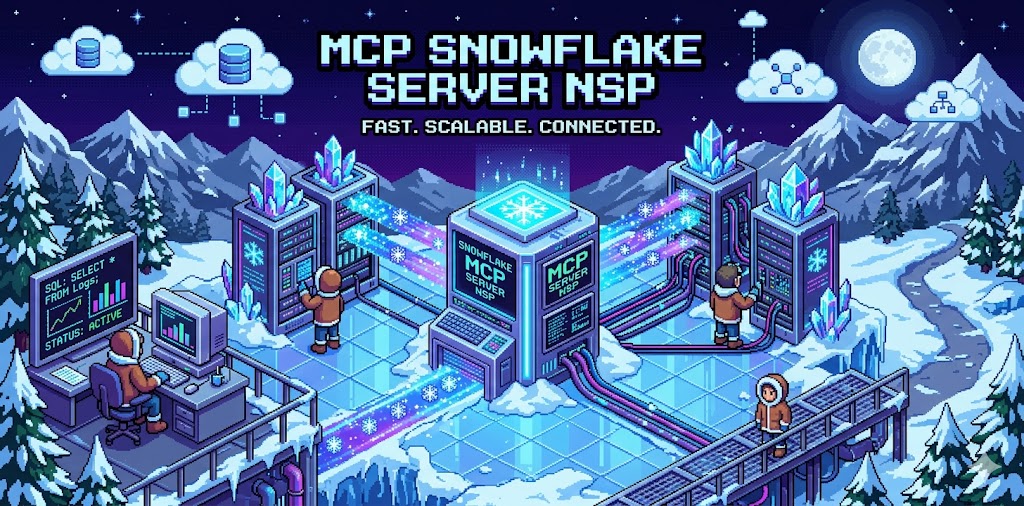
Snowflake MCP Server NSP
A Model Context Protocol (MCP) server / MCP server that connects AI assistants to Snowflake — enabling SQL queries, schema exploration, and data insights directly from your LLM client.
Highlights:
- Multiple authentication methods: password, key-pair, external browser, OAuth 2.0 (client credentials & bearer token), TOML connection files
- TOML multi-connection config — manage
production,staging, anddevelopmentenvironments in one file - Write-safety guard — write operations are disabled by default and must be explicitly enabled
- Exclusion patterns — filter out databases, schemas, or tables from discovery
--exclude-json-resultsflag — reduces LLM context window usage- Selective tool exclusion via
--exclude_tools - Prefetch mode — pre-load table schema as MCP resources
- Docker support with hardened image (DHI, nonroot user, no shell in runtime)
Table of Contents
- Snowflake MCP Server NSP
Quick Start
The fastest way to try it — using uvx with a TOML connection file:
# 1. Create a connections file
cat > ~/snowflake_connections.toml << 'EOF'
[myconn]
account = "your_account"
user = "your_user"
password = "your_password"
warehouse = "COMPUTE_WH"
database = "MY_DB"
schema = "PUBLIC"
role = "MYROLE"
EOF

# 2. Run the server
uvx --python=3.13 --from mcp-snowflake-server-nsp mcp_snowflake_server \
  --connections-file ~/snowflake_connections.toml \
  --connection-name myconn
Claude Code
Add to your MCP client config (e.g. claude_desktop_config.json) using snowflake_connections.toml:
"mcpServers": {
  "snowflake": {
    "command": "uvx",
    "args": [
      "--python=3.13",
      "--from", "mcp-snowflake-server-nsp",
      "mcp_snowflake_server",
      "--connections-file", "/absolute/path/to/snowflake_connections.toml",
      "--connection-name", "myconn"
    ]
  }
}
Visual Studio Code (VSCode)
uvx — 

Docker — 

Or add manually to your MCP client config (e.g. .vscode/mcp.json) using .env file (see Authentication):
"snowflake": {
      // Snowflake MCP server
      "type": "stdio",
      "command": "uvx",
      "args": [
        "--from", "mcp-snowflake-server-nsp",
        "--python=3.13",
        "mcp_snowflake_server"
      ],
      "envFile": "${workspaceFolder}/.env"
    }
OpenCode
Add to your MCP client config (e.g. opencode.jsonc) with .env file (see Authentication):
"snowflake": {
  "type": "local",
  "command": [
    "uvx",
    "--from",
    "mcp-snowflake-server-nsp",
    "--python=3.13",
    "mcp_snowflake_server",
  ],
  "enabled": true,
  "timeout": 300000,
}
Components
Resources
| URI | Description |
|---|---|
memo://insights |
A continuously updated memo aggregating data insights appended via append_insight. |
context://table/{table_name} |
(Prefetch mode only) Per-table schema summaries including columns and comments. |
Tools
Query Tools
| Tool | Description | Requires |
|---|---|---|
read_query |
Execute SELECT queries. Input: query (string). |
— |
write_query |
Execute INSERT, UPDATE, or DELETE queries. Input: query (string). |
--allow_write |
create_table |
Execute CREATE TABLE statements. Input: query (string). |
--allow_write |
Schema Tools
| Tool | Description | Input |
|---|---|---|
list_databases |
List all databases in the Snowflake instance. | — |
list_schemas |
List all schemas within a database. | database (string) |
list_tables |
List all tables within a database and schema. | database, schema (strings) |
describe_table |
Describe columns of a table (name, type, nullability, default, comment). | table_name as database.schema.table |
Analysis Tools
| Tool | Description | Input |
|---|---|---|
append_insight |
Add a data insight to the memo://insights resource. |
insight (string) |
Authentication
Password
Set credentials via environment variables or CLI flags (see Configuration Reference):
SNOWFLAKE_USER="user@example.com"
SNOWFLAKE_ACCOUNT="myaccount"
SNOWFLAKE_AUTHENTICATOR="snowflake"
SNOWFLAKE_PASSWORD="secret"
SNOWFLAKE_WAREHOUSE="COMPUTE_WH"
SNOWFLAKE_DATABASE="MY_DB"
SNOWFLAKE_SCHEMA="PUBLIC"
SNOWFLAKE_ROLE="MYROLE"
Key-Pair
Both RSA (RS256) and ECDSA (ES256, ES384, ES512) private keys are supported (requires snowflake-connector-python ≥ 4.5.0 for ECDSA).
SNOWFLAKE_USER="user@example.com"
SNOWFLAKE_ACCOUNT="myaccount"
SNOWFLAKE_AUTHENTICATOR="snowflake_jwt"
SNOWFLAKE_PRIVATE_KEY_FILE="/absolute/path/to/key.p8"
SNOWFLAKE_PRIVATE_KEY_FILE_PWD="passphrase"  # Optional — only if key is encrypted
SNOWFLAKE_WAREHOUSE="COMPUTE_WH"
SNOWFLAKE_DATABASE="MY_DB"
SNOWFLAKE_SCHEMA="PUBLIC"
SNOWFLAKE_ROLE="MYROLE"
Or via CLI: --private_key_file /path/to/key.p8 --private_key_file_pwd passphrase
External Browser
SNOWFLAKE_AUTHENTICATOR="externalbrowser"
Or in a TOML connection entry: authenticator = "externalbrowser"
OAuth 2.0 Client Credentials
Use the OAuth 2.0 client credentials flow to authenticate with a client ID and secret (no user interaction required):
SNOWFLAKE_AUTHENTICATOR="oauth_client_credentials"
SNOWFLAKE_ACCOUNT="myaccount"
SNOWFLAKE_OAUTH_CLIENT_ID="your_client_id"
SNOWFLAKE_OAUTH_CLIENT_SECRET="your_client_secret"
SNOWFLAKE_OAUTH_TOKEN_REQUEST_URL="https://your-idp.example.com/oauth/token"
SNOWFLAKE_OAUTH_SCOPE="session:role:MY_ROLE"  # Optional
SNOWFLAKE_WAREHOUSE="COMPUTE_WH"
SNOWFLAKE_DATABASE="MY_DB"
SNOWFLAKE_SCHEMA="PUBLIC"
SNOWFLAKE_ROLE="MYROLE"
OAuth Bearer Token
Use a pre-fetched OAuth bearer token:
SNOWFLAKE_AUTHENTICATOR="oauth"
SNOWFLAKE_ACCOUNT="myaccount"
SNOWFLAKE_TOKEN="eyJhbGciOiJSUzI1NiJ9..."
SNOWFLAKE_WAREHOUSE="COMPUTE_WH"
SNOWFLAKE_DATABASE="MY_DB"
SNOWFLAKE_SCHEMA="PUBLIC"
SNOWFLAKE_ROLE="MYROLE"
TOML Connection File (Recommended)
Manage multiple environments in a single file. See example_connections.toml for a full template.
[production]
account = "your_account"
user = "your_user"
password = "your_password"
authenticator = "snowflake"
warehouse = "COMPUTE_WH"
database = "PROD_DB"
schema = "PUBLIC"
role = "ACCOUNTADMIN"

[development]
account = "your_account"
user = "dev_user"
authenticator = "externalbrowser"
warehouse = "DEV_WH"
database = "DEV_DB"
schema = "PUBLIC"
role = "DEVELOPER"

[reporting]
account = "your_account"
user = "reporting_user"
authenticator = "snowflake_jwt"
private_key_file = "/path/to/private_key.pem"
private_key_file_pwd = "passphrase"  # Optional
warehouse = "REPORTING_WH"
database = "REPORTING_DB"
schema = "REPORTS"
role = "REPORTING_ROLE"

[analytics_oauth]
account = "your_account"
authenticator = "oauth_client_credentials"
oauth_client_id = "your_client_id"
oauth_client_secret = "your_client_secret"
oauth_token_request_url = "https://your-idp.example.com/oauth/token"
oauth_scope = "session:role:ANALYTICS_ROLE"  # Optional
warehouse = "ANALYTICS_WH"
database = "ANALYTICS_DB"
schema = "PUBLIC"
role = "ANALYTICS_ROLE"
Pass the file with --connections-file and select a profile with --connection-name. Both flags are required together.
Installation
The package is published on PyPI as mcp-snowflake-server-nsp.
Contributing or running from source? See
CONTRIBUTING.mdfor local development setup, test commands, formatting, and building the Docker image from source.
Via UVX
TOML configuration (recommended)
"mcpServers": {
  "snowflake_production": {
    "command": "uvx",
    "args": [
      "--python=3.13",
      "--from", "mcp-snowflake-server-nsp",
      "mcp_snowflake_server",
      "--connections-file", "/path/to/snowflake_connections.toml",
      "--connection-name", "production"
      // Optional flags — see Configuration Reference
    ]
  },
  "snowflake_staging": {
    "command": "uvx",
    "args": [
      "--python=3.13",
      "--from", "mcp-snowflake-server-nsp",
      "mcp_snowflake_server",
      "--connections-file", "/path/to/snowflake_connections.toml",
      "--connection-name", "staging"
    ]
  }
}
Individual parameters
"mcpServers": {
  "snowflake": {
    "command": "uvx",
    "args": [
      "--python=3.13",
      "--from", "mcp-snowflake-server-nsp",
      "mcp_snowflake_server",
      "--account", "your_account",
      "--warehouse", "your_warehouse",
      "--user", "your_user",
      "--password", "your_password",
      "--role", "your_role",
      "--database", "your_database",
      "--schema", "your_schema"
      // Optional: "--private_key_file", "/absolute/path/key.p8"
      // Optional: "--private_key_file_pwd", "passphrase"
      // Optional flags — see Configuration Reference
    ]
  }
}
Via Docker Hub
The image is published on Docker Hub — no build step required:
docker pull nsphung/mcp-snowflake-server-nsp
Note:
-i(--interactive) is required to keep stdin open for the MCP stdio transport. Do not use-d(detach).
Claude Desktop — claude_desktop_config.json
With .env file (see Authentication):
"mcpServers": {
  "snowflake": {
    "command": "docker",
    "args": [
      "run", "--rm", "-i",
      "--env-file", "/absolute/path/to/.env",
      "nsphung/mcp-snowflake-server-nsp"
    ]
  }
}
With TOML connections file:
"mcpServers": {
  "snowflake": {
    "command": "docker",
    "args": [
      "run", "--rm", "-i",
      "-v", "/path/to/snowflake_connections.toml:/app/snowflake_connections.toml:ro",
      "nsphung/mcp-snowflake-server-nsp",
      "--connections-file", "/app/snowflake_connections.toml",
      "--connection-name", "production"
    ]
  }
}
VS Code — .vscode/mcp.json
With .env file:
"snowflake": {
  "type": "stdio",
  "command": "docker",
  "args": [
    "run", "--rm", "-i",
    "nsphung/mcp-snowflake-server-nsp"
  ],
  "envFile": "${workspaceFolder}/.env"
}
With TOML connections file:
"snowflake": {
  "type": "stdio",
  "command": "docker",
  "args": [
    "run", "--rm", "-i",
    "-v", "/path/to/snowflake_connections.toml:/app/snowflake_connections.toml:ro",
    "nsphung/mcp-snowflake-server-nsp",
    "--connections-file", "/app/snowflake_connections.toml",
    "--connection-name", "production"
  ]
}
OpenCode — opencode.jsonc
"snowflake": {
  "type": "local",
  "command": [
    "docker", "run", "--rm", "-i",
    "--env-file", "/absolute/path/to/.env",
    "nsphung/mcp-snowflake-server-nsp"
  ],
  "enabled": true,
  "timeout": 300000
}
Configuration Reference
All connection parameters can also be set as environment variables (SNOWFLAKE_<PARAM_UPPER>).
| Flag | Env var | Default | Description |
|---|---|---|---|
--account |
SNOWFLAKE_ACCOUNT |
— | Snowflake account identifier |
--user |
SNOWFLAKE_USER |
— | Snowflake username |
--password |
SNOWFLAKE_PASSWORD |
— | Password (not required for key-pair / SSO) |
--warehouse |
SNOWFLAKE_WAREHOUSE |
— | Virtual warehouse to use |
--database |
SNOWFLAKE_DATABASE |
(required) | Default database |
--schema |
SNOWFLAKE_SCHEMA |
(required) | Default schema |
--role |
SNOWFLAKE_ROLE |
— | Role to assume |
--private_key_file |
SNOWFLAKE_PRIVATE_KEY_FILE |
— | Absolute path to RSA or ECDSA (ES256/384/512) private key file (.p8 / .pem) |
--private_key_file_pwd |
SNOWFLAKE_PRIVATE_KEY_FILE_PWD |
— | Passphrase for encrypted private key |
--connections-file |
— | — | Path to TOML connections file |
--connection-name |
— | — | Connection profile name in TOML file (required with --connections-file) |
--allow_write |
— | false |
Enable write_query and create_table tools |
--prefetch / --no-prefetch |
— | false |
Pre-load table schema as context://table/* resources (disables list_tables / describe_table) |
--exclude_tools |
— | [] |
Space-separated list of tool names to disable |
--exclude-json-results |
— | false |
Omit embedded JSON resources from responses (reduces context window usage) |
--log_dir |
— | — | Directory for log file output |
--log_level |
— | INFO |
Log verbosity: DEBUG, INFO, WARNING, ERROR, CRITICAL |
Exclusion Patterns
Edit runtime_config.json to exclude databases, schemas, or tables from all discovery tools. Patterns are matched case-insensitively as substrings.
{
  "exclude_patterns": {
    "databases": ["temp"],
    "schemas": ["temp", "information_schema"],
    "tables": ["temp"]
  }
}
The server loads this file automatically at startup from the working directory.
License
This project is licensed under the MIT License. See the LICENSE file for the full text.
Fork and Attribution
This repository is a fork of isaacwasserman/mcp-snowflake-server.
- Upstream authors and contributors retain copyright for their contributions.
- Fork-specific changes are maintained by
nsphung. - A summary of notable modifications is tracked in
NOTICE.
Project details
Verified details
These details have been verified by PyPIProject links
GitHub Statistics
Maintainers
Release history Release notifications | RSS feed


Download files
Download the file for your platform. If you're not sure which to choose, learn more about installing packages.
Source Distribution
Built Distribution
Filter files by name, interpreter, ABI, and platform.
If you're not sure about the file name format, learn more about wheel file names.
Copy a direct link to the current filters
File details
Details for the file mcp_snowflake_server_nsp-0.13.0.tar.gz.
File metadata
- Download URL: mcp_snowflake_server_nsp-0.13.0.tar.gz
- Upload date:
- Size: 109.5 kB
- Tags: Source
- Uploaded using Trusted Publishing? Yes
- Uploaded via: twine/6.1.0 CPython/3.13.13
File hashes
| Algorithm | Hash digest | |
|---|---|---|
| SHA256 |
1e055496cc378078ec340701d1c0fce4f1e83c0243b0852e4744a550fa998b3d
|
|
| MD5 |
72d88189f64fda9a2c921c2a7b2b4874
|
|
| BLAKE2b-256 |
c4136438e3b9f4181af5499581122c5aa61336f8dee542afd5014e8ffd9f2603
|
Provenance
The following attestation bundles were made for mcp_snowflake_server_nsp-0.13.0.tar.gz:
Publisher:
publish.yml on nsphung/mcp-snowflake-server
-
Statement:
-
Statement type:
https://in-toto.io/Statement/v1 -
Predicate type:
https://docs.pypi.org/attestations/publish/v1 -
Subject name:
mcp_snowflake_server_nsp-0.13.0.tar.gz -
Subject digest:
1e055496cc378078ec340701d1c0fce4f1e83c0243b0852e4744a550fa998b3d - Sigstore transparency entry: 1640226945
- Sigstore integration time:
-
Permalink:
nsphung/mcp-snowflake-server@1a42023381de07fe02de641777575b7af634bf9a -
Branch / Tag:
refs/tags/v0.13.0 - Owner: https://github.com/nsphung
-
Access:
public
-
Token Issuer:
https://token.actions.githubusercontent.com -
Runner Environment:
github-hosted -
Publication workflow:
publish.yml@1a42023381de07fe02de641777575b7af634bf9a -
Trigger Event:
release
-
Statement type:
File details
Details for the file mcp_snowflake_server_nsp-0.13.0-py3-none-any.whl.
File metadata
- Download URL: mcp_snowflake_server_nsp-0.13.0-py3-none-any.whl
- Upload date:
- Size: 24.5 kB
- Tags: Python 3
- Uploaded using Trusted Publishing? Yes
- Uploaded via: twine/6.1.0 CPython/3.13.13
File hashes
| Algorithm | Hash digest | |
|---|---|---|
| SHA256 |
c6e6a8bbb5ae741597296edec5d9a3d54a61d6b0d42eadf531685021a0817830
|
|
| MD5 |
0ec75e25199cb39686580dc9fa03a518
|
|
| BLAKE2b-256 |
907ef302558ce4b11058d3c952175914238319b7df39fe01a9ab03461108f407
|
Provenance
The following attestation bundles were made for mcp_snowflake_server_nsp-0.13.0-py3-none-any.whl:
Publisher:
publish.yml on nsphung/mcp-snowflake-server
-
Statement:
-
Statement type:
https://in-toto.io/Statement/v1 -
Predicate type:
https://docs.pypi.org/attestations/publish/v1 -
Subject name:
mcp_snowflake_server_nsp-0.13.0-py3-none-any.whl -
Subject digest:
c6e6a8bbb5ae741597296edec5d9a3d54a61d6b0d42eadf531685021a0817830 - Sigstore transparency entry: 1640227047
- Sigstore integration time:
-
Permalink:
nsphung/mcp-snowflake-server@1a42023381de07fe02de641777575b7af634bf9a -
Branch / Tag:
refs/tags/v0.13.0 - Owner: https://github.com/nsphung
-
Access:
public
-
Token Issuer:
https://token.actions.githubusercontent.com -
Runner Environment:
github-hosted -
Publication workflow:
publish.yml@1a42023381de07fe02de641777575b7af634bf9a -
Trigger Event:
release
-
Statement type:






