
Minette for Python

Minette is a minimal and extensible chatbot framework. It is extremely easy to develop and the architecture preventing to be spaghetti code enables you to scale up to complex chatbot.
🎉 version 0.4.2 is available
-
0.4.3 Sep 5, 2020
-
0.4.2 Aug 26, 2020
- Support Janome 0.4
-
0.4.1 Aug 7, 2020
- SQLAlchemy is supported (experimental). See also examples/todo.py
🚀 Quick start
Running echo bot is extremely easy.
from minette import Minette, EchoDialogService

# Create chatbot instance using EchoDialogService
bot = Minette(default_dialog_service=EchoDialogService)

# Send and receive messages
while True:
    req = input("user> ")
    res = bot.chat(req)
    for message in res.messages:
        print("minette> " + message.text)
$ python echo.py
user> hello
minette> You said: hello
Creating LINE bot is also super easy.
from flask import Flask, request
from minette import Minette, EchoDialogService
from minette.adapter.lineadapter import LineAdapter

# Create chatbot wrapped by LINE adapter
bot = LineAdapter(default_dialog_service=EchoDialogService)

# Create web server and its request handler
app = Flask(__name__)

@app.route("/", methods=["POST"])
def handle_webhook():
    bot.handle_http_request(request.data, request.headers)
    return "ok"

# Start web server
app.run(port=12345)
See also examples.md to get more examples.
📦 Installation
$ pip install minette
✅ Supported Platforms
Python 3.5 or higher is supported. Mainly developed using Python 3.7.7 on Mac OSX.
Messaging Service
- LINE
- Clova
- Symphony
You can connect to other messaging services by extending minette.Adapter.
Database
- SQLite
- Azure SQL Database
- Azure Table Storage
- MySQL (Tested on 8.0.13)
You can use other databases you like by extending the classes in minette.datastore package. (Context / User / MessageLog)
Or, maybe you can use supported databases by SQLAlchemy by just setting connection string for it.
Tagger
- MeCab
- Janome
You can use other morphological engines including cloud services and for other languages by extending minette.Tagger.
To setup and use MeCab and Janome Tagger, see the Appendix at the bottom of this page.
📚 Dependencies
(Required)
- pytz >= 2018.9
- schedule >= 0.6.0
(Optional)
- line-bot-sdk >= 1.12.1 (for LINE)
- clova-cek-sdk >= 1.1.1
- sym-api-client-python >= 0.1.16 (for Symphony)
- pyodbc >= 4.0.26 (for Azure SQL Databsae)
- azure-cosmosdb-table >= 1.0.5 (for Azure Table Storage)
- MySQLdb (for MySQL)
- SQLAlchemy (for SQLAlchemyStores)
- mecab-python3 >= 1.0.1 (for MeCabTagger)
- Janome >= 0.3.8 (for Janome Tagger)
✨ Features
To create a bot, developers just implement DialogService(s) and DialogRouter.
- DialogService: process the application logic and compose the response message to the user
- DialogRouter: extract intents and entities from request message to route the proper DialogService
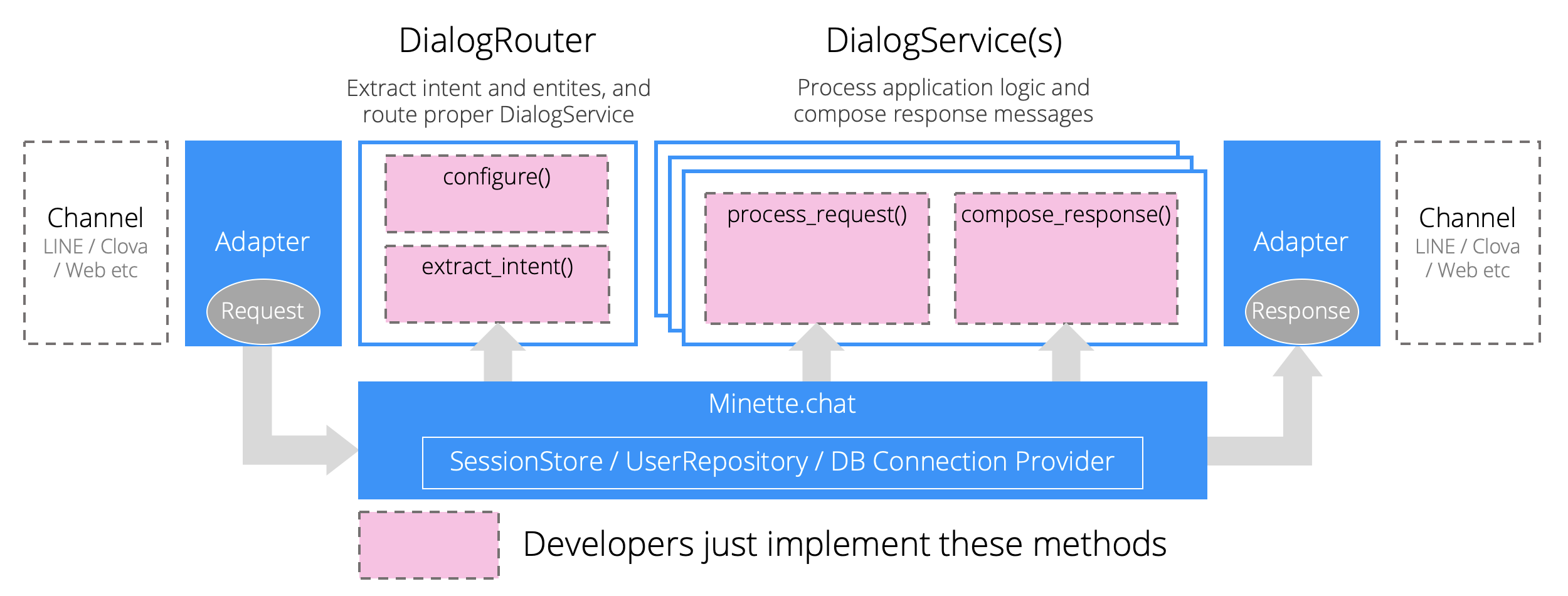
Any other common operations (e.g. context management) are done by framework.
Context management
Minette provides a data store that enables your bot to continue conversasion accross the requests like HTTP Session.
Set data
# to use context data at the next request, set `True` to `context.topic.keep_on` in DialogService
context.data["pizza_name"] = "Seafood Pizza"
context.topic.keep_on = True
Get data
pizza_name = context.data["pizza_name"]
User management
Users are identified by the Channel (e.g LINE, FB Messanger etc) and the UserID for the Channel. Each users are automatically registered at the first access and each changes for user is saved automatically.
# framework saves the updated user info automatically and keep them until the app delete them
request.user.nickname = "uezo"
request.user.data["horoscope"] = "cancer"
Natural language analyzing
Taggers are the components for analyzing the text of request and the result will be automatically set to request object. Minette has 2 built-in taggers for Japanese - MeCabTagger and JanomeTagger.
To use JanomeTagger, at first install Janome: a pure python Japanese morphological analyzer.
$ pip install janome
Check tagger like below.
>>> from minette.tagger.janometagger import JanomeTagger
>>> tagger = JanomeTagger()
>>> words = tagger.parse("今日は良い天気です")
>>> words[0].to_dict()
{'surface': '今日', 'part': '名詞', 'part_detail1': '副詞可能', 'part_detail2': '', 'part_detail3': '', 'stem_type': '', 'stem_form': '', 'word': '今日', 'kana': 'キョウ', 'pronunciation': 'キョー'}
Sample usage in DialogService is here.
# bot = Minette(tagger=JanomeTagger) <- Note: create bot with JanomeTagger

def process_request(self, request, context, connection):
    # result of parsing morph is set in `request.words` automatically
    nouns = [w.surface for w in request.words if w.part == "名詞"]
Task scheduler
Built-in task scheduler is ready-to-use. Your chatbot can run periodic jobs without cron.
class MyTask(Task):
    # implement periodic task in `do` method
    def do(self, arg1, arg2):
        # The Logger of scheduler is available in each tasks
        self.logger.info("Task started!: {} / {}".format(arg1, arg2))

# Create Scheculer
sc = Scheduler()
# Register the task. This task runs every 3 seconds
sc.every_seconds(MyTask, seconds=3, arg1="val1", arg2="val2")
# Start the scheduler
sc.start()
Message Log
Request, response and context at each turns are stored as Message Log. It provides you the very useful information to debug and improve your chatbot.
Testing Dialogs
Minette provides a helper to test dialogs. This is an example using pytest.
channel_user_idfor each test cases(functions) is set to request automatically.chatmethod takes arguments forMessage. This enables youbot.chat("hello", intent="HelloIntent")instead ofbot.chat(Message(text="hello", intent="HelloIntent"))to make your test code simple.- Response from
chathastextattribute that equals toresponse.messages[0].text.
import pytest
from minette import Message, DialogService, Priority, Payload
from minette.test.helper import MinetteForTest

# dialogs to test
class FooDialog(DialogService):
    def compose_response(self, request, context, connetion):
        return "foo:" + request.text

class BarDialog(DialogService):
    def compose_response(self, request, context, connetion):
        context.topic.keep_on = True
        return "bar:" + request.text

class PayloadDialog(DialogService):
    def compose_response(self, request, context, connetion):
        return "payload:" + str(request.payloads[0].content)

# bot created for each test functions
@pytest.fixture(scope="function")
def bot():
    # use MinetteForTest instead of Minette
    return MinetteForTest(
        intent_resolver={
            "FooIntent": FooDialog,
            "BarIntent": BarDialog,
            "PayloadIntent": PayloadDialog
        },
    )

# test cases function using bot
def test_example(bot):
    # trigger intent
    assert bot.chat("hello", intent="FooIntent").text == "foo:hello"
    # empty response without intent
    assert bot.chat("hello").text == ""
    # trigger other intent
    assert bot.chat("hello", intent="BarIntent").text == "bar:hello"
    # context and topic is kept by dialog service
    assert bot.chat("hi", intent="FooIntent").text == "bar:hi"
    assert bot.chat("yo").text == "bar:yo"
    # update topic by higher priority request
    assert bot.chat("hello", intent="FooIntent", intent_priority=Priority.High).text == "foo:hello"

def test_payload(bot):
    # use Message to test your dialog with payloads, channel_message and so on
    assert bot.chat(Message(
        intent="PayloadIntent",
        type="data",
        text="hello",
        payloads=[Payload(content={"key1": "value1"})]
    )).text == "payload:" + str({"key1": "value1"})
💝 Contribution
See the Contribution Guideline
⚖️ License
This software is licensed under the Apache v2 License.
Appendix1. Setup MeCab Tagger
Installing MeCab
- Ubuntu 16.04
$ sudo apt-get install mecab libmecab-dev mecab-ipadic
$ sudo apt-get install mecab-ipadic-utf8
- Mac OSX
$ brew install mecab mecab-ipadic git curl xz
Installing python binding
$ pip install mecab-python3==1.0.1
Version 0.996.1 has a bug(?) so we strongly recommend to use version 0.7. Fixed at current version
Usase
from minette.tagger.mecabtagger import MeCabTagger
bot = Minette(
    tagger=MeCabTagger
)
Appendix2. Migration from version 0.3
- Some packages are deprecated. All standard classes can be imported from
minette. - The way to create instance of
Minetteis changed. (just call constructor) Sessionis renamed toContext. The arguments namedsessionis also changed.minette.user.User#save()is deleted. CreateUserStoreand callsave(user)instead.SessionStore->ContextStore,UserRepository->UserStore,MessageLogger->MessageLogStore- HTTP request handler method of
LineAdapteris changed tohandle_http_request.
If you need version 0.3 install from github.
$ pip install git+https://github.com/uezo/minette-python.git@v0.3
1 maintainer

Metadata
1 maintainer
Release files for minette 0.4.3
For a detailed explanation of source distributions (sdists) and built distributions (wheels), please see the package formats documentation.
Source distribution (sdist)
| File | Size | Uploaded | |
|---|---|---|---|
| minette-0.4.3.tar.gz | 36.7 kB | Details |
Built distribution (wheel)
| File | Interpreter | ABI | Platform | Reset |
|---|---|---|---|---|
| minette-0.4.3-py3-none-any.whl | Python 3 | none | any | Details |
Total release size: 88.6 kB
Release files / minette-0.4.3.tar.gz
| Download URL | minette-0.4.3.tar.gz |
|---|---|
| Size | 36.7 kB |
| Tags | Source |
|
SHA-256 checksum How to use checksums |
cdf10d05d47ce074b25bec619ebbc76713f9578ace9f7a3ca834ce2ebccc1f3e
|
|
BLAKE2b-256 checksum How to use checksums |
67c4c1e3b4043c53c3b2b1efe9405cc44a89704166957d1df49fb5efe557a957
|
| Upload date | |
|
Uploaded using Trusted Publishing? What is trusted publishing? |
No |
| Uploaded via |
twine/3.2.0 pkginfo/1.5.0.1 requests/2.24.0 setuptools/41.2.0 requests-toolbelt/0.9.1 tqdm/4.48.2 CPython/3.7.7
|
Release files / minette-0.4.3-py3-none-any.whl
| Download URL | minette-0.4.3-py3-none-any.whl |
|---|---|
| Size | 51.9 kB |
| Tags | Python 3 |
|
SHA-256 checksum How to use checksums |
b74ac66c3f9e6040957def3d5cc028810915ac44fa778f2ce612691c44f6d507
|
|
BLAKE2b-256 checksum How to use checksums |
9122f0c96e6e1fc8a050356ac7f364adc1b096dce67262870c6f1b200611ee0a
|
| Upload date | |
|
Uploaded using Trusted Publishing? What is trusted publishing? |
No |
| Uploaded via |
twine/3.2.0 pkginfo/1.5.0.1 requests/2.24.0 setuptools/41.2.0 requests-toolbelt/0.9.1 tqdm/4.48.2 CPython/3.7.7
|














