

To protect tree-like resources:
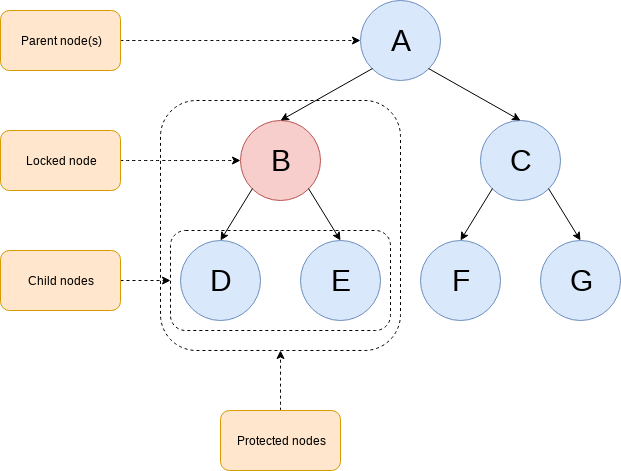
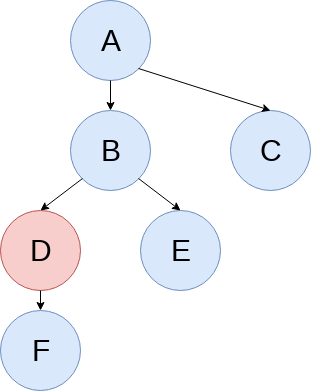
Nodes have to be represented by their fully qualified name. For instance, the node D is represented by [A, B, D]:
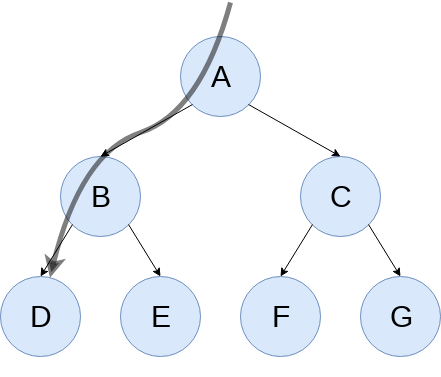
The algorithm to lock a node is the following:
We lock the parent nodes in order:
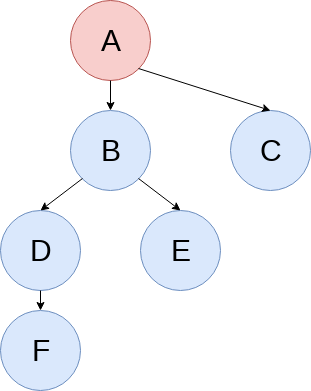
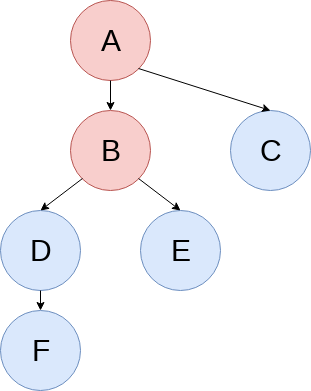
Then we check that no child node is already locked:
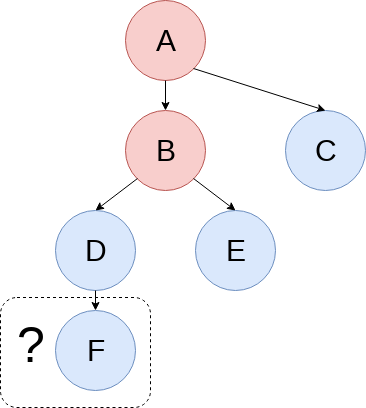
We lock the wanted node
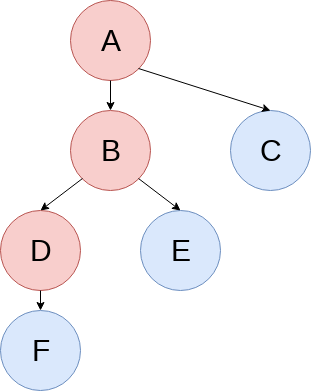
We release all the parent locks that are no longer usefull.
Interface targeted to be exactly like threading.Lock.
The mutex tree is actually designed to use redis and python-redis-lock but the locking backend may be changed.
Usage
To use mutextree with the redis locks back end, simply instanciate a redis client and create your lock. The redis client should be strict and decode responses itself.
import redis
from mutextree import RedisLockBackend, TreeLock

redis_client = redis.StrictRedis(decode_responses=True)
redis_lock_backend = RedisLockBackend(redis_client)
lock = TreeLock(redis_lock_backend, ["nodeA"], expire=10, timeout=10, id=1)
try:
    lock.acquire()
    # do things
finally:
    lock.release()
You can use it as a context manager or a decorator:
import redis
from mutextree import RedisLockBackend, TreeLock, tree_lock

redis_client = redis.StrictRedis(decode_responses=True)
redis_lock_backend = RedisLockBackend(redis_client)

with TreeLock(redis_lock_backend, ["nodeA"], expire=10):
    # do things
    pass
    # release will be automatically called

# Or with a decorator
@tree_lock(redis_lock_backend, ["nodeA"], expire=10)
def protected_function():
    # do things
    pass
    # release will be automatically called
Lock has the same basic interface as threading.Lock() with some more methods: acquire, release, refresh.
Tests
Tests should be run under python 2.7 and python 3.6 to tests everything
$ pip install tox
$ tox -e py27,py36
Coverage reports will be the merge of the coverage for py27 and py36.
1 maintainer

Release files for mutextree 1.2.3
For a detailed explanation of source distributions (sdists) and built distributions (wheels), please see the package formats documentation.
Source distribution (sdist)
| File | Size | Uploaded | |
|---|---|---|---|
| mutextree-1.2.3.tar.gz | 189.5 kB | Details |
Release files / mutextree-1.2.3.tar.gz
| Download URL | mutextree-1.2.3.tar.gz |
|---|---|
| Size | 189.5 kB |
| Tags | Source |
|
SHA-256 checksum How to use checksums |
e0e4d32a85af51dd3db7bc94f26febd75bbac803a1509f53a3614c0fa483892c
|
|
BLAKE2b-256 checksum How to use checksums |
cd9c675bf05e768d60f3e1006f3d476d6db452c714e24d85160c47e934240f49
|
| Upload date | |
|
Uploaded using Trusted Publishing? What is trusted publishing? |
No |
| Uploaded via |
twine/1.12.1 pkginfo/1.4.2 requests/2.19.1 setuptools/40.8.0 requests-toolbelt/0.8.0 tqdm/4.26.0 CPython/2.7.15
|













