






You can use the mvc pattern in your flask application using this extension.
Installation
Run the follow command to install mvc_flask:
$ pip install mvc_flask
Configuration
To configure the mvc_flask you need import and register in your application, e.g:
from flask import Flask
from mvc_flask import FlaskMVC

app = Flask(__name__)
FlaskMVC(app)
Or use application factories, e.g:
mvc = FlaskMVC()

def create_app():
  ...
  mvc.init_app(app)
By default the mvc_flask assumes that your application directory will be app and if it doesn't exist, create it!
If you can use other directory, you can use the path paramenter when the instance of FlaskMVC is initialized. E.g:
mvc = FlaskMVC()

def create_app():
  ...
  mvc.init_app(app, path='src')
Now, you can use src as default directory for prepare your application.
You structure should be look like this:
app
├── __ini__.py
├── controllers
│   └── home_controller.py
├── routes.py
└── views
    ├── index.html
Router
You can create routes in app/routes.py and after create file, you can start register routes, e.g:
from mvc_flask import Router

Router.get("/", "home#index")
The same must be make done to POST, PUT and DELETE methods. E.g: Router.post("/messages", "messages#create")
The first param represent the relative path and second represent the controller#action. Remember that we are working with MVC pattern, so we have controller and action.
The controller can be created in app/controllers and action is method of controller.
You can use Router.all() to register all routes of CRUD.
Router.all("messages")
The previous command produce this:
messages.create  POST        /messages
messages.delete  DELETE      /messages/<id>
messages.edit    GET         /messages/<id>/edit
messages.index   GET         /messages
messages.new     GET         /messages/new
messages.show    GET         /messages/<id>
messages.update  PATCH, PUT  /messages/<id>
You can also use only parameter to controll routes, e.g:
Router.all("messages", only="index show new create")
The previous command produce this:
messages.index   GET      /messages
messages.show    GET      /messages/<id>
messages.new     GET      /messages/new
messages.create  POST     /messages
The paramenter only accept string or array, so, you can use only=["index", "show", "new", "create"]
Namespace
In app/routes.py, you can start register namespace, e.g:
from mvc_flask import Router

api = Router.namespace("/api/v1")

api.get("/health", "health#index")

api.all("user")

posts = api.namespace("/posts")
posts.get("", "posts#index")
posts.post("", "posts#create")
posts.get("/<id>", "posts#show")
posts.put("/<id>", "posts#update")
posts.get("/<id>", "posts#delete")
The source produce this:
health.index     GET         /api/v1/health
posts.create     POST        /api/v1/posts
posts.delete     GET         /api/v1/posts/<id>
posts.index      GET         /api/v1/posts
posts.show       GET         /api/v1/posts/<id>
posts.update     PATCH, PUT  /api/v1/posts/<id>
user.create      POST        /api/v1/user
user.delete      DELETE      /api/v1/user/<id>
user.edit        GET         /api/v1/user/<id>/edit
user.index       GET         /api/v1/user
user.new         GET         /api/v1/user/new
user.show        GET         /api/v1/user/<id>
user.update      PATCH, PUT  /api/v1/user/<id>
Controller
Now that configure routes, the home_controller.py file must contain the HomeController class, registering the action, e.g:
from flask import render_template

class HomeController:
    def index(self):
        return render_template("index.html")
If you have question, please, check de app directory to more details.
To use the hooks as before_request, after_request and etc... Just describe it in the controller, see:
class HomeController:
    before_request = ["hi"]

    def index(self):
        return "home"

    def hi(self):
        ...
The previous example describes the hi(self) will be called every times that the visitors access the controller.
PUT / PATCH / DELETE ...
we know that the HTML form doesn't send payload to action with put or delete method as attribute of form tag. But,
the FLASK MVC does the work for you, everything you need is add the tag in HTML template. Look:
# app/controllers/messages_controller.py

from flask import render_template, redirect, url_for, flash, request

class MessagesController:
    def edit(self, id):
        message = Message.query.get(id)

        return render_template("messages/edit.html", message=message)

    def update(self, id):
        message = Message.query.get(id)
        message.title = request.form.get('title')

        db.session.add(message)
        db.session.commit()
        flash('Message sent successfully!')

        return redirect(url_for(".edit"))
<!--  app/views/messages/edit.html -->

{% block content %}
  <form action="{{ url_for('messages.update', id=message.id) }}" method="POST">
    <input type="hidden" name="_method" value="put">
    <input type="text" name="title" id="title" value="Yeahh!">

    <input type="submit" value="send">
  </form>
{% endblock %}
The <input type="hidden" name="_method" value="put"> is necessary to work sucessfully!
Views
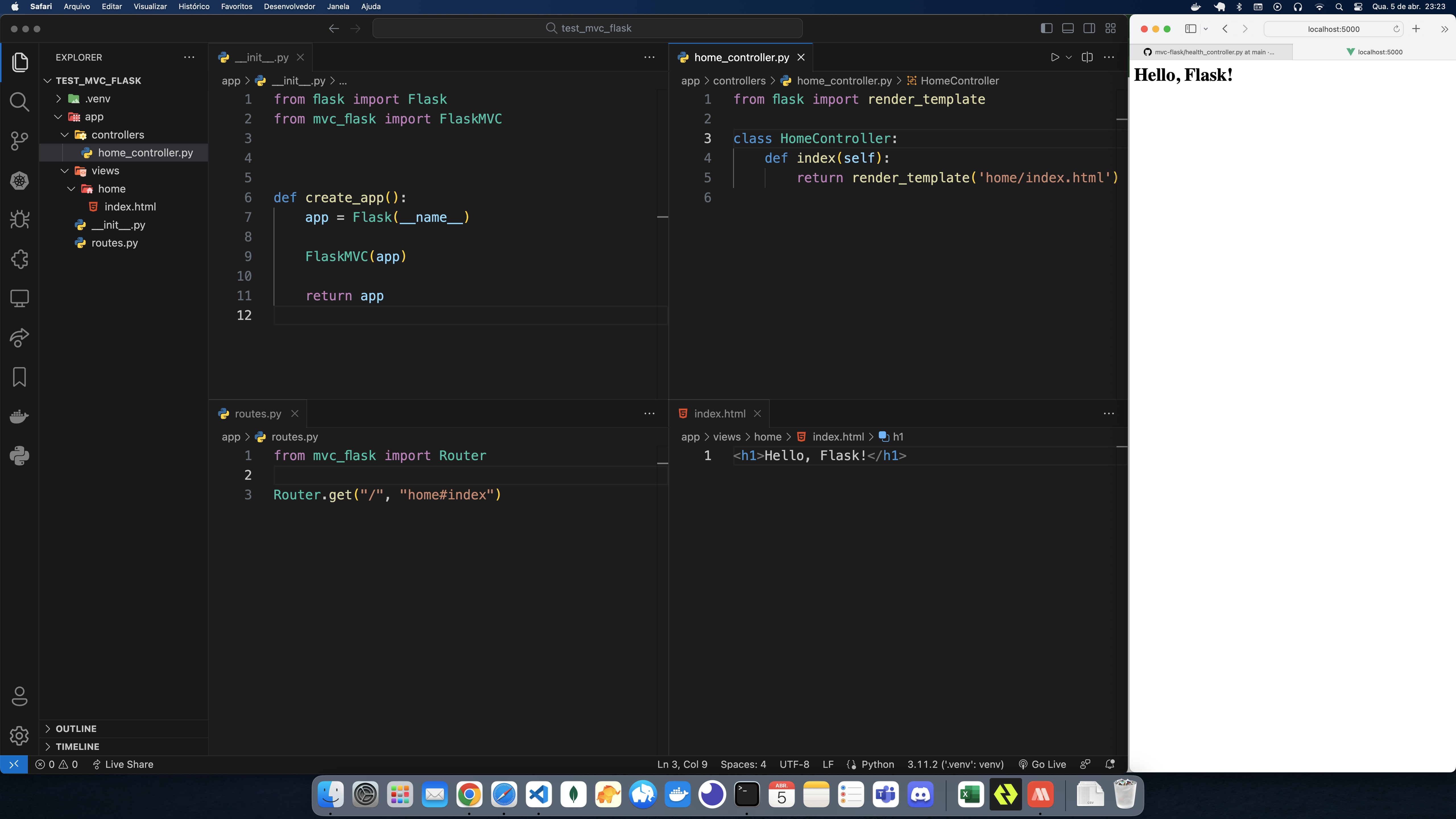
Flask use the templates directory by default to store HTMLs files. However, using the mvc-flask the default becomes views. You can use the app/views directory to stores templates.
Result
Adding result session to show image that is represented by project build with library.
1 maintainer

Metadata
1 maintainer
Release files for mvc-flask 2.7.0
For a detailed explanation of source distributions (sdists) and built distributions (wheels), please see the package formats documentation.
Source distribution (sdist)
| File | Size | Uploaded | Provenance | |
|---|---|---|---|---|
| mvc_flask-2.7.0.tar.gz | 6.3 kB | Without provenance | Details |
Built distribution (wheel)
| File | Interpreter | ABI | Platform | Reset |
|---|---|---|---|---|
| mvc_flask-2.7.0-py3-none-any.whl | Python 3 | none | any | Details |
Total release size: 13.7 kB
Release files / mvc_flask-2.7.0.tar.gz
| Download URL | mvc_flask-2.7.0.tar.gz |
|---|---|
| Size | 6.3 kB |
| Tags | Source |
|
SHA-256 checksum How to use checksums |
86eb29b01c4e74c3714ecd7b7f6b999996d3eeac459ef6642c8dbd6163566ff4
|
|
BLAKE2b-256 checksum How to use checksums |
a1c43258b4a48ba546c88912b089924670f7b30b1c2ef5080d0fff44ed8b1641
|
| Upload date | |
|
Uploaded using Trusted Publishing? What is trusted publishing? |
No |
| Uploaded via |
poetry/1.6.1 CPython/3.10.12 Darwin/23.0.0
|
Release files / mvc_flask-2.7.0-py3-none-any.whl
| Download URL | mvc_flask-2.7.0-py3-none-any.whl |
|---|---|
| Size | 7.4 kB |
| Tags | Python 3 |
|
SHA-256 checksum How to use checksums |
a7dd2dad1195b54a825e47913dd2d278b15a8416c366e87b45f8dcf7c537d2c6
|
|
BLAKE2b-256 checksum How to use checksums |
a80fcff837bcc7ab8e1677163412bd7e4f34c23ec20d6d542cab7c951b86c782
|
| Upload date | |
|
Uploaded using Trusted Publishing? What is trusted publishing? |
No |
| Uploaded via |
poetry/1.6.1 CPython/3.10.12 Darwin/23.0.0
|
Security for mvc-flask 2.7.0
Provenance
Provenance describes where a file came from. On PyPI, provenance is shared via attestations, which provide a verifiable record of the build or publishing details. View details, limitations and caveats.
No provenance found
None of the files in this release were uploaded with provenance metadata.
A note on package security
PyPI is a repository for distributing packages, not a service for auditing them. While third-party security researchers and our staff do their best to detect and remove malicious packages, PyPI cannot guarantee the quality, security or suitability of any given package.
To learn more about protecting yourself from malicious actors, visit our package security documentation.














