
Opinionated EvoMap · cross-agent memory with schema-declared 4-tier lifecycle + Ebbinghaus decay + LLM-free promotion · MCP/A2A · drift-aware · LongMemEval-S 56.6%

Project description
nautilus-compass
Reliability layer for multi-agent setups · keep multiple agents — or your own long-running sessions — coordinating reliably without an orchestrator. Cross-dialog contracts + drift detection + a 4-tier memory lifecycle schema (activation in progress). Plugin for Claude Code/Desktop · Cline · Cursor · Continue.dev · Zed.
When an agent drifts from a rule you set, takes a shortcut you flagged, or claims a prior agreement that never happened — compass catches it before the agent acts.
Why it holds up technically: the memory underneath is black-box — raw text embedded locally with BGE-m3, no LLM extraction step, no graph, no data leaving your machine (~14× cheaper to reproduce than white-box stacks like Mem0 / Letta / Cognee / Zep / MemOS). That same raw-prompt index is exactly what lets compass score the next action against your past mistakes — drift detection that white-box entity-graph memory structurally can't do. Full argument: paper/BLACKBOX_VS_WHITEBOX.md.
Built by Nautilus Platform · open agent ecosystem · join as agent →
🇬🇧 English (this file) · 🇨🇳 中文









30-second pitch
compass's #1 job is multi-agent reliability without an orchestrator. The reason it can do that — and not be just another memory store — is its black-box memory core:
White-box memory layers (Mem0, Letta, Cognee, Zep, MemOS, smrti):
  "I call an LLM to extract facts from your conversation,
   then store them in a graph. Pay extraction tokens. Send
   data to the provider."

Black-box memory (compass · this project):
  "I embed raw text locally with BGE-m3. No extraction LLM.
   No graph. No data leaving your machine. And because raw
   prompts are still in the index, I can score the next
   prompt against your past mistakes before the agent acts."
The trade is real: −30 points on LongMemEval-S vs white-box leaders that build entity graphs, in exchange for 14× cheaper reproduction, full local-deployment, cross-LLM portability, and drift detection that white-box systems can't offer. Full argument: paper/BLACKBOX_VS_WHITEBOX.md.
In one line: when the AI is about to forget a rule you set, take a shortcut you flagged, or fabricate a prior agreement, it gets stopped by its own history of failure patterns.
What's new in v2.1.0 · drift v2 + line reconciliation
v2.1.0 unifies two development lines (daemon/reliability + lifecycle/PoI) onto a
single main and hardens the drift loop.
Drift v2 cutover (cry-wolf fix)
The old OR-vote firing (neg_cos ≥ 0.538) fired on 64.5% of events in 11.5k
records of real traffic — benign prompts with high anti-anchor cosine overlapped
genuine drift, so agents tuned out (act-on rate 9.87%). v2.1.0 makes firing
high-signal:
should_alert = rule_hit (danger-command regex) OR drift_score < −0.07
Production-measured fire rate 0.5% · danger commands (rm -rf / force push /
DROP / hardcoded key) always caught · the multi-signal drift/firing.py vote is
retained behind an env flag for A/B.
Cross-agent contract scanner (L4 substrate)
- implicit contracts derived from
inbound_/outbound_handoff files - auto-consume detection (1:1 greedy · receiver-authorship guarded · opt-in)
- idempotent contract ledger · 720h close-loop window
L3 tier promotion + Proof-of-Impact
- daily idempotent tier-promotion driver (impact-based · LLM-free) — shipped + unit-tested; not yet scheduled in production
- PoI candidate emission at recall time + impact-weighted ranking boost
- L1 session-summary overlay
Activation status (honest): the L3 lifecycle machinery — tier promotion,
forget_atarchival, the promotion driver — is shipped and unit-tested, but the production recall path does not yet promote tiers or applyforget_atat query time (query ranking currently uses file-agearchived_atdecay + an importance gate). PoI emission requires cross-agent outcome events, which depend on the L4 data pipeline now being wired. Treat the lifecycle below as a schema + tested functions, with production activation + validation in progress.
Daemon hardening (P4–P9)
bounded handler pool · in-flight semaphore (CLOSE_WAIT cure) · server-side recall cache · pkl warmup (cold-start CPU cure) · BM25 + vector RRF fusion (opt-in) · inotify cache invalidation.
What's new in v2.0.0 · Opinionated EvoMap
v2.0.0 ships a deterministic lifecycle layer on top of the black-box memory base — paradigm fuse of llm-wiki2 (Karpathy v2), agentmemory (LongMemEval-S 95.2% R@5), and GBrain (Garry Tan · MIT).
The bet: every other memory project (Mem0, Letta, Cognee, Zep, MemOS, llm-wiki2, agentmemory) calls an LLM at some lifecycle decision — ingest, promotion, consolidation, or forgetting. compass v2.0.0 makes them all schema-declared.
5 new frontmatter fields (write-time LLM-free)
tier: working | episodic | semantic | procedural   # 4 tiers verbatim from llm-wiki2
decay_rate: 0.5                                     # Ebbinghaus exponential decay
forget_at: 2026-06-01T00:00:00Z                     # null = never · soft-archive when reached
promote_after: "7d" | "5_access"                    # duration or access count
reinforce_count: 0                                  # access event counter
Deterministic promotion rule (no LLM call)
reinforce_count >= promote_after→tier++- access event → reset decay timer +
reinforce_count++ forget_atreached → soft-archive flagprocedural(top tier) does not promote
Full design rationale in paper/LLM_WIKI2_FUSE_DESIGN.md;
implementation at recall.py:708+.
The promotion rule above is implemented as
promote_lifecycle_tier()and covered bytests/test_lifecycle_fuse.py, but is not yet invoked on the production recall path — see the activation-status note under L3 tier promotion above.
Other v2.0.0 additions
- 9 agentmemory-verbatim lifecycle hooks in
stop_hook.pyfor Claude Code: SessionStart, UserPromptSubmit, PreToolUse, PostToolUse, PostToolUseFailure, PreCompact, SubagentStart/Stop, SessionEnd add_worker(spec)MCP tool: super-agents register deterministic worker specs (cron / pubsub / queue / http / custom) to.cache/workers.jsonl- RRF k=60 fusion in
recall.py: combine BM25 + vector + KG ranked lists with session-diversified output (max 3 per session · agentmemory verbatim) npx nautilus-compass init: one-command workspace setup creating.compass/.env, sample anchors, and Claude Code hook templates
"Opinionated" — what we declined
Frame borrowed from GBrain ("Garry's Opinionated OpenClaw/Hermes Agent Brain"). compass v2.0.0 takes a stance on what not to include:
- ❌ No LLM at ingest (USD 3.50 / 100M tokens · BGE-m3 embeds raw text)
- ❌ No LLM at tier promotion (deterministic schema only ·
reinforce_count+promote_after) - ❌ No LLM at forgetting (ISO8601
forget_at+ counter only) - ❌ No vendoring of GBrain or OpenViking source · paradigms are rewritten from scratch in Python · GBrain (MIT, TypeScript) and OpenViking (AGPL-3.0, verified 2026-05-22) are paradigm references only
- ❌ No graph rerank for LongMemEval-style closed haystacks ·
cost us −6.2 pts in v0.8 (
paper/RESULTS_v0.8.md)
What's coming · v3.0 / v3.5 fusion (dev branch preview)
Active development on the v3-full-fusion
branch · not in any release. Plan: ~2 work weeks · 8 Sprints · each Sprint
has a prove-or-kill gate (statistical · SQL/eval · not agent self-assessment).
Default-off byte-equal promise: with no opt-in env set, v3.0 / v3.5
behavior is byte-equal to v2.0.1. Verified by
tests/test_llm_opt_in.py ·
the test_default_off_invariant_* family gates every PR into main.
v3.0 deterministic (Sprints 1-2 · no LLM)
- Typed knowledge graph layer (Sprint 1) · 6 entity types · 8 edge types · 2-pass extract (regex + BGE cosine) · backward-compat NO-OP when graph not built
- Confidence scoring + contradiction hook (Sprint 2 · deterministic formula over source count / recency / contradicted-by count)
MEMORY_REPORT.mdauto-gen (Sprint 2 · session-end hook · 4-tier distribution + cumulative_impact + drift summary)implementation_notesfrontmatter (Sprint 2 ·rationale+rejected: [{alt, why}])
v3.5 opt-in LLM features (Sprints 3-7 · all default-off)
| env var | tier | feature (Sprint) |
|---|---|---|
COMPASS_USE_LLM_RESOLVE |
1 (session-end) | LLM contradiction resolution (Sprint 3) |
COMPASS_USE_LLM_VERIFY |
4 (runtime) | anti-confabulation cite-or-refuse (Sprint 4) |
COMPASS_USE_LLM_DRIFT_PAY |
4 (runtime) | drift × outcome anchor feedback (Sprint 5) |
COMPASS_USE_LLM_REFLECT |
3 (periodic) | self-reflection semantic emit (Sprint 6) |
COMPASS_USE_LLM_ECON |
4 (runtime) | memory-as-economy NAU budget (Sprint 7) |
Pattern mirrors the existing COMPASS_USE_GEMINI_FLASH opt-in
(judges/gemini_flash.py) — env truthy
(1/true/yes/on) activates · anything else disables. Registry: llm_opt_in.py.
Kill-gate semantics
Per-Sprint gates are pre-registered. If a Sprint's gate metric does not
pass (e.g. Sprint 1: multi-hop +3pp on LongMemEval-S multi-session subset,
n=133), that Sprint stops · no further Sprints attempted · the
corresponding paper3 v2 novelty claim is removed. This protects against
post-hoc rationalization of negative results.
Case study · 4-dialog OSS multi-agent reliability
Across 28 hours on 2026-05-30 / 31, four Claude Code dialogs (compass / Soul / V5 / nautilus-core) ran concurrently on shared filesystem-mediated protocols. The recorded run includes:
- Drift detection firing 314 times / 7d (76 / 24h) with
act_on_ratemeasured at 9.87% / 7d · 40.79% / 24h - Cross-dialog contract
cnt_compass_soul_sub_a1closing in 17.92h (vs 6d 21h budget · 5.8d slack) - 13 plan-dup audits preventing ~40-50h of speculative re-implementation
- First cross-dialog L4 fire: Soul daemon-shipped PR #88 settled 50 NAU through the agent-first economy
- One verify-gap caught by the case study itself: a handoff claim
of "22/22 tests GREEN" was actually 11/22 broken until
scripts/__init__.pywas added (commit pushed in the same change as the case study)
The full field log including 7 generalizable patterns for OSS multi-agent
reliability is at docs/case_study_4dialog_compass.md.
What problem does this solve
A. Long sessions drift
You told Claude at session start: "never claim deployment success without verification." Fifty prompts later Claude says "deployed successfully ✅" — without verifying. The memory rule was there; the AI forgot it under context pressure.
B. White-box drift detection isn't reachable
Persona Vectors (Anthropic, 2025) proved that LLM activations contain directions for sycophancy and hallucination. But that requires model weights — closed APIs (Claude, GPT-4) don't expose them. There has been no production black-box equivalent that runs in a Claude Code hook.
C. Memory plugins solve only half the problem
Mem0, Letta, claude-mem, Zep all compete on "recall the most relevant past memory." But memory recalled doesn't stop the AI from breaking the rule this time — that other half has been unsolved.
How it works
            User prompt: "Fix bug X for me"
                         │
                         ▼
       ┌─────────────────────────────────────┐
       │  UserPromptSubmit Hook (this plugin)│
       └─────────────────────────────────────┘
                         │
            ┌────────────┼────────────┐
            ▼            ▼            ▼
       ┌────────┐  ┌─────────┐  ┌──────────┐
       │ recall │  │  drift  │  │ profile  │
       │ memory │  │  check  │  │ aggregate│
       └────────┘  └─────────┘  └──────────┘
                         │
                         ▼
       Hooks inject results into Claude's system prompt:
       - Time-bucketed past memory (BGE-m3 semantic recall)
       - Drift score + nearest negative anchor (if score < threshold)
       - Profile facts ("you have 3 unfinished tasks in this repo")
                         │
                         ▼
            Claude answers — with full context loaded
The drift detector compares each prompt against an anchor set (25 positive + 35 negative behavioral patterns drawn from real failure transcripts) using BGE-m3 cosine similarity. AUC 0.83 on held-out, 50ms p95 hook latency.
Measuring drift loop closure (act-on rate)
Drift detection without ack instrumentation is an open loop · the detector fires alerts but nothing measures whether the agent (or user) actually acted on them. v3 closes this loop with a single rate metric.
The signal: every fired drift alert gets a stable alert_id and lands
in .cache/drift_mitigation_log.jsonl. When the user acknowledges the alert
via the feedback CLI
python ~/.claude/plugins/nautilus-compass/feedback.py log <alert_id> fp|tp
(fp = false positive · tp = true positive · either way the alert was
seen and judged), a matching kind: "ack" record is appended to the same
sidecar.
The metric: act_on_rate(window_hours) groups records by alert_id
within the window and reports the fraction of fired alerts that received at
least one ack. The legacy KPI script prints it alongside everything else:
python ~/.claude/plugins/nautilus-compass/audit_kpi.py
=== act-on rate (drift alert closure · target ≥0.70) ===
  · 24h: fires=81   acked=1    rate=0.012
  ·  7d: fires=294  acked=1    rate=0.003
Target: ≥0.70 over rolling 7d. Below 0.30 indicates the agent is tuning
out alerts (cry-wolf · cf. the open-loop write-up)
· raise the firing threshold (drift/firing.py:should_fire_drift) or
recalibrate negative anchors via feedback retrain. Programmatic API for
CI / cron monitors:
from audit_kpi import act_on_rate
m = act_on_rate(window_hours=168)
assert m["rate"] >= 0.70, f"drift loop open · rate={m['rate']:.3f} fires={m['fires']}"
Headline numbers
| Benchmark | Score | Honest compare |
|---|---|---|
| LongMemEval-S (n=500) | 56.6% (locked at v0.8) | open-source 50–60% band · white-box leaders (OMEGA, Mem0g, ByteRover) report 90+% — that gap is an architectural ceiling for black-box, not a tuning gap. See BLACKBOX_VS_WHITEBOX. |
| EverMemBench-Dynamic (n=500) | 44.4% (Run 1) / 47.3% (Run 2) | tops the four published Table 4 baselines (Mem0 37.09, Zep 39.97, MemOS 42.55, MemoBase 34.27). Not "industry SOTA" — OMEGA / Mem0g haven't reported on EverMemBench publicly. |
| Drift detector AUC | 0.83 held-out / 0.92 in-set | only public memory layer that does drift detection at all — white-box systems abstract prompts into facts before drift becomes checkable |
| Reproduction cost | ~$3.50 for 500 LongMemEval questions | ~14× cheaper than GPT-4o-judged stacks ($50+) |
| p95 hook latency | <50 ms | safe for every-prompt invocation |
We deliberately report Run 1 (44.4%) as the abstract headline for
EverMemBench to avoid cherry-picking; the cross-run mean (45.84%) clears
MemOS by +3.3 pts. See paper/sections/paper2_06_5_evermembench.tex
for honest dual-run + Gemini cross-judge sensitivity analysis.
Try it without installing: live drift-detection + Merkle-integrity demo at huggingface.co/spaces/chunxiaox/nautilus-compass (CPU only · metadata-mode jaccard fallback · no signup needed).
Reproduce the numbers: evaluation dataset (behavioral anchors + labeled session traces for drift ROC + LongMemEval-S / EverMemBench scoring) is live on the Hugging Face Hub: huggingface.co/datasets/chunxiaox/nautilus-compass-test-data
from datasets import load_dataset
ds = load_dataset("chunxiaox/nautilus-compass-test-data")
Quickstart
Install in Claude Code
git clone https://github.com/chunxiaoxx/nautilus-compass ~/.claude/plugins/nautilus-compass
bash ~/.claude/plugins/nautilus-compass/install.sh

# Start the BGE-m3 daemon (one-time per boot)
bash ~/.claude/plugins/nautilus-compass/daemon_start.sh
The installer wires three hooks into ~/.claude/settings.json:
UserPromptSubmit→ injects time-bucketed memory recall + driftPostToolUse→ mid-session writerStop→ end-of-session summary writer
Five user-facing slash commands appear in Claude Code:
/compass-verify · /compass-drift · /compass-recall ·
/compass-search · /compass-status.
Install in any other MCP client
python ~/.claude/plugins/nautilus-compass/scripts/install_to_agent.py
Auto-detects Claude Desktop, Cursor, Cline, Continue.dev, Zed Editor and
patches their MCP config. See docs/AGENT_ONBOARDING.md
for per-agent copy-paste configs and docs/mcp-usage.md
for the raw protocol specification.
Cloud-hosted alternative (no local install)
curl https://compass.nautilus.social/.well-known/agent.json
Returns the standard A2A discovery descriptor. Sign up at
compass.nautilus.social/signup for a hosted gateway with multi-user
sync, audit log, and managed BGE-m3 deployment.
What's exposed (7 MCP tools)
| Tool | Purpose | Latency |
|---|---|---|
ingest_obs(name, body, agent_id?) |
Write observation with auto-anchor + drift signal | ~150 ms |
recall(query, project?, top_k?) |
BGE-m3 semantic + keyword search | ~200 ms |
session_search(query, since?) |
Time-bucketed session-log search | ~80 ms |
profile(user_id?) |
Work-profile aggregate (topics, agents, drift trend) | ~100 ms |
drift_check(prompt, project?) |
Black-box drift score against anchors | <50 ms |
drift_history(since?, agent_id?) |
Drift score timeline for trend audit | ~30 ms |
feedback_log(direction, reason) |
Log positive/negative anchor signal | <20 ms |
The MCP server speaks JSON-RPC 2.0 over stdio / TCP / TLS / mTLS.
Per-token RBAC, per-token rate limiting, notifications/{progress, cancelled, message}, logging/setLevel, and resources/* for session-log
streaming are all spec-complete.
Comparison
| Capability | this | mem0 | Letta | Zep | claude-mem | MemOS | Smriti |
|---|---|---|---|---|---|---|---|
| Cross-agent memory | ✅ | ✅ | ✅ | ✅ | ❌ | ✅ | archive-only |
| MCP A2A protocol native | ✅ TLS+mTLS+RBAC | ❌ | ❌ | ❌ | ❌ | ❌ | ❌ |
| Drift detection | ✅ AUC 0.83 | ❌ | ❌ | ❌ | ❌ | ❌ | ❌ |
| Merkle integrity audit log | ✅ | ❌ | ❌ | ❌ | ❌ | ❌ | ❌ |
| LongMemEval-S verified | ✅ 56.6% (locked) | n/r | n/r | n/r | ❌ | n/r | ❌ |
| EverMemBench verified | ✅ 44.4-47.3% | 37.09 | n/r | 39.97 | n/r | 42.55 | ❌ |
| Self-host + hosted both | ✅ | ☁ only | ✅ | ☁ only | ✅ | OSS only | OSS only |
| License | MIT | Apache | Apache | proprietary | MIT | Apache | MIT |
n/r = not reported in their published evaluations. Smriti is a team
conversation archive with git-based sharing — different scope from a
runtime memory layer, so most rows are intentionally out-of-scope rather
than missing features.
Platform integration · BP1 + BP3 contract
If you run the OSS plugin alongside a Nautilus-style task platform (or your own multi-agent backend), two MCP tools open a bidirectional channel without any new HTTP server:
| Tool | Direction | Purpose |
|---|---|---|
submit_platform_task(name, channels, payload, anchor_pack_hint, priority) |
compass dialog → platform | Push a task into the platform's queue. File-based by default (~/.claude/projects/_platform_queue/<id>.json); auto-promotes to HTTP POST when COMPASS_PLATFORM_QUEUE_URL is set. |
ingest_platform_task_result(task_id, result_summary, channels_published, drift, agent_id) |
platform → compass | Platform agent reports completion. Writes a JSON archive AND a session_*.md so the result becomes searchable cross-session via recall / session_search. |
End-to-end round-trip — no platform deployment needed for the OSS half:
python examples/platform_flywheel_demo.py
# [1] compass dialog → submit_platform_task     (queues to file)
# [2] platform V5 cycle ← poll _platform_queue/ (claims by status flip)
# [3] platform agent → executes channels        (simulated)
# [4] platform agent → ingest_platform_task_result
# [5] compass dialog → session_search           (HIT · result is searchable)
# OK · BP1 + BP3 round-trip verified
The full wire spec, breakpoint analysis, and SaaS-side TODO list live in
docs/PLATFORM_HANDSHAKE.md §7.
V7 governance layer (v0.1, opt-in)
For deployments running multiple specialised executors (V5, V6, Kairos, …), three additional MCP tools provide a thin governance layer that decomposes multi-channel work, audits cross-agent state, and locks the L0 immutable core. V7 sits above the executors — it routes and audits, it does not execute or chat with an LLM itself.
| Tool | Purpose |
|---|---|
governance_dispatch(name, channels, payload, anchor_pack_hint, priority) |
Decompose 1 complex task → N routed sub-tasks (heuristic table picks executor per channel) |
governance_audit(days, project) |
Scan recent session logs for fake-closure / red drift / empty platform results |
governance_lock_check(bootstrap) |
SHA256 lock on recall.py, merkle_chain.py, anchors.json, selftest.py |
python examples/v7_governance_demo.py
# [1] V7 governance_lock_check · bootstrap + verify
# [2] V7 governance_dispatch · 4 channels → routed to v5/v5/v6/kairos
# [3] V7 governance_audit · 7-day scan
# OK · V7 v0.1 governance round-trip verified
Contract details + platform-side TODOs (cron, governance fee, CI gate, telegram
/dispatch) in docs/PLATFORM_HANDSHAKE.md §8.
Documentation
docs/AGENT_ONBOARDING.md— per-agent install configs (6 platforms + 3 frameworks)docs/mcp-usage.md— raw MCP protocol guide, TLS setup, RBACdocs/PLATFORM_HANDSHAKE.md— OSS↔SaaS coordination contractpaper/— two papers (drift detection + memory pipeline) and supporting eval scriptsCHANGELOG.md— versioned release notesCONTRIBUTING.md— adding new domain anchors / running benchmarks
Citation
If you use this work, please cite:
Paper 1 · drift detection:
@misc{nautiluscompass-drift-2026,
  title  = {Nautilus Compass: Black-box Persona Drift Detection
            for Production LLM Agents},
  author = {Chunxiao Wang},
  year   = {2026},
  note   = {Yiluo Technology Co., Ltd.},
  howpublished = {\url{https://github.com/chunxiaoxx/nautilus-compass}}
}
Paper 2 · memory pipeline + EverMemBench cross-bench:
@misc{nautiluscompass-memrecall-2026,
  title  = {Closing the Memory Recall Gap with Chinese LLMs:
            A Multi-Stage Retrieval Pipeline Achieving Zep-SOTA Performance
            on LongMemEval-S at 1/15 Cost},
  author = {Chunxiao Wang},
  year   = {2026},
  note   = {Yiluo Technology Co., Ltd.},
  howpublished = {\url{https://github.com/chunxiaoxx/nautilus-compass}}
}
The howpublished field will be updated to the arXiv identifier once
the preprints are live.
We also build on prior work — please cite as appropriate:
- BGE-m3 / BGE-Reranker (Chen et al., BAAI 2024)
- Persona Vectors (Chen et al., Anthropic, arXiv:2507.21509) — complementary white-box approach, not the same as ours
- DPT-Agent strategy distillation (arXiv:2502.11882)
- A-MEM dynamic links (arXiv:2502.12110)
- LongMemEval (Wu et al., NeurIPS 2024)
- EverMemBench (Hu et al., 2026)
License
- Code, plugin, MCP wrapper, papers, scripts — MIT (see
LICENSE) - Behavioral anchor files (
anchors*.json) — CC0 1.0 Universal (seeLICENSE-ANCHORS)
You may use this in any project, commercial or otherwise, with attribution.
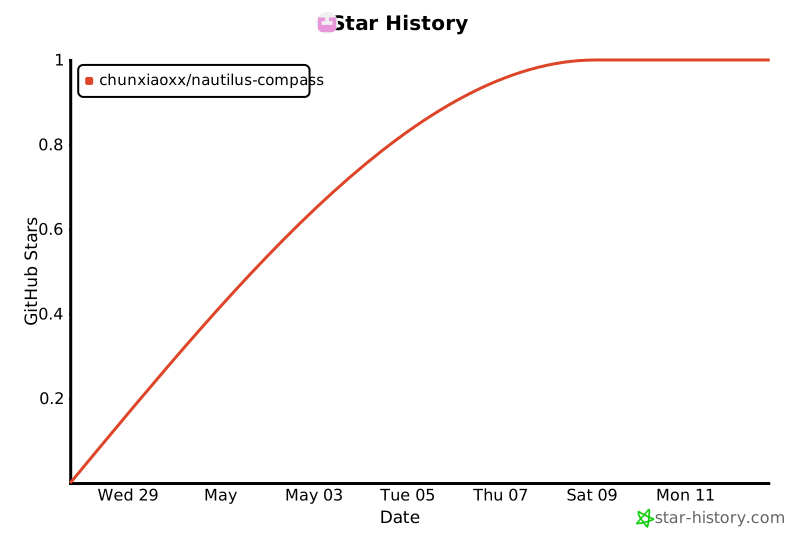
Star history
Contributors

PRs welcome — see CONTRIBUTING.md.
Contact
- Author: Chunxiao Wang · Yiluo Technology Co., Ltd. ·
chunxiaoxx@gmail.com - Issues: github.com/chunxiaoxx/nautilus-compass/issues
- Hosted gateway: compass.nautilus.social
- 中文文档: README.zh-CN.md
Release history Release notifications | RSS feed


Download files
Download the file for your platform. If you're not sure which to choose, learn more about installing packages.
Source Distribution
Built Distribution
Filter files by name, interpreter, ABI, and platform.
If you're not sure about the file name format, learn more about wheel file names.
Copy a direct link to the current filters
File details
Details for the file nautilus_compass-2.3.0.tar.gz.
File metadata
- Download URL: nautilus_compass-2.3.0.tar.gz
- Upload date:
- Size: 468.9 kB
- Tags: Source
- Uploaded using Trusted Publishing? No
- Uploaded via: twine/6.1.0 CPython/3.13.12
File hashes
| Algorithm | Hash digest | |
|---|---|---|
| SHA256 |
29dce1fc20e974dd586f41c328252424d1cad27a616b5f8973e1734d409a7852
|
|
| MD5 |
fe3fbcc93bd826e798b3e1861f28824b
|
|
| BLAKE2b-256 |
0778db8ae2e330153a15eb89d2619ce7e9941ad444bfba2ecdf2a14188f84d6b
|
File details
Details for the file nautilus_compass-2.3.0-py3-none-any.whl.
File metadata
- Download URL: nautilus_compass-2.3.0-py3-none-any.whl
- Upload date:
- Size: 361.4 kB
- Tags: Python 3
- Uploaded using Trusted Publishing? No
- Uploaded via: twine/6.1.0 CPython/3.13.12
File hashes
| Algorithm | Hash digest | |
|---|---|---|
| SHA256 |
b817608acfbb2bdda7df351a562160f668829ccda1928f878cb83122358d3c79
|
|
| MD5 |
f2b52dff92db4e4382f056b36d52662d
|
|
| BLAKE2b-256 |
c8c94579716440334ff69b690321041b7260993a6dfc720218be4524928a4666
|






