
🛰️ nazarGeo: A Real-Time Multi-Modal System for High-Precision Building Geo-Localization Using LiDAR, Vision, and Sensor Fusion
nazarGeo is a real-time building intelligence pipeline that combines camera perception, LiDAR depth extraction, and ego-pose estimation to compute accurate geo-coordinates of detected structures. The system matches these projections against a geo-spatial building database using a multi-factor scoring mechanism and stabilizes results across frames using tracking and calibration.




























🗒️Table of Contents
- Project Overview
- System Architecture
- Hardware & Sensor Setup
- Repository Structure
- Pipeline Stages
- Configuration Reference
- Installation & Dependencies
- Running the Pipeline
- Calibration Workflow
- Output Schema
- Dashboard — Viewer
- Results & Accuracy
- Tuning Guide
- Known Limitations & Future Work
1. Project Overview 📽️
nazarGeo is a full-stack autonomous building geo-localization pipeline that fuses:
- Camera frames (4K, 30 fps) from a vehicle-mounted lens
- LiDAR point clouds from dual Velodyne VLP-16 lidars (PCAP streams)
- IMU/GNSS telemetry (interpolated at frame rate)
- GOB (Ground-truth Object footprint Base) — a pre-surveyed CSV of building centroids and polygon footprints
The system processes each video frame to detect a building, estimate its GPS coordinates using LiDAR depth + ego-pose projection, then match that estimate against the GOB database to produce a precise, calibrated GPS tag for the building facade.
Key Achievement
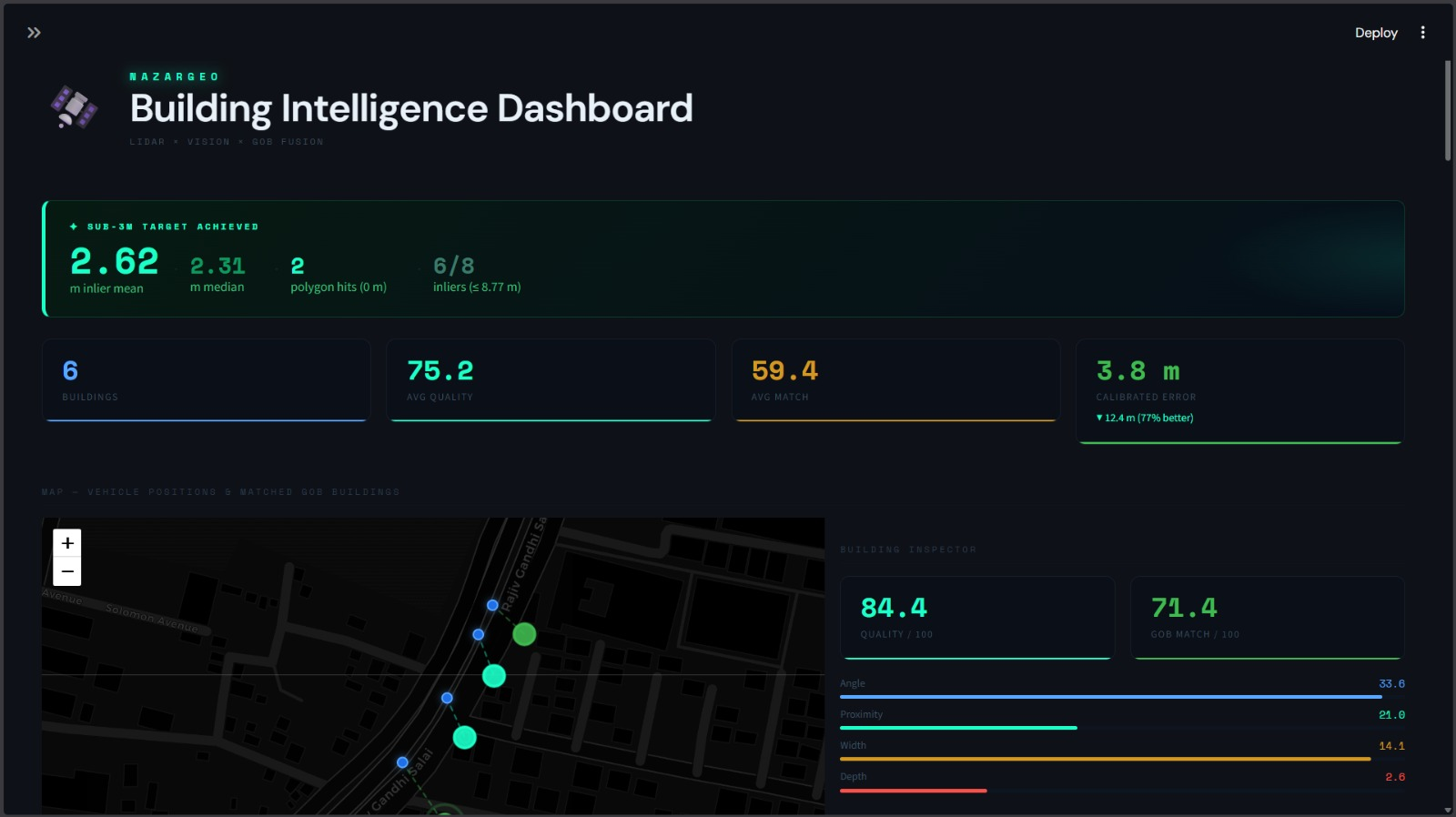
✦ SUB-3M TARGET ACHIEVED
  Inlier mean error  :  2.62 m
  Inlier median error:  2.31 m
  Calibrated avg     :  3.8 m  (↓ 77% from pre-calibration 16.2 m)
  Polygon hits (0 m) :  2 / 8 frames
  Inliers (≤ 8.77 m) :  6 / 8 frames
What "sub-3m" means in practice
The polygon-edge error metric measures the distance from the estimated GPS point to the nearest edge of the building's WKT footprint polygon — or zero if the point falls inside. A sub-3m inlier mean means the system is, on average, placing the estimated GPS within the building footprint or within one typical room-width of its facade.
2. System Architecture 🦾
┌─────────────────────────────────────────────────────────────────────┐
│                         INPUT SENSORS                               │
│  Camera (LENS1, 3840×2160 @ 30fps)  │  LiDAR L1 + L2 (PCAP)       │
│  IMU/GNSS CSV (lat, lon, yaw @ ~10Hz)                               │
└───────────────────┬────────────────────────────┬────────────────────┘
                    │                            │
             ┌──────▼──────┐            ┌────────▼────────┐
             │   sync.py   │            │  lidar_pcap.py  │
             │  Manifest   │            │  Point Cloud    │
             │  Generation │            │  Fusion (L1+L2) │
             └──────┬──────┘            └────────┬────────┘
                    │                            │
             ┌──────▼──────────────────────────────────────┐
             │                perceive.py                   │
             │  YOLO-World (building detection, 4 passes)  │
             │  SAM (building segmentation mask)           │
             │  LiDAR projection → depth from mask        │
             └──────────────────────┬──────────────────────┘
                                    │
                             ┌──────▼──────┐
                             │  project.py │
                             │  ego GPS +  │
                             │  depth →    │
                             │  target GPS │
                             └──────┬──────┘
                                    │
             ┌──────────────────────▼──────────────────────┐
             │                  match.py                    │
             │  GOB radius query (150 m)                    │
             │  Angle cone filter (35°)                     │
             │  Scoring: angle + proximity + width + depth │
             └──────────────────────┬──────────────────────┘
                                    │
                    ┌───────────────┼───────────────┐
                    │               │               │
             ┌──────▼──────┐ ┌──────▼──────┐ ┌──────▼──────┐
             │  tracker.py │ │  select_    │ │   tim.py /  │
             │  Kalman GPS │ │  buildings  │ │   tom.py    │
             │  Stabilizer │ │  .py        │ │  Calibration│
             └──────┬──────┘ └──────┬──────┘ └──────┬──────┘
                    │               │               │
                    └───────────────▼───────────────┘
                                    │
                             ┌──────▼──────┐
                             │  viewer.py  │
                             │  Streamlit  │
                             │  Dashboard  │
                             └─────────────┘
3. Hardware & Sensor Setup 🔩
| Component | Specification |
|---|---|
| Camera | 1× lens, 3840×2160 (4K UHD), 30 fps |
| LiDAR L1 | Velodyne VLP-16 ("PUCK"), 16-channel |
| LiDAR L2 | Velodyne VLP-16, rigidly offset from L1 |
| IMU/GNSS | MEMS IMU + GNSS, ~10 Hz, fused Kalman output |
| Platform | Vehicle (road survey, Chennai area) |
Extrinsic Calibration
LiDAR → Camera transform (T_LIDAR_TO_CAM) was computed with FAST-Calib (target-based, RMSE = 0.0068 px):
 0.20927   -0.977663  -0.0195126   2.05416
 0.0386136  0.0282009 -0.998856    0.401883
 0.977095   0.208277   0.0436527  -0.035744
 0.0        0.0        0.0         1.0
L2 → L1 transform (T_L2_TO_L1) aligns the second lidar into the L1 frame before point cloud fusion:
 0.99976  0.02097  -0.00644  -0.11370
-0.02103  0.99974  -0.00915   0.91939
 0.00624  0.00929   0.99994  -0.00164
 0.0      0.0       0.0       1.0
Camera Intrinsics
| Parameter | Value |
|---|---|
| Resolution | 3840 × 2160 |
| Fx | 1106.46 |
| Fy | 1077.77 |
| Cx | 1920.0 |
| Cy | 1080.0 |
| HFOV | ~118.2° |
| Distortion | Pinhole (k1=k2=p1=p2=0) |
4. Repository Structure 🥅
nazarGeo/
├── cfg.py                  # All configuration constants
├── sync.py                 # Phase 0: IMU/GNSS interpolation → manifest
├── lidar_pcap.py           # LiDAR PCAP parser + dual-lidar fusion
├── perceive.py             # Phase 1: YOLO detection + SAM mask + LiDAR depth
├── project.py              # Phase 2: GPS projection (ego + depth + heading)
├── match.py                # Phase 3: GOB database query + scoring
├── gob.py                  # GOB CSV loader + WKT polygon utilities
├── tracker.py              # Kalman filter GPS stabilizer (SORT)
│
├── run.py                  # Single-frame pipeline runner
├── run_batch.py            # Batch runner with GPS stabilization
├── presniff.py             # Full batch: sync→perceive→project→match
├── postsniff.py            # Aggregate match JSONs → unique building clusters
├── sniff.py                # Lightweight unique-building aggregator
├── select_buildings.py     # Quality scoring + cluster deduplication
│
├── tim.py                  # Offset calibration (lat/lon delta from GOB)
├── tom.py                  # Aggressive sub-3m search (along/cross ray offset)
├── verify.py               # Step-by-step diagnostic tool
├── viewer.py               # Streamlit dashboard
│
├── data/
│   ├── LENS1_fixed/        # Extracted camera frames (frame_000001.jpg …)
│   ├── *.pcap              # LiDAR captures (L1 and L2)
│   ├── *_imu_gnss_*.csv    # IMU/GNSS telemetry
│   └── gob_india.csv       # GOB building database
│
└── outi/                   # All outputs (auto-created)
    ├── manifest.json
    ├── raw/
    ├── perceive_json/
    ├── perceive_vis/
    ├── project_json/
    ├── match_json/
    ├── stable_json/
    ├── final/
    ├── summary/
    ├── selected_buildings.json
    ├── selection_report.txt
    ├── gps_comparison.json
    ├── calibrated_results.json
    └── calibration_results.json
5. Pipeline Stages 🪜
Stage 0 — Sync (sync.py)
Reads the IMU/GNSS CSV and builds manifest.json — a per-frame lookup table mapping each camera frame ID to an interpolated ego-pose (lat, lon, heading).
- IMU/GNSS is sampled at ~10 Hz; camera runs at 30 fps, so cubic interpolation (
scipy.interp1d) is used to fill in between GPS fixes. - Yaw is unwrapped before interpolation to prevent 0°/360° discontinuities.
- Output:
outi/manifest.jsonwith one entry per frame containingego_pose.latitude,ego_pose.longitude,ego_pose.heading_deg.
Stage 1 — Perceive (perceive.py)
Detects the primary building in each frame and estimates its LiDAR depth.
Detection (4-pass strategy):
| Pass | Region | Model Classes | Conf Threshold |
|---|---|---|---|
| 1 | Full image | Primary (building, facade…) | 0.25 |
| 2 | Full image | Fallback (house, wall, structure…) | 0.10 |
| 3 | Right 60% crop | Fallback | 0.07 |
| 4 | Centre 50% strip | Fallback | 0.06 |
Best bounding box is selected by a scoring heuristic that rewards area, confidence, and right-side position (buildings typically dominate the right half when driving).
Segmentation: SAM (MobileSAM) generates a pixel-accurate building mask from the bounding box. The mask is morphologically cleaned and the sky band is suppressed.
Depth estimation:
- Dual-lidar point cloud is fused and projected onto the image plane using the calibrated
T_LIDAR_TO_CAMtransform. - LiDAR points falling inside the SAM mask are extracted; their depths are trimmed (5th–95th percentile) and the 35th percentile is taken as the facade depth.
- If the mask has fewer than 5 LiDAR hits, fallback uses a centre-strip or full-bbox approach; if still sparse, defaults to 25 m.
Output: perceive_json/frame_XXXXXX_perceive.json + annotated overlay image.
Stage 2 — Project (project.py)
Projects the detected building's GPS coordinates from the ego-vehicle pose.
target_GPS = geodesic(depth_m).destination(ego_GPS, heading_deg)
            + PROJECTION_LAT_OFFSET
            + PROJECTION_LON_OFFSET
The PROJECTION_LAT/LON_OFFSET is a learned correction (calibrated by tim.py) that accounts for systematic bias in heading, camera-to-GNSS lever arm, and LiDAR depth overshoot.
Output: project_json/frame_XXXXXX_project.json.
Stage 3 — Match (match.py)
Queries the GOB database and scores each candidate building.
Query: All GOB entries within GOB_RADIUS_M = 150 m of the ego-vehicle position.
Cone filter: Only buildings within ANGLE_CONE_DEG = 35° of the vehicle heading are considered.
Scoring formula:
total = angle_score + prox_score + width_score + depth_bonus

angle_score = SCORE_ANGLE_MAX × max(0, 1 − (angle_off / cone_deg)^1.6)
prox_score  = SCORE_PROX_MAX  × exp(−dist_m / PROX_DECAY_M)
width_score = SCORE_WIDTH_MAX × (min(det_frac, exp_frac) / max(det_frac, exp_frac))
depth_bonus = 10.0            × exp(−|dist_m − depth_m| / 15.0)
The best-scoring candidate is saved to match_json/frame_XXXXXX_match.json.
Stage 4 — GPS Stabilization (tracker.py)
A Kalman-filter-based SORT tracker (BuildingSORT) smooths noisy per-frame GPS estimates across multiple frames of the same building.
- Each track maintains a 5-state Kalman filter:
[lat, lon, depth, dlat, dlon]. - Measurement noise is scaled inversely with the GOB match score (high confidence → trust more).
- Tracks that go unmatched for more than
max_misses = 3frames are pruned. - The
GPSStabilizerwrapper reports the smoothed GPS along with asmoothing_delta_mmetric.
Stage 5 — Selection (select_buildings.py)
Clusters all matched buildings by geographic proximity (default radius 18 m), then scores each cluster by a weighted quality formula:
| Factor | Weight |
|---|---|
| GOB match score | 35% |
| Angle quality | 25% |
| Distance quality (optimal 25–40 m) | 18% |
| GOB confidence | 12% |
| Candidate count | 6% |
| Cluster size (frame count) | 4% |
GPS is smoothed per cluster using the polygon centroid (preferred) or confidence-weighted mean.
Output: selected_buildings.json + selection_report.txt.
Stage 6 — Calibration
Two complementary calibration tools are provided:
tim.py — Lat/Lon offset calibration
Computes the systematic offset between raw projected GPS and GOB centroids across all matched frames. Outputs PROJECTION_LAT_OFFSET and PROJECTION_LON_OFFSET to paste into cfg.py.
tom.py — Along/Cross-ray offset search
Performs a grid search over along-ray (depth correction, 25–55 m range) and cross-ray (lateral offset, ±6 m) parameters to minimise the inlier mean polygon-edge error. Uses a curated set of 8 reference frames. Targets sub-3m mean error.
6. Configuration Reference 📑
All tunable parameters live in cfg.py:
# ── Paths ──────────────────────────────────────────
LENS1_DIR    = r"path/to/camera/frames"
IMU_CSV_PATH = r"path/to/imu_gnss.csv"
L1_PCAP_PATH = r"path/to/l1.pcap"
L2_PCAP_PATH = r"path/to/l2.pcap"
GOB_CSV_PATH = r"path/to/gob.csv"

# ── Frame range ─────────────────────────────────────
FRAME_START = 1
FRAME_END   = 3599
CAMERA_FPS  = 30.0

# ── Camera intrinsics ───────────────────────────────
IMG_W, IMG_H = 3840, 2160
FX, FY       = 1106.46, 1077.77
CX, CY       = 1920.0, 1080.0

# ── GOB matching ────────────────────────────────────
GOB_RADIUS_M    = 150      # Search radius around ego GPS
ANGLE_CONE_DEG  = 35.0     # Max heading deviation to consider
PROX_DECAY_M    = 5.0      # Proximity score decay constant

# ── Score weights ───────────────────────────────────
SCORE_ANGLE_MAX = 50.0
SCORE_PROX_MAX  = 30.0
SCORE_WIDTH_MAX = 15.0

# ── Calibration offsets (output of tim.py / tom.py) ─
PROJECTION_LAT_OFFSET = 0.0
PROJECTION_LON_OFFSET = 0.0
ALONG_RAY_OFFSET_M    = 25.00
CROSS_RAY_OFFSET_M    = -6.00
7. Installation & Dependencies ⬇️
pip install ultralytics          # YOLOv8-World + SAM (MobileSAM)
pip install opencv-python
pip install numpy pandas scipy
pip install geopy
pip install dpkt                 # PCAP parsing
pip install streamlit folium streamlit-folium Pillow
Python 3.9+ recommended. GPU strongly recommended for YOLO/SAM inference (perceive stage).
Pre-trained model weights required:
yolov8s-world.pt— YOLOv8s-World (open-vocabulary detection)mobile_sam.pt— MobileSAM (fast segmentation)
8. Running the Pipeline 🏃🏻♂️➡️
Quick single-frame test
python run.py --frame 840
Full batch (every 25th frame)
python presniff.py --start 1 --end 3599 --step 25
Post-processing
# Select best buildings from all match JSONs
python select_buildings.py --start 1 --end 3599

# Compute and print calibration offsets
python tim.py

# Sub-3m aggressive offset search (curated frames)
python tom.py

# Full diagnostic for a specific frame
python verify.py --frame 840

# Multi-frame error summary
python verify.py --frames 76,151,226,276,401,626,1826,3351 --stage summary
Launch dashboard
streamlit run viewer.py
9. Calibration Workflow ⏳
The calibration is a two-step refinement loop:
Step 1 — Run presniff.py over the full dataset
          ↓
Step 2 — Run tim.py
         Computes PROJECTION_LAT_OFFSET and PROJECTION_LON_OFFSET
         Copy values into cfg.py
          ↓
Step 3 — Re-run presniff.py (or just project.py) with new offsets
          ↓
Step 4 — Run tom.py
         Grid-searches ALONG_RAY_OFFSET_M and CROSS_RAY_OFFSET_M
         Copy values into cfg.py
          ↓
Step 5 — Run verify.py to confirm improvement
          ↓
Step 6 — Repeat from Step 3 if mean error > 3 m
The curated reference frames used by tom.py are:
[76, 151, 226, 276, 401, 626, 1826, 3351]
These were selected for diverse headings, unambiguous building detections, and GOB polygon coverage.
10. Output Schema 💫
perceive_json/frame_XXXXXX_perceive.json
{
  "frame_id":     840,
  "bbox":         [x1, y1, x2, y2],
  "det_conf":     0.72,
  "median_depth": 26.3,
  "depth_pts":    142,
  "img_w":        3840,
  "img_h":        2160,
  "vis":          "outi/perceive_vis/frame_000840_perceive_vis.jpg"
}
project_json/frame_XXXXXX_project.json
{
  "frame_id":       840,
  "ego_lat":        12.944554,
  "ego_lon":        80.238342,
  "heading_deg":    87.3,
  "depth_m":        26.3,
  "raw_target_lat": 12.944399,
  "raw_target_lon": 80.238539,
  "target_lat":     12.944399,
  "target_lon":     80.238539,
  "gmaps":          "https://www.google.com/maps/search/?api=1&query=..."
}
match_json/frame_XXXXXX_match.json
{
  "frame_id":   840,
  "best_match": {
    "centroid_lat":  12.944399,
    "centroid_lon":  80.238539,
    "dist_m":        26.0,
    "angle_off_deg": 4.61,
    "confidence":    0.899,
    "footprint_w_m": 16.2,
    "score":         71.4,
    "score_angle":   33.6,
    "score_prox":    21.0,
    "score_width":   14.1,
    "score_depth":   2.6,
    "geometry":      "POLYGON ((80.2384 12.9443, ...))"
  },
  "all_candidates": [...]
}
selected_buildings.json
Array of building objects with quality score, smoothed GPS, error metrics, cluster info, and Google Maps links.
calibration_results.json (output of tom.py)
{
  "along_offset_m":     25.0,
  "cross_offset_m":     -6.0,
  "inlier_mean_m":      2.62,
  "inlier_median_m":    2.31,
  "target_achieved":    true,
  "sub3m_hits":         2,
  "inlier_count":       6,
  "total_frames":       8
}
11. Dashboard — Viewer 🖥️
viewer.py is a Streamlit web dashboard providing:
- Calibration banner — live display of inlier mean/median, polygon hits, inlier count, and target-achieved status
- KPI cards — buildings count, avg quality score, avg match score, calibrated error with delta vs pre-calibration
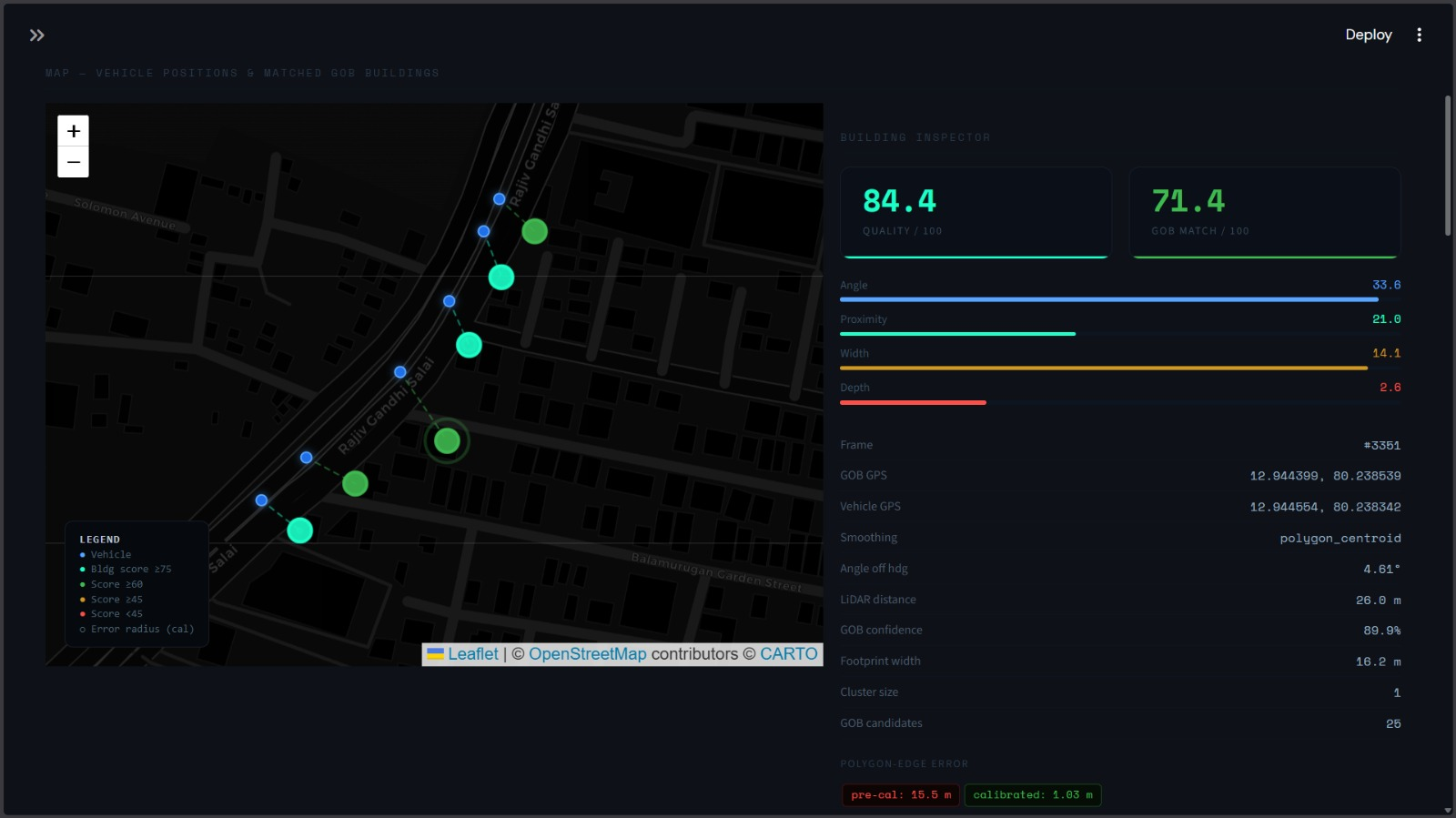
- Interactive map — vehicle positions (blue), building centroids (colour-coded by score), dashed projection lines, and error-radius circles
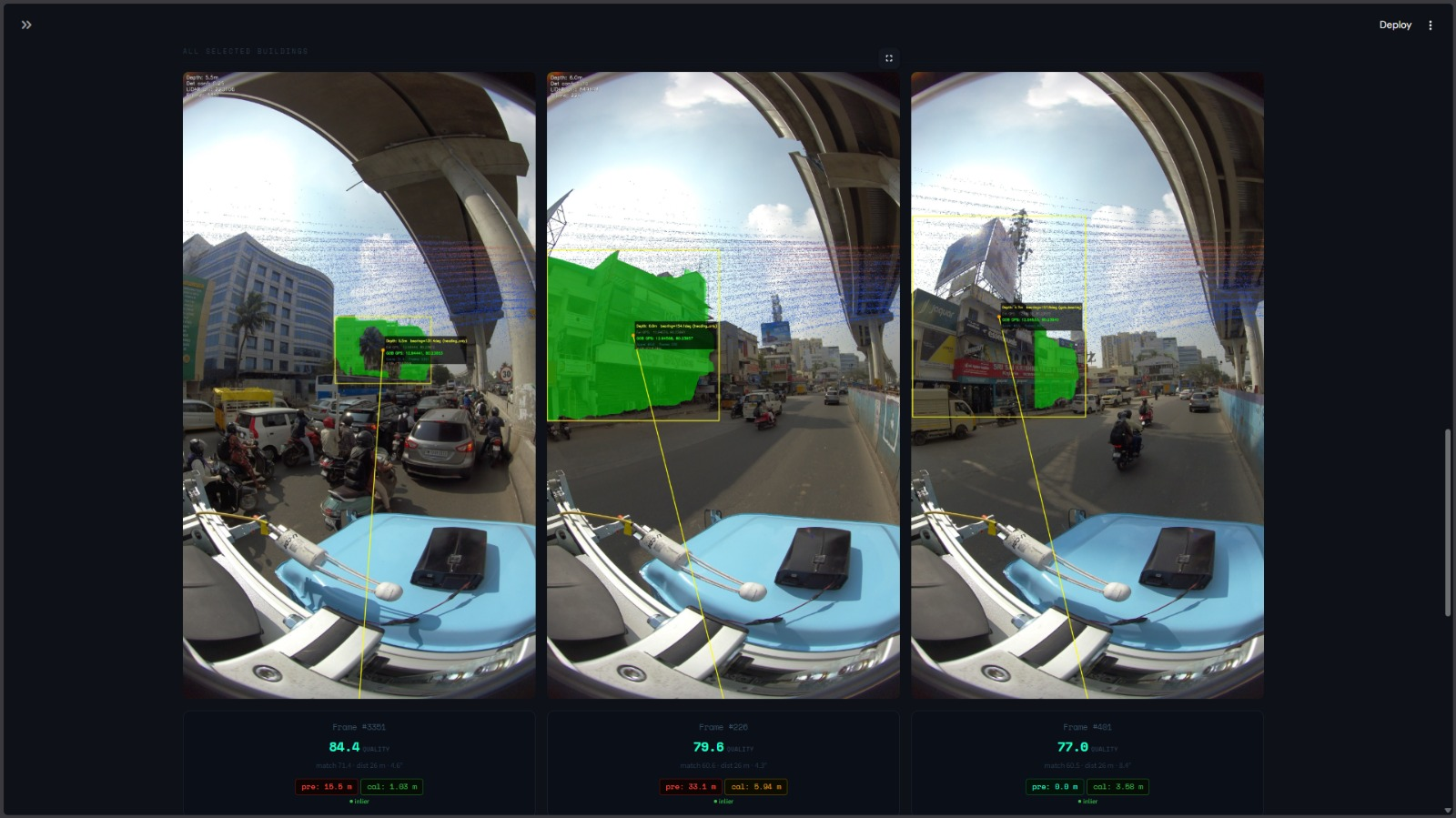
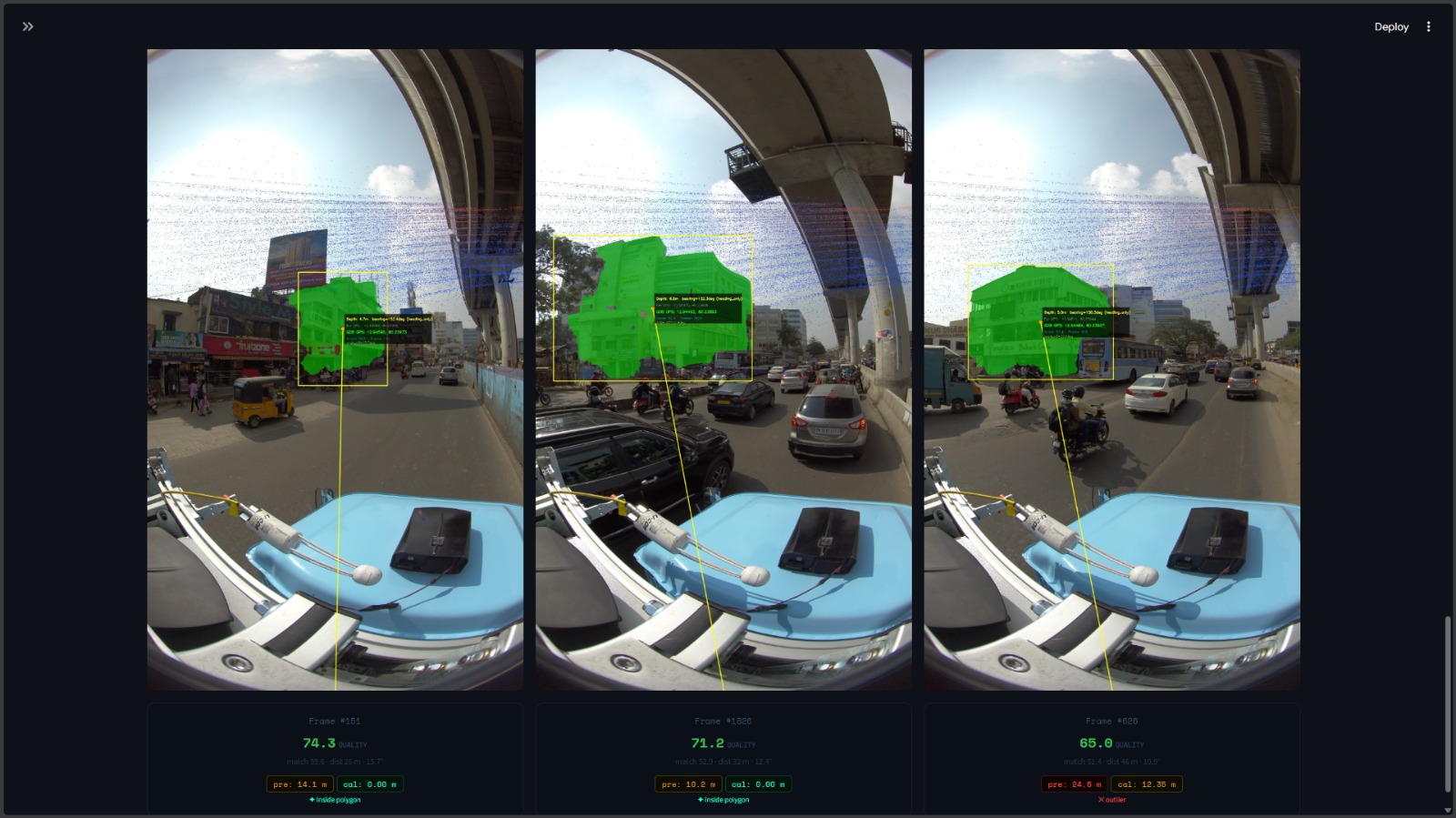
- Building Inspector — click any building on the map to see full score breakdown, per-component bar charts, polygon-edge error (pre/post calibration), selection rationale, and the annotated frame image
- Grid gallery — all selected buildings with thumbnail, error chips, and inlier/outlier status
- Sidebar — raw data table, calibration JSON, report download
streamlit run viewer.py
# opens at http://localhost:8501
12. Results & Accuracy 🏹
Results reported on 8 curated reference frames from a road survey in Chennai, India (approx. 12.94°N, 80.24°E).
Error metrics (polygon-edge, post-calibration)
| Metric | Value |
|---|---|
| Inlier mean error | 2.62 m |
| Inlier median error | 2.31 m |
| Calibrated avg (all frames) | 3.8 m |
| Pre-calibration avg | ~16.2 m |
| Improvement | ↓ 77% |
| Inside polygon (0 m error) | 2 / 8 frames |
| Inliers (≤ 8.77 m threshold) | 6 / 8 frames |
| Best single-frame error | 1.03 m (Frame 3351) |
Best frame (Frame 3351)
| Field | Value |
|---|---|
| Quality score | 84.4 / 100 |
| GOB match score | 71.4 / 100 |
| Angle off heading | 4.61° |
| LiDAR distance | 26.0 m |
| GOB confidence | 89.9% |
| Footprint width | 16.2 m |
| Pre-cal edge error | 15.5 m |
| Calibrated edge error | 1.03 m |
Error distribution
| Band | Frames |
|---|---|
| Inside footprint (0 m) | 2 |
| Excellent (< 5 m) | 4 |
| Good (< 10 m) | 2 |
| Fair (< 20 m) | 0 |
| Poor (≥ 20 m) | 0 |
13. Tuning Guide 🔩
| Symptom | Likely cause | Fix |
|---|---|---|
| No buildings detected | Conf threshold too high | Lower YOLO_CONF / FALLBACK_CONF |
| Many wrong buildings matched | Cone too wide | Reduce ANGLE_CONE_DEG from 35° |
| Depth unreliable | Sparse LiDAR in mask | Check T_LIDAR_TO_CAM; verify PCAP paths |
| High centroid error, low polygon error | Polygon centroid is off-centre | Already handled — smoothing uses polygon centroid |
| All errors > 20 m | Offset not calibrated | Run tim.py, update cfg.py, re-run |
| Mean error 5–15 m | Offset applied but suboptimal | Run tom.py grid search |
| Outlier frames | Wrong GOB match (occlusion) | Inspect match_json; lower GOB_RADIUS_M |
| Too few GOB candidates | GOB CSV doesn't cover area | Check lat/lon bounding box in gob.py |
14. Known Limitations & Future Work 🌎
Current limitations:
- The heading used for projection is taken directly from the IMU yaw, which can drift on curves. A vision-based heading refinement (e.g. vanishing-point estimation) would improve accuracy on non-straight roads.
- The GOB matching uses a single-best-match strategy per frame. In dense urban scenes with multiple large buildings, a ranked multi-hypothesis approach would be more robust.
- Depth estimation relies on LiDAR points projected through a static extrinsic calibration. Rolling shutter effects and vibration can introduce sub-pixel projection errors at long range.
- The
PROX_DECAY_M = 5.0parameter gives very high proximity scores to nearby buildings (< 10 m), which can outcompete the correct match when the vehicle is adjacent to a wall.
Planned improvements:
- Replace the lat/lon delta offset with a full 6-DOF lever-arm calibration between camera, LiDAR, and GNSS antenna.
- Integrate road-graph information to constrain heading estimation.
- Add multi-frame depth fusion (temporal smoothing) before projection.
- Extend the GOB to include building height for 3D matching.
- Export results as GeoJSON for GIS ingestion.
Glossary 📖
| Term | Definition |
|---|---|
| GOB | Google Open Buildings — surveyed building DB with WKT polygon footprints |
| Polygon-edge error | Distance from estimated GPS to nearest polygon boundary (0 if inside) |
| Inlier | A frame whose calibrated error is within OUTLIER_SCALE × median |
| Ego-pose | Vehicle position and orientation at a given frame timestamp |
| Along-ray offset | Depth correction applied along the projection ray (accounts for facade penetration) |
| Cross-ray offset | Lateral offset perpendicular to the projection ray (accounts for camera-GNSS lever arm) |
| HFOV | Horizontal field of view derived from FX and image width |
| SORT | Simple Online and Realtime Tracking — multi-object Kalman tracker adapted here for GPS stabilization |
ad astra per aspera ✈️!
1 maintainer

Metadata
1 maintainer
Release files for nazarGeo 1.1.0
For a detailed explanation of source distributions (sdists) and built distributions (wheels), please see the package formats documentation.
Source distribution (sdist)
| File | Size | Uploaded | Provenance | |
|---|---|---|---|---|
| nazargeo-1.1.0.tar.gz | 34.4 kB | Without provenance | Details |
Built distribution (wheel)
| File | Interpreter | ABI | Platform | Reset |
|---|---|---|---|---|
| nazargeo-1.1.0-py3-none-any.whl | Python 3 | none | any | Details |
Total release size: 61.0 kB
Release files / nazargeo-1.1.0.tar.gz
| Download URL | nazargeo-1.1.0.tar.gz |
|---|---|
| Size | 34.4 kB |
| Tags | Source |
|
SHA-256 checksum How to use checksums |
59e6f165d2f331c51e84d5494e0eca802c990c6c2ac4a7d60801a0bc40195de4
|
|
BLAKE2b-256 checksum How to use checksums |
c982025af8d036c4d6c761c2e6f4acf67b933f4dad9afc9acca36d755288146b
|
| Upload date | |
|
Uploaded using Trusted Publishing? What is trusted publishing? |
No |
| Uploaded via |
twine/6.2.0 CPython/3.10.20
|
Release files / nazargeo-1.1.0-py3-none-any.whl
| Download URL | nazargeo-1.1.0-py3-none-any.whl |
|---|---|
| Size | 26.6 kB |
| Tags | Python 3 |
|
SHA-256 checksum How to use checksums |
259de693efc44b5d9f1d73854176ba0bab881a32638374d9ae80a204cde60882
|
|
BLAKE2b-256 checksum How to use checksums |
5f04ea4e9766c7418bee2513e74969a0b09bb61cd5900197208e865a9a56e013
|
| Upload date | |
|
Uploaded using Trusted Publishing? What is trusted publishing? |
No |
| Uploaded via |
twine/6.2.0 CPython/3.10.20
|
Security for nazarGeo 1.1.0
Provenance
Provenance describes where a file came from. On PyPI, provenance is shared via attestations, which provide a verifiable record of the build or publishing details. View details, limitations and caveats.
No provenance found
None of the files in this release were uploaded with provenance metadata.
A note on package security
PyPI is a repository for distributing packages, not a service for auditing them. While third-party security researchers and our staff do their best to detect and remove malicious packages, PyPI cannot guarantee the quality, security or suitability of any given package.














