
nbragg




nbragg is a package designed for fitting neutron Bragg edge data using NCrystal cross-sections. This tool provides a straightforward way to analyze neutron transmission through polycrystalline materials, leveraging Bragg edges to extract information on material structure and composition.
Quick Example
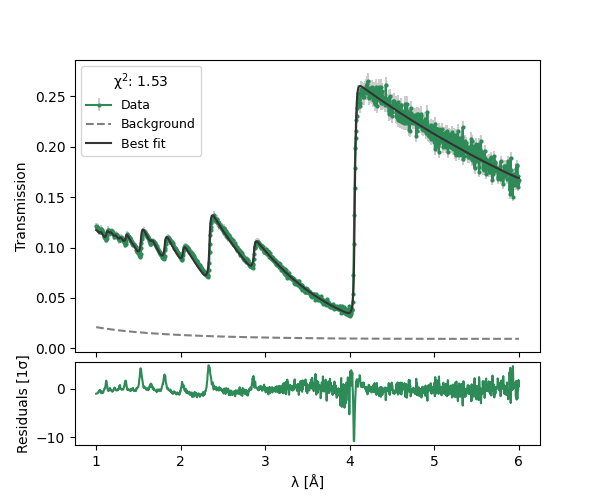
Fit a measured iron-powder transmission spectrum in a few lines:
import nbragg

data = nbragg.Data.from_transmission("iron_powder.csv") # read data
xs = nbragg.CrossSection(iron="Fe_sg229_Iron-alpha.ncmat") # define sample
model = nbragg.TransmissionModel(xs, vary_background=True, vary_response=True) # define model
result = model.fit(data) # perform fit
result.plot() # plot results
Features
- Flexible Cross-Section Calculations: Interfaces with NCrystal to fetch cross-sections for crystalline materials.
- Multi-Phase and Oriented Materials: Combine phases with simple arithmetic (
xs = 0.5*alpha + 0.5*gamma), and model textured or single-crystal samples with full orientation control. - Grouped/Gridded Data Fitting: Analyze spatially-resolved or multi-sample data with support for 1D arrays, 2D grids, and named groups. Includes parallel fitting with automatic result visualization via parameter maps.
- Rietveld-Type Analysis: Iterative, staged refinement of Bragg edge data, accumulating parameters across stages for robust fitting.
- MTEX Integration: Import phase weights and orientation distributions exported from MTEX for texture analysis.
- SANS Modeling: Built-in support for Small Angle Neutron Scattering (SANS) using hard-sphere models for samples with nanoscale features.
- Extinction Effects: Support for primary and secondary extinction modeling for large crystallites and thick samples.
- Built-In Response and Background Functions: Includes predefined models for instrument response (e.g., Jorgensen, square) and background components (polynomial functions).
- LMFit Integration: Flexible, nonlinear fitting of experimental data using the powerful lmfit library.
- Save and Load: JSON-based persistence of models and fit results for reproducible analysis sessions.
- Pythonic API: Simple to use, yet flexible enough for custom modeling.
- Plotting Utilities: Ready-to-use plotting functions for easy visualization of data, cross-sections, and fit results.
Installation
nbragg requires Python 3.9 or later.
Basic Installation
To install the base package from PyPI:
pip install nbragg
Installation with Extinction Effects
To include extinction effects in your analysis, you'll need to install the extinction plugin separately:
pip install nbragg
pip install git+https://github.com/XuShuqi7/ncplugin-CrysExtn
The ncrystal-plugin-crysextn plugin provides extinction corrections for crystallographic calculations.
Note: The extinction plugin is only required if you plan to use extinction effects. For standard Bragg edge fitting without extinction corrections, the base installation is sufficient.
Tutorials and Documentation
Full documentation is available at nbragg.readthedocs.io.
Three Jupyter notebook tutorials cover the main workflows:
- Getting started with nbragg — data loading, cross-sections, model definition, fitting, oriented materials, and MTEX integration.
- Rietveld-type refinement — staged, parametric refinement of Bragg edge data.
- Grouped/gridded data fitting — spatially-resolved and multi-sample analysis with parallel fitting.
Citing nbragg
If you use nbragg in your research, please cite the accompanying paper:
T. Y. Hirsh, A. F. T. Leong, A. M. Long, D. D. DiJulio, S. Xu, G. Muhrer, T. H. Kittelmann, J. I. Marquez Damian, D. J. Savage and S. C. Vogel, nbragg: A Versatile Python Tool for Bragg-Edge Transmission Analysis Using NCrystal, Journal of Applied Crystallography (submitted, 2026).
BibTeX:
@article{nbragg2026,
  title   = {nbragg: A Versatile Python Tool for Bragg-Edge Transmission Analysis Using NCrystal},
  author  = {Hirsh, Tsviki Y. and Leong, Andrew F. T. and Long, Alexander M. and
             DiJulio, Douglas D. and Xu, Shuqi and Muhrer, G{\"u}nter and
             Kittelmann, Thomas H. and Marquez Damian, Jos{\'e} I. and
             Savage, Daniel J. and Vogel, Sven C.},
  journal = {Journal of Applied Crystallography},
  year    = {2026},
  note    = {Submitted}
}
Citation metadata is also provided in CITATION.cff, and GitHub's "Cite this repository" button generates BibTeX/APA entries automatically.
Contributing
Contributions are welcome! See CONTRIBUTING.md for guidelines, and use the issue tracker to report bugs or request features.
License
nbragg is licensed under the MIT License.
Third-Party Dependencies
This project depends on several open-source packages with permissive licenses compatible with MIT:
- scipy, pandas, numpy, lmfit: BSD/BSD 3-Clause
- setuptools, tqdm: MIT License
- matplotlib: PSF License
- ncrystal: Apache 2.0 (license)
All dependencies allow free use, modification, and distribution.
1 maintainer

Download files
Download the file for your platform. If you're not sure which to choose, learn more about installing packages.
Source Distribution
Built Distribution
Filter files by name, interpreter, ABI, and platform.
If you're not sure about the file name format, learn more about wheel file names.
Copy a direct link to the current filters
File details
Details for the file nbragg-1.0.0.tar.gz.
File metadata
- Download URL: nbragg-1.0.0.tar.gz
- Upload date:
- Size: 145.2 kB
- Tags: Source
- Uploaded using Trusted Publishing? Yes
- Uploaded via:
twine/6.1.0 CPython/3.13.14
File hashes
| Algorithm | Hash digest | |
|---|---|---|
| SHA256 |
470475b28255dcae1d9a14af4f55a5ec5984549a17b2494789e92bf074c39282
|
|
| MD5 |
cae0a3277ad17f1a55fb180cd371b715
|
|
| BLAKE2b-256 |
710e3fa9afdb650a267e5bb4f2e4da39043c7ed4bd334d89a893db39f8f42aec
|
Provenance
The following attestation bundles were made for nbragg-1.0.0.tar.gz:
Publisher:
python-publish.yml on TsvikiHirsh/nbragg
-
Statement:
-
Statement type:
https://in-toto.io/Statement/v1 -
Predicate type:
https://docs.pypi.org/attestations/publish/v1 -
Subject name:
nbragg-1.0.0.tar.gz -
Subject digest:
470475b28255dcae1d9a14af4f55a5ec5984549a17b2494789e92bf074c39282 - Sigstore transparency entry: 2275316881
- Sigstore integration time:
-
Permalink:
TsvikiHirsh/nbragg@ecaf7643955dd8f8667923a03e3aa3d045548194 -
Branch / Tag:
refs/tags/v1.0.0 - Owner: https://github.com/TsvikiHirsh
-
Access:
public
-
Token Issuer:
https://token.actions.githubusercontent.com -
Runner Environment:
github-hosted -
Publication workflow:
python-publish.yml@ecaf7643955dd8f8667923a03e3aa3d045548194 -
Trigger Event:
release
-
Statement type:
File details
Details for the file nbragg-1.0.0-py3-none-any.whl.
File metadata
- Download URL: nbragg-1.0.0-py3-none-any.whl
- Upload date:
- Size: 109.0 kB
- Tags: Python 3
- Uploaded using Trusted Publishing? Yes
- Uploaded via:
twine/6.1.0 CPython/3.13.14
File hashes
| Algorithm | Hash digest | |
|---|---|---|
| SHA256 |
b26475249ba7a739ed3ccbe9c9147d8634dbcb256d1bbbe30805c88523049f1e
|
|
| MD5 |
62c2266e017a0a3223d15a0f56e47997
|
|
| BLAKE2b-256 |
51ba9861c5ecacbce2a77ccc02c76c2ba94b9e55f16e948d8ef91ee5f9433d11
|
Provenance
The following attestation bundles were made for nbragg-1.0.0-py3-none-any.whl:
Publisher:
python-publish.yml on TsvikiHirsh/nbragg
-
Statement:
-
Statement type:
https://in-toto.io/Statement/v1 -
Predicate type:
https://docs.pypi.org/attestations/publish/v1 -
Subject name:
nbragg-1.0.0-py3-none-any.whl -
Subject digest:
b26475249ba7a739ed3ccbe9c9147d8634dbcb256d1bbbe30805c88523049f1e - Sigstore transparency entry: 2275317192
- Sigstore integration time:
-
Permalink:
TsvikiHirsh/nbragg@ecaf7643955dd8f8667923a03e3aa3d045548194 -
Branch / Tag:
refs/tags/v1.0.0 - Owner: https://github.com/TsvikiHirsh
-
Access:
public
-
Token Issuer:
https://token.actions.githubusercontent.com -
Runner Environment:
github-hosted -
Publication workflow:
python-publish.yml@ecaf7643955dd8f8667923a03e3aa3d045548194 -
Trigger Event:
release
-
Statement type:














