









NegMAS is a Python library for developing autonomous negotiation agents embedded in simulation environments. It supports bilateral and multilateral negotiations, multiple negotiation protocols, and complex multi-agent simulations with interconnected negotiations.
Documentation: https://negmas.readthedocs.io/
Installation
pip install negmasFor additional features:
# With Genius bridge support (Java-based agents)
pip install negmas[genius]

# With visualization support
pip install negmas[plots]

# All optional dependencies
pip install negmas[all]
Quick Start
Run a simple negotiation in 10 lines:
from negmas import SAOMechanism, TimeBasedConcedingNegotiator, make_issue
from negmas.preferences import LinearAdditiveUtilityFunction as LUFun

# Define what we're negotiating about
issues = [make_issue(name="price", values=100)]

# Create negotiation session (Stacked Alternating Offers)
session = SAOMechanism(issues=issues, n_steps=50)

# Add buyer (prefers low price) and seller (prefers high price)
session.add(
    TimeBasedConcedingNegotiator(name="buyer"),
    ufun=LUFun.random(issues=issues, reserved_value=0.0),
)
session.add(
    TimeBasedConcedingNegotiator(name="seller"),
    ufun=LUFun.random(issues=issues, reserved_value=0.0),
)

# Run and get result
result = session.run()
print(f"Agreement: {result.agreement}, Rounds: {result.step}")
Multi-issue negotiation with custom preferences:
from negmas import SAOMechanism, AspirationNegotiator, make_issue
from negmas.preferences import LinearAdditiveUtilityFunction

# Create a 2-issue negotiation domain
issues = [
    make_issue(name="price", values=10),
    make_issue(name="quantity", values=5),
]

# Define utility functions
buyer_ufun = LinearAdditiveUtilityFunction(
    values={
        "price": lambda x: 1.0 - x / 10.0,  # lower price = better
        "quantity": lambda x: x / 5.0,  # more quantity = better
    },
    issues=issues,
)
seller_ufun = LinearAdditiveUtilityFunction(
    values={
        "price": lambda x: x / 10.0,  # higher price = better
        "quantity": lambda x: 1.0 - x / 5.0,  # less quantity = better
    },
    issues=issues,
)

# Run negotiation
session = SAOMechanism(issues=issues, n_steps=100)
session.add(AspirationNegotiator(name="buyer"), ufun=buyer_ufun)
session.add(AspirationNegotiator(name="seller"), ufun=seller_ufun)
session.run()

# Visualize
session.plot()
Command Line Interface
NegMAS includes a negotiate CLI for quick experimentation:
# Run with default negotiators
negotiate -s 50

# Specify negotiators and steps
negotiate -n AspirationNegotiator -n NaiveTitForTatNegotiator -s 100

# Use Python-native Genius agents (no Java required)
negotiate -n GBoulware -n GConceder -s 50

# Use custom BOA components
negotiate -n "boa:offering=GTimeDependentOffering(e=0.2),acceptance=GACNext" -n AspirationNegotiator

# Save results and plot
negotiate -s 100 --save-path ./results
See negotiate --help for all options, or the CLI documentation.
Architecture Overview
NegMAS is built around four core concepts:
┌─────────────────────────────────────────────────────────────────┐
│                           WORLD                                 │
│  (Simulation environment where agents interact)                 │
│                                                                 │
│   ┌─────────┐     ┌─────────┐         ┌─────────────────────┐  │
│   │  Agent  │     │  Agent  │   ...   │  BulletinBoard      │  │
│   │         │     │         │         │  (Public info)      │  │
│   └────┬────┘     └────┬────┘         └─────────────────────┘  │
│        │               │                                        │
│        │ creates       │ creates                                │
│        ▼               ▼                                        │
│   ┌─────────────────────────────────────────────────────────┐  │
│   │                    MECHANISM                             │  │
│   │  (Negotiation protocol: SAO, SingleText, Auction, etc.) │  │
│   │                                                          │  │
│   │   ┌────────────┐  ┌────────────┐  ┌────────────┐        │  │
│   │   │ Negotiator │  │ Negotiator │  │ Negotiator │        │  │
│   │   │  + UFun    │  │  + UFun    │  │  + UFun    │        │  │
│   │   └────────────┘  └────────────┘  └────────────┘        │  │
│   └─────────────────────────────────────────────────────────┘  │
└─────────────────────────────────────────────────────────────────┘
Core Components:
Outcome Space (outcomes module) - Issues: Variables being negotiated (price, quantity, delivery date, etc.) - Outcomes: Specific assignments of values to issues - Supports discrete, continuous, and categorical issues
Preferences (preferences module) - UtilityFunction: Maps outcomes to utility values - Built-in types: LinearAdditiveUtilityFunction, MappingUtilityFunction, NonLinearAggregationUtilityFunction, and more - Supports probabilistic and dynamic utility functions
Negotiators (negotiators, sao modules) - Implement negotiation strategies - Built-in: AspirationNegotiator, TitForTatNegotiator, NaiveTitForTatNegotiator, BoulwareTBNegotiator, etc. - Easy to create custom negotiators
Mechanisms (mechanisms, sao modules) - Implement negotiation protocols - SAOMechanism: Stacked Alternating Offers (most common) - Also: Single-text protocols, auction mechanisms, etc.
For Situated Negotiations (World Simulations):
Worlds (situated module) - Simulate environments where agents negotiate - Agents can run multiple concurrent negotiations - Example: Supply chain simulations (SCML)
Controllers (sao.controllers module) - Coordinate multiple negotiators - Useful when negotiations are interdependent
Key Features
Multiple Protocols: SAO (Alternating Offers), Single-Text, Auctions, and custom protocols
Rich Utility Functions: Linear, nonlinear, constraint-based, probabilistic, dynamic
Bilateral & Multilateral: Support for 2+ party negotiations
Concurrent Negotiations: Agents can participate in multiple negotiations simultaneously
World Simulations: Build complex multi-agent simulations with situated negotiations
Genius Integration: Run Java-based Genius agents via the built-in bridge
Visualization: Built-in plotting for negotiation analysis
Extensible: Easy to add new protocols, negotiators, and utility functions
Creating Custom Negotiators
NegMAS offers two approaches to creating custom negotiators:
Inheritance: Subclass a base negotiator and override methods
Composition: Combine multiple negotiators using MetaNegotiator
Inheritance (Traditional Approach)
Subclass a base negotiator and implement the required methods:
from negmas.sao import SAONegotiator, ResponseType


class MyNegotiator(SAONegotiator):
    """A simple negotiator using inheritance."""

    def propose(self, state, dest=None):
        # Propose a random outcome above reservation value
        return self.nmi.random_outcome()

    def respond(self, state, source=None):
        offer = state.current_offer
        # Accept any offer with utility > 0.8
        if offer is not None and self.ufun(offer) > 0.8:
            return ResponseType.ACCEPT_OFFER
        return ResponseType.REJECT_OFFER
Using the negotiator:
session = SAOMechanism(issues=issues, n_steps=100)
session.add(MyNegotiator(name="custom"), ufun=my_ufun)
session.add(AspirationNegotiator(name="opponent"), ufun=opponent_ufun)
session.run()
Composition (Ensemble Approach)
Use SAOAggMetaNegotiator to combine multiple negotiators and aggregate their decisions:
from negmas.sao import SAOMechanism, ResponseType
from negmas.sao.negotiators import (
    SAOAggMetaNegotiator,
    BoulwareTBNegotiator,
    NaiveTitForTatNegotiator,
)


class MajorityVoteNegotiator(SAOAggMetaNegotiator):
    """An ensemble negotiator that uses majority voting."""

    def aggregate_proposals(self, state, proposals, dest=None):
        # Use the proposal from the first negotiator that offers something
        for neg, proposal in proposals:
            if proposal is not None:
                return proposal
        return None

    def aggregate_responses(self, state, responses, offer, source=None):
        # Majority vote: accept if more than half accept
        accept_count = sum(1 for _, r in responses if r == ResponseType.ACCEPT_OFFER)
        if accept_count > len(responses) / 2:
            return ResponseType.ACCEPT_OFFER
        return ResponseType.REJECT_OFFER


# Create an ensemble of different strategies
ensemble = MajorityVoteNegotiator(
    negotiators=[
        BoulwareTBNegotiator(),  # Tough strategy
        NaiveTitForTatNegotiator(),  # Reactive strategy
        BoulwareTBNegotiator(),  # Another tough vote
    ],
    name="ensemble",
)

# Use in a negotiation
session = SAOMechanism(issues=issues, n_steps=100)
session.add(ensemble, ufun=my_ufun)
session.add(AspirationNegotiator(name="opponent"), ufun=opponent_ufun)
session.run()
The ensemble approach is useful for:
Voting strategies: Combine multiple negotiators via majority/weighted voting
Dynamic delegation: Switch between strategies at runtime
A/B testing: Compare strategies within the same negotiation
Composition (BOA Components)
Use BOANegotiator to build negotiators from reusable components following the Bidding-Opponent modeling-Acceptance (BOA) pattern:
from negmas.gb.negotiators.modular import BOANegotiator
from negmas.gb.components import (
    GSmithFrequencyModel,  # Opponent modeling
    GACTime,  # Acceptance strategy
    GTimeDependentOffering,  # Offering strategy
)

# Create a BOA negotiator with Genius-style components
negotiator = BOANegotiator(
    offering=GTimeDependentOffering(e=0.2),  # Boulware-style offering
    acceptance=GACTime(t=0.95),  # Accept after 95% of time
    model=GSmithFrequencyModel(),  # Opponent frequency model
    name="my_boa_agent",
)
The BOA approach is useful for:
Mix-and-match: Combine different strategies from the Genius library
Research: Easily swap components to compare different strategies
Extensibility: Create custom components that integrate with existing ones
Creating Custom Protocols
from negmas import Mechanism, MechanismStepResult


class MyProtocol(Mechanism):
    def __call__(self, state, action=None):
        # Implement one round of your protocol
        # Return MechanismStepResult with updated state
        ...
        return MechanismStepResult(state=state)
Running World Simulations
For complex scenarios with multiple agents and concurrent negotiations:
from negmas.situated import World, Agent


class MyAgent(Agent):
    def step(self):
        # Called each simulation step
        # Request negotiations, respond to events, etc.
        pass


# See SCML package for a complete example
# pip install scml
Citation
If you use NegMAS in your research, please cite:
@inproceedings{mohammad2021negmas,
  title={NegMAS: A Platform for Automated Negotiations},
  author={Mohammad, Yasser and Nakadai, Shinji and Greenwald, Amy},
  booktitle={PRIMA 2020: Principles and Practice of Multi-Agent Systems},
  pages={343--351},
  year={2021},
  publisher={Springer},
  doi={10.1007/978-3-030-69322-0_23}
}
Reference:
Mohammad, Y., Nakadai, S., Greenwald, A. (2021). NegMAS: A Platform for Automated Negotiations. In: PRIMA 2020. LNCS, vol 12568. Springer. https://doi.org/10.1007/978-3-030-69322-0_23
The NegMAS Ecosystem
NegMAS is the core of a broader ecosystem for automated negotiation research:
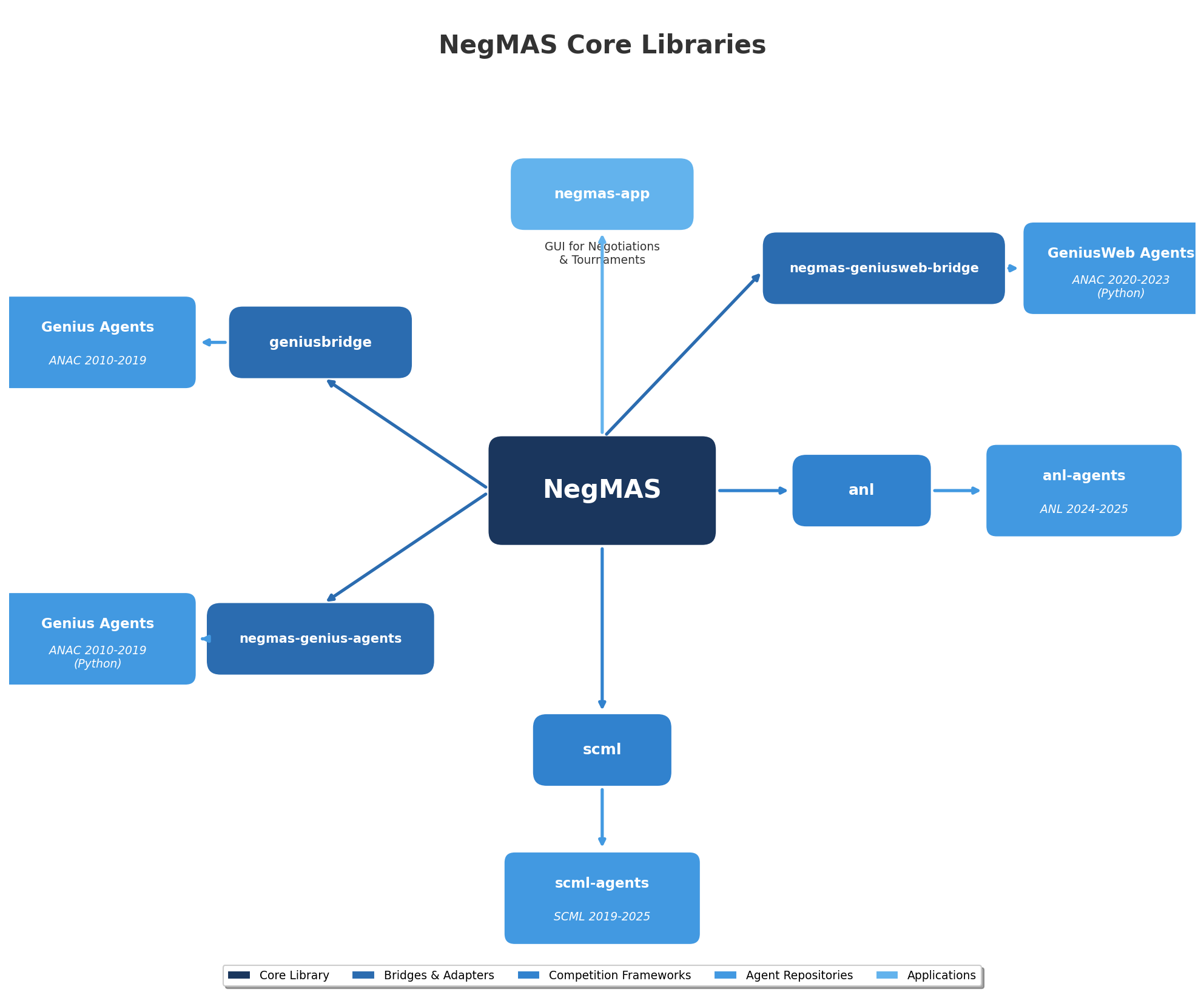
Competition Frameworks
Agent Repositories
anl-agents - ANL competition agents
scml-agents - SCML competition agents
Bridges & Extensions
negmas-geniusweb-bridge - Run GeniusWeb agents
negmas-llm - LLM-powered negotiation agents
negmas-elicit - Preference elicitation during negotiation
geniusbridge - Java Genius bridge
Visualization & Tools
negmas-app - Applications and interfaces for NegMAS
scml-vis - SCML visualization
jnegmas - Java interface (not maintained)
Specialized Tools
negmas-elicit - Preference Elicitation during Negotiation Methods
More Resources
Tutorials: https://negmas.readthedocs.io/en/latest/tutorials.html
API Reference: https://negmas.readthedocs.io/en/latest/api.html
YouTube Playlist: https://www.youtube.com/playlist?list=PLqvs51K2Mb8IJe5Yz5jmYrRAwvIpGU2nF
Publications: https://negmas.readthedocs.io/en/latest/publications.html
Papers Using NegMAS
Selected papers (see full list):
Core NegMAS Research (by the NegMAS authors)
Mohammad, Y. (2025). Tackling the Protocol Problem in Automated Negotiation. AAMAS. Cited by 1
Florijn et al. (2025). A Survey on One-to-Many Negotiation. IJCAI. Cited by 1
Mohammad, Y. et al. (2024). Automated Negotiation in Supply Chains: A Generalist Environment for RL/MARL. PRIMA. Cited by 1
Mohammad, Y. (2023). Generalized Bargaining Protocols. AI 2023. Cited by 3
Mohammad, Y. (2023). Optimal Time-based Strategy for Automated Negotiation. Applied Intelligence. Cited by 9
Mohammad, Y. (2023). Evaluating Automated Negotiations. IEEE WI-IAT. Cited by 2
Mohammad, Y. (2021). Concurrent Local Negotiations with a Global Utility Function. AAMAS Journal. Cited by 14
Mohammad, Y. (2020). Optimal Deterministic Time-based Policy in Automated Negotiation. PRIMA. Cited by 4
Mohammad, Y., Nakadai, S. (2019). Optimal Value of Information Based Elicitation. AAMAS.
Mohammad, Y., Nakadai, S. (2018). FastVOI: Efficient Utility Elicitation. PRIMA.
Mohammad, Y. et al. (2019). Supply Chain Management World. PRIMA. Cited by 38
Competition & Benchmarks
Aydoğan et al. (2025). ANAC 2024 Challenges and Results. AAMAS. Cited by 2
Aydoğan et al. (2020). Challenges and Main Results of ANAC 2019. EUMAS/AT. Cited by 51
Negotiation Strategies
Sengupta et al. (2021). RL-Based Negotiating Agent Framework. IJCAI Cited by 48
Higa et al. (2023). Reward-based Negotiating Agent Strategies. AAAI. Cited by 16
Applications
Inotsume et al. (2020). Path Negotiation for Multirobot Vehicles. IROS. Cited by 17
Last updated: February 2026
Contributing
Contributions are welcome! Please see the contributing guide.
License
NegMAS is released under the BSD 3-Clause License.
AI Assistance Disclosure
This project uses AI assistance for specific, limited tasks while remaining predominantly human-developed:
Publications list: AI assisted in compiling and formatting the publications list
Documentation polishing: AI assisted in proofreading and improving documentation clarity
gb.components.genius module: AI assisted in reimplementing Genius BOA components in NegMAS
Registry feature: AI assisted in developing the negotiator/mechanism registry system
Some tests: AI assisted in writing tests, particularly for new features like the registry
tournaments.analysis module: AI assisted in implementing the post-tournament game-theoretic and statistical analysis package (EGTA-based evaluation, Sequential Elimination Ranking, replicator dynamics, and pairwise significance/normality testing)
All AI-assisted contributions are reviewed and approved by human maintainers. The core architecture, algorithms, and research direction of NegMAS are human-driven and will remain so.
Acknowledgements
NegMAS was developed at the NEC-AIST collaborative laboratory. It uses scenarios from ANAC 2010-2018 competitions obtained from the Genius Platform.
1 maintainer

Metadata
1 maintainer
Release files for negmas 0.16.0
For a detailed explanation of source distributions (sdists) and built distributions (wheels), please see the package formats documentation.
Source distribution (sdist)
| File | Size | Uploaded | |
|---|---|---|---|
| negmas-0.16.0.tar.gz | 1.0 MB | Details |
Built distribution (wheel)
| File | Interpreter | ABI | Platform | Reset |
|---|---|---|---|---|
| negmas-0.16.0-py3-none-any.whl | Python 3 | none | any | Details |
Total release size: 2.1 MB
Release files / negmas-0.16.0.tar.gz
| Download URL | negmas-0.16.0.tar.gz |
|---|---|
| Size | 1.0 MB |
| Tags | Source |
|
SHA-256 checksum How to use checksums |
c4bde84532fff62748f468f85704e7a2be0fd85808dccfd0b912548df0209e21
|
|
BLAKE2b-256 checksum How to use checksums |
72611c12d915e5bed01e346566cf39913c080c3bbcbd861a87f4d522b258190c
|
| Upload date | |
|
Uploaded using Trusted Publishing? What is trusted publishing? |
No |
| Uploaded via |
twine/7.0.0 CPython/3.13.14
|
Release files / negmas-0.16.0-py3-none-any.whl
| Download URL | negmas-0.16.0-py3-none-any.whl |
|---|---|
| Size | 1.1 MB |
| Tags | Python 3 |
|
SHA-256 checksum How to use checksums |
cb5c2b14156a4aabec78df68136b99833ae0eb4075ed8f7525fff2322e72e42d
|
|
BLAKE2b-256 checksum How to use checksums |
ab8a77c1c00af857e9bca45e3c4327499c7b6507ef7d477c1d5e9c852a8d014f
|
| Upload date | |
|
Uploaded using Trusted Publishing? What is trusted publishing? |
No |
| Uploaded via |
twine/7.0.0 CPython/3.13.14
|














