
Add custom filters for fields via UI





This module allows to define custom filters in the search views for an specific field belonging to the document or any other related document.
This nature makes the definition quite technical, but once done, it adds the element in the UI for regular user use.
Table of contents
Configuration
Go to Settings > Technical > User Interface > Custom Field Filters.
Create a new record, and define following information:
The Model for which you are defining the filter. It will appear in all the search views of this model.
The label you want to see on the search line on the Name field. This field allows translations for proper UI in different languages.
The Expression, which is the field chain string with dot notation. Examples: product_id, product_id.seller_ids.name, partner_id.lang.
Optionally, you can fill Position After for indicating after which existing field (technical name) the filter will appear. If empty or not found, the filter will be added at the end.
You can reorder records for determining sorting for multiple filters for the same model with the arrow handle in the left part.
Usage
Go to the menu entry for which you have defined the custom field filter.
On the search bar, type anything.
In the filter list, you will see the line for the element you have defined.
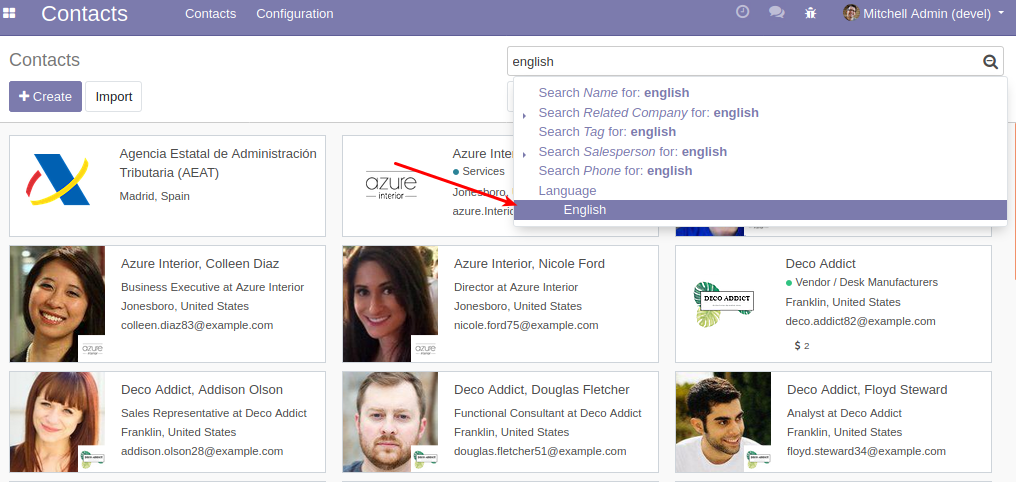
As demo data, a custom field filter is included for sample purposes:

Steps for trying this sample:
Install contacts module.
Go to Contacts.
Type “english” and you’ll find the filter “Language” at the end:
Bug Tracker
Bugs are tracked on GitHub Issues. In case of trouble, please check there if your issue has already been reported. If you spotted it first, help us smashing it by providing a detailed and welcomed feedback.
Do not contact contributors directly about support or help with technical issues.
Credits
Contributors
-
Carlos Dauden
Pedro M. Baeza
Denis Roussel <denis.roussel@acsone.eu>
Maintainers
This module is maintained by the OCA.

OCA, or the Odoo Community Association, is a nonprofit organization whose mission is to support the collaborative development of Odoo features and promote its widespread use.
Current maintainer:

This module is part of the OCA/server-ux project on GitHub.
You are welcome to contribute. To learn how please visit https://odoo-community.org/page/Contribute.
1 maintainer

Metadata
1 maintainer
Release files for odoo10-addon-base-search-custom-field-filter 10.0.1.0.1
For a detailed explanation of source distributions (sdists) and built distributions (wheels), please see the package formats documentation.
Built distribution (wheel)
| File | Interpreter | ABI | Platform | Actions Reset |
|---|---|---|---|---|
| odoo10_addon_base_search_custom_field_filter-10.0.1.0.1-py2-none-any.whl | Python 2 | none | any | Details for odoo10_addon_base_search_custom_field_filter-10.0.1.0.1-py2-none-any.whl |
Release files / odoo10_addon_base_search_custom_field_filter-10.0.1.0.1-py2-none-any.whl
| Download URL | odoo10_addon_base_search_custom_field_filter-10.0.1.0.1-py2-none-any.whl |
|---|---|
| Size | 233.0 kB |
| Tags | Python 2 |
|
SHA-256 checksum How to use checksums |
048409badf2f6dd00c1d13fcd6b1b5066e37d85f995e61775a91f91d1b0b8a04
|
|
BLAKE2b-256 checksum How to use checksums |
a15e5ba7eaee58c05106cad7f9128cb6de9a30c15ef61e57823399e07ee5da9a
|
| Upload date | |
|
Uploaded using Trusted Publishing? What is trusted publishing? |
No |
| Uploaded via |
twine/3.2.0 pkginfo/1.6.1 requests/2.25.1 setuptools/51.0.0 requests-toolbelt/0.9.1 tqdm/4.54.1 CPython/3.7.3
|
Security for odoo10-addon-base-search-custom-field-filter 10.0.1.0.1
Provenance
Provenance describes where a file came from. On PyPI, provenance is shared via attestations, which provide a verifiable record of the build or publishing details. View details, limitations and caveats.
No provenance found
None of the files in this release were uploaded with provenance metadata.
A note on package security
PyPI is a repository for distributing packages, not a service for auditing them. While third-party security researchers and our staff do their best to detect and remove malicious packages, PyPI cannot guarantee the quality, security or suitability of any given package.
To learn more about protecting yourself from malicious actors, visit our package security documentation.














