
This release is a pre-release and may not be stable for production use.
ITA - Banking SEPA Credit Transfer CBI





This module adds new payment export types to use in the payment order. For italian credit transfer, the format codes are
CBIBdyPaymentRequest.00.04.01
CBIBdyCrossBorderPaymentRequest.00.01.01
The created XML follows the CBI standards in https://www.cbi-org.eu/My-Menu/Servizio-CBI-Documentazione/Servizio-CBI-Documentazione-Standard.
Note (ITA):
Le specifiche CBI del bonifico XML SEPA (versione 00.04.01) si basano sul messaggio ISO20022 pain.001.001.09 e sono compliant al Rulebook SEPA.
Ad esempio la presenza obbligatoria dell’ABI della banca di addebito contenuto nel campo “MmbId” che è invece facoltativo nel tracciato ISO.
Table of contents
Configuration
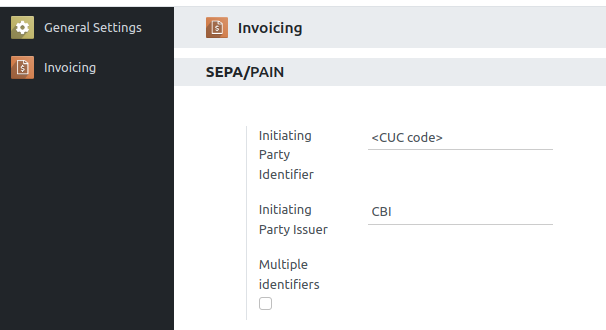
In Invoicing / Configuration / Settings / SEPA/PAIN, set:
the CUC code in field Initiating Party Identifier
the Initiating Party Identifier (must be “CBI”).
In Invoicing / Configuration / Management / Payment Modes, create a new payment mode.
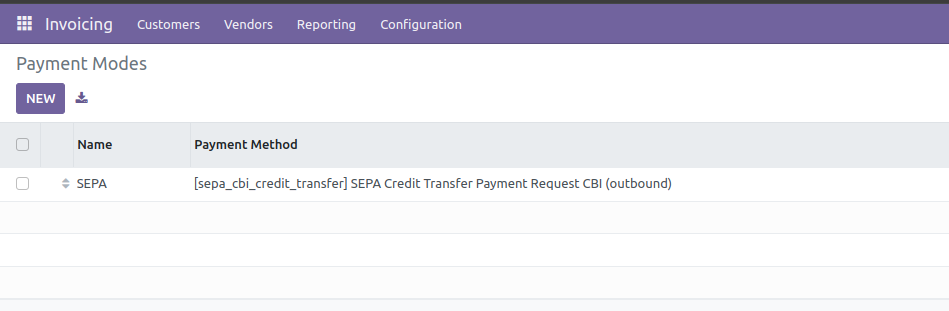
In the new payment mode is important to set the Italian format SEPA CBI

Usage
This module uses the grouped payments implemented by the OCA in account_payment_order, grouped payments are also implemented in Odoo EE.
When you create a new payment order, you must select the payment mode created during configuration
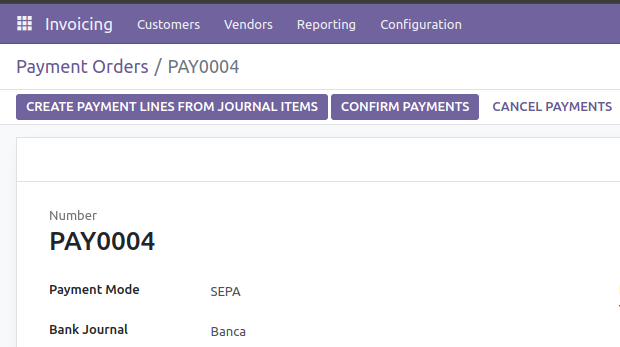
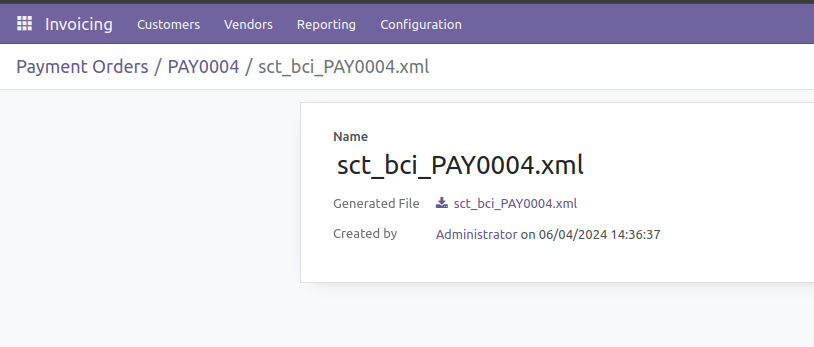
In order to get the xml file:
click on “Confirm payments”
click on “Generate payment file”
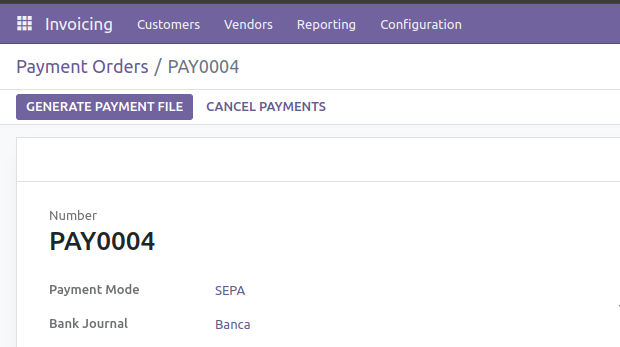
Then you can download the generated file
Bug Tracker
Bugs are tracked on GitHub Issues. In case of trouble, please check there if your issue has already been reported. If you spotted it first, help us to smash it by providing a detailed and welcomed feedback.
Do not contact contributors directly about support or help with technical issues.
Credits
Contributors
Alessandro Camilli <alessandro.camilli@openforce.it>
Andrea Colangelo <andrea.colangelo@openforce.it>
Lorenzo Battistini <lorenzo.battistini@agilebg.com>
Alex Comba <alex.comba@agilebg.com>
-
Simone Rubino <simone.rubino@aion-tech.it>
Maintainers
This module is maintained by the OCA.

OCA, or the Odoo Community Association, is a nonprofit organization whose mission is to support the collaborative development of Odoo features and promote its widespread use.
Current maintainer:

This module is part of the OCA/l10n-italy project on GitHub.
You are welcome to contribute. To learn how please visit https://odoo-community.org/page/Contribute.
1 maintainer

Metadata
1 maintainer
Release files for odoo14-addon-l10n-it-sct-cbi 14.0.1.0.1.dev3
For a detailed explanation of source distributions (sdists) and built distributions (wheels), please see the package formats documentation.
Built distribution (wheel)
| File | Interpreter | ABI | Platform | Actions Reset |
|---|---|---|---|---|
| odoo14_addon_l10n_it_sct_cbi-14.0.1.0.1.dev3-py3-none-any.whl | Python 3 | none | any | Details for odoo14_addon_l10n_it_sct_cbi-14.0.1.0.1.dev3-py3-none-any.whl |
Release files / odoo14_addon_l10n_it_sct_cbi-14.0.1.0.1.dev3-py3-none-any.whl
| Download URL | odoo14_addon_l10n_it_sct_cbi-14.0.1.0.1.dev3-py3-none-any.whl |
|---|---|
| Size | 166.2 kB |
| Tags | Python 3 |
|
SHA-256 checksum How to use checksums |
2e51a7da4e6aade17265c5cb39f5f0a73baedafee7685738db0896f7a321d84d
|
|
BLAKE2b-256 checksum How to use checksums |
6233a86d8b9ed9fe9b49f6028d5102fdf1838639a160c84481443dfaa3f03fe0
|
| Upload date | |
|
Uploaded using Trusted Publishing? What is trusted publishing? |
No |
| Uploaded via |
twine/5.1.1 CPython/3.12.3
|
Security for odoo14-addon-l10n-it-sct-cbi 14.0.1.0.1.dev3
Provenance
Provenance describes where a file came from. On PyPI, provenance is shared via attestations, which provide a verifiable record of the build or publishing details. View details, limitations and caveats.
No provenance found
None of the files in this release were uploaded with provenance metadata.
A note on package security
PyPI is a repository for distributing packages, not a service for auditing them. While third-party security researchers and our staff do their best to detect and remove malicious packages, PyPI cannot guarantee the quality, security or suitability of any given package.
To learn more about protecting yourself from malicious actors, visit our package security documentation.














