




OMADS
OMADS (Optimization using Mesh Adaptive Direct Search) is a Python implementation of the MADS algorithm for blackbox optimization. It solves single- and multi-objective problems, with or without constraints.
Documentation, tutorials and algorithms: ahmed-bayoumy.github.io/OMADS
Version 2610
Why OMADS
Optimize what you can only run. Your simulation, CAD pipeline or legacy code gives you a
number, not a gradient: it may be noisy, non-smooth, slow, or crash at some inputs. OMADS
optimizes it directly from pip install and a ten-line Python dictionary, with no
derivatives, no surrogate to train and no solver to compile.
- Built on a convergence theory, not a heuristic. OMADS implements Mesh Adaptive Direct Search (MADS), whose iterates converge, under standard assumptions and from any starting point, to points satisfying Clarke stationarity conditions.
- Strong where evaluations are scarce. On the 54 constrained problems of the COCO
bbob-constrainedsuite in 2D, the published benchmark configuration solves about 98% of the (function, target) pairs within 100 × n evaluations, ahead of fmincon (92%), and close to COBYLA and AL1-CMA-ES, which were run with up to 10⁷ × n evaluations. - Constraints the way engineers have them. Relaxable constraints are steered towards feasibility with a progressive barrier; points that violate hard constraints (where the code cannot even run) are rejected; failed evaluations are discarded and the search carries on.
- One input, many problems. The same dictionary or JSON file handles constrained and unconstrained, single- and multi-objective (Pareto) problems, serial or parallel evaluation, and any Python callable, including wrappers around external programs.
- Results you can check. Every published benchmark is reproducible with a single command
(
python benchmarks/coco/reproduce_results.py), and a regression suite runs on Linux, Windows and macOS in continuous integration.
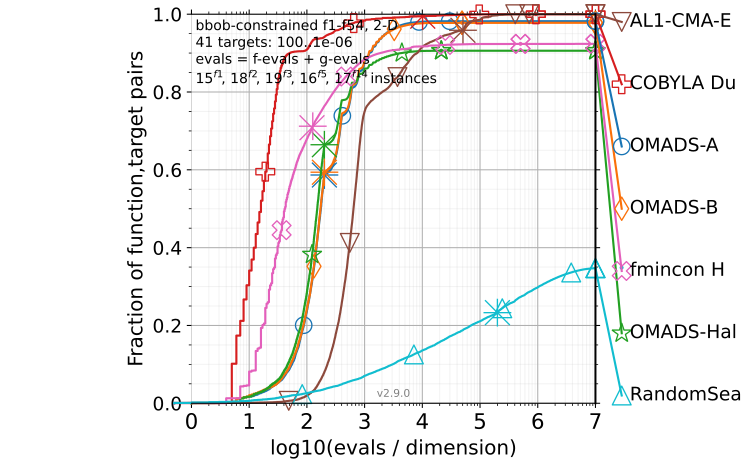
Fraction of (function, target) pairs solved versus evaluations per variable, over the 54
COCO bbob-constrained functions in 2D. OMADS-A is the published benchmark configuration
(OMADS-B and OMADS-Hal are two alternatives); OMADS used at most 100 × n evaluations
(more on the axis, since COCO also counts constraint evaluations), the reference algorithms
up to 10⁷ × n. Details in the
benchmarking documentation.
Features
- Three solvers with one input format: full MADS (
mads), poll only (poll) and search only (search) - Orthogonal Householder poll directions,
2n(ORTHO_2N) orn+1(ORTHO_N+1) - Orthogonal mesh or anisotropic granular mesh (
GMESH) - Progressive (
PB) and extreme (EB) barriers for constraints - A cheap speculative step plus a constraint-aware quadratic model search at every iteration
- An
ACTIVEsampling search (BiTPE density-ratio sampling with Halton, LHS, simulated annealing and particle swarm fallbacks) - Multi-objective Pareto studies with the hypervolume indicator
- Cache, opportunistic evaluation, parallel evaluation, CSV logs and reproducible seeds
Installation
pip install OMADS
Quick start
import numpy as np
from OMADS import mads

def rosenbrock(x):
    x = np.asarray(x)
    f = np.sum(100.0 * (x[1:] - x[:-1] ** 2) ** 2 + (1 - x[:-1]) ** 2)
    return [f, [0]]              # [objective, list of constraints c(x) <= 0]

data = {
    "evaluator": {"blackbox": rosenbrock},
    "param": {"name": "rosen", "baseline": [-2.0, -2.0], "lb": [-5, -5],
              "ub": [10, 10], "scaling": [15, 15], "post_dir": "./post"},
    "options": {"seed": 0, "budget": 1000, "tol": 1e-9, "rich_direction": True,
                "store_cache": True, "check_cache": True},
    "search": {"type": "sampling", "s_method": "ACTIVE", "ns": 10},
}

if __name__ == "__main__":
    out, poll_step, search_step = mads.main(data)
    print(out["xmin"], out["fmin"], out["nbb_evals"])   # [1.0, 1.0] [0.0] 223
poll.main(data) and search.main(data) take the same input and return (out, sampler).
Each solver also accepts the path to a JSON file holding the same dictionary.
Input at a glance
| Section | Purpose | Main keys |
|---|---|---|
evaluator |
How to evaluate a point | blackbox (callable or executable), constants, path, input, output, timeout |
param |
The problem | name, baseline, lb, ub, var_names, scaling, post_dir, constraints_type, h_max, mesh_type, nobj, is_pareto |
options |
Algorithm and run options | seed, budget, tol, psize_init, store_cache, check_cache, rich_direction, direction_type, opportunistic, parallel_mode, np, save_results |
search |
The search step (mads, search) |
type (sampling or VNS), s_method (ACTIVE, LH, RS, HALTON, FULLFACTORIAL), ns |
The blackbox receives the design vector and returns [f, [c1, c2, ...]], with constraints
feasible when c_j(x) <= 0. Every key, with its default, is listed in the
configuration reference.
Note: keep
store_cacheandcheck_cacheset toTrue; themadsandsearchsolvers need the cache. Theinternalevaluator suites ("con","uncon") of older releases have been removed.
Multi-objective MADS
Return a list of objectives from the blackbox and set "nobj" and "is_pareto": True in
param to run a Pareto study (use poll.main in this release). See the
multi-objective tutorial.
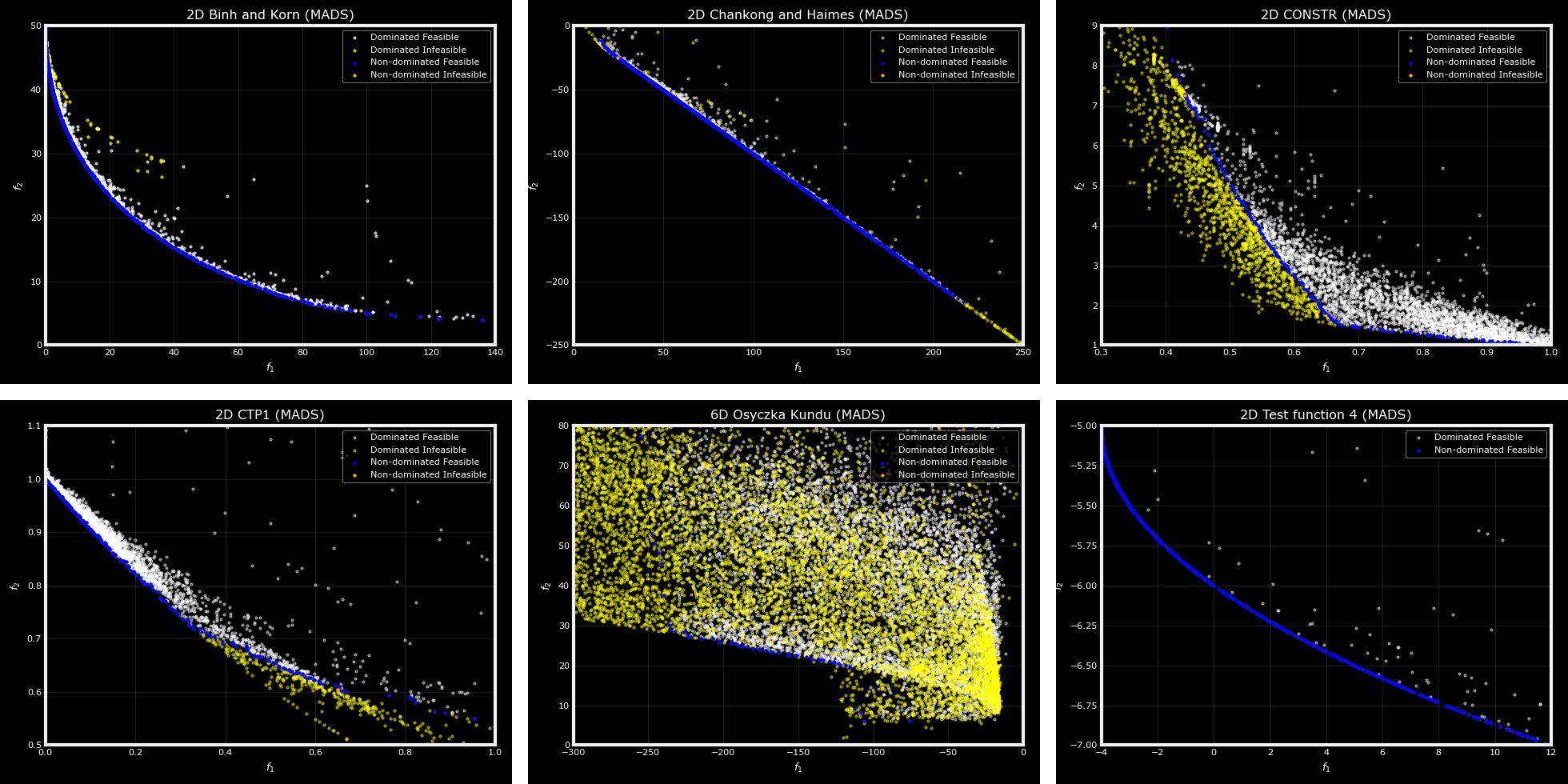
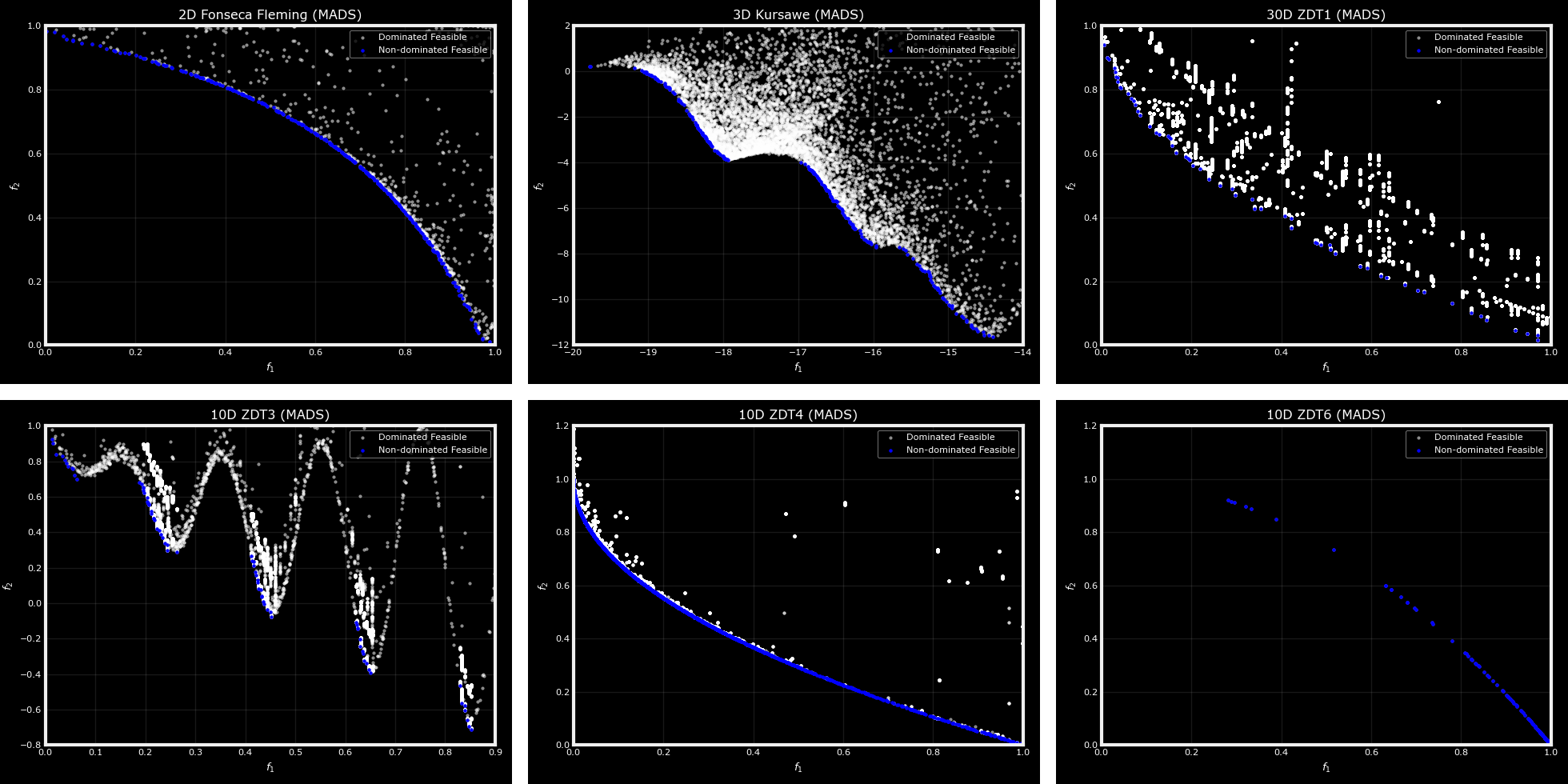
The figures below show fronts found on test problems from the literature.
Constrained test functions
Unconstrained test functions
Benchmarking
pytest testsruns the regression suite (Rosenbrock in 2, 10 and 20 dimensions, constrained and geometric-programming problems), with a target value for each solver.benchmarks/coco/run_mads_bbob_constrained.pyruns OMADS on the COCObbob-constrainedsuite.
See the benchmarking page.
Building the documentation
pip install -r docs_src/requirements.txt
sphinx-build -b html docs_src docs
The sources live in docs_src/; the rendered site in docs/ is served by GitHub Pages.
License & copyright
© Ahmed H. Bayoumy 2022-2026
This program is free software: you can redistribute it and/or modify it under the terms of the GNU General Public License as published by the Free Software Foundation, either version 3 of the License, or (at your option) any later version. See the LICENSE file for the full license text.
Citation
If you use this code, please cite it as follows.
@software{OMADS_AB,
  author    = {Bayoumy, Ahmed H.},
  title     = {OMADS: Optimization using Mesh Adaptive Direct Search},
  year      = {2022},
  publisher = {GitHub},
  version   = {2610},
  doi       = {10.5281/zenodo.7212701},
  url       = {https://github.com/Ahmed-Bayoumy/OMADS}
}
https://github.com/Ahmed-Bayoumy/OMADS/assets/22842095/5dc72c34-4722-4d93-8c84-d17f5595556d
1 maintainer

Metadata
1 maintainer
Release files for OMADS 2610
For a detailed explanation of source distributions (sdists) and built distributions (wheels), please see the package formats documentation.
Built distribution (wheel)
| File | Interpreter | ABI | Platform | Reset |
|---|---|---|---|---|
| omads-2610-py3-none-any.whl | Python 3 | none | any | Details |
Release files / omads-2610-py3-none-any.whl
| Download URL | omads-2610-py3-none-any.whl |
|---|---|
| Size | 142.8 kB |
| Tags | Python 3 |
|
SHA-256 checksum How to use checksums |
d00dcb0e6b2c41fef81fbfa1d924f37f59c18d99a6e2a59fba80b105a746b853
|
|
BLAKE2b-256 checksum How to use checksums |
0f8717e762b35d2b23c70b172352f86292df00f32f24be41394dcde606fb1d35
|
| Upload date | |
|
Uploaded using Trusted Publishing? What is trusted publishing? |
No |
| Uploaded via |
uv/0.11.23 {"installer":{"name":"uv","version":"0.11.23","subcommand":["publish"]},"python":null,"implementation":{"name":null,"version":null},"distro":null,"system":{"name":null,"release":null},"cpu":null,"openssl_version":null,"setuptools_version":null,"rustc_version":null,"ci":null}
|














