
A library for Optimal Control and System Dynamics

Project description

The library facilitates:
- System Objects
- Multi-Horizon Optimization
- Control Algorithms
- Real-time visualization
How to install
Run the flowing code using pip:
pip install OpenCtrl
For specific version X use:
pip install OpenCtrl==X
Quick Guide
Version Check:
python -c "import OpenCtrl print(OpenCtrl.__version__)"
Create a Linear System
To create Linear System:
import numpy as np
from OpenCtrl.SystemDynamicExample import LinearSystem
''' define your input space parameters '''
input_space = { '1' : {'discrete' : [0,512]},
                '2' : {'random' : ['uniform',-128,127]},
                '3' : {'continuous' : [-10,10]},
                '4' : {'continuous' : [512,1024]},
              }
''' Instantiate Linear System Object '''
linear_sys = LinearSystem(sys_dim = 4,
                          input_dim = 4,
                          input_space = input_space,
                          disturbance_type = 'uniform',
                          disturbance_scale = [-255, 255],
                          disturbance_params = None
                          )
''' Info : sys_dim equals input_dim since we considered we can control 4 degrees of freedom, if the case is different like we have 1 degree of freedom then input_space can only have { '1' : {'discrete' : [0,512] } } only. For disturbance_params some degree of freedom can have no impact by disturbance if only 1 degree is impacted the disturbance_params will be 1. '''
u_o = np.array([np.random.randint(0,512),
              np.random.uniform(-128,127),
              np.random.uniform(-10,10),
              np.random.uniform(512,1024)]
            )
linear_sys.step(u_o)
print(linear_sys.x)
Create an Optimizer
To create an optimizer object to optimize the system:
from OpenCtrl.optim import VanillaOptim
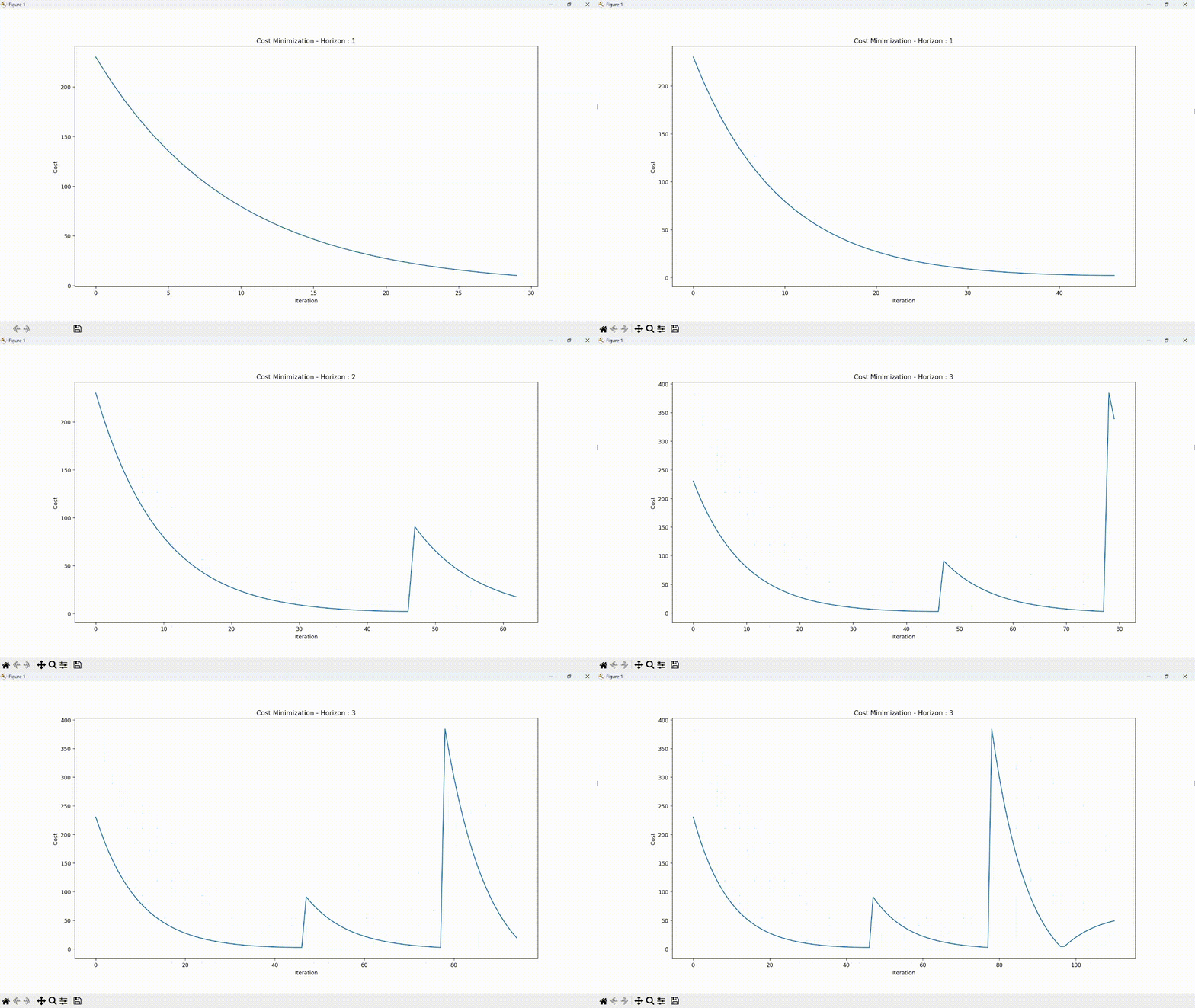
''' Let's create 3 different types of Optimizers '''
cost_func = 'quadratic'
horizon = 5
max_iteration = 50
tolerance_step = 10

def get_predictions(horizon):
    return [u_o for _ in range(horizon)]

def print_metrics(type,cost,u):
    print(f"For optimizer type {type} \nCost: {cost}\nOptimal Input : {u}")

''' Random Search '''
optimizer_random = VanillaOptim( system = linear_sys,
                                 horizon = horizon,
                                 cost_function = cost_func,
                                 optimizer_type = 'random',
                                 max_iterations = max_iteration,
                                 tolerance_step = tolerance_step
                                )
cost_random, u_random = optimizer_random.optimize( preds = get_predictions(horizon),
                                                    verbose = True
                                                  )
print_metrics('random',cost_random,u_random)

''' Gradient Descent '''
optimizer_gradient = VanillaOptim( system = linear_sys,
                                   horizon = 5,
                                   cost_function = 'quadratic',
                                   optimizer_type = 'gradient',
                                   alpha = 1e-3,
                                   max_iterations = max_iteration,
                                   tolerance_step = tolerance_step
                                )
cost_gradient,u_gradient = optimizer_gradient.optimize(preds = get_predictions(horizon),
verbose = True )
print_metrics('gradient',cost_gradient,u_gradient)
''' Genetic Algorithm '''
optimizer_genetic = VanillaOptim( system = linear_sys,
                                  horiozn = horizon,
                                  cost_function = cost_func,
                                  optimizer_type = 'genetic',
                                  population_size = 1000,
                                  cross_over_rate = 0.42,
                                  mutation_rate = 0.23,
                                  cut_off_rate = 0.5,
                                  max_iterations = max_iteration,
                                  tolerance_step = tolerance_step
                                  )
cost_genetic,u_genetic = optimizer_genetic.optimize(pred = get_predictios(horizon),
verbose = True)
print_metrics('genetic',cost_genetic,u_genetic)
Use Control Algorithm
To use a control algorith to tune the system:
from OpenCtrl.controls import LAC
control_horizon = 10
lac = LAC(system = linear_sys,
          optimizer = optimizer_gradient,
          horizon = horizon,
          nominal_disturbance = 'baseline'
          )
''' nominal_disturbance is a conventional method of predicting disturbance '''
for _ in range(control_horizon):
    preds = get_predictions(horizon)
    cost,u = lac.tune(preds = preds,
                      verbose = True,
                      base_line= _
                     )
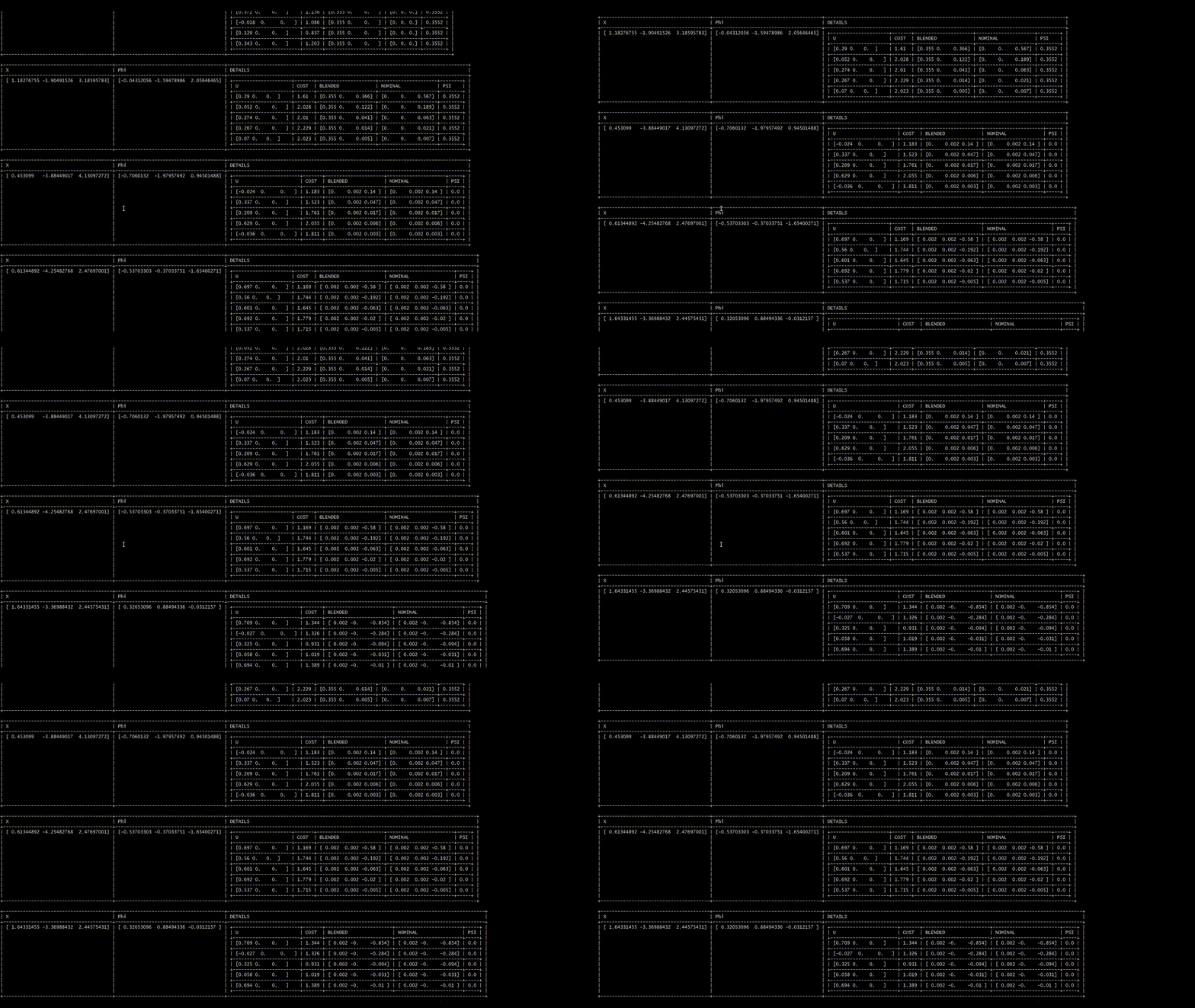
    print_metrics('gradient',cost, u)
To Create Extension of Algos and System Dynamics
*** Developer Documentation in Progress ***
To Contribute
You can check out the dev repo of OpenCtrl: OpenCtrl
Release history Release notifications | RSS feed

Download files
Download the file for your platform. If you're not sure which to choose, learn more about installing packages.
Source Distribution
Built Distribution
Filter files by name, interpreter, ABI, and platform.
If you're not sure about the file name format, learn more about wheel file names.
Copy a direct link to the current filters
File details
Details for the file openctrl-1.0.16.tar.gz.
File metadata
- Download URL: openctrl-1.0.16.tar.gz
- Upload date:
- Size: 19.5 kB
- Tags: Source
- Uploaded using Trusted Publishing? No
- Uploaded via: twine/6.2.0 CPython/3.14.0
File hashes
| Algorithm | Hash digest | |
|---|---|---|
| SHA256 |
01e0720091607f154d41e482a005d605b8b2f1043404ff6d714f73183b476ed0
|
|
| MD5 |
14a5e310e01bc76de5599a0e184e7076
|
|
| BLAKE2b-256 |
bc4ddd1b033024ded8e0c294837bf3cb784f39e48f78a0671914260c40f472a3
|
File details
Details for the file openctrl-1.0.16-py3-none-any.whl.
File metadata
- Download URL: openctrl-1.0.16-py3-none-any.whl
- Upload date:
- Size: 23.3 kB
- Tags: Python 3
- Uploaded using Trusted Publishing? No
- Uploaded via: twine/6.2.0 CPython/3.14.0
File hashes
| Algorithm | Hash digest | |
|---|---|---|
| SHA256 |
a3a3f9d71c6281c01e082f64ed7b7b614430577fdfba436ad20c8e44c8713c4c
|
|
| MD5 |
e358cd6c9691329927108672c5e2ea02
|
|
| BLAKE2b-256 |
ebf2d7706ee2bcfbe75e423b0ff710269a8792b02382ba807be2fd7c6cad8d03
|






