

Triangular mesh optimization.






Several mesh smoothing/optimization methods with one simple interface. optimesh
- is fast,
- preserves submeshes,
- only works for triangular meshes, flat and on a surface, (for now; upvote this issue if you're interested in tetrahedral mesh smoothing), and
- supports all mesh formats that meshio can handle.
Installation
Install optimesh from PyPI with
pip install optimesh
How to get a license
Licenses for personal and academic use can be purchased here. You'll receive a confirmation email with a license key. Install the key with
slim install <your-license-key>
on your machine and you're good to go.
For commercial use, please contact support@mondaytech.com.
Using optimesh
Example call:
optimesh in.e out.vtk
Output:
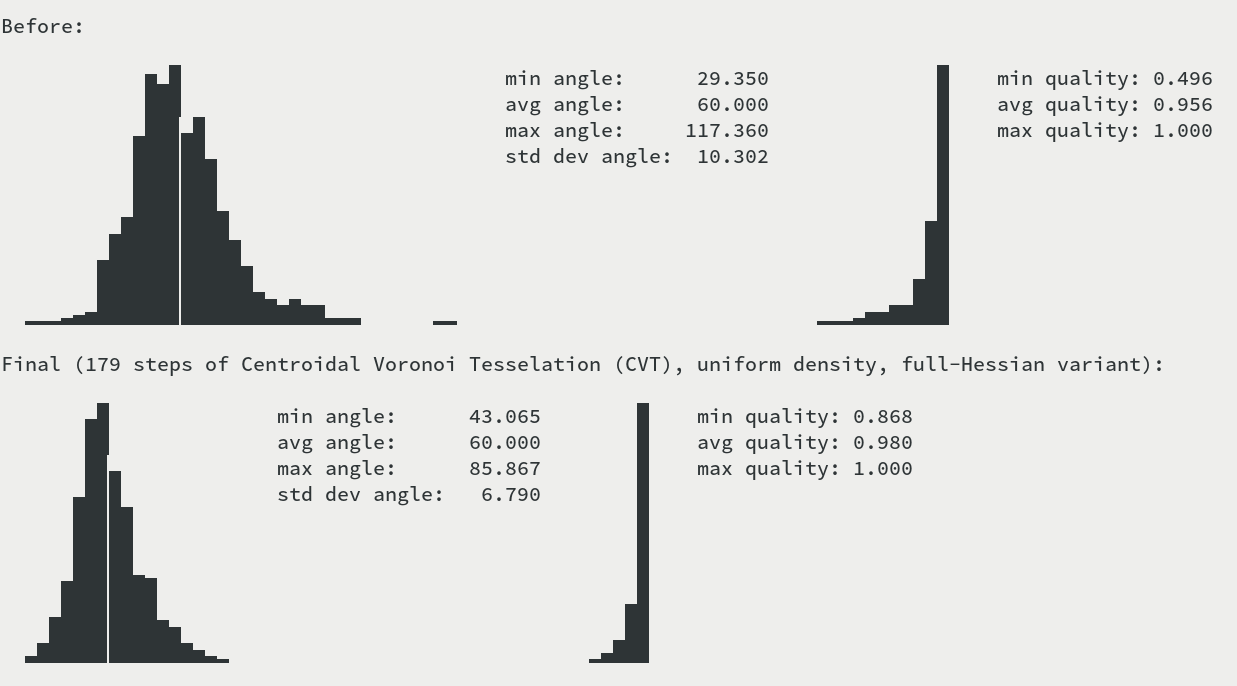
The left hand-side graph shows the distribution of angles (the grid line is at the optimal 60 degrees). The right hand-side graph shows the distribution of simplex quality, where quality is twice the ratio of circumcircle and incircle radius.
All command-line options are documented at
optimesh -h
Showcase
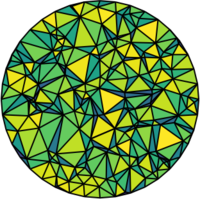






The following examples show the various algorithms at work, all starting from the same randomly generated disk mesh above. The cell coloring indicates quality; dark green is bad, yellow is good.
CVT (centroidal Voronoi tessellation)
 |
 |
 |
|---|---|---|


uniform-density relaxed Lloyd's algorithm (--method lloyd --omega 2.0) |
uniform-density quasi-Newton iteration (block-diagonal Hessian, --method cvt-block-diagonal) |
uniform-density quasi-Newton iteration (default method, full Hessian, --method cvt-full) |
Centroidal Voronoi tessellation smoothing (Du et al.) is one of the oldest and most reliable approaches. optimesh provides classical Lloyd smoothing as well as several variants that result in better meshes.
CPT (centroidal patch tessellation)
 |
 |
 |
|---|---|---|
density-preserving linear solve (Laplacian smoothing, --method cpt-linear-solve) |
uniform-density fixed-point iteration (--method cpt-fixed-point) |
uniform-density quasi-Newton (--method cpt-quasi-newton) |
A smoothing method suggested by Chen and Holst, mimicking CVT but much more easily implemented. The density-preserving variant leads to the exact same equation system as Laplacian smoothing, so CPT smoothing can be thought of as a generalization.
The uniform-density variants are implemented classically as a fixed-point iteration and as a quasi-Newton method. The latter typically converges faster.
ODT (optimal Delaunay tessellation)
 |
 |
 |
|---|---|---|
density-preserving fixed-point iteration (--method odt-dp-fp) |
uniform-density fixed-point iteration (--method odt-fixed-point) |
uniform-density BFGS (--method odt-bfgs) |
Optimal Delaunay Triangulation (ODT) as suggested by Chen and Holst. Typically superior to CPT, but also more expensive to compute.
Implemented once classically as a fixed-point iteration, once as a nonlinear optimization method. The latter typically leads to better results.
Using optimesh from Python
You can also use optimesh in a Python program. Try
import optimesh

# [...] create points, cells [...]

points, cells = optimesh.optimize_points_cells(
    points, cells, "CVT (block-diagonal)", 1.0e-5, 100
)

# or create a meshplex Mesh
import meshplex

mesh = meshplex.MeshTri(points, cells)
optimesh.optimize(mesh, "CVT (block-diagonal)", 1.0e-5, 100)
# mesh.points, mesh.cells, ...
If you only want to do one optimization step, do
points = optimesh.get_new_points(mesh, "CVT (block-diagonal)")
Surface mesh smoothing
optimesh also supports optimization of triangular meshes on surfaces which are defined implicitly by a level set function (e.g., spheres). You'll need to specify the function and its gradient, so you'll have to do it in Python:
import meshzoo
import optimesh

points, cells = meshzoo.tetra_sphere(20)


class Sphere:
    def f(self, x):
        return 1.0 - (x[0] ** 2 + x[1] ** 2 + x[2] ** 2)

    def grad(self, x):
        return -2 * x


# You can use all methods in optimesh:
points, cells = optimesh.optimize_points_cells(
    points,
    cells,
    "CVT (full)",
    1.0e-2,
    100,
    verbose=False,
    implicit_surface=Sphere(),
    # step_filename_format="out{:03d}.vtk"
)


This code first generates a mediocre mesh on a sphere using meshzoo,
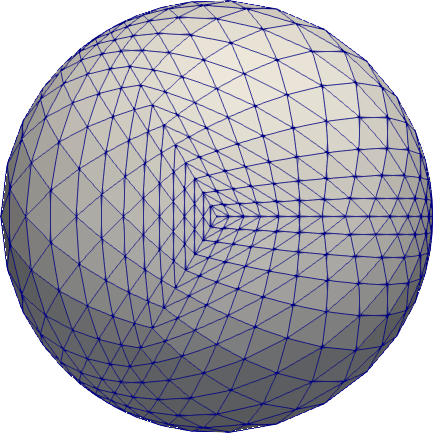

and then optimizes. Some results:
 |
 |
 |
|---|---|---|
| CPT | ODT | CVT (full Hessian) |
Which method is best?
From practical experiments, it seems that the CVT smoothing variants, e.g.,
optimesh in.vtk out.vtk -m cvt-uniform-qnf
give very satisfactory results. (This is also the default method, so you don't need to specify it explicitly.) Here is a comparison of all uniform-density methods applied to the random circle mesh seen above:
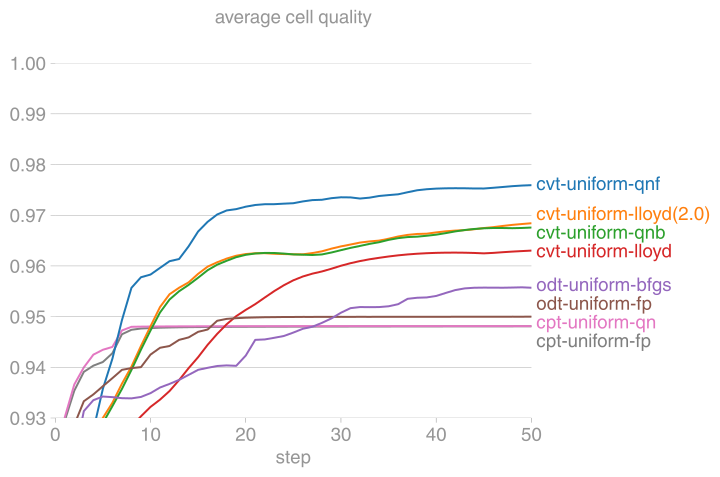
(Mesh quality is twice the ratio of incircle and circumcircle radius, with the maximum being 1.)
Why optimize?
 |
 |
 |
|---|---|---|
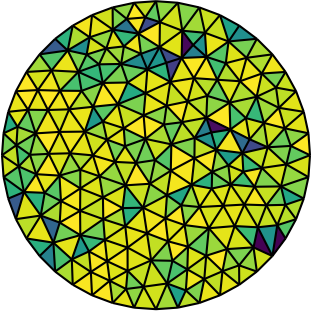
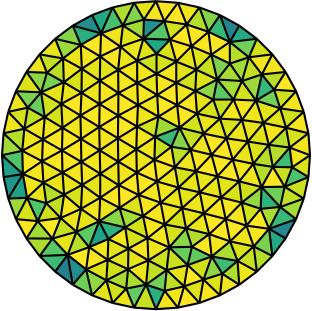
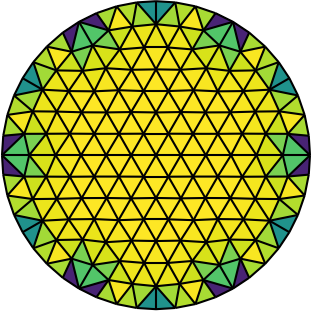
| Gmsh mesh | Gmsh mesh after optimesh | dmsh mesh |
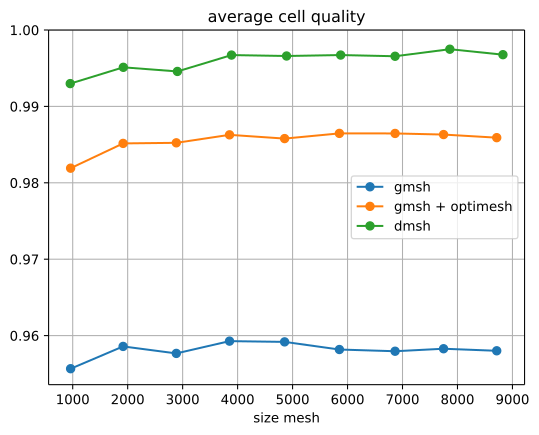
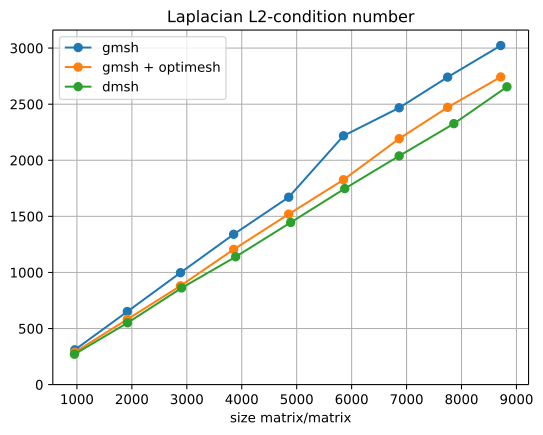
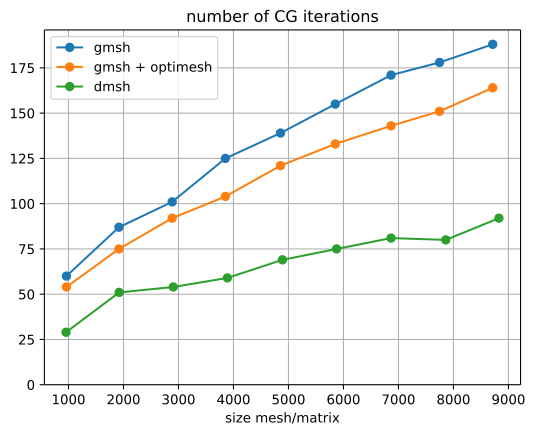
Let us compare the properties of the Poisson problem (Δu = f with Dirichlet boundary conditions) when solved on different meshes of the unit circle. The first mesh is the on generated by Gmsh, the second the same mesh but optimized with optimesh, the third a very high-quality dmsh mesh.
We consider meshings of the circle with an increasing number of points:
 |
 |
 |
|---|---|---|
| average cell quality | condition number of the Poisson matrix | number of CG steps for Poisson problem |
Quite clearly, the dmsh generator produces the highest-quality meshes (left). The condition number of the corresponding Poisson matrices is lowest for the high quality meshes (middle); one would hence suspect faster convergence with Krylov methods. Indeed, most CG iterations are necessary on the Gmsh mesh (right). After optimesh, one saves between 10 and 20 percent of iterations/computing time. The dmsh mesh cuts the number of iterations in half.
Access from Python
All optimesh functions can also be accessed from Python directly, for example:
import optimesh

X, cells = optimesh.odt.fixed_point(X, cells, 1.0e-2, 100, verbose=False)
Relevant publications
1 maintainer

Metadata
1 maintainer
Release files for optimesh 0.12.6
For a detailed explanation of source distributions (sdists) and built distributions (wheels), please see the package formats documentation.
Built distributions (wheels)
| File | Reset | |||
|---|---|---|---|---|
| optimesh-0.12.6-cp314-none-any.whl | CPython 3.14 | none | any | Details |
| optimesh-0.12.6-cp313-none-any.whl | CPython 3.13 | none | any | Details |
| optimesh-0.12.6-cp312-none-any.whl | CPython 3.12 | none | any | Details |
| optimesh-0.12.6-cp311-none-any.whl | CPython 3.11 | none | any | Details |
| optimesh-0.12.6-cp310-none-any.whl | CPython 3.10 | none | any | Details |
Total release size: 386.0 kB
Release files / optimesh-0.12.6-cp314-none-any.whl
| Download URL | optimesh-0.12.6-cp314-none-any.whl |
|---|---|
| Size | 83.8 kB |
| Tags | CPython 3.14 |
|
SHA-256 checksum How to use checksums |
5d2e74de2391ea9ddb9cb431deb20c39d4e37156d455a4bcbbf44cd1ee67c3c7
|
|
BLAKE2b-256 checksum How to use checksums |
73d1bcc6c401e3f302e7712c1dae84f4eb041a941ee53143f7e03e3ce4b1a698
|
| Upload date | |
|
Uploaded using Trusted Publishing? What is trusted publishing? |
Yes |
| Uploaded via |
twine/6.1.0 CPython/3.13.12
|
Provenance
Provenance describes where a file came from. On PyPI, provenance is shared via attestations, which provide a verifiable record of the build or publishing details. View details, limitations and caveats.


PyPI Publish Attestation
PyPI verified that this artifact, at this checksum, originated from the publisher listed below.
Signed by GitHub Actions, verified by PyPI on May 18, 2026.
Transparency logRelease files / optimesh-0.12.6-cp313-none-any.whl
| Download URL | optimesh-0.12.6-cp313-none-any.whl |
|---|---|
| Size | 80.4 kB |
| Tags | CPython 3.13 |
|
SHA-256 checksum How to use checksums |
ddba2462babb86d18d7db7bcc67d47d8426cd80447df3b4c2e7e30d38f1b8827
|
|
BLAKE2b-256 checksum How to use checksums |
d147ac9721064e0dddefb6092e6ee4d0464fad3ff305b1930085a5353f3bec1d
|
| Upload date | |
|
Uploaded using Trusted Publishing? What is trusted publishing? |
Yes |
| Uploaded via |
twine/6.1.0 CPython/3.13.12
|
Provenance
Provenance describes where a file came from. On PyPI, provenance is shared via attestations, which provide a verifiable record of the build or publishing details. View details, limitations and caveats.
PyPI Publish Attestation
PyPI verified that this artifact, at this checksum, originated from the publisher listed below.
Signed by GitHub Actions, verified by PyPI on May 18, 2026.
Transparency logRelease files / optimesh-0.12.6-cp312-none-any.whl
| Download URL | optimesh-0.12.6-cp312-none-any.whl |
|---|---|
| Size | 80.6 kB |
| Tags | CPython 3.12 |
|
SHA-256 checksum How to use checksums |
b22c33d864dd8c8257ccb8e2aed885570d11acf7c2f9d981bc572932afcdec3c
|
|
BLAKE2b-256 checksum How to use checksums |
a4f5f09e9554edaadb05791852cbd0cd94a05fb20faa633a66845fa462d4916b
|
| Upload date | |
|
Uploaded using Trusted Publishing? What is trusted publishing? |
Yes |
| Uploaded via |
twine/6.1.0 CPython/3.13.12
|
Provenance
Provenance describes where a file came from. On PyPI, provenance is shared via attestations, which provide a verifiable record of the build or publishing details. View details, limitations and caveats.
PyPI Publish Attestation
PyPI verified that this artifact, at this checksum, originated from the publisher listed below.
Signed by GitHub Actions, verified by PyPI on May 18, 2026.
Transparency logRelease files / optimesh-0.12.6-cp311-none-any.whl
| Download URL | optimesh-0.12.6-cp311-none-any.whl |
|---|---|
| Size | 89.0 kB |
| Tags | CPython 3.11 |
|
SHA-256 checksum How to use checksums |
1ff033a375d624812dff5fc53b04d6cf4c33431169cf9b0486933ddf4fd8ada1
|
|
BLAKE2b-256 checksum How to use checksums |
7ebd8a62ad029d3761db8a48739fb14bba79f962bcda48288e05427d4b880eb0
|
| Upload date | |
|
Uploaded using Trusted Publishing? What is trusted publishing? |
Yes |
| Uploaded via |
twine/6.1.0 CPython/3.13.12
|
Provenance
Provenance describes where a file came from. On PyPI, provenance is shared via attestations, which provide a verifiable record of the build or publishing details. View details, limitations and caveats.
PyPI Publish Attestation
PyPI verified that this artifact, at this checksum, originated from the publisher listed below.
Signed by GitHub Actions, verified by PyPI on May 18, 2026.
Transparency logRelease files / optimesh-0.12.6-cp310-none-any.whl
| Download URL | optimesh-0.12.6-cp310-none-any.whl |
|---|---|
| Size | 52.3 kB |
| Tags | CPython 3.10 |
|
SHA-256 checksum How to use checksums |
03339b2ba3be526a328270c3fe7bf59d0502a3893aa47322b20d00d32ff65ff4
|
|
BLAKE2b-256 checksum How to use checksums |
8eb180a0fff016d230540235efc8a6ca5d858fe8f1a79ef108fb3d4429443765
|
| Upload date | |
|
Uploaded using Trusted Publishing? What is trusted publishing? |
Yes |
| Uploaded via |
twine/6.1.0 CPython/3.13.12
|
Provenance
Provenance describes where a file came from. On PyPI, provenance is shared via attestations, which provide a verifiable record of the build or publishing details. View details, limitations and caveats.
PyPI Publish Attestation
PyPI verified that this artifact, at this checksum, originated from the publisher listed below.
Signed by GitHub Actions, verified by PyPI on May 18, 2026.
Transparency log













